
The Three AI Trends That Will Actually Define 2026
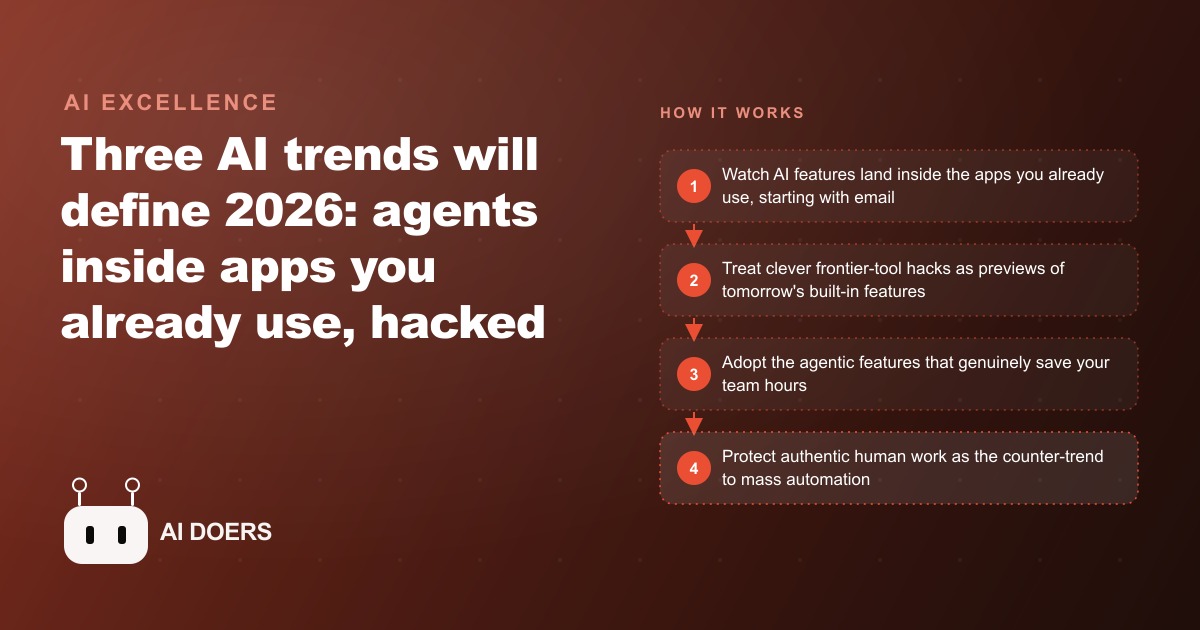
Three data-grounded trends will shape AI in 2026: agentic features built into apps you already use like Gmail and Sheets, frontier tools being bent to new uses that later become mainstream features, and a wave of physical AI devices.

Most predictions about AI trends in 2026 will age badly, and the reason has nothing to do with whether the technology delivers. The technology is delivering. The reason most predictions will be wrong is that they confuse capability with adoption. They describe what AI can do in a research environment or a developer's terminal and present it as something businesses need to prepare for. The businesses that will win this year are not the ones preparing for AI to arrive. They are the ones who noticed that it already did.
The three trends that will actually determine competitive outcomes in 2026 are not on a roadmap. They are live. They are inside apps that business owners open every morning, and the majority of those owners are walking past them every single day. I am Madhuranjan Kumar, and this piece is a direct argument against the posture of waiting.
The predictions you are reading describe technology that still needs eighteen months of infrastructure
Spend an hour reading AI trend reports from major consulting firms and technology publications and a pattern becomes clear. The predictions are written in the future tense. "AI will transform," "companies will need to," "by the end of the year, expect to see." The authorial voice is that of someone reporting from a vantage point slightly ahead of where things currently stand.
The problem is that this framing teaches business owners to wait. It positions AI as something arriving rather than something already here, and the gap between those two frames is where competitive advantages are being built and missed simultaneously.
Most trend pieces describe things like general-purpose autonomous agents negotiating on your behalf, persistent memory systems woven across every application you use, and AI that operates continuously across your business without human checkpoints. These things are being developed. Some of them are in early access somewhere. None of them are features you can click on this morning inside the tools you already pay for.
What I am going to describe instead is different. These three trends are not arriving. They are operating. The distinction matters because it changes what you are supposed to do with the information. Arriving trends require you to watch and prepare. Operating trends require you to act, because your competitors who act first are compounding an advantage while you read about it.
Trend one: the agent is already inside the app you opened this morning
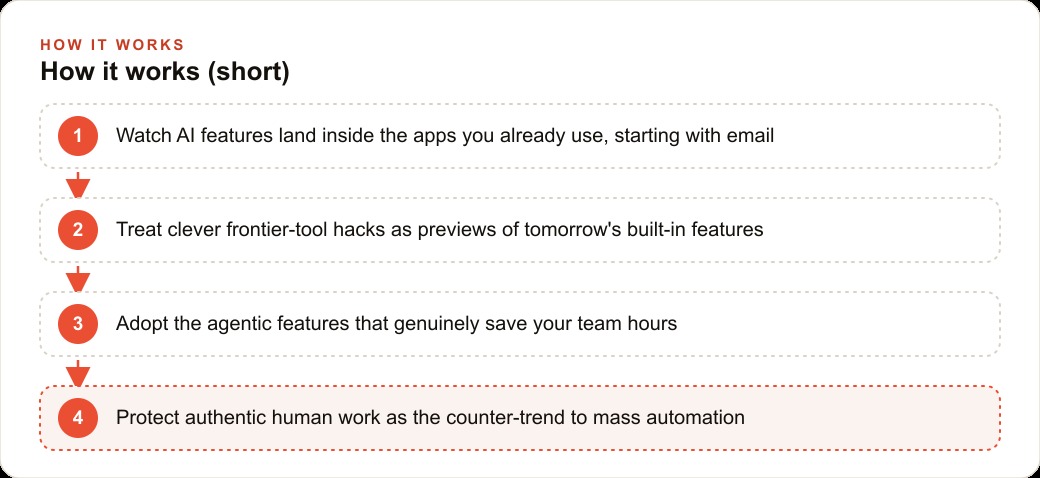
Gmail has an AI inbox tab. Not in beta, not available to enterprise accounts on a waitlist. There, in the product, processing email. It summarizes threads, drafts replies, and surfaces what requires a decision while filtering what does not. For anyone who has spent cumulative hours each week reading, categorizing, and drafting responses to email, this is not a marginal quality-of-life improvement. It is a structural change in how much of that work requires human attention.
Google Sheets now has an =AI() function. You type it into a cell the way you would type =SUM() or =VLOOKUP(), pass a prompt as the argument, and the cell returns the result of a language model processing whatever is in the referenced data. If you have a column of customer reviews and you want a sentiment classification in the adjacent column, you write one formula and drag it down. If you have a product catalog with five hundred entries and you need a concise description for each item, the same process applies. The LLM is inside the spreadsheet, accessible through the same interface that has existed since the 1980s.
ChatGPT now has a health records connector. Roughly five percent of messages sent to ChatGPT are already about healthcare topics. The connector lets users share relevant health data with the model and receive responses that account for actual medical context rather than generalized information. Meta acquired Manus AI specifically to integrate agentic capability into the products used by billions of people daily.
These are not pilot programs in controlled environments. These are features that shipped. The significance of this shift is not that AI is getting more powerful, though it is. The significance is that the delivery mechanism changed. AI is no longer something you navigate to. It is inside something you were already going to anyway.
For a business owner, this changes the calculus entirely. You do not need to evaluate a new platform, purchase access to a new service, or train your team on a new interface. You need to know what the tools you are already paying for can now do, and then you need to use those things. The owners who understand this are compressing decision cycles, cutting response times, and extracting leverage from data they already had. The ones waiting for AI to arrive are running workflows from eighteen months ago inside tools that have quietly changed.
=AI() is the most powerful business function most owners have never typed
The spreadsheet is where most small and mid-sized businesses actually keep their data. Not in a sophisticated CRM, not in a purpose-built analytics platform, not in a data warehouse. In a spreadsheet. And for years, the limitation of a spreadsheet was that it could compute numbers extremely well but could not process language. If you had a thousand customer reviews, a spreadsheet could count them, sort them, filter them by date, average their numerical rating. It could not tell you what the reviews were actually saying.
=AI() closes that gap at the structural level. The gap between quantitative data analysis and language understanding, the gap that had previously required either a data analyst who could interpret qualitative data at scale or an expensive third-party tool built for text analysis, is now a formula entry away inside a tool that almost every business in the world already uses.
You can ask it to extract the most common complaint from each review in a list. You can ask it to categorize each entry in a sales call notes column by the primary objection raised. You can ask it to generate a personalized subject line for each row in an email outreach list based on the contact name, company, and context you already have. You can classify incoming support requests by urgency and category. You can compare product descriptions against a brief and flag the ones that deviate.
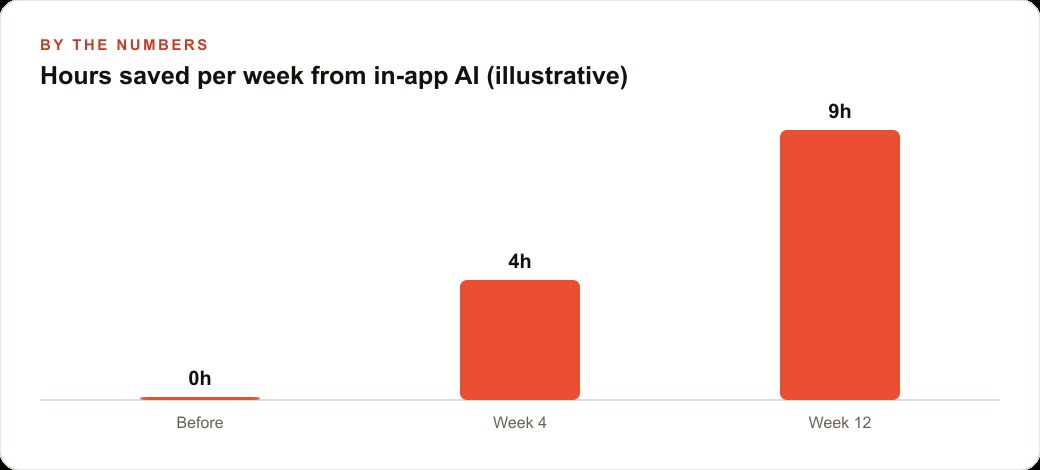
These operations ran across hundreds or thousands of rows in the time it takes to enter the formula once and drag it down. The cost is a small language model API charge per cell call. The output is analysis that would previously have required either a team of people reading and categorizing manually or a contracted data analyst and a project timeline.
For a business owner who has been staring at a spreadsheet of customer data and not knowing what to do with the language inside it, this is not an incremental upgrade. It is a structural change in what the tool can do and therefore what the owner can know without additional human labor.
The question is not whether this is available. It is. The question is whether you have opened a Google Sheet this week and tried it.
Trend two: the weird hacks that went viral are becoming features and most owners missed the transition
There is a recognizable pattern in how AI capabilities make their way from researcher demonstrations into mainstream products. Something unusual happens in public. Someone posts documentation of it. The thing circulates in AI-adjacent communities for a period that feels like it is mostly enthusiasm and not much adoption. Eighteen months later, it is a button inside an application that hundreds of millions of people use daily, and nobody thinks of it as unusual anymore.
Image generation inside AI assistants followed this path. What began as a technically impressive novelty in research demonstrations became a standard feature. Agent mode, the ability to give an AI a high-level instruction and have it plan and execute a sequence of steps without human direction at each intermediate step, followed the same path.
The example I keep returning to from the past year is the person who used Claude Code to automate a hydroponic garden. They set up a monitoring loop that read sensor data at regular intervals, evaluated the readings against target ranges for moisture, temperature, and light levels, and then took actions accordingly: activating a heat mat, adjusting grow lights, triggering a water pump. The plants grew. The system ran continuously without human intervention between sensor reads.
The point is not that Claude Code is a gardening tool. The point is that the pattern, read some data, evaluate against a goal, take an action, is the same pattern that underlies every useful business automation. And agentic behavior is not a feature waiting to be built. It is a capability that already exists, was already demonstrated through a hydroponic garden, and is already finding its way into mainstream product features.
The gap between "weird hack that went viral" and "feature in an app you already have" has been consistently shorter than anyone expected. Business owners who track the weird hacks are eighteen months ahead of the business owners who wait for the features. The pattern is reliable enough that tracking what is being done with these tools at the fringe of technical experimentation is a legitimate business intelligence activity.
A hydroponic garden runs on Claude Code and your customer inbox runs on the same logic
When I describe the hydroponic garden to business owners, the initial reaction is often something like: that is impressive, but what does it have to do with me. Let me answer that directly.
Your customer inbox is a sensor array. Every message that arrives tells you something. A question about pricing signals intent to purchase. A complaint about a specific aspect of your service signals a failure in a specific area of your operation. A request for information about a particular product or service signals a customer who is in research mode and can be converted with the right information at the right speed.
The current default for most businesses is to read each incoming message manually and respond manually, even when the message fits a recognizable pattern and the appropriate response is already known. A business that receives fifty inquiries per week, forty of which fit three or four templates, is spending significant human time on decisions that have already been made.
An agent loop applied to that inbox reads the incoming message, classifies it against known patterns, drafts a response appropriate to the category, and either sends it automatically or queues it for a brief human review before sending. The technology that monitored moisture sensors and triggered a water pump is the same technology that runs this sequence. The sensor is the incoming email. The actuator is the draft reply. The evaluation logic is the classification and response generation step in the middle.
This is not a feature that requires enterprise software licensing or a dedicated technical team to implement. It is a workflow that can be built with the tools that are already available to any business willing to spend a few hours learning the pattern.
Trend three: the physical layer is arriving and it is quieter than expected
OpenAI has announced a wearable for 2026. Amazon Alexa Plus now runs its own AI model and handles multi-step requests natively, meaning you can give it a complex instruction and it executes the intermediate steps without requiring you to break the request into individual commands yourself. At CES, AI desk companions were demonstrated alongside local AI computers, NAS units and mini PCs designed to run AI models entirely on premises, without sending data to any external cloud service.
AI companions in pet form were there too. The demonstrations sat somewhere between earnest and uncanny. But they pointed at something structurally important: the expectation that AI is primarily a screen-based, keyboard-driven experience is beginning to erode. The form factor is multiplying. The contexts in which AI can be present in a daily routine are expanding beyond the laptop and the phone.
For most business owners, this does not require an immediate operational change. The wearable is not available yet. The AI desk companion is not yet a tool with a clear business use case. But the mental model update it requires is important.
The assumption that customers interact with AI only when they sit down at a device and deliberately invoke an application is going to be incorrect within a relatively short timeframe. Ambient AI, always-on AI, AI that is present in an environment rather than waiting to be summoned, is coming. The businesses that have already developed habits around integrating AI into their operations will adapt more easily to the physical form factor than the businesses that have been treating AI as something to consider eventually.
Early movers in the ambient AI context will be the businesses that already understand how to provide information in forms that AI can consume and relay. The content infrastructure you build for AI-assisted discovery on a screen translates directly to the same infrastructure for AI-assisted discovery through a wearable or a voice device. The foundation is the same.
The counter-trend nobody in the trend pieces wants to acknowledge: authenticity is becoming a premium product
Here is the position that almost no AI trend piece is willing to take because it cuts against the direction of the enthusiasm: as AI gets better at producing content at scale, the content it produces at scale will become identifiable. Not necessarily because the quality is low, it is often quite good, but because the volume is everywhere and because it reads like everything else produced by the same underlying models.
Gmail's AI tab drafts email responses. AI writing tools generate social posts, ad copy, blog articles, product descriptions. The logical consequence of all of this happening simultaneously across millions of businesses is that the signal-to-noise ratio in every communication channel deteriorates. The thing that stands out in a deteriorating signal environment is the thing that sounds like a specific person with a specific perspective and something specific to say.
This is not an argument against using AI for content. It is an argument for using it selectively and strategically. AI should handle the volume, the templated, the routine communication that does not require a specific voice. The communication that builds actual relationships, the message that arrives at a specific moment and says something that could only come from the person who knows the situation and the recipient, should carry a human voice.
The authenticity premium is already visible in creator economics. Accounts and publications that feel personal and uncontrived consistently outperform accounts that feel produced. The same effect is beginning to appear in small business marketing as the AI-generated content baseline rises. The business that uses AI to clear operational noise and free up human attention for the communication that matters is better positioned than either the business that refuses AI entirely or the business that automates everything without distinguishing between the communication that requires a human and the communication that does not.
The bakery that stopped waiting and started using what was already there
Consider a bakery that handles catering inquiries by email. Before integrating Gmail's AI inbox features, the typical response time to a catering inquiry was the next business day. The owner read messages each morning, drafted a reply, sent it. When the morning was busy, it could extend to a second day.
After configuring the AI inbox tab with a response framework tuned for the most common catering inquiry types, response time dropped to roughly fifteen minutes from inquiry receipt. Not because the owner worked faster but because the system drafted the reply based on the context of the inquiry, the owner reviewed it in a minute, and the owner sent it. The drafting step, which previously consumed ten to fifteen focused minutes of cognitive effort, happened automatically.
The second change involved Google Sheets. The owner maintained a spreadsheet tracking sales by day, time of day, and item. After adding =AI() to run a pattern analysis across the historical data, the model identified something the owner had not consciously registered: demand for a specific seasonal item on Saturday mornings was consistently thirty to forty percent higher than any other window of the week, and the bakery was regularly selling out before noon, leaving revenue on the table and turning away customers at peak demand.
The owner adjusted the Saturday morning bake quantity for that item. Revenue for the item increased without any change to pricing, marketing, or staffing. The insight was inside the data that had always been there. The tool to extract it was inside the spreadsheet the owner had always been using.
The third thing the owner did was resist the temptation to automate the social media presence. The account works because it sounds like the owner: specific observations about what went into a particular recipe, honest comments about a week when something did not turn out as expected, photos that are clearly taken in the actual kitchen. The AI is handling the inbox and the data analysis. The human voice is handling the relationship and the public presence. That combination is the working model.
The competitive window is not should I use AI; it is which features are already live right now
Business owners approach AI adoption as a philosophical question and it sits at that level of abstraction for months. Should I use AI? Is this the right moment? Am I ready? Meanwhile the tools they are already paying for add capabilities they are not using because they are still waiting to decide whether to engage with AI at all.
The question that actually matters in 2026 is: what has changed in the tools I am already inside, and am I using those changes?
Gmail's AI tab: are you using it? Google Sheets =AI(): have you typed it once? Whatever AI assistant you are paying a monthly subscription for: do you know what it can do now that it could not do six months ago?
The competitive advantage this year does not come from adopting a tool nobody else has access to. It comes from actually using the capabilities that have already been rolled out inside tools that are everywhere. Most business owners are not doing this. The minority that are building the habit of checking what their existing tools can do and integrating those capabilities into their daily operations are compounding an advantage quietly, without press releases or announcements.
The predictions about AI trends will keep arriving. Most of them will describe technology that is sixteen months away and condition you to wait for it. What is actually happening is already running in the apps you opened this morning. The inbox tab, the spreadsheet function, the agentic pattern that grew tomatoes and is already finding its way into mainstream features, the physical form factor multiplying at CES. These are not previews. They are the trends. And the window for competitive advantage from early adoption of what is already here is the window you are in right now, not after the next trend report arrives.
That is exactly what we do at AI DOERS. Book a private 30-minute call with Madhuranjan Kumar and we will map the fastest path to it for your specific business.
Book your call →
Madhuranjan Kumar
Madhuranjan Kumar brings 20 years of performance-marketing experience and has managed over $200 million in Facebook ad spend for brands across the United States and beyond. His expertise spans the full modern marketing stack: Meta, Google Ads, TikTok, email automation, CRM, and the websites that hold it together. At AI DOERS he turns that track record into lead-generation systems for businesses across every industry.