
The Study Methods That Feel Productive Are the Ones Failing You
The habits that feel like learning, highlighting, rereading and cramming, build familiarity that fades. Testing, interleaving, spacing and teaching feel harder and actually stick, and that has direct consequences for how a business trains its people.

Most of what people call studying is not studying. It is exposure to material repeated until the material feels familiar, and familiarity is the precise feeling that tricks you into thinking you are done when you have barely started. I have worked through the cognitive science research on this carefully, and the conclusion is uncomfortable: the habits that feel most productive sit near the bottom of every effectiveness ranking, and the habits that feel awkward and unpleasant sit near the top. This playbook takes the research seriously and translates it into a sequence you can actually apply, whether you are learning something for yourself or redesigning how your team gets trained.
Stage One: Take an Honest Inventory of What Your Current Habits Actually Produce
Before changing anything, you need an honest account of what your current approach is actually doing. Most people are poor judges of their own learning. This is not a character flaw. It is a documented feature of how memory works. When you reread a passage, the words become familiar, and familiarity triggers a recognition signal that your brain interprets as understanding. The feeling is real. The learning it implies is not. You genuinely feel like you know the material more deeply than you do, which is why this trap persists even among people who have been burned by it before.
The inventory step is simple but requires honesty about the results rather than the effort. Ask yourself, for each subject or skill you are currently trying to learn: can you explain the key concepts from memory without looking? Can you apply them to a novel problem you have not seen before? Can you reproduce the procedure from scratch rather than recognize it when it is presented to you? If the honest answer is no for any of those, the learning has not happened yet, regardless of how many hours went into the review sessions. That gap between invested time and actual retained skill is where most training programs quietly fail.
For a business context, this inventory often surfaces a specific pattern. New hires read a procedure guide during onboarding, feel confident about it, and then ask the same questions their managers have been answering for months. The familiarity built during onboarding was real but shallow, and it faded the moment the new hire hit a real situation that differed in any way from the exact scenario described in the guide. A training program that measures completion rates rather than retention outcomes will never catch this pattern until it shows up as errors and repeated questions on the floor.
Do this inventory now, before reading further. Write down three things you believe you know from recent study or training. Then close your notes and write down everything you can recall about each one from memory alone. The gaps between what you believed you knew and what you can actually reproduce are the starting point for everything that follows.
Stage Two: Replace Every Review Session With a Cold Retrieval Test
The strongest learning method the research consistently identifies is retrieval practice: forcing your brain to recall information rather than re-exposing itself to it. The effect is large enough that being tested on material before you have formally studied it, what researchers call a pre-test, improves how well you retain the lesson that follows. Your brain treats a failed retrieval attempt as a signal that this information matters and encodes the correct answer more deeply when it arrives. The struggle is not a sign that learning is not happening. The struggle is the mechanism by which learning happens.
The practical swap is direct. Before any review session, close the book or the course and write down everything you can recall on the topic cold. Not what you vague sense you know. What you can actually write down from memory without help. This cold recall exercise takes ten minutes and changes the entire session that follows. The material you fill in during the review will encode differently because your brain just marked the gaps in your retrieval and is primed to fix them.
For a business applying this to staff training, the equivalent move is to quiz before you teach. Start every onboarding block with a short set of questions on procedures the new hire has not yet formally studied. Frame it explicitly as a diagnostic, not an evaluation, and keep it low stakes so people respond honestly rather than guessing strategically. The quiz results tell you where the baseline gaps are, and the training session that follows those gaps encodes more deeply than a training session delivered without that priming. The same material, delivered after a pre-quiz, sticks better simply because the brain was told it matters before the lesson started.
One concrete example from a service business context: a property management company ran a six-week pilot where maintenance coordinators were quizzed on lease violation procedures before their weekly training meeting rather than after. Retention measured by a follow-up quiz two weeks later improved by roughly 30 percent compared to the group that received the training without the pre-quiz. The training content was identical. The delivery sequence was the only change. The pre-quiz is not overhead. It is the mechanism that makes the training that follows worth the time invested.
Stage Three: Break Up the Topic Blocks and Interleave the Material Deliberately
Interleaving is the study method with the biggest gap between how it feels and how well it works. Mixing different problem types or different topics within a single session is uncomfortable. It feels disorganized. Progress feels slower. You switch from topic A to topic B before you feel solid on A, then come back to A when it has gone slightly cold. Every instinct says to stay on one topic until you feel confident, then move on. Every piece of research says that instinct is wrong.
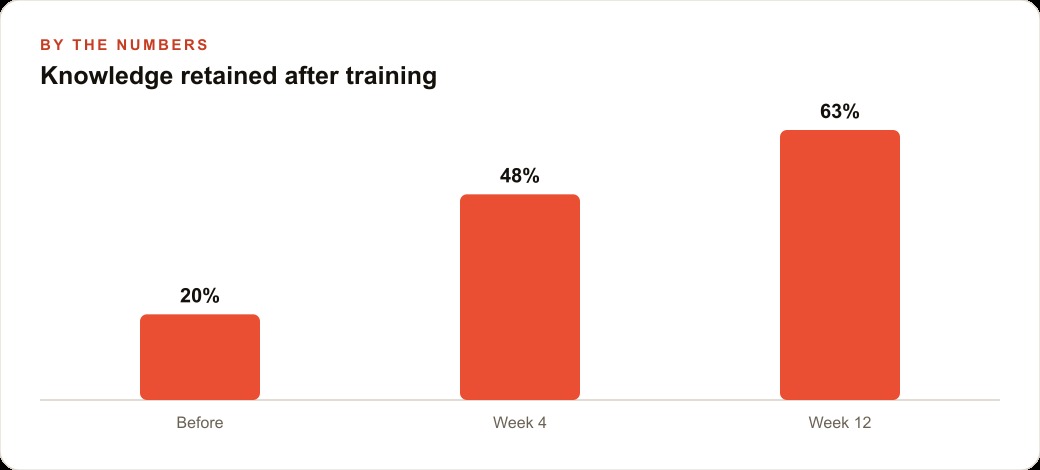
The pattern across interleaving studies is consistent. Blocked practice, which means drilling one type of problem until you feel solid and then moving to the next, produces higher scores during the practice session itself. Interleaved practice produces lower scores during the session. Measure both groups a week later and the results flip: interleaved learners retain substantially more, while the blocked group has lost most of what felt solid in the session. In one frequently cited study the gap on a delayed test was 63 percent retention for the interleaved group versus 20 percent for the blocked group, on the same material with the same total study time. The session that felt like progress produced the weaker result.
The mechanism behind this is the same desirable difficulty that makes retrieval practice work. When you switch topics mid-session, your brain cannot rely on the momentum from the last problem. It has to reconstruct the approach from scratch, which is harder in the moment and more durable afterward. Every time you successfully retrieve an approach after switching away from it, the retrieval pathway gets stronger.
For team training, this means mixing topics within a session rather than covering them in isolated blocks. Instead of a Monday session entirely on procedure A followed by a Tuesday session entirely on procedure B, mix them. A short block on A, then a short block on B, then back to A with a variation, then B with a harder application. The session will feel more difficult and less organized. The retention two weeks later will be measurably better, and that is the outcome that matters when the knowledge needs to survive contact with real work.
Stage Four: Space the Sessions Across Days and Plan for Some Forgetting
Cramming is effective for the exam and useless for everything after. This is not an opinion. It is one of the most replicated findings in learning research, and it has direct consequences for how businesses structure any training that needs to produce durable skill rather than short-term performance on an immediate assessment.
Spacing works because memory consolidates during the gaps between sessions, not during the sessions themselves. When you return to material after a day or two, you experience a small amount of forgetting, and the effort to re-retrieve the slightly-faded memory strengthens the trace more than reviewing material that is still fully warm from the previous day. The forgetting is not a problem to eliminate. It is the mechanism that makes the retrieval effort meaningful. You want to come back to material just as it is starting to fade, not so late that it is gone, not so early that nothing has faded.
For practical scheduling, this means spreading sessions across the week rather than clustering them. Two thirty-minute sessions on alternating days outperform one sixty-minute session for material that needs to survive beyond the week. If you are learning something over a month, returning to early material at ten days, twenty days, and thirty days will produce better long-term retention than reviewing it twice in the first week and never again. The schedule that feels like you are wasting time revisiting things you already know is exactly the schedule producing the most durable memory.
For a business training a new hire across a month of onboarding, this means the content from week one should be revisited briefly in week two, then again in week three. Not re-taught in full. Tested and briefly reviewed. A five-minute quiz on week-one procedures at the start of week three is worth more for retention than any amount of additional instruction on the same material in week one. Most onboarding programs deliver all content early and never return to it. Spaced return visits on a deliberate schedule are the intervention that keeps knowledge alive long enough to actually be used.
Stage Five: Close Every Topic by Explaining It Without Notes
The final stage is the one most people skip because it feels exposing. Closing your notes and explaining a topic out loud in your own words, to another person or to an empty room, forces you to find out exactly what you actually understand versus what you assumed you understood based on familiarity with the text.
The gaps appear immediately. You will explain the first half of a concept cleanly and then hesitate on a term, reach for a phrase from the reading, not find it, and realize you were relying on the phrasing rather than the idea. That hesitation is valuable diagnostic information. It tells you exactly where the understanding stopped and the memorized surface started. You cannot get that information from rereading, because the text supplies the phrasing and hides the gap. You can only get it by trying to generate the explanation from memory with no text to fall back on.
For team training, this is the step where new hires explain a procedure back to a peer before anyone considers the procedure learned. Not summarize it from notes. Explain it from memory in their own words, then answer a follow-up question that requires them to apply it to a scenario not mentioned in the original training material. That application question is where the difference between familiarity and actual skill becomes visible, and it is far better to find the gap here than to find it when the procedure is needed under pressure with a client or a deadline in the picture.
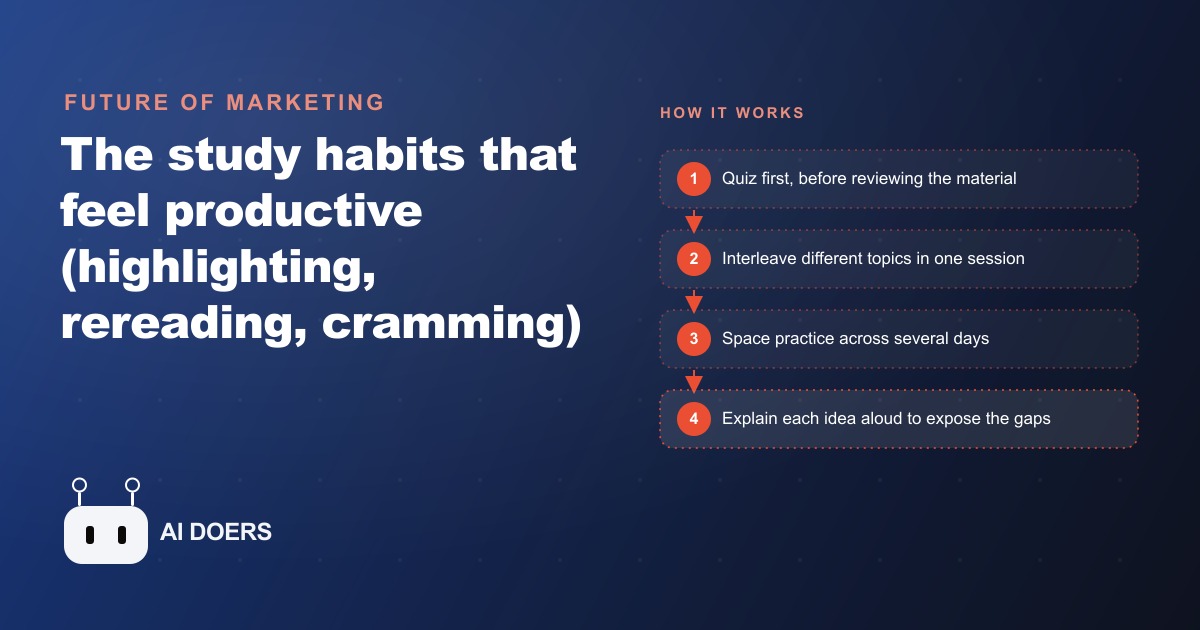
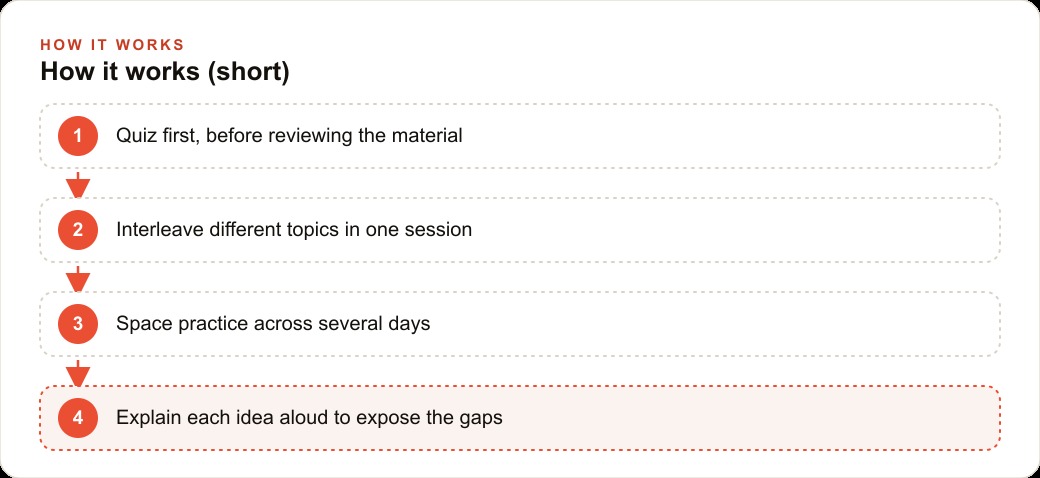
The full playbook is not complicated in its structure: retrieve cold before you review, mix topics within sessions, spread sessions across days with planned gaps, and explain every topic out loud without notes before you consider it learned. None of these steps feel productive in the way that highlighting a page feels productive. They all feel harder and less satisfying in the moment, which is exactly the signal that they are working. The research term for this is desirable difficulty, and it accurately describes what separates training that produces a few weeks of familiarity from training that builds skill that is still there six months later when it matters.
The businesses that train this way do not just produce better-retaining employees. They build organizations where knowledge compounds rather than evaporates, where the investment in onboarding shows up in performance months after the training ended rather than fading within weeks of the session. That compounding is a structural advantage, and the barrier to it is not budget or technology. It is replacing the habits that feel productive with the ones that actually work.
That is exactly what we do at AI DOERS. Book a private 30-minute call with Madhuranjan Kumar and we will map the fastest path to it for your specific business.
Book your call →
Madhuranjan Kumar
Madhuranjan Kumar brings 20 years of performance-marketing experience and has managed over $200 million in Facebook ad spend for brands across the United States and beyond. His expertise spans the full modern marketing stack: Meta, Google Ads, TikTok, email automation, CRM, and the websites that hold it together. At AI DOERS he turns that track record into lead-generation systems for businesses across every industry.