
The Real Playbook for a $100M AI Agency Exit
The path to a $100M AI agency is not selling automations, it is selling AI strategy and outcomes to mid-market firms with documented business logic. Development value is collapsing, so the money lives in the business case and the revenue rerate past $5M.

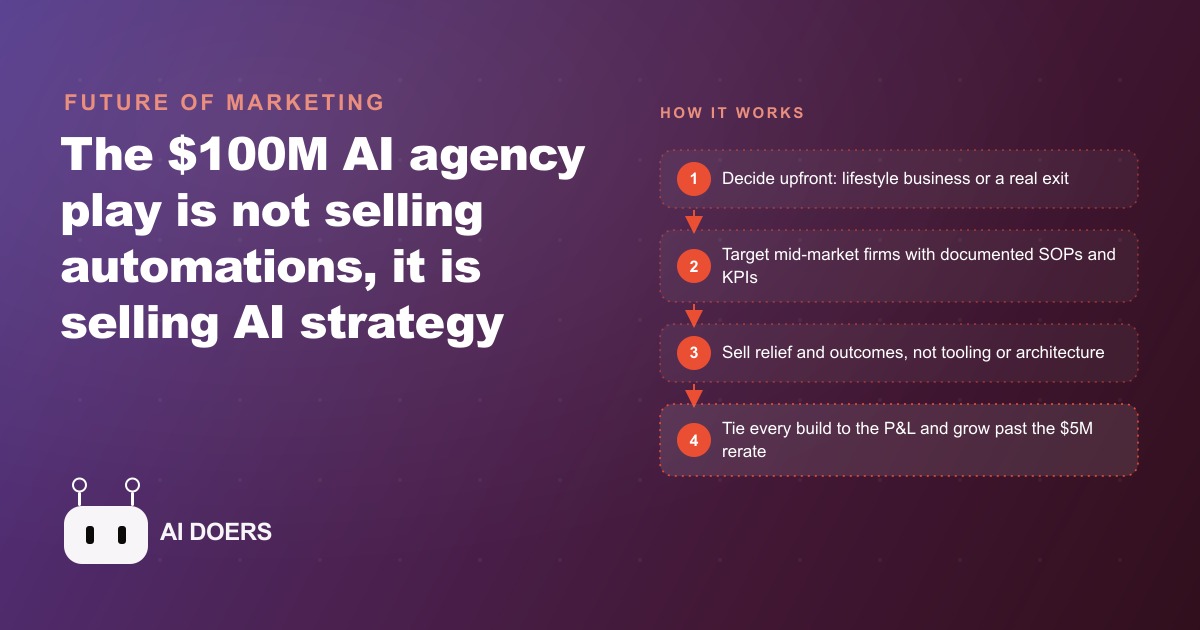
Most AI agencies die comfortable. The founder in this story noticed that pattern early, and the decision they made the day they noticed it is the only reason the agency is still growing.
The Day the Founder Decided Comfortable Was Not the Goal
I am Madhuranjan Kumar, and the most important thing I have watched happen in the AI agency world is that almost everyone building one is building it wrong for their own stated goals. Not because they are bad at the work. Because they never made a deliberate choice about what they were building.
The founder had been running automations for clients for about fourteen months when they sat down and looked at the business honestly. Revenue was solid. Clients were happy. The lifestyle was comfortable. Mornings started when they wanted. The work was interesting. They were building custom workflow replacements, API integrations, and the occasional chatbot for small businesses and a few mid-size companies. Each project landed somewhere between two and twelve thousand dollars. The pipeline was reliable because the demand for this kind of work was real and growing.
The problem was the ceiling. Each project was priced on what it cost to build, not on what it was worth to the client. Every time a model improved and build costs dropped, the founder's margin improved but they did not raise their prices, because the clients were already paying what they thought was fair for the deliverable, not what the outcome was worth. The business was generating a comfortable income but not building anything that had value beyond what the founder could personally produce each month.
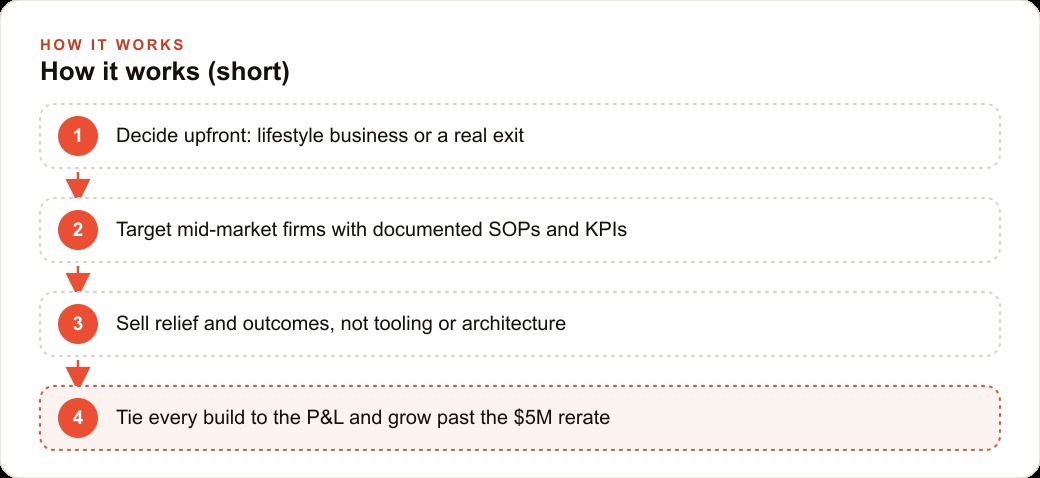
The founder had two options clearly in front of them. Option one: stay where they were, optimize for a comfortable lifestyle business, and exit eventually at something close to one year's revenue. That was a fine outcome. Option two: build something with real enterprise value, documented systems, recurring relationships, and the kind of revenue profile that produces a multiple worth caring about.
They chose option two. That choice changed everything that came after.
From Selling Automations to Selling the Business Case
The first thing the founder changed was what they sold in the discovery call. Previously the call was about scoping the automation. The prospect described a workflow that was slow or broken, the founder asked about the systems involved, and by the end of the call both parties were aligned on what would be built and roughly what it would cost.
The new first call sold nothing about what would be built. It sold an audit. The agency would spend two weeks reviewing the client's operations, interviewing their department heads, mapping their documented processes, and returning a prioritized project proposal. The audit was priced at four to six thousand dollars. At the end of the audit, the client received a document that told them, in their own business language, what the three to five highest-leverage places to deploy an AI system were, what each one would likely cost, what metric it would move, and roughly how long it would take to see the effect.
The change in how clients responded was immediate. Before the audit model, prospects negotiated on scope. After it, they asked when they could start. The audit changed the relationship from vendor to advisor before a single line of code was written. It also filtered out the clients who were shopping for the cheapest build, because anyone not willing to invest four thousand dollars to understand their own situation was not the client the agency was positioning itself to serve.
The underlying logic the founder was applying was something they articulated plainly to the team: clients are not buying an AI system, they are buying relief. They are executives getting pressure from their boards to have an AI strategy. The product is the peace of mind of having a real strategy, credibly communicated and actually implemented. Sell the relief, not the system.
Choosing the First Mid-Market Client
The target segment for the new model was firms with between ten and two hundred fifty million dollars in annual revenue. That range had a specific combination of properties that made it the right territory.
These businesses were large enough to have documented their operations. They had written procedures because they had hired enough people that institutional knowledge could not live in one person's head. They had performance metrics their leadership tracked because someone was responsible for those numbers. And they had meaningful budget to act on a well-made business case, not because they were careless with money but because a clear return on investment justification moved through their approval process in a reasonable time.
The founder approached a regional e-commerce company doing about forty million dollars in annual revenue as their first mid-market target. The category was home goods, and they had a refund problem. Their refund rate was running at twenty-one percent, which was high for their product category and was directly costing them margin on every order. They had a customer service team handling refund requests manually, following a script that was four years old and was not well matched to the actual reasons customers were returning items.
The pitch was not about AI. It was about the refund rate. The founder told the operations director that they had worked with companies in adjacent categories and had seen how much of a refund problem was typically upstream of the return request itself. They proposed an audit to find where the real problem was. The director agreed.
What the Business Logic Audit Actually Looked Like
The audit took eleven working days. The founder and a junior team member reviewed twelve months of refund data, interviewed five people across the customer service and product teams, and mapped the full journey from a customer's purchase decision to the resolution of a refund request.
The audit produced a fourteen-page document. The first five pages mapped the client's existing refund-handling process in detail, from the initial contact through the resolution and the restocking workflow. The next four pages mapped the data: where the refunds were concentrated by product category, by customer segment, and by the time between purchase and return request.
Page ten was the finding. Nearly sixty percent of refunds were coming from two product subcategories where the size and dimension information on the product pages was inconsistently formatted and was being misread by customers on mobile devices. The customer service team was processing returns for a problem that existed upstream, at the point of purchase. They were the last stop for a failure that was happening at the first stop.
The proposal described two systems. The first reviewed every new and updated product page and flagged any dimension formatting that fell outside a defined standard, catching the upstream problem before it became a refund. The second handled the initial refund contact, asked a standardized set of diagnostic questions, and routed the case based on the answers, which would reduce average time-to-resolution and free the customer service team for the cases that required genuine judgment.
The total engagement value was sixty-eight thousand dollars, split between the two systems. That was larger than any single project the founder had taken on in the previous fourteen months. The client approved the proposal within a week.
How the Revenue Rerated When They Stopped Billing for Time
The refund management system was delivered in five weeks. The result, measured ninety days after deployment, was a drop in the refund rate from twenty-one percent to sixteen point three percent. A four point seven percentage point improvement on a company processing tens of thousands of orders per month was worth several million dollars in annual retained revenue. The client's board saw it in the numbers. The founder was in the room when the finance team presented the quarterly results and credited the AI system as a contributing factor.
That meeting produced two things. A contract extension for ongoing system maintenance and a second project scope, this time for the product description standardization system that addressed the root cause. And a referral to another mid-market company in the same investor group.
The revenue math began to change at this point. The initial automations that had taken the founder a week or two to build were now a single sixty-eight thousand dollar engagement that had taken five structured weeks and produced a measurable outcome the client could present to their board. The founder was not billing more hours. They were billing for the outcome, which meant the pricing was anchored to the client's gain rather than to the cost of production.
The development cost structure had collapsed in a way that made the model work. Work that previously required a team for several months could now be shipped as a working prototype in days using agentic tools. The compression of build cost is what made it economically viable to take on mid-market clients with a meaningful problem and a modest budget for solving it, while still generating the margin the agency needed to grow.
The Numbers That Changed the Direction of the Business
The refund project was the example the founder returned to most often when describing the pivot to other agency owners, because the math was clean and the before-and-after was measurable. Here is the illustrative version of that math, generalized from the actual engagement.
A mid-market e-commerce company processing thirty-five thousand orders per month at an average order value of eighty-five dollars had a twenty-one percent refund rate. That was approximately seven thousand three hundred fifty refunds per month. At an average processing cost of twelve dollars per refund and an average restocked-goods loss of eighteen dollars per return, the refund operation was costing roughly two hundred twenty thousand dollars per month.
A four and a half percentage point reduction in the refund rate, achieved through an AI system that cost sixty-eight thousand dollars to build and four thousand dollars per month to maintain, reduced the monthly refund count by approximately one thousand five hundred seventy-five refunds. The monthly cost savings on those refunds was approximately forty-seven thousand dollars. The annual savings on the cost structure was approximately five hundred sixty-five thousand dollars. The one-time build cost was recovered in seven weeks.
The sixty-eight thousand dollar project produced five hundred sixty-five thousand dollars in annual operational savings. That is the business case the founder sold, and it is the reason the client's finance team was presenting it at the board meeting. That kind of documented outcome is also what makes the agency's own case studies compelling to the next prospect, and what makes the agency itself worth a multiple to a buyer who wants to replicate the model.
What the Path to a Meaningful Exit Multiple Actually Requires
A high exit multiple on an agency does not come from doing good work. It comes from having documented proof of a repeatable system that produces good work without depending on any one person being present. The founder understood this at month twelve and spent the following year building that documentation alongside the client work.
Every engagement produced a standardized audit template the team could use on the next client in that vertical. Every system built produced a deployment checklist a junior team member could follow without inventing anything. Every outcome measurement produced a case study that described the business problem, the system built, and the result measured, without naming the client. The body of case studies accumulated into a library that made the sales process faster because prospects could see the pattern of the work before agreeing to an engagement.
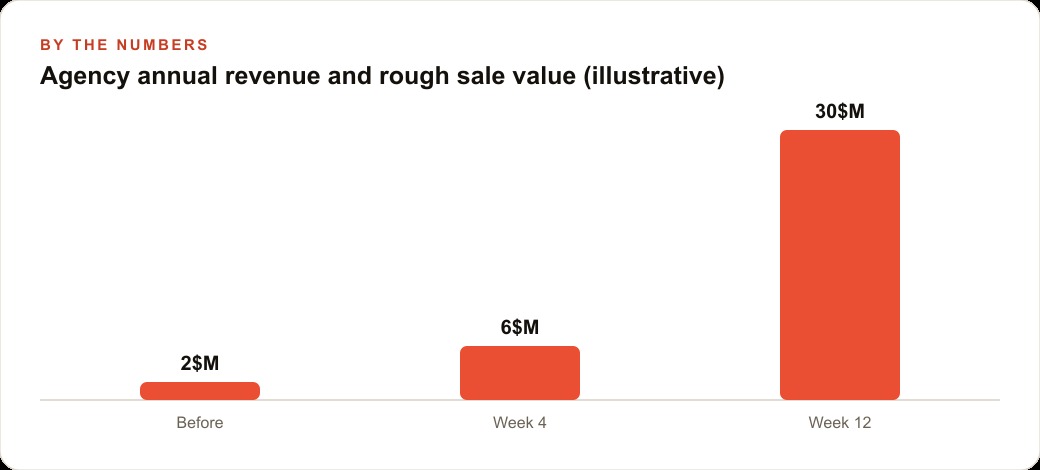
By month twenty-four, the agency had vertical playbooks for four industries, team members who could run an audit independently, and a pipeline of three concurrent mid-market engagements. Annual revenue was tracking past five million dollars. The significance of that threshold is that a services firm earning two million dollars per year typically sells for close to its annual revenue, because buyers see concentration risk and people-dependency. Cross five to six million with documented systems and recurring client relationships, and the multiple changes substantially. Six million in annual recurring revenue from AI strategy engagements, with documented delivery processes, can produce a sale value of twenty-five to thirty-five million depending on the quality of the relationships and the depth of the documentation.
The founder's agency had not yet reached that exit. But the business had crossed the threshold where the exit was a real option rather than a theoretical one. Every month of documented system-building and every mid-market case study added to the multiple, rather than just to the revenue number.
The most AI work that gets built today will be abandoned by 2027, because it is bolt-on features and chatbots that were never tied to a number anyone's board actually tracked. The work that survives is holistic, documented, and measured against a metric that matters. The agency that builds that kind of work earns a different relationship with its clients and a different price from a buyer than the one that delivers disconnected features and moves on.
That is exactly what we do at AI DOERS. Book a private 30-minute call with Madhuranjan Kumar and we will map the fastest path to it for your specific business.
Book your call →
Madhuranjan Kumar
Madhuranjan Kumar brings 20 years of performance-marketing experience and has managed over $200 million in Facebook ad spend for brands across the United States and beyond. His expertise spans the full modern marketing stack: Meta, Google Ads, TikTok, email automation, CRM, and the websites that hold it together. At AI DOERS he turns that track record into lead-generation systems for businesses across every industry.