
The One-Person AI Business Built To Thrive In A Recession
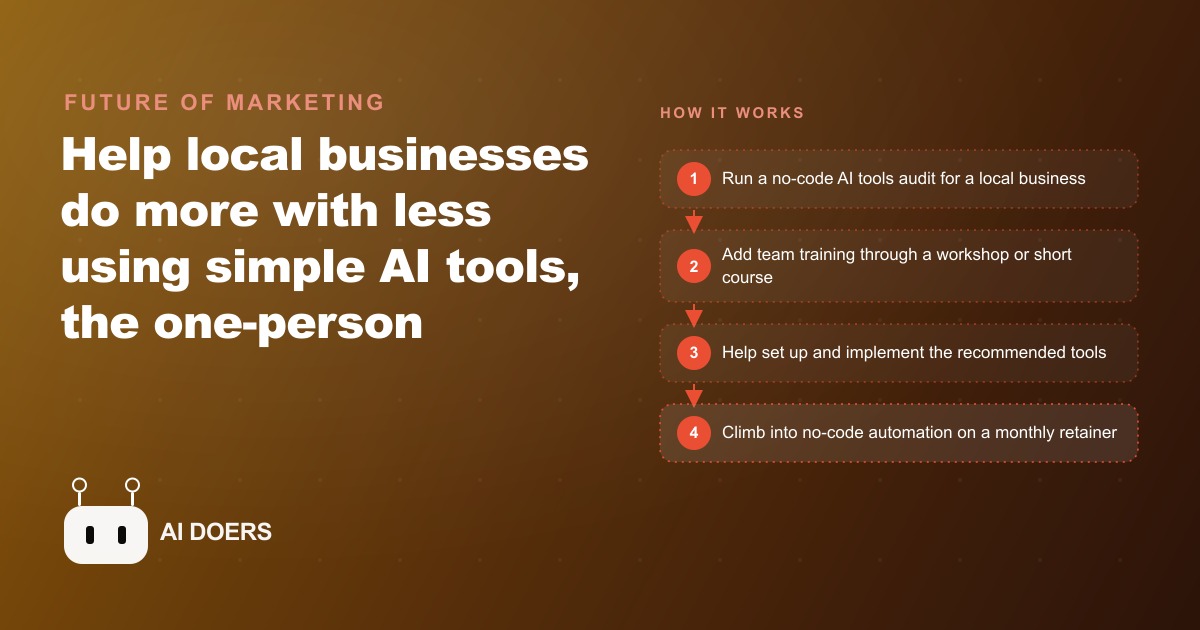
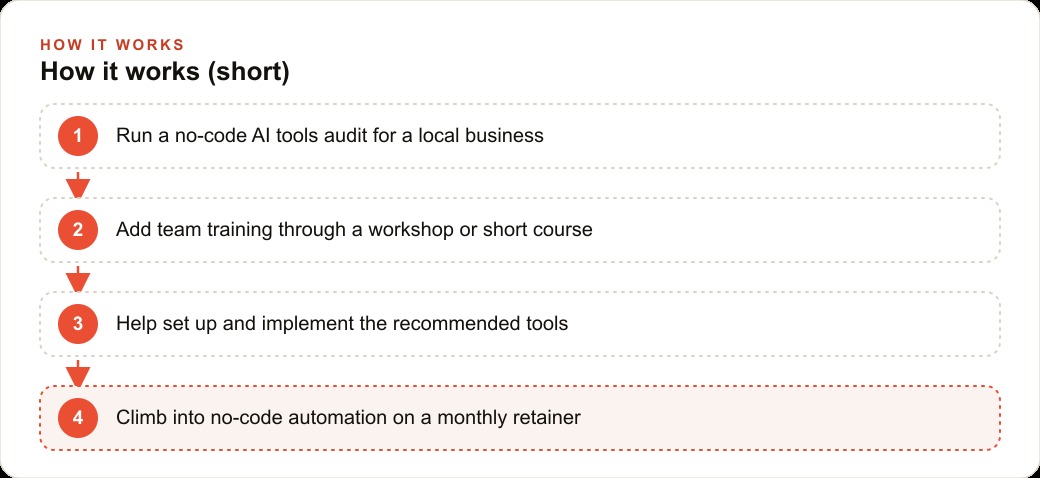
A downturn redirects spending toward efficiency, so a one-person business that helps local companies adopt simple AI tools gets stronger, not weaker. You start with a no-code tools audit, add training and setup, then climb into automation retainers.

How to build a one-person AI service business that survives a recession
I am Madhuranjan Kumar, and the timing question most people ask about AI consulting is backwards. They ask whether right now is a good time to start. The recession framing flips the question in a more useful direction: is a period of business contraction actually a better time to sell AI automation than a period of expansion?
The answer, based on what I have observed across business service sales, is yes, with a specific explanation. When business is good, owners invest in growth. When business tightens, they invest in cost reduction and efficiency. AI automation delivers both, but the efficiency argument lands harder and faster when margins are under pressure. A business owner who dismissed your pitch about saving 10 hours a week when times were good will hear it differently when every hour of labor cost has become a problem.
This is the foundation of the following playbook. It is built specifically for the constraint environment of a downturn, where your overhead needs to be zero, your tools need to be free or nearly free, and every client you take on needs to produce enough monthly recurring revenue to justify continued investment.
Step 1: Identify the one business problem you can solve with AI in two hours or less
The first step is the most important one and the one most people skip. They start by listing AI capabilities, tools, platforms, and use cases, and then try to match those capabilities to a market. This is the wrong direction.
Start with a specific operational pain. The best pain for this business model has three characteristics: it is time-consuming for a business to handle manually, it has a clear measurable output (calls answered, appointments booked, leads followed up), and it is currently being solved with labor that costs more per month than an automated solution would.
Phone inquiries and appointment scheduling are the most common entry point for a single reason: the math is obvious to a non-technical buyer. If a business is paying a part-time receptionist or losing calls that go to voicemail, the cost of the current state is calculable and the benefit of an AI voice agent is directly comparable. The owner does not need to understand how the technology works. They need to understand that the tool answers every call, never takes a break, and costs a fraction of a human equivalent.
Choose one pain. Document exactly how you would solve it. Know the tools you would use, the setup time, and the deliverable. Before you approach a single client, you should be able to answer: what exactly will I build, how long will it take me, and what will the client be able to measure after it is live?
Step 2: Build your first version for a local business that lets you work for free
Your first deployment should not be paid. This is a deliberate investment in proof, not charity.
Choose a local business where you have a personal connection or can easily get a meeting: a dentist, a law firm, a restaurant, a plumber, any service business that relies on phone inquiries. Offer to build and deploy an AI voice agent or lead follow-up system at no cost in exchange for permission to document the outcome and use the results in your portfolio.
Set up the agent, train it on their content, run it for 30 days, and then document what happened. How many calls did it handle? How many appointments did it book? What was the average response time? Compare these numbers to whatever the baseline was before the agent went live.
This documentation is the first piece of content in your portfolio. It is not a case study you write about the tool in general. It is a specific account of what happened for this specific business, with the actual numbers. When you approach a second business of the same type, you show them this document. The conversation is completely different when you have real numbers from a real deployment versus a pitch about what AI can theoretically do.
The free deployment also forces you to build something that actually works. If you were charging from day one, the pressure to ship quickly might push you to deliver something mediocre. When you know the quality of this first deployment determines whether anyone pays you afterward, you build it right.
Step 3: Price based on the cost of the problem you solve, not on the cost of the tools you use
The most common pricing mistake in AI consulting is tool-based pricing: what does the platform cost me, times some multiple, equals what I charge the client. This produces prices that are either too low to sustain a business or too high relative to the perceived value.
The correct pricing anchor is the cost of the problem. A dental practice that misses an average of 15 calls per day, converting at 30 percent to new patient appointments worth 200 dollars each, is losing approximately 900 dollars per day in potential revenue from missed calls alone. An AI voice agent that captures those calls at 300 dollars per month is not priced at 300 dollars based on what you pay for the platform. It is priced at 300 dollars because that is a small fraction of the value being created, and the business can see the math clearly.
Build the value calculation for your specific use case before you build your pricing sheet. Calculate what the problem currently costs the business. Quote a price that is clearly less than that cost and clearly more than what you need to make the engagement worthwhile. For a one-person operation, the floor is the monthly platform cost plus three to four hours of your time at a rate that makes the business sustainable.
For a recession environment specifically, the value anchor argument is more powerful than ever. A business that is looking at every line of labor expense has already done the math on what their staff costs. When you show them that an AI system does a specific task for 10 to 20 percent of the labor cost, the savings are more concrete and more persuasive than in a growth environment where the main concern is scale.
Step 4: Stack retainers before you add clients
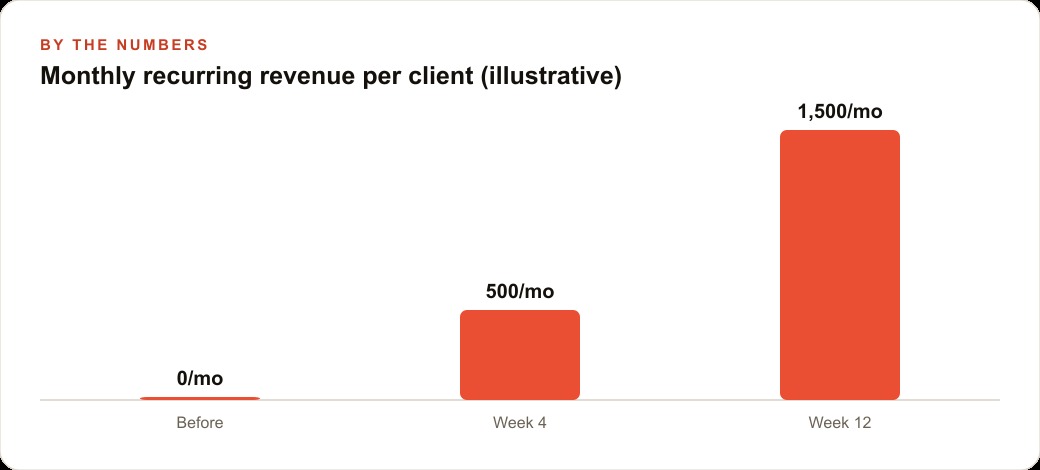
The income structure of a one-person AI service business only becomes sustainable when the majority of revenue is recurring rather than project-based. Project income requires continuous selling. Retainer income requires good delivery and a renewal conversation once per year.
The retainer should cover three things: ongoing maintenance of the deployed agent, monthly content or knowledge-base updates as the business changes, and performance monitoring that surfaces any degradation in agent quality. These three services justify a monthly fee because they represent real ongoing work and real ongoing value.
The maintenance argument is the easiest to make. An agent trained on the business's website from six months ago may have outdated information about pricing, hours, services, or staff. A client who receives a monthly summary showing that their agent handled 420 calls last month, with 95 percent accuracy on standard inquiries, and that you refreshed the knowledge base to reflect their new service pricing, experiences the ongoing value of the retainer directly.
Build the retainer expectation into the initial proposal, not as an upsell after the project is complete. When you present the initial build, present it as a two-part engagement: a setup fee for the initial build and deployment, and a monthly retainer for ongoing maintenance and monitoring. The client who agrees to both from the beginning is far more likely to renew than the client who signed up for a one-time project and later receives a pitch for a retainer they did not originally expect.
Step 5: Systematize your build process so each new client costs you less time
The first client deployment takes you ten to fifteen hours. The tenth client of the same type should take you three to four hours. The gap is your build process.
Document every step of your first deployment in detail. Note the exact sequence: the platform setup, the content crawl parameters, the system prompt template, the testing protocol, the handoff checklist. Convert this documentation into a repeatable process you can follow exactly for each new client of the same type.
Create template system prompts for each business type you serve. A dental practice system prompt will be different from a law firm system prompt in specific ways, but the structure and the sections are the same. Having a tested template to start from rather than writing a new prompt for each client eliminates a significant amount of variability and reduces the risk of a poorly configured agent going live.
The systematization also enables you to work across time zones and business types without additional overhead. When your setup process is documented and repeatable, you can bring in a part-time contractor to handle some of the initial build work, freeing your time for client acquisition and strategy. This is how a one-person operation scales without hiring full-time staff.
Step 6: Choose one vertical and own it completely before expanding
The temptation in the early stages of an AI consulting practice is to say yes to every opportunity: dental practices, law firms, restaurants, real estate agents, retail stores. The problem with serving every vertical simultaneously is that the case study portfolio remains shallow and the referral network remains thin.
A portfolio with five dental practice case studies is more persuasive to a new dental prospect than a portfolio with one dental case study and four from unrelated industries. The dental prospect wants to know that you understand their specific compliance requirements, their patient communication norms, their peak call volume patterns. A vertical-specific case study demonstrates that understanding in a way a generic AI consulting portfolio does not.
Choose the vertical where your first paid client came from. Build four more clients in that same vertical. Become the person in your market who handles AI agent deployment for that specific type of business. At five clients in one vertical, you will have enough case studies to generate referrals within the industry, because businesses in the same vertical know each other and talk.
Expand to a second vertical only after the first is producing stable recurring revenue and reliable referrals. The second vertical is easier to enter with the credibility from the first, and the process knowledge from the first vertical reduces the setup time in the second.
The recession-specific pitch that changes the conversation
Selling AI automation to a business in a growth environment is selling them more capacity. Selling it in a recession is selling them cost reduction and survival. The pitch changes accordingly, and the practitioner who recognizes this shift early has an advantage over one who continues leading with the growth story.
The recession pitch starts with the labor cost calculation, not the capability showcase. Before the demo, before the system prompt walkthrough, before the pricing conversation, the opening question is: what does it currently cost you, in total labor expense, to handle the category of customer interaction or operational task that I am going to automate? Get that number on the table. Then show the monthly cost of the automated alternative. The gap between those two numbers is the value proposition, and in a recession environment it is the most persuasive number you can present.
The second element of the recession pitch is reliability: not the reliability of the AI tool, but the reliability of the cost. A part-time employee calls in sick, takes vacation, requests a raise, or leaves. An AI agent costs the same per month regardless of volume, does not require benefits or employment taxes, and does not negotiate. For a business owner managing labor costs in an uncertain environment, the predictability of the AI cost is a meaningful feature independent of the efficiency gain.
The third element is scalability in both directions. If the business volume drops, the AI agent cost stays flat at the monthly subscription rate rather than requiring a layoff conversation. If the business volume increases, the agent handles more volume without a corresponding labor cost increase. For a business owner who cannot predict whether the next six months will require contracting or expanding, the AI agent's flat cost with unlimited volume handling is a hedge against both outcomes.
That is exactly what we do at AI DOERS. Book a private 30-minute call with Madhuranjan Kumar and we will map the fastest path to it for your specific business.
Book your call →
Madhuranjan Kumar
Madhuranjan Kumar brings 20 years of performance-marketing experience and has managed over $200 million in Facebook ad spend for brands across the United States and beyond. His expertise spans the full modern marketing stack: Meta, Google Ads, TikTok, email automation, CRM, and the websites that hold it together. At AI DOERS he turns that track record into lead-generation systems for businesses across every industry.