
The NotebookLM Upgrades That Change How You Do Research
NotebookLM quietly added a wave of upgrades that turn your raw sources into briefing docs, blog posts, infographics, slide decks, and videos, with deep research now built straight into the app.

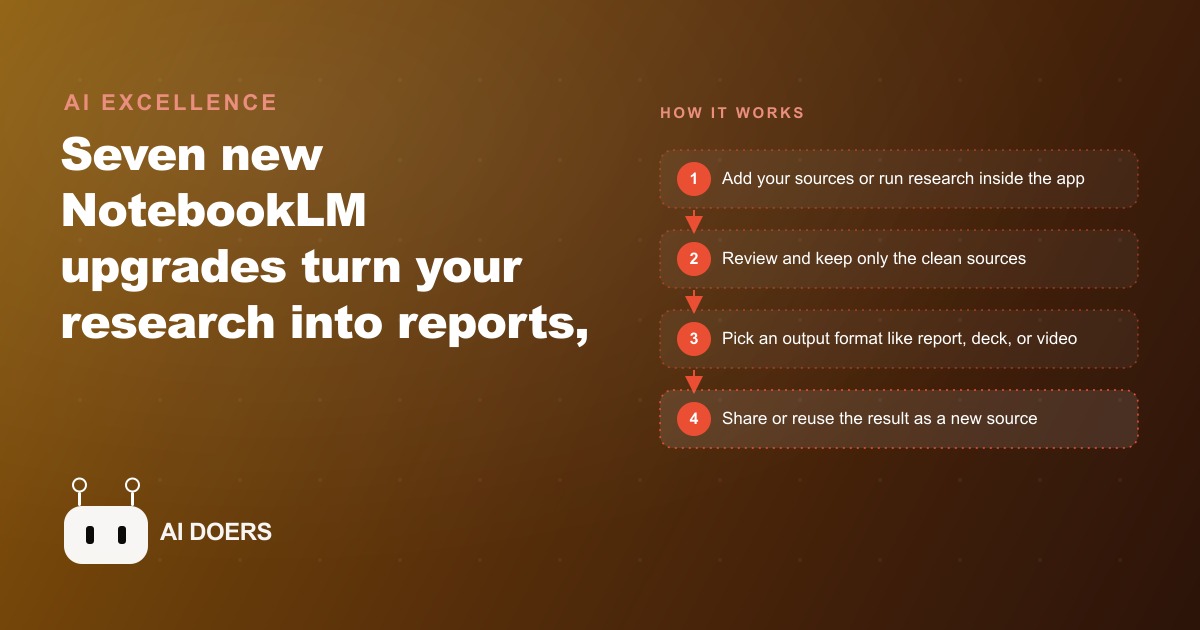
Google shipped a significant batch of NotebookLM upgrades in close succession, and this is the update that changes the tool from a clever Q-and-A assistant into a genuine production system for research-heavy work. I am Madhuranjan Kumar, and the practical implication is that several categories of business knowledge work that used to require hours of manual reformatting can now be handled in one workspace from a single set of sources.
NotebookLM stopped being a Q-and-A box and became a multi-format knowledge engine
The short version of what shipped: deep research built directly into the app, video overviews generated from your sources, a new blog post report format, infographics exportable for social platforms, slide decks playable and downloadable as PDFs, data tables that export directly to Google Sheets, and more flexible sharing controls. Any one of these would be a meaningful update. Shipped together, they change what the tool is for.
The old version of NotebookLM was valuable but limited to answering questions and generating text summaries from your uploaded documents. The new version takes those same sources and turns them into whatever format a person actually absorbs: a podcast they listen to on a commute, a slide deck they walk into a meeting with, an infographic they post on LinkedIn, a quiz they use to test their team's understanding. The sources stay the same. The output adapts to the audience and the channel.
The mechanism that makes all of this work is still source grounding. NotebookLM answers from what you give it, not from the open internet, which is what makes it useful for business applications where accuracy is non-negotiable. A marketing team that uploads their actual product documentation and customer research gets outputs grounded in those specific documents. They do not get confidently stated general information that happens to contradict the product's actual behavior. That grounding is the whole value proposition, and none of the new output formats change it.
Deep research is now built in, and that changes the starting point for any serious research pass
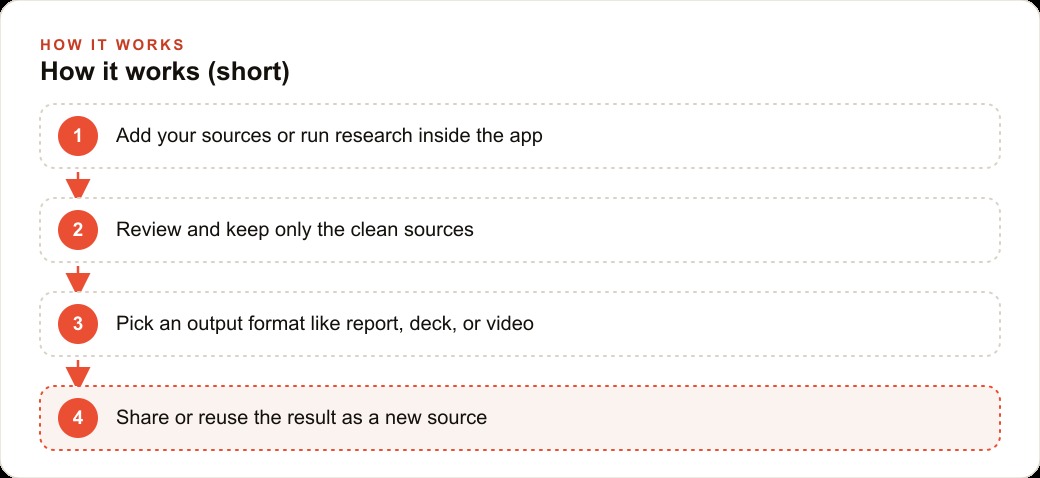
The friction point that the deep research addition removes is significant. Previously, doing a thorough research pass on any topic meant gathering sources outside NotebookLM, organizing them manually, and importing them file by file. The built-in research modes eliminate that external step. Fast research pulls roughly ten strong sources in seconds. Deep research browses a larger set of pages over ten to twenty minutes and synthesizes across them, producing a sourced briefing that would have taken a junior analyst most of a morning to compile by hand.
The two modes also combine with Google Drive access. Because the tool lives inside Google's ecosystem, you can search your own Drive during a research session and pull in internal documents alongside web sources. That means the output blends external market information with your own internal context, which is the combination that most useful business research actually requires. External competitive data is more useful when it sits next to your own pricing and positioning. Customer behavior data from the web is more useful when it sits next to your own customer notes.
Selectivity during import is still the discipline that separates good outputs from muddled ones. When deep research returns results, reviewing each source before importing it rather than accepting everything keeps the notebook's grounding clean. Paid accounts support up to three hundred sources. Free accounts support fifty. Neither limit is a barrier to useful work if you are selective, and an unfocused notebook with weak sources produces weak outputs regardless of which feature you use to generate them.
The practical move for any business that regularly produces research-backed content, whether for internal briefings, client reports, or published SEO and organic content, is to run one full deep research pass on your most important current topic, review the sources carefully, import only the strong ones, and generate a briefing doc. That test tells you within an hour whether this workflow fits your research volume and format requirements.
The note-to-source loop is the most underused feature in the new release
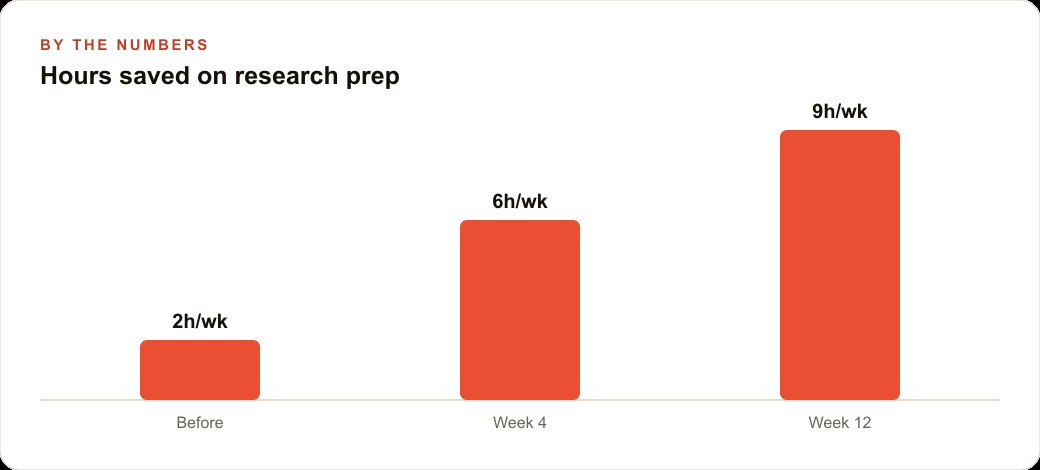
The note-to-source workflow is the piece that most users have not discovered yet, and it is the one that produces the sharpest focused outputs. The mechanic works in three moves: highlight the most useful section of any generated report output, save that text as a note, and convert that note into its own source. From that single focused source, generate an audio overview, a short video, or a tight briefing doc covering just that one topic.
The value is in the narrowing. Deep research produces broad coverage across many sources. The note-to-source workflow lets you identify the three paragraphs that directly answer your most pressing question, elevate those into their own source, and generate a focused output that speaks only to that question. A forty-page competitive analysis becomes a five-minute audio briefing on the one pricing trend that matters for next quarter's positioning. A year of customer support tickets becomes a focused quiz on the ten most common product misunderstandings. The compression is what makes the outputs actually usable.
This is also the workflow that enables one of the new sharing features most relevant to business teams. After using the note-to-source loop to produce a tight, focused notebook on a specific client matter or project phase, you share that notebook in chat-only mode, which lets teammates query it without seeing the raw underlying sources. Sensitive competitive research stays private. The team's ability to question the synthesized version stays accessible. For professional services firms, agencies, and any team that handles client information alongside proprietary research, that separation is a meaningful operational control.
A property management company, a bakery, or an HVAC firm can deploy this in an afternoon
The category of business that benefits from this update is not limited to research-intensive professional services. Any business that sits on scattered knowledge and spends time answering the same questions repeatedly has the same problem at a different scale.
A property management company that loads its maintenance procedures, lease terms, vendor contacts, and common tenant questions into a notebook and generates a briefing doc for every new property manager is running the same operation as a law firm that loads case materials and generates a client briefing. The problem is the same: knowledge is scattered, retrieval is slow, and the formatted output that people actually use is manually produced every time. NotebookLM closes all three gaps in one session.
The HVAC company angle is concrete. Load equipment manuals by chapter, each chapter as its own source so you can toggle to only what is relevant. Add a year of service notes. Run deep research on current refrigerant regulations and import the clean sources. From that grounded notebook, generate a one-page briefing doc for new technicians, a data table of every equipment model you service with common failure modes, an infographic on seasonal maintenance steps that doubles as a social post, and a short video overview that explains a maintenance plan to a homeowner in non-technical language. That is a half-day of setup that replaces several weeks of scattered document creation and produces materials that actually get read.
For a business feeding a CRM and website stack that needs consistent, accurate content across multiple channels, the workflow also eliminates one of the most common errors in content production: inconsistency between what the website says and what the team communicates directly. A notebook grounded in the same source documents that define the product or service keeps every output channel consistent automatically, because every output draws from the same verified source set.
The concrete move is to create one notebook today, load the five to ten most important documents your business currently answers questions from, and generate a briefing doc. That test takes under an hour and produces a clear signal on whether the deeper workflow is worth building out. The businesses that run that test today and build the fuller system next week will be ahead of the ones that read this and wait another month to start.
That is exactly what we do at AI DOERS. Book a private 30-minute call with Madhuranjan Kumar and we will map the fastest path to it for your specific business.
Book your call →
Madhuranjan Kumar
Madhuranjan Kumar brings 20 years of performance-marketing experience and has managed over $200 million in Facebook ad spend for brands across the United States and beyond. His expertise spans the full modern marketing stack: Meta, Google Ads, TikTok, email automation, CRM, and the websites that hold it together. At AI DOERS he turns that track record into lead-generation systems for businesses across every industry.