
The Lean AI Startup Playbook Hiding Inside a Katowice Office Vlog
A small AI team ships features live with sub-minute deploys, builds custom internal tools, and treats the whole company as a harness where the structure around a model, not the raw API call, is the product. Here is how I would borrow that playbook for a gym.

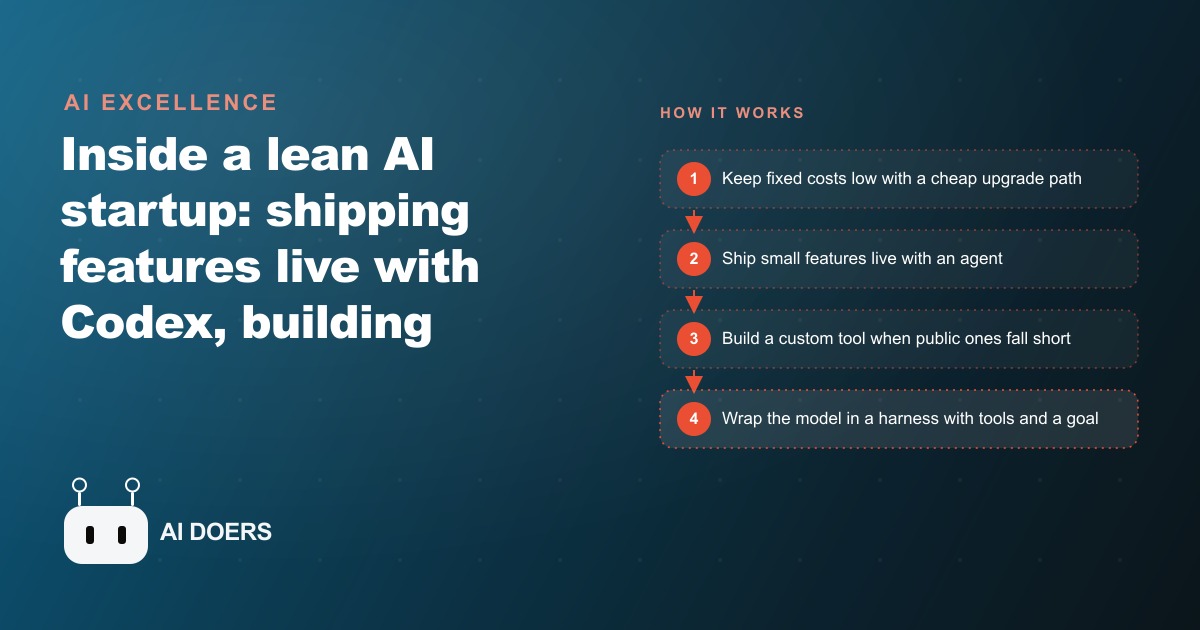
Most advice about AI startups tells you to hire fast, raise big, and scale hard. A small team shipping features live from a modest office in Katowice is quietly doing the opposite, and I think their way is right and the conventional way is wrong. The lesson buried inside what looks like a simple office vlog is not about AI at all. It is that the structure you build around a model, and the restraint you build into your costs, matter far more than the model itself or the size of your team.
I am Madhuranjan Kumar, and I want to stake out a clear position: in the AI era, small and structured beats big and fast, and the companies chasing headcount and raw model access are solving the wrong problem. Let me argue it with the specific moves this team makes, because each one contradicts a piece of standard startup wisdom, and each one is more useful to an ordinary small business than to a venture backed rocket ship.
Overhead is a strategy, not an afterthought
Standard advice treats office space and fixed costs as boring logistics. This team treats overhead as a competitive weapon. They signed their first office for three people, with room for six, and a pre negotiated path to twelve in the same building for only about 2.9k zloty more a month. Read that carefully. They did not lease for the size they hope to be. They leased for the size they are, and they made the next step cheap before they needed it.
The conventional move is to lease ambitiously so you look the part and never have to move. I think that is exactly backwards. Ambitious fixed costs turn a slow month into a crisis and a good month into a trap, because now you are paying for space and headcount you took on speculatively. Keeping fixed costs low and the upgrade path cheap means growth never forces a painful move or a rushed lease. The restraint is not timidity, it is the thing that keeps you alive long enough to compound. Most businesses that die do not die from lack of ambition, they die from carrying costs their revenue could not yet justify.
Ship in tiny live increments, not big brave launches
The dominant instinct is to batch changes into a polished release and launch with fanfare. This team does the opposite in the most mundane way possible: the founder alt tabs into Codex mid task, describes a feature in plain English, pushes to GitHub, and Vercel deploys it in 30 to 40 seconds. The live software has a new feature before the meeting is over.
Here is why the small live increment beats the big launch, and it is not obvious. Short feedback loops catch mistakes in seconds rather than weeks. A big bang release concentrates all your risk into one nerve wracking moment and hides bugs behind a pile of simultaneous changes. Continuous tiny shipping spreads the risk thin and keeps the product improving without drama. The contrarian claim is that the unglamorous, boring cadence of shipping one small thing live and immediately testing it produces better software than the heroic launch, and it does so with less stress. The heroic launch is mostly theater.
There is a subtler lesson too. On one favorites highlight feature, Codex went past the request and added a zoom in interaction nobody asked for, and the founder admits the zoom is what actually makes the feature work. The takeaway most people miss: review what your agent contributes unprompted, because sometimes the unrequested polish is the best part. That only happens when you ship small and look closely, not when you batch a hundred changes and skim.
Build custom tools, do not rent your workflow
Conventional wisdom says do not build what you can buy. This team inverts it. When public tools failed their exact workflow, they built an internal app for running thumbnail tests and highlighting favorites, treating custom software as the default move rather than a last resort. The bet is that in a world where an agent can build a working tool in an afternoon, bending your process around someone else's software is now the expensive option, not the cheap one.
I largely agree, with a caveat. The old logic against building was that custom software carried a huge cost in developer time and maintenance. AI coding agents have collapsed the build cost, which genuinely shifts the calculus toward building for the parts of your workflow that are truly yours. But the contrarian position has a limit: you should still rent the commodity parts, the payment processing, the email, the plumbing nobody differentiates on. The skill now is knowing which parts of your process are distinctive enough to deserve custom software and which are commodity you should never rebuild. Build where you are different, rent where you are the same.
The harness is the product, and the model is not
This is the sharpest and most useful idea in the whole vlog, and it cuts against the entire narrative that the frontier model is what matters. The founder frames the whole company as a harness running a single goal toward a one billion target: a worker runs non stop toward the goal without needing to be managed, and the decision maker can be swapped for a model so the worker does not have to think about what to do next. The point he hammers is that they do not want a simple raw model API call, they want the structure around it, the tools, the context, and the goal to loop against.
The harness is the product, not the bare model, because a model on its own has no memory of the goal and no tools to act on it. This is where I plant my flag hardest. Everyone is obsessed with which model is smartest this week. That obsession is a distraction. A mediocre model inside a well built harness, with the right tools, clear context, and a goal to loop against, beats a frontier model fired off as a one shot prompt with none of that scaffolding. The value you create is almost entirely in the harness, and the harness is something you own and improve, unlike the model, which everyone can rent. He is equally deliberate about matching the model to the job, using Grok specifically for social research while noting it is weaker at coding, rather than forcing one model to do everything. And he insists the human edge is taste, the judgment about which feature actually matters, which is exactly why the unrequested zoom was worth keeping.
A worked example: the gym that runs like a franchise
Let me prove the position works outside a tech startup, with a single location gym. The conventional path is to lease a big space to look established and buy five separate apps for bookings, billing, and classes that never quite talk to each other. Follow this team's playbook instead and the whole shape changes.
Start with overhead as strategy: take the space that fits now, lock a cheap expansion clause for when membership grows, so a strong month never traps you in rent you cannot yet justify. Then bring the shipping habit indoors. Instead of the five disconnected apps, build one small custom tool that fits the gym's exact flow, shipping it feature by feature with an agent, the check in view this week and the waitlist next week, rather than waiting for a perfect launch. Now the harness. Instead of the owner manually chasing every lapsed member, wrap a model in a harness that watches for members who have not checked in for two weeks, drafts a personal win back message, and keeps looping until the list is worked through. The owner sets the goal, fill the empty 6am class, and the harness runs toward it without daily babysitting.
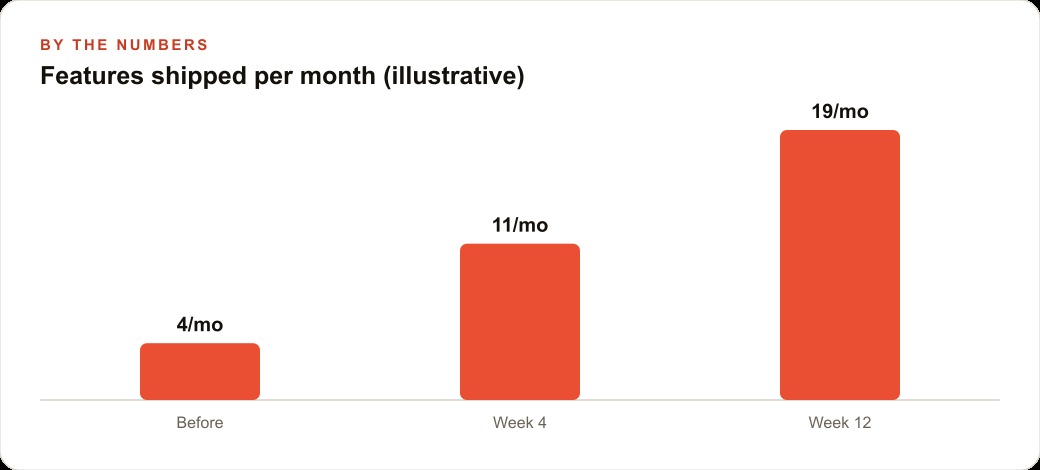
Put illustrative numbers on it. Say the gym ships around 4 small operational improvements a month by hand today. With an agent shipping live in tiny increments, that could climb toward 11 in the first month and 19 by week twelve, because the cost of each change collapsed. Match the model to the job the same way the founder does, a chatty model for the friendly member messages and a stricter one for the billing logic. The win back harness feeds the gym's CRM and website stack so no lapsed member slips through, while the freed up owner attention goes into the Facebook and Instagram ad campaigns and SEO and organic search that fill the top of the funnel. Staff keep the human edge, the judgment about which member needs a real call from a trainer and which just needs an automated nudge.
The objection worth answering honestly
The obvious pushback to my position is that this only works for a software company staffed by people who can already code and prompt fluently, and that an ordinary small business owner cannot replicate it. I take that objection seriously, and I think it is half right, which is why the honest version of this argument has a boundary.
The half that is right: you should not go build your own custom software for a workflow you do not understand, and you should not wrap a model in a harness for a process you have never mapped by hand. The team in Katowice can ship live because they deeply understand what they are shipping. An owner who automates a broken process just gets a faster broken process. So the prerequisite for this playbook is not coding skill, it is clarity about your own operations, and clarity is something a small business owner can build without a single line of code.
The half that is wrong: the idea that the tooling is out of reach. The whole reason this playbook matters now and did not five years ago is that the build cost collapsed. An owner does not need to write the custom scheduling tool or the win back harness themselves. They need to know which parts of their business are distinctive enough to deserve custom tooling, and which are commodity to rent, and then either use an agent to build the distinctive parts or hire someone to. The judgment is the owner's job. The construction is cheap and delegable. That division is precisely why small and structured is now available to businesses that could never have afforded custom software before, and why the conventional advice to just buy everything off the shelf is quietly outdated.
There is a second objection I hear, which is that shipping live and letting an agent add unrequested features sounds reckless for a business where mistakes cost customers. I think this gets the risk exactly backwards, and it is worth saying why. The reckless approach is the big batched launch, because it concentrates all your risk into one moment and hides a dozen changes behind each other, so when something breaks you cannot tell which change caused it. Shipping one small feature live and testing it immediately is the safer path, not the riskier one, because the blast radius of any single change is tiny and you find out in seconds whether it worked. The discipline that makes it safe is the same discipline that makes it work: ship small, look closely at what the agent produced including the parts you did not ask for, and keep a human on the judgment about what is worth keeping. Recklessness is not shipping fast. Recklessness is shipping without looking, and that is a choice, not a consequence of the method.
The position, stated plainly
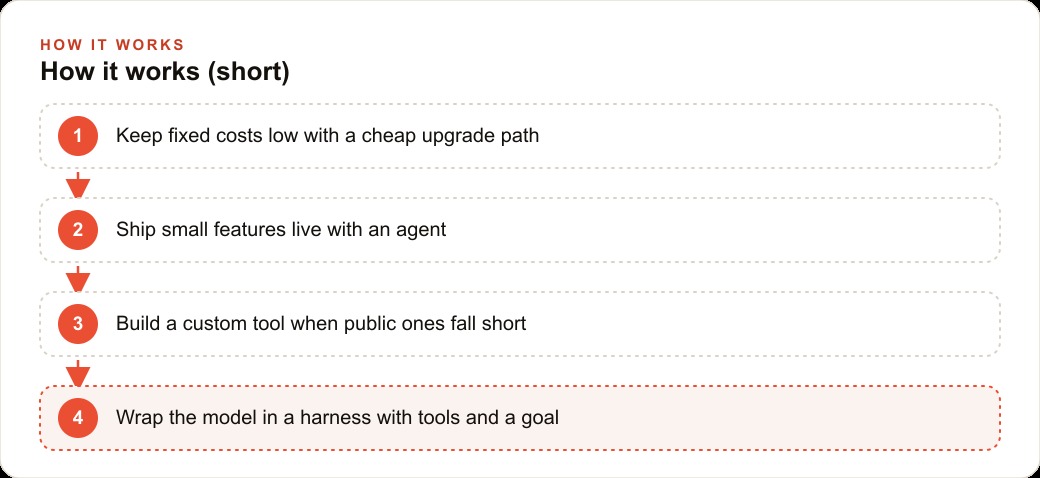
Small and structured beats big and fast. The businesses that win the AI era are not the ones with the biggest team or access to the smartest model. They are the ones that keep overhead low with a cheap upgrade path, ship in tiny live increments and read what their agents add unprompted, build custom tools where they are genuinely different, and wrap models in a real harness instead of firing off one off prompts. The harness, the tools and the goal wrapped around a model, is the product. A bare API call is not.
You can adopt all of it yourself, one habit at a time, and feel the difference in the first month. If you would rather have the harness and the custom tooling designed and wired up correctly for your business, you can do it yourself or bring in an expert to build it, and that is the kind of build I take on for clients.
That is exactly what we do at AI DOERS. Book a private 30-minute call with Madhuranjan Kumar and we will map the fastest path to it for your specific business.
Book your call →
Madhuranjan Kumar
Madhuranjan Kumar brings 20 years of performance-marketing experience and has managed over $200 million in Facebook ad spend for brands across the United States and beyond. His expertise spans the full modern marketing stack: Meta, Google Ads, TikTok, email automation, CRM, and the websites that hold it together. At AI DOERS he turns that track record into lead-generation systems for businesses across every industry.