
The Lean AI Agency Model That Prints 35,000 a Month at 80% Margin
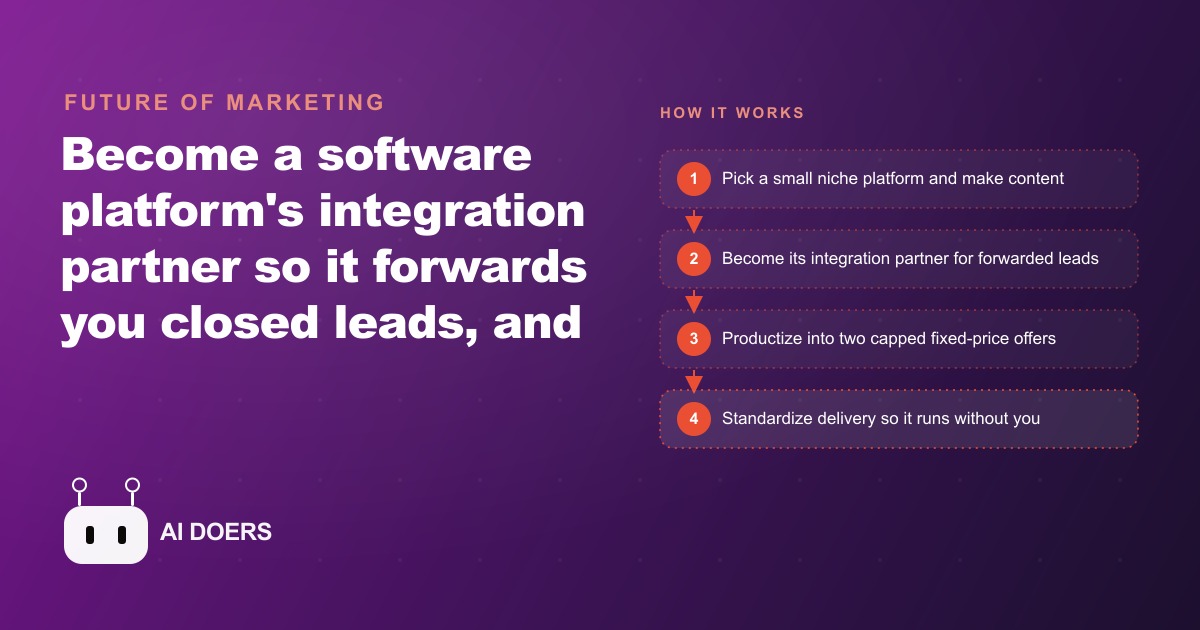
Become the integration partner for small software platforms so they forward you pre-closed leads at near-zero acquisition cost, then productize and standardize the work. This is how a lean agency runs 150-plus projects in four months at an 80% margin.

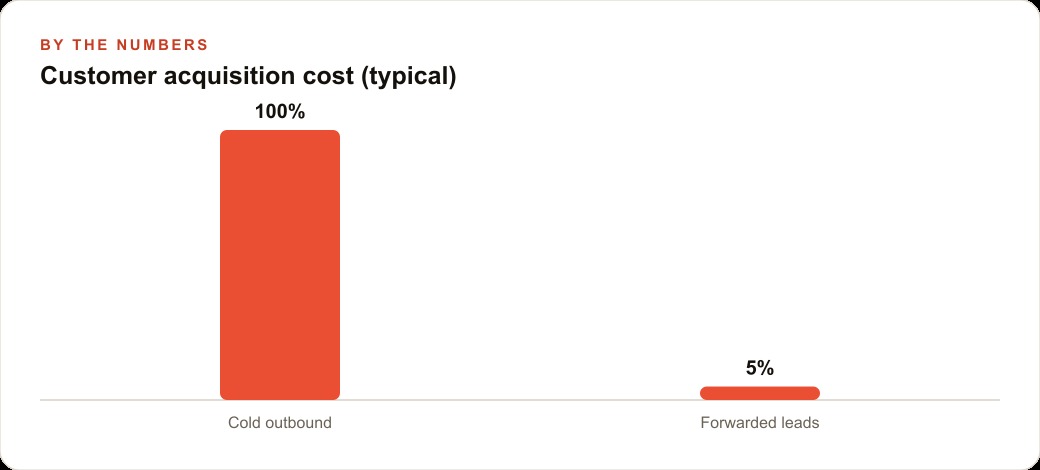
The standard AI agency model has a structural flaw that shows up clearly in the numbers. Every project you deliver costs roughly what it costs you to build it. But every client you acquire costs an additional layer on top, through cold outbound campaigns, content hours, and sales calls that convert at somewhere between 10 and 50 percent on a good run. I, Madhuranjan Kumar, have spent time studying this model, and the math is uncomfortable: for many agencies, 30 to 40 percent of the effective project cost is buried in acquisition before the work begins. The integration partner model removes that layer almost entirely.
The premise is simple. A fast-growing software platform sells more seats than its team can support. The users who buy the product often cannot configure it themselves. The platform engineers want to build product features, not run customer onboarding calls. A trusted external partner who handles all that setup work is not a cost for the platform; it is a relief. That partner gets a stream of clients who have already decided to pay. The client acquisition cost approaches zero.
Over 150 projects in four months, at more than 30,000 euros per month, with margins around 80 percent: those are the numbers that make this model worth understanding in detail. One month showed over 42,000 euros in revenue against 7,000 in expenses. The gap between revenue and cost exists because there is almost no sales infrastructure to maintain.
The acquisition cost that eats most agency models alive
When you run a typical agency, the cost of winning a client is largely invisible because it is spread across activities that feel like marketing or business development. The content you produce, the outreach sequences you send, the calls you take that do not close, the proposal revisions: all of this costs real time and real money even when it produces no revenue.
A cold email campaign that converts 2 to 3 percent of contacts is considered solid performance. That means for every closed deal, you sent 30 to 50 messages, each requiring research, personalization, and follow-up. The time cost per closed deal through cold outbound can easily run to several hundred euros of equivalent labor, and that cost repeats with every new client. Agencies that do not track this carefully often discover their effective margin is far lower than the rate minus the direct delivery cost.
The integration partner model changes the unit economics at the source. When a platform forwards leads to you, those people already need exactly the setup work you do, they already decided to use the platform, and they are often already sold on the concept of a partner handling the setup. Conversion from forwarded leads can run close to 100 percent when the platform actively sells the integration package. The effective acquisition cost per project drops from several hundred euros to the cost of a brief discovery call.
The compounding effect matters too. An outbound channel degrades over time as your contact list saturates and competitors flood the same inboxes. A platform partnership compounds: the more projects you deliver well, the more the platform trusts you, the better the placements you receive, and the more consistently the leads arrive. The channel gets stronger as you use it, rather than weaker.
Why platform size is the single deciding variable
Not every platform is the right target for this model, and size is the most important filter. The logic is straightforward once you think about it from the platform's perspective.
A very large platform with an engineering team of a hundred or more people and a dedicated customer success function already has the internal resources to handle onboarding. Partnership conversations with large platforms hit a wall fast because the incentive structure is wrong. They might offer an affiliate program, but that is not the same as a real integration partner relationship where they forward leads and sell your packages on your behalf.
A very small platform with three people is also a poor fit. They are often too focused on survival to invest in managing a partner relationship, and the volume of leads they generate is too low to build a real business on.
The sweet spot is platforms with roughly 10 to 15 people. These are teams large enough to be generating real revenue and real user volume, but small enough that setup and integration requests are a genuine distraction from their core work. They know they cannot handle it internally without pulling engineers off product development. They are actively looking for a solution. The conversation about a partnership lands well because it solves a problem they are already aware of.
Within that size band, there is a second filter: the complexity of the setup work. Skip platforms where the gap between an expert user and a beginner is small. A tool that most users figure out in an hour produces leads who do not need a paid partner. Target platforms where getting the most value out of the product genuinely requires connecting it to a CRM, building custom workflows, and configuring API integrations. That complexity is what creates a market for a setup partner, and it is what lets you charge fixed prices that the platform can sell confidently to its own customers.
How the kickback converts a casual referral into an active sales channel
A referral relationship and a true partnership are different things, and the difference is financial incentive. If you tell a platform you are available and ask them to mention you to interested customers, they will do so occasionally and with decreasing frequency over time. There is no ongoing reason for them to prioritize you.
Offering the platform a 10 to 25 percent revenue share on every deal changes the calculation entirely. Now when a customer signs up and struggles with setup, the platform has a direct financial reason to route that customer to you rather than handling it themselves or passing along a list of general resources. Each referral that converts is money for the platform for work they were never going to do themselves. That is a compelling offer to receive, and it is one of the reasons conversion on forwarded leads can approach 100 percent when the platform is actively selling your packages rather than passively mentioning you.
The kickback also changes the conversation when you pitch the partnership. Instead of asking a platform to trust you with their customers out of goodwill, you are presenting a model where they earn a percentage of every deal you close from their referrals, the integration work lifts their retention and reduces churn, and you feed back real insights from doing many implementations that their support team never captures cleanly. The pitch answers the platform's three most common concerns before they are raised. Trust, revenue, and product intelligence all point toward yes.
The specific percentage depends on the average deal size and the margin you are working with. At an 80 percent margin on a 1,500 euro average deal, a 15 percent kickback costs 225 euros and keeps 975 in profit per project. That is still a strong margin, and the 225 euros is far cheaper than running any outbound channel that converts at a fraction of the rate.
Standardization as the exit from founder-dependency
The integration partner model can generate strong revenue, but without standardization it creates a different problem: a business where every project requires the founder because no one else knows how to run it properly. That caps growth as firmly as a bad acquisition model does.
The fix is a delivery manual that documents every step in enough detail that a junior team member can run the process without consulting the founder on judgment calls. The structure for an integration business looks roughly like this: a short intake form that collects the information needed before the first call; a single clarifying call structured around a fixed set of questions; a documented build process with specific steps for each tier of offering; a review and feedback cycle with defined criteria; and a go-live checklist. Once every step is documented and the logic behind each decision is explained in the manual, delivery becomes teachable.
This standardization has a secondary effect that matters: it makes productization natural. When delivery is documented step by step, the boundaries of each product tier become clear. A 1,000 euro offer that caps at 8 hours of simple prompt configuration and a booking integration is a specific thing with a defined scope. A 2,000 euro offer that adds API work with a workflow tool is a specific thing with a defined scope. Both tiers can be sold by someone who understands the product without understanding the technical delivery, because the manual handles the technical decisions.
The result is a business where the founder's attention is on finding the next platform partner and improving the delivery system, not on executing every individual project. Growth is no longer gated by founder time.
The pattern that emerges after 150 projects
Volume produces something that individual client projects never reveal: repeating patterns. When you deliver the same category of integration across 150 projects in four months, you start to see which setups every customer wants, which workflow configurations nobody ever actually uses, and which problems appear in every third project regardless of client type. Those patterns are the raw material for a product.
An agency that delivers 150 voice AI integrations will notice that a large fraction of clients want the same appointment-setting flow with the same basic configuration. That flow is a productizable piece of software. An agency that delivers 150 marketing automation integrations will notice that a specific report format and a specific client onboarding sequence appear in nearly every project. That pattern is a template product. The agency work generates the data that tells you exactly what to build and who will buy it, because you have already worked with 150 people who told you with their purchasing behavior what they needed.
This is the long-term compounding effect of the model that most people overlook when they focus on the near-term revenue numbers. The agency margin pays the bills while the pattern data informs a product with near-zero customer acquisition cost, because it is sold through the same platform channel the agency already built.
What this looks like applied to an automation consultancy
Take a boutique automation consultancy that currently wins clients through cold outreach and content. The owner is technically skilled, delivers good work, and has reasonable margins. But client acquisition is inconsistent and expensive. Some months are strong; others stall because the pipeline dried up.
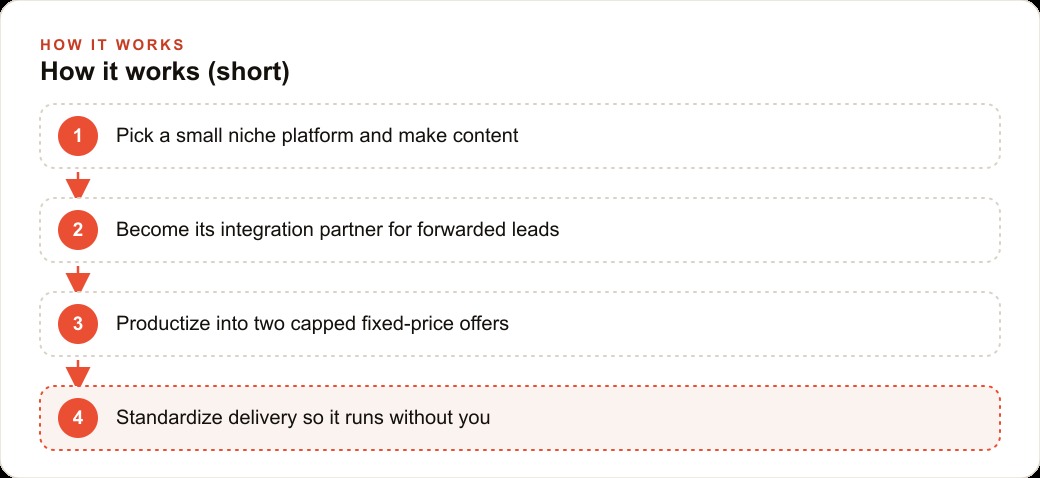
Applying the integration partner model, the owner first identifies one small niche platform in the automation space where setup genuinely requires expertise. The platform has a team of about 12 people and a growing user base of small business owners who sign up and immediately hit a wall configuring the product. The owner spends a few weeks producing content about the platform: detailed tutorials, real configuration walkthroughs, honest takes on where the product excels and where it requires workarounds.
The platform's founder sees the content and reaches out. The owner proposes the partnership: handle all integration requests, offer two fixed-price tiers (900 euros for a standard setup, 1,800 euros for a full API workflow build), give the platform 15 percent of each deal, and deliver against a documented manual so the turnaround is reliable. The platform agrees.
In the first full month of partnership, say 8 projects close. Revenue is roughly 11,600 euros. Expenses include two junior staff members at roughly 1,000 euros each for the month's delivery work, plus the platform kickback of about 1,740 euros. Margin on the month sits close to 75 percent. In month three, the platform has experienced the quality and reliability of the delivery and starts actively selling the integration packages in its own sales conversations, pushing the monthly project count to 14. Revenue approaches 20,000 euros. The owner's time is on platform relationship management and quality review, not on individual project delivery.
By month six, the owner identifies a configuration pattern that appears in 60 percent of all projects: the same three-step booking workflow with the same CRM connection every time. That pattern becomes a documented product tier with a fixed price and a fixed scope. Later it becomes a lightweight software tool. The agency funded the product development through its own margins, and the product's first customers are the platform's own users.
The consultancy that was stressed about inconsistent revenue now runs on a stable platform channel with documented delivery, strong margins, and a product roadmap funded by the work itself.
The conversation to start the partnership
The hardest part for most consultants is the first conversation with a platform. The resistance usually comes from not knowing what to offer and worrying about asking for too much. The pitch is simpler than it sounds, because it is grounded in facts the platform already knows.
Every platform with a user base knows that some fraction of those users cannot configure the product fully. They receive the support tickets and the churned subscriptions as evidence of that. The offer is: let us handle those users so your team stays on product development; in return we take a percentage and deliver consistent, reliable setup work that your customers will associate positively with your platform. The platform gains retention, reduces support load, earns revenue on work it was giving away, and gets feedback from real implementation experience. The only ask is a referral flow and an introduction when customers ask about getting set up.
That framing removes the worry about asking for too much. You are not asking for a favor. You are proposing a business arrangement that pays the platform to do something they already want to do. Walk into that conversation with that framing clear in your own head, and the platform's response becomes much easier to navigate. The ones that say no are usually too large to benefit from it, or too early-stage to have the lead volume that makes it worthwhile. Neither is a failure. It is information that helps you target the next platform with better precision. The research to find the right partner platform and the first conversation to earn the relationship are the two steps that take the most judgment, and doing them well early saves months of friction later.
That is exactly what we do at AI DOERS. Book a private 30-minute call with Madhuranjan Kumar and we will map the fastest path to it for your specific business.
Book your call →
Madhuranjan Kumar
Madhuranjan Kumar brings 20 years of performance-marketing experience and has managed over $200 million in Facebook ad spend for brands across the United States and beyond. His expertise spans the full modern marketing stack: Meta, Google Ads, TikTok, email automation, CRM, and the websites that hold it together. At AI DOERS he turns that track record into lead-generation systems for businesses across every industry.