
The Free Google AI Tools That Replace Your Design and Photo Stack
Google Labs at labs.google ships free tools like Pomelli, which crawls your website to learn your brand and generate on-brand social campaigns, plus a photo shoot feature that turns one snapshot into professional studio and lifestyle photos using Nano Banana Pro.

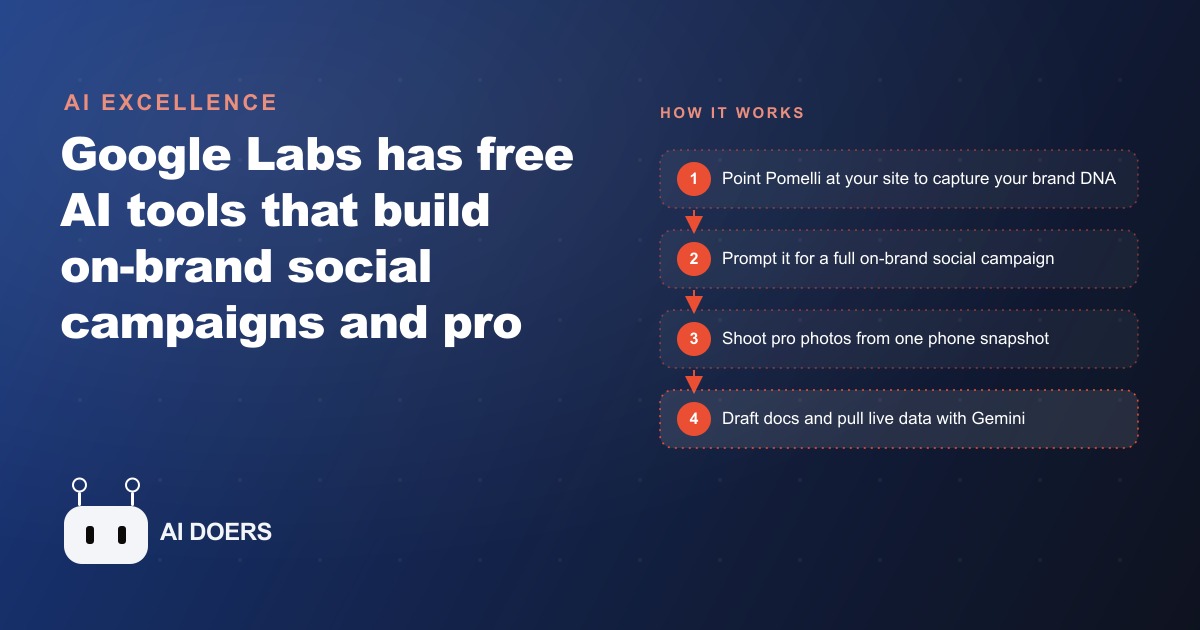
Most small businesses are paying for tools that labs.google quietly replaces for free
I am Madhuranjan Kumar, and the argument I want to make is specific: most small businesses that pay separate monthly subscriptions for a graphic design tool, a stock photo library, and a social media content tool are maintaining an expense that became unnecessary when Google started shipping free tools at labs.google. The tools are there. Most business owners do not know they exist because Google does not market them the way a startup with a paid marketing budget would.
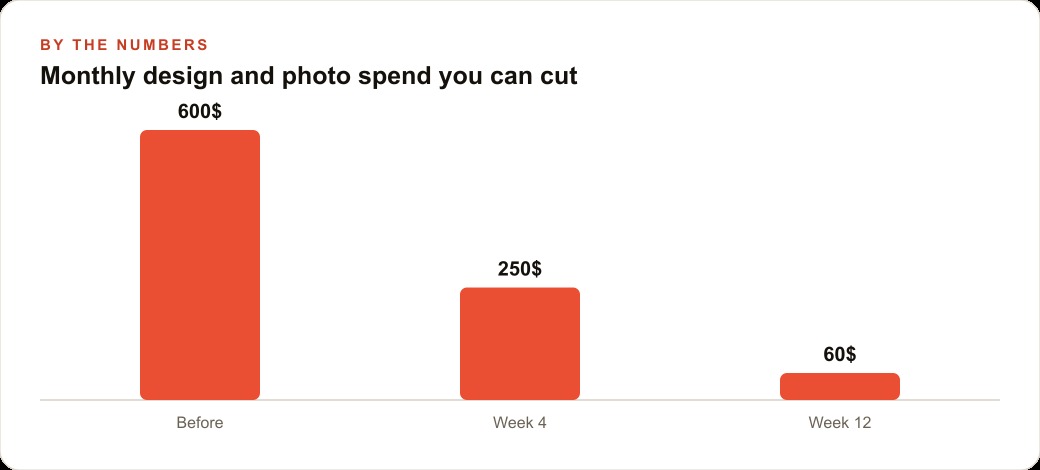
The paid-tool stack I am describing is familiar. A Canva Pro subscription at roughly $15 per month for design capabilities. A stock photo subscription, whether Adobe Stock, Shutterstock, or Getty, typically $25 to $50 per month for the smaller plans. A social media scheduling or content creation tool at $15 to $30 per month. Together, this stack costs $55 to $95 per month before any other marketing software, and it produces exactly what the labs.google stack produces, on-brand social content and usable product photography, but with a monthly invoice attached.
The tools at labs.google are not labeled clearly for business use, and they are not heavily promoted. They are labeled as experimental, which correctly describes their development status while also making business owners dismiss them as unfinished. That dismissal is increasingly wrong. Several of the tools have crossed the threshold from experiment to reliable utility, and the threshold for what counts as reliable for a small business content workflow is lower than the threshold for a Fortune 500 brand with a legal review process.
What Pomelli's brand-DNA capture actually does
The centerpiece tool is Pomelli, and its approach to the brand consistency problem is more systematic than anything in the paid alternatives at this price point. The problem it solves is one every small business with more than one person creating content eventually encounters: posts that look like they came from three different businesses because three different people made them with three different templates on three different days.
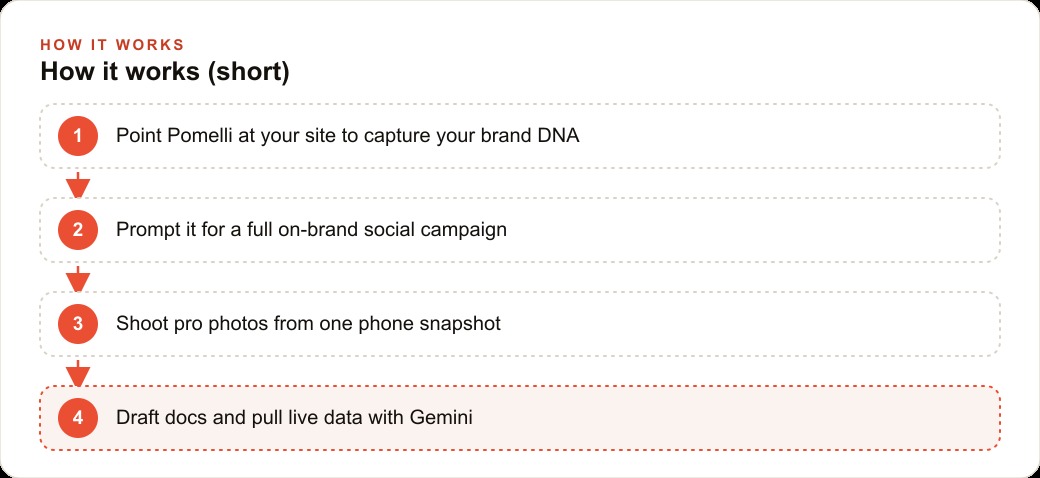
Pomelli's setup is a one-time crawl of the business website. In roughly ten seconds, it reads the site and extracts the brand's color palette, the fonts in use, the logo in its various forms, the tagline, the voice and tone visible in the copy, and the existing images on the site. This brand DNA becomes the foundation for every subsequent content generation. You do not set the color to match the website. The tool already read the website and knows the color.
From that point, generating a social campaign is a single prompted request: create five posts for an Instagram campaign about our new service, warm and professional tone, targeting first-time clients. The tool produces five on-brand posts using the business's actual colors, fonts, and logo, not templates that look like the brand if you squint. The posts use images from the website or generated images that match the visual style the site established. The edit tools, a fix-layout button and a set of manual adjustment options, let you refine any post that needs adjustment without starting over.
The consistency this produces across a month's worth of posts is the outcome that used to require either a dedicated designer or extremely disciplined template adherence from everyone creating content. The tool does the discipline work automatically after a single setup session.
The photo shoot feature and what one phone snapshot now produces
The second tool that directly challenges the paid stock photo subscription is the photo shoot feature inside Pomelli. A business owner takes a phone snapshot of a product, a service deliverable, or a physical object relevant to their business. They upload it to photo shoot, select an aspect ratio and a set of visual treatment templates, and the tool returns four versions: a clean studio shot on a white background, a floating product shot against a neutral surface, a lifestyle shot showing the product in use or in context with a person, and an in-context shot placing the product in a real setting.
The four versions take a few minutes to generate and use Google's Nano Banana Pro image model, which is the reason they look substantially more realistic than earlier AI image generation tools. The lifestyle and in-context versions in particular look convincing enough for business social posts and most web use cases because they are generated from a real source image rather than invented entirely from text.
For a business that currently pays for stock photos because they cannot afford professional product photography sessions, this tool removes the subscription cost and the generic-image problem simultaneously. Stock photos are generic because they are not of the actual product. The photo shoot output is specific because it uses the actual product as the source. The difference in marketing effectiveness between an image of a generic skincare bottle and an image of the actual product in the same lifestyle setting is the difference between content that sells something and content that fills space.
Why Google ships these tools without marketing them, and what that means
Google's approach to distributing these tools is the inverse of how a startup with investor capital would do it. A funded startup with a comparable toolkit would spend aggressively on acquisition, customer success, testimonials, and awareness campaigns. The features would be on a landing page, the landing page would have reviews, and the reviews would be on a comparison site that ranks it against Canva and Adobe.
Google ships to labs.google, adds minimal description, and moves on. The result is that the tools accumulate quietly while the businesses that would benefit from them continue paying for the alternatives. This is not a strategic oversight on Google's part. It is consistent with how Google has always treated product launches that do not fit neatly into its core revenue model. The tools exist, they are usable, and finding them requires actively visiting labs.google rather than responding to a marketing campaign.
The business implication of this distribution approach is that early adopters get a window of competitive advantage simply because they looked. A small business owner who discovers Pomelli this week, sets up the brand DNA, and generates a month's worth of on-brand content in a single two-hour session is operating with a workflow that their competitors using Canva Pro templates or paying a freelancer for content are not aware of yet. That window closes as the tools get wider coverage, but the businesses that build the habit early develop the efficiency and the content quality standard that becomes their baseline.
The business types where switching is obvious and the ones where it is not
The switch from a paid tool stack to the Google Labs stack is most obviously correct for three business types. Solo practitioners and small service businesses with one or two people managing their own marketing, who need consistent visual content but cannot justify a design team. Product-based businesses with a physical product to photograph that have been relying on stock photos or infrequent professional shoots. Businesses that already run their operations inside Google Workspace, where the Gemini integration inside Docs and Sheets extends the free stack into document drafting and data analysis without any new logins.
The switch is less obvious for businesses with very specific brand standards that require pixel-level control over every output. A business with a brand style guide enforced by a creative director and legal review of every piece of content will hit the limitations of AI-generated outputs in ways a small business operating on good judgment and a style reference will not. For those businesses, the comparison is between a free tool that produces good output and a professional creative team that produces exactly right output. The professional team wins.
For the vast majority of small businesses that are currently choosing between inconsistent DIY content and expensive professional content, the Google Labs stack represents a third option that produces consistent, on-brand output at zero cost. Knowing the option exists is the only requirement for taking advantage of it. Most businesses do not know. That gap is the opportunity for the ones who do.
The specific workflow recommendation: visit labs.google this week, open Pomelli, and spend 20 minutes doing the brand setup. Generate one campaign from a prompt that names the audience and the tone. Then test the photo shoot feature with one real product or service photo. The two tests together are enough to evaluate whether the stack replaces the paid tools for your specific use case. The evaluation costs nothing, and the answer is usually clear within the first session.
The pattern of quiet deployment that Google has used before
Google's approach to releasing significant tools without significant marketing campaigns is not a new behavior. The pattern appears repeatedly in Google's history: a capability that would warrant a major product launch from a smaller company gets added to Google's tool ecosystem with a blog post and a documentation update. The tool becomes widely used among practitioners before the general business audience has heard of it.
The reason Google does not market these releases the way a startup would is partly structural and partly strategic. Structurally, Google's marketing apparatus is oriented toward consumer products and enterprise contracts, not toward reaching small business practitioners through the channels where those practitioners actually learn about new tools. Strategically, releasing tools without loud marketing allows Google to observe real usage patterns before committing to them as official products with official support obligations.
The implication for a practitioner is that Google's tool releases are better tracked through developer and practitioner channels than through general tech news. The tools that have been quietly available for six to twelve months before they receive mainstream coverage are the ones with the most favorable learning-curve-to-competition ratio: they are stable enough to build real workflows around but unknown enough that early adopters still have an informational advantage.
What Pomelli's brand-DNA capture means for a business without a design team
The brand DNA capture feature in the tools discussed in the source video addresses a specific and common problem for small businesses: the inability to maintain visual brand consistency across all the content they produce. A small business with a defined visual brand, a specific color palette, a logo treatment, and a characteristic type style, typically maintains that consistency only in the materials produced by the person or agency that originally designed the brand. Everything produced outside that controlled environment drifts.
An AI tool that can extract the visual patterns from a set of existing brand-consistent images and apply those patterns to new image generation is solving a problem that has previously required either a brand manual that most businesses do not have, a designer who knows the brand on every content project, or careful manual review of every piece of content for brand adherence.
The practical application for a small business is not the generation of new brand assets, which is a limited use case. It is the maintenance of brand consistency across the operational content the business produces daily: social posts, email headers, promotional graphics, event announcements. This is the category of content that most consistently drifts from brand standards because it is produced under time pressure by people who are not designers.
How to evaluate which existing tools the free Google alternatives actually replace
Not every tool in a small business's software stack is replaceable by a free Google alternative, even when the Google alternative offers comparable core functionality. The evaluation should be based on three factors: where the data for this tool lives and whether it can move, which other tools in the stack depend on this tool's specific output format, and what the organization's tolerance is for rebuilding institutional knowledge about how to use a tool.
The data location factor is often the decisive one. A business that has 18 months of customer correspondence in a specific CRM will not replace that CRM with a free alternative even if the alternative has better AI features, because the switching cost is not just the subscription price but the migration cost for 18 months of irreplaceable customer data.
The integration dependency factor matters in a different way. A tool that is central to a workflow stack, that other tools feed into and pull from, carries an integration cost when replaced that is proportional to the number of connected tools. A tool that stands alone, producing output that a human reviews and acts on without automated handoff to another system, can be replaced with lower switching cost.
The institutional knowledge factor is the most underestimated of the three. Every tool an organization uses has accumulated workarounds, configurations, and tribal knowledge about how to get reliable output from it. Replacing the tool resets this knowledge. The reset cost is not the time to learn the new tool. It is the time to rebuild the knowledge about the specific failure modes of the new tool that the organization previously accumulated through painful experience.
The Google tools that make the clearest replacement case are the ones used for single-session tasks with no data dependency and no integration dependency: one-off image editing, occasional research synthesis, ad hoc document translation. These tasks have low switching cost because each session is independent and the institutional knowledge about the tool is minimal. The tools that should be evaluated more carefully are the ones embedded in daily workflows where the switching cost exceeds the subscription cost savings.
That is exactly what we do at AI DOERS. Book a private 30-minute call with Madhuranjan Kumar and we will map the fastest path to it for your specific business.
Book your call →
Madhuranjan Kumar
Madhuranjan Kumar brings 20 years of performance-marketing experience and has managed over $200 million in Facebook ad spend for brands across the United States and beyond. His expertise spans the full modern marketing stack: Meta, Google Ads, TikTok, email automation, CRM, and the websites that hold it together. At AI DOERS he turns that track record into lead-generation systems for businesses across every industry.