
The Easiest SaaS to Start in 2026 Is a Single Skill File
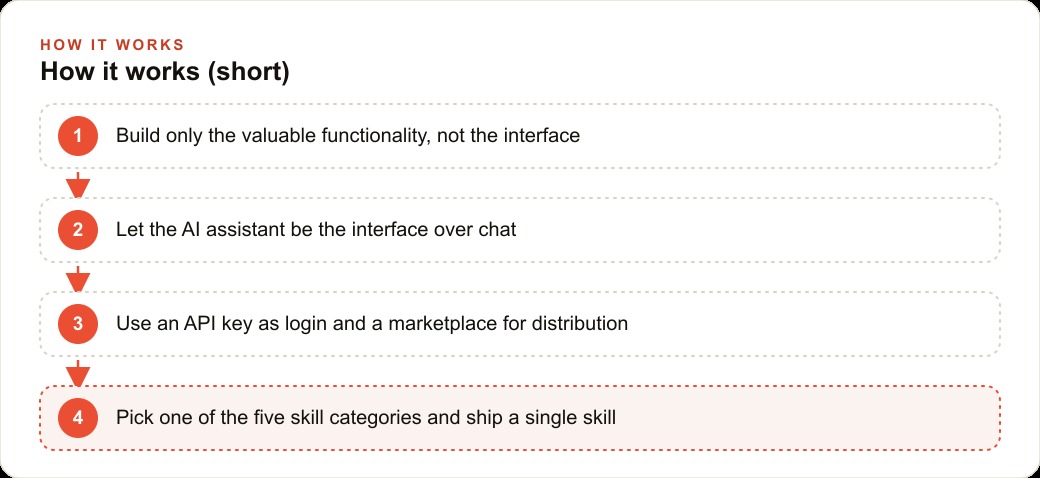
The easiest software business to start in 2026 is a skill-based service for AI assistants: you build only the core functionality, let the assistant be the interface, use an API key as login, and let a marketplace handle distribution.

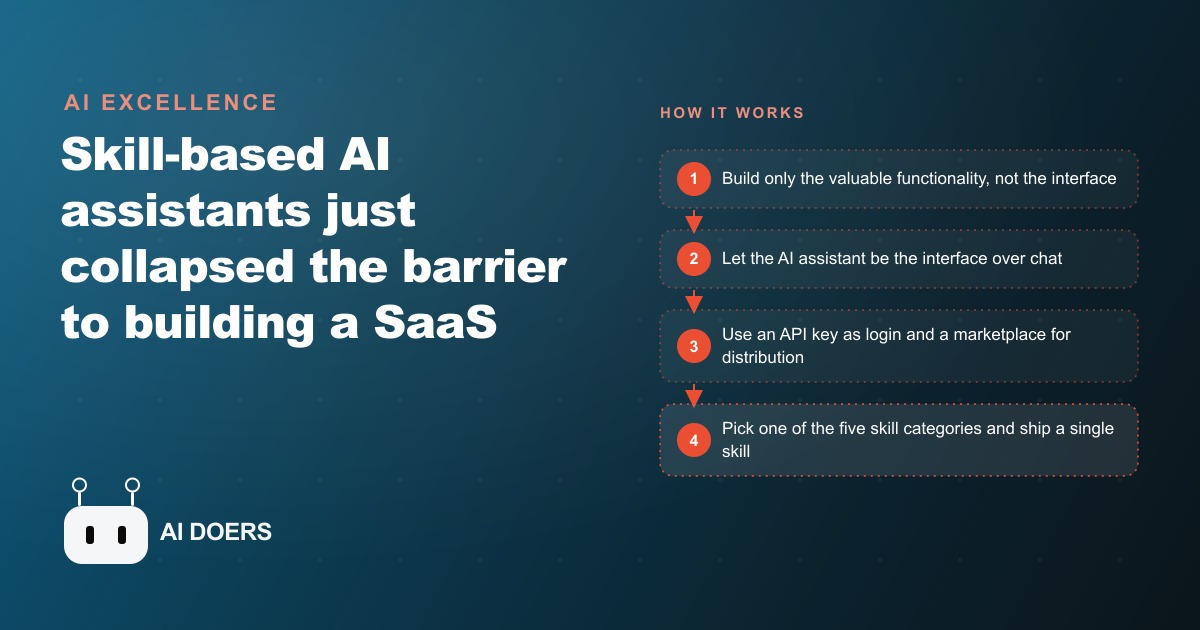
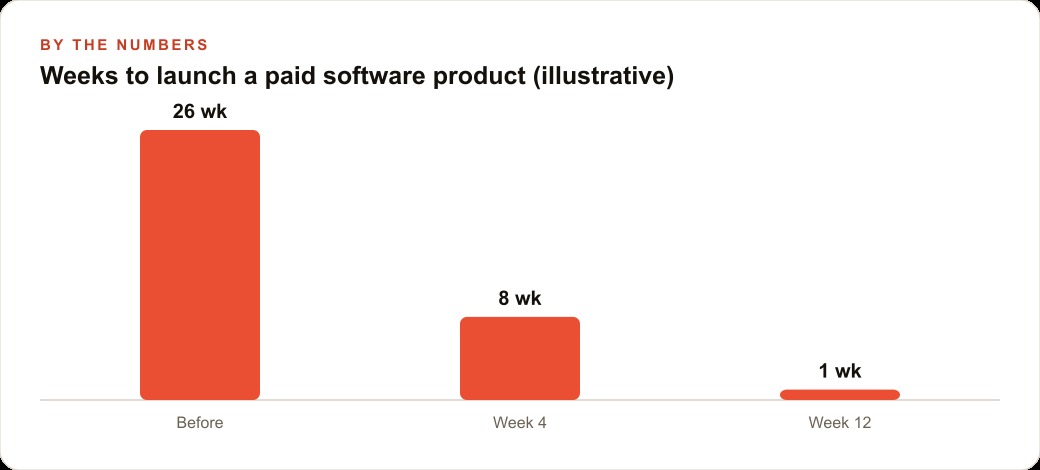
A software business model that used to require six months and somewhere between $50,000 and $200,000 in development cost just collapsed to a single instruction file and one week of work. That is not a gradual improvement. That is a structural discontinuity, and the businesses and creators who recognize it early will build recurring revenue positions that are difficult to replicate once the category is established.
I am Madhuranjan Kumar. What I want to do in this piece is explain exactly what changed, what the five distinct categories of this new model look like, where the real moat is, and what the honest risk is that most of the enthusiastic coverage of this space is not telling you.
The dashboard, the login system, and the distribution layer just became someone else's problem
The traditional software business required you to build three expensive things before you could charge your first customer a single dollar. You needed a product, which required development time and technical talent. You needed a way for customers to authenticate and manage their accounts, which required a login system, a user database, session management, and security infrastructure. And you needed a distribution channel, a way for potential customers to find your product and evaluate it, which required either significant marketing investment or time building an audience.
Those three requirements did not just add cost. They rationed who could even attempt to build a software business. If you did not have technical co-founders, a developer network, or enough capital to hire both a technical team and a go-to-market function, the model was not available to you regardless of how good your underlying idea was.
Skills change each of those three requirements fundamentally. A skill is a small instruction file that teaches an AI assistant a new capability. The AI assistant handles the interface: the user accesses the capability through WhatsApp, through Telegram, through whatever messaging platform the assistant lives in. The user does not need to create an account on your platform because they already have an account on the platform they are using. The authentication layer is handled by the messaging platform. The interface is handled by the messaging platform. The distribution, the fact that billions of people already have these platforms installed and use them daily, is someone else's infrastructure.
What you provide is the instruction file: the expertise, the logic, the proprietary data, the workflow that makes the assistant more capable in a specific domain. The marketplace, if there is one, handles the commercial relationship. Your job is to build the thing that makes the assistant more useful in a specific context. Everything else has been abstracted away.
The login system is someone else's problem. The dashboard is someone else's problem. The distribution layer, at least the initial distribution, is someone else's problem. You provide one thing: the capability.
Five distinct categories of skill product with completely different moats and pricing ceilings
Not all skills are equal as business propositions. The five categories I am going to describe exist on a spectrum from "easy to copy, low price ceiling" to "difficult to replicate, strong recurring revenue." Understanding which category you are building in determines whether you are building a real business or an interesting experiment.
Category one is the pure prompt skill. This is a text file containing expert instructions, a persona, a workflow, a communication style, a framework for thinking about a problem. It teaches the AI assistant how to behave in a specific way. Pure prompt skills can be sold as one-time purchases, typically in the $10 to $50 range. The moat is near zero. Anyone can read the instructions once and replicate them. The only sustainable advantage comes from being first and building a reputation, which is a marketing advantage, not a product advantage. Treat category one as a way to validate an audience and a topic, not as the foundation of a durable business.
Category two is the utility skill. This is a wrapped script that the skill calls to perform a specific task: formatting data, converting between formats, performing a calculation, fetching publicly available information through an API. You maintain it when it breaks. The skill is the interface. Utility skills can command monthly subscription pricing in the $5 to $15 range because the user is paying for the ongoing maintenance and reliability, not just the initial setup. The moat is moderate: someone could build an equivalent, but they would need to maintain it, and switching costs create some stickiness.
Category three is the API bridge. This skill connects the AI assistant to a tool the user already uses and already finds valuable, making that tool accessible through natural language. A skill that lets users query their Notion workspace, update their CRM from a chat message, or post to their social platforms through a conversation with an assistant. These can be priced from $20 to $100 as one-time purchases, or at a lower monthly rate for ongoing access. The moat comes from the quality of the integration and the specificity of the use case you address.
Category four is the skill as SaaS. The skill calls your own server. Your server runs your own application logic, your own proprietary algorithms, your own processing. The skill is the interface to your software. This means you can charge software pricing: $9 to $50 per user per month, depending on the value the underlying application delivers. The moat is as strong as your underlying application logic. If your server is doing something that takes real expertise to build and is genuinely useful to a specific audience, this is a real software business with recurring revenue.
Category five is the proprietary data skill. The skill calls a vector database that contains information no one else has. Your own research, your own client work product, your own curated dataset, your own compiled expertise. The user is paying for access to data, not just to a capability. This category commands the highest prices, from $19 to $200 per month depending on how specialized and valuable the data is, and has the strongest moat because the data cannot be replicated without the underlying work. Category five is where the skill model intersects with the traditional data business model, and it is where the most durable recurring revenue is built.
The defensibility test every skill builder should run before writing a line of code
Before you spend any time building a skill, answer three questions honestly. The answers determine which category you are actually building in and whether the business proposition is strong enough to justify the investment.
First: if someone reads my skill's instructions once, can they replicate what it does without me? If the answer is yes, you are in category one. The business will be easy to enter and easy to exit. Price accordingly and manage your expectations.
Second: does what I am building require ongoing maintenance, a connection to external services I manage, or proprietary data I have that others do not? If yes to any of those, you have the foundation for categories two through five. The specific category depends on what the ongoing requirement is and how difficult it is to replicate.
Third: is there a specific audience who has a recurring need for what I am building, and is that audience willing to pay monthly to have the need served reliably? If the answer to this question is uncertain, the right move is to validate it with a small number of real users before building the infrastructure for recurring billing.
The defensibility test is not designed to discourage category one and two skills. They have their place, particularly for validating that a topic has an audience and generating the early revenue that funds building toward category four or five. The test is designed to make sure you know which game you are playing before you invest in building it.
The mistake most skill builders make is building a category one skill and pricing it like a category four. The user pays once, reads the instructions, understands them, and implements the same behavior themselves. The business does not recur. Defensibility must come from the underlying category, not from the pricing structure you place on top of a category one product.
The revenue math that makes categories four and five worth pursuing over category one
One hundred customers paying $19 per month generates $1,900 in monthly recurring revenue. At $49 per month, 100 customers generates $4,900 per month. These numbers are not aspirational; they are illustrations of what category four and five skills can generate at a scale that is achievable for a solo operator without a marketing team.
The customer acquisition math for a skill is different from traditional SaaS because the distribution layer is partially handled by the platform. A skill listed in a marketplace, or recommended by users to each other in communities where the platform is used, has inherent discovery mechanics that pure SaaS products do not. The cost of acquiring the first hundred customers through organic recommendation and marketplace visibility is lower than the equivalent cost for a standalone product that requires users to find a new website, evaluate it, and sign up for a new account.
The comparison point for most skills is not other software businesses. It is freelance income from equivalent expertise. If you have specialized knowledge that you currently monetize through consulting, coaching, or service work, a category four skill that encodes that knowledge and delivers it at scale through a subscription model is an alternative to trading time for money. One hundred clients at $19/month, served through an automated system, is a different business model than one hundred consulting calls, even if the underlying expertise is identical.
The operating cost for a category four skill is a server, an API key from the skill platform, and the time you spend maintaining the application logic. For many category four skills, the monthly infrastructure cost runs under $50. The margin at 100 subscribers paying $19/month is substantial. At 500 subscribers, the economics of a single-person software business become visible.
Category five adds the cost of maintaining and expanding the proprietary data, which varies significantly depending on the source. If the data comes from your own ongoing work, the cost is your time. If the data requires licensing or curation from external sources, that changes the margin profile. The pricing premium for category five reflects the data moat, not just the software, and the pricing ceiling is correspondingly higher.
How a fitness coach built a $1,900/month recurring product without a development team
Consider a fitness coach who had been working with clients through one-on-one video calls and an email newsletter. The knowledge, the training methodology, the nutrition frameworks, the progression logic for different client profiles, was all in their head and in a Google Drive folder of templates accumulated over years. The clients who had direct access to that knowledge got results. The constraint was the coach's time: every client required weekly calls, program updates, and ongoing check-ins.
The category four skill they built encoded the core methodology into a server application. Clients message through WhatsApp, the platform they were already using daily. The server receives the message, runs it through the program logic, and generates a personalized response based on the client's current program, their recent check-in data, and the coach's methodology. The weekly program update is automated. The nutrition framework is accessible through a conversation. The progression logic runs automatically based on the client's reported outputs.
The coach remains available for the high-stakes decisions, the moments when a client's situation requires judgment that the automated system is not equipped to handle. But the volume of routine program management, the check-ins, the standard adjustments, the common questions, runs through the skill without requiring calendar time.
One hundred clients at $19 per month generates $1,900 per month recurring. The coach's calendar is no longer the constraint. The underlying methodology is the product. Scaling from 100 clients to 200 clients requires no additional time from the coach; it requires better marketing for the skill and adequate server capacity to handle the load.
This is a real business. Not a replacement for the coach's existing practice, but a parallel revenue stream that scales differently. The one-on-one relationships remain for clients who want them. The skill serves clients who want access to the methodology at a lower price point, which is a market the coach was previously unable to serve because they could not be in one hundred places at once.
The honest risk the tutorials about this space are not telling you
The enthusiastic coverage of skill-based SaaS as a business model consistently underweights one risk that I want to be direct about: this is a new space built on platforms that the big AI labs control, and the big AI labs are explicitly building their own competing products.
OpenAI is building agentic features into its own products. Anthropic is building Claude directly into developer workflows. Google is expanding what its assistant can do natively. Every capability that a third-party skill provides is a capability that the platform provider could choose to absorb into the core product. The history of platform-dependent businesses is a history of platform providers eventually competing with their best third-party developers.
This is not a reason to avoid building skills. It is a reason to structure your position honestly. Category four and five skills, where the value is in your application logic or your proprietary data rather than in the skill interface itself, are less exposed to this risk because the platform cannot easily replicate what you have built. Category one and two skills, where the value is in the instructions rather than in infrastructure you control, are more exposed.
The honest framing for this business model, which the tutorials are not providing, is: treat it as an exciting opportunity to build recurring revenue in a new distribution channel, and treat it as one revenue stream among several rather than as the entire foundation of your business. A category four or five skill generating $1,900 per month alongside your existing work is a strong outcome. Burning your existing client base and revenue to go all-in on a platform-dependent model in a space that is still being defined by the platform providers is a risk profile that does not match the opportunity.
Build in the space. Generate real recurring revenue. Monitor what the platform providers announce. Keep your underlying expertise and your direct relationships with your audience as assets that exist independent of the platform. That is the position from which you can take advantage of this opportunity without becoming dependent on it.
That is exactly what we do at AI DOERS. Book a private 30-minute call with Madhuranjan Kumar and we will map the fastest path to it for your specific business.
Book your call →
Madhuranjan Kumar
Madhuranjan Kumar brings 20 years of performance-marketing experience and has managed over $200 million in Facebook ad spend for brands across the United States and beyond. His expertise spans the full modern marketing stack: Meta, Google Ads, TikTok, email automation, CRM, and the websites that hold it together. At AI DOERS he turns that track record into lead-generation systems for businesses across every industry.