
The Best Upcoming Jobs for 2026 to 2030, and How to Actually Land One
The World Economic Forum projects frontline, care, and technology roles to grow most through 2030, with AI, fintech, and green-energy specialists rising fastest by percentage. The real edge is to stack a growing role on a macro trend and use a soft commit model of self-study plus freelancing before betting on a degree.

Here is a position most career advice will not tell you: chasing the hottest job title on the 2026 to 2030 growth lists is the wrong move, and the biggest safe bet of the last generation, get a degree and the job follows, is now the riskiest thing you can do. I am Madhuranjan Kumar, and I will argue that plainly, because the data backs it and the usual advice does not. The growth lists are real and useful, but they are a map, not a destination. Read them the way most people do, as a ranking of titles to pursue, and you will bet years and money on hope. Read them the way I will lay out here, as raw material for a method, and you tilt the odds hard in your favor.
The lists are two different stories, and picking the wrong one is the first mistake
Start with what the data actually says, because my argument depends on reading it correctly. There are two lists, and they tell two different stories. The first is the largest growing jobs by volume, drawn from the World Economic Forum and checked against labor statistics. Here the frontline leads in sheer numbers: farm and agricultural workers at the top, then light truck and delivery drivers, construction workers, salespeople, and food processing workers. Care and education climb too, including nursing professionals, social work and counseling roles, personal care aides, and teachers.
The second list is the fastest growing jobs by percentage, and technology dominates it: big data specialists, fintech engineers, AI and machine learning specialists, software developers, and security management specialists. Green roles surge alongside them, including electric and autonomous vehicle specialists, environmental engineers, and renewable energy engineers. The common error is to glance at the percentage list, see a shiny tech title, and chase it without noticing that fastest-growing by percentage can still mean a small absolute number of jobs, while a boring-sounding frontline role can mean far more actual openings. Picking a list without understanding which kind of growth you are betting on is the first place people go wrong, and it is why the naive reading of these rankings fails.
The real edge is stacking a role on a trend, not chasing a title
Now the core of my argument. The edge does not come from the job title. It comes from stacking a growing role on top of the larger force pushing it upward. Five macro trends are reshaping the labor market: rapid technological change led by AI, the green transition, geo-economic fragmentation, broad economic uncertainty, and demographic shifts such as aging populations. When you place one of the largest or fastest growing roles on top of one of these trends, you compound your leverage, because you are riding a tide rather than fighting it.
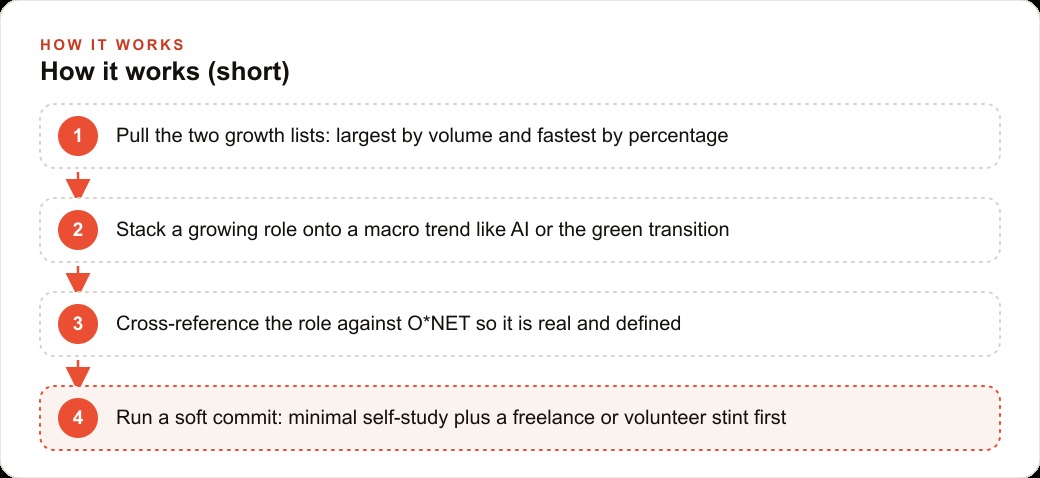
This is why chasing a title in isolation is a weak strategy. A role that appears on a growth list but is not connected to a durable trend can fade. A role that sits on the intersection of a growth list and a macro trend has structural wind behind it for a decade. The discipline that keeps this honest is cross-referencing every candidate role against the O*NET list, so you are targeting a real, defined occupation and not a buzzword you saw in a headline. Method beats title every time, and the method is: read both lists, tie a role to a trend, verify it is a real occupation, and only then commit.
The degree is no longer the safe default, and pretending otherwise is expensive
This is the part of my position that makes people uncomfortable, so let me put the evidence on the table. A degree alone no longer guarantees a job. Even Harvard MBA graduates face a 23 percent youth unemployment rate, and recent graduates average 12.6 percent. Credentials that used to function as a near-automatic ticket now clear the bar in some fields and fall flat in others. Treating a degree as the safe default, the thing you do first and figure out the rest later, is exactly the high-cost, low-certainty bet that the old advice still pushes.
I am not arguing that education is worthless. In many fields it remains necessary. I am arguing that necessary is not the same as sufficient, and that betting years of your life and a pile of money on the assumption that a credential equals a career is a worse bet than it has ever been. The safe-looking path is now the risky one, because it front-loads the cost and back-loads the proof. The smarter sequence flips that around, and that is the next part of the argument.
Soft commit: prove the fit before you bet the years
If you should not lock into a degree on hope, what do you do instead? You soft commit. Build a minimal self-study plan, with AI acting as a patient tutor, then volunteer, freelance, or intern in the field before you commit anything expensive. The logic is simple and it is the opposite of the usual order. Instead of paying up front and hoping the work suits you, you taste the work cheaply first and let the evidence tell you whether to go all in.
There is one more piece the raw growth lists leave out, and it is decisive: the best objective role still has to fit you. Define your dream-job traits before you chase anything, whether that is remote, flexible, well paid, or room to grow, then filter the growth lists down to roles that match how you actually want to live. A role can be booming and still be wrong for you. For some people, the honest answer to those traits is not a job on either list at all but a digital lifestyle business, which AI has made reachable with a few hundred dollars and no coding, though it is non-linear and can take years to pay off. The point of soft committing is that you find out which of these fits before it costs you, not after.
Worked example: an electrician business aims at the growth instead of guessing
Let me argue this with a concrete case, using illustrative numbers. Take an electrical contracting business, because the trades prove my point neatly: they sit on the large-volume list and they ride two macro trends at once, the green transition and rapid electrification. So the smart move is not just to keep doing generic electrical work. It is to aim the company at the slice of electrical work the next five years will pull upward.
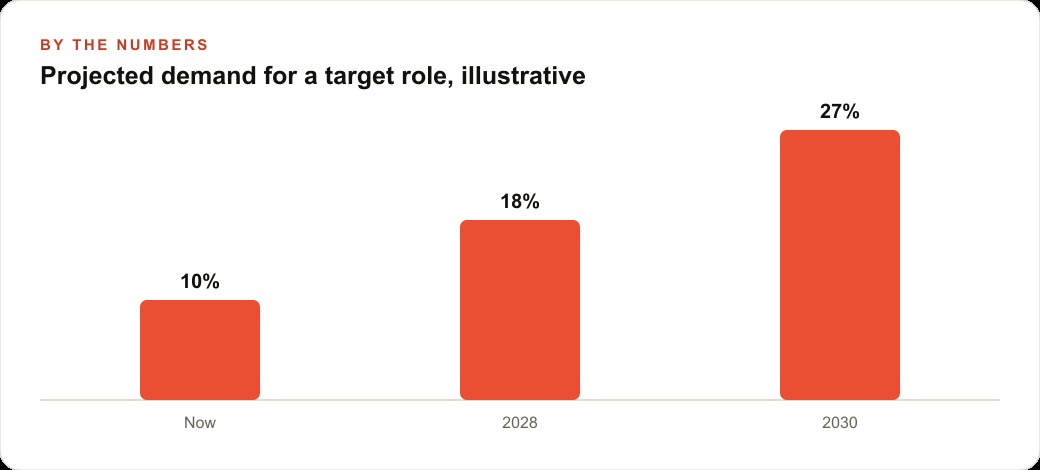
I would point the business at electric vehicle charger installation, residential battery and solar tie-ins, and panel upgrades for electrified homes, because every one of those stacks the electrician role on the green-energy wave. For hiring, I would run the soft commit model in reverse. Instead of paying to fully credential an apprentice on hope, I would build a minimal self-study and on-site training plan, let them run real installs alongside a journeyman first, and confirm the fit before funding a full certification. To make sure the demand is real and not a guess, I would cross-reference the exact roles, like solar installer and EV infrastructure technician, against O*NET so the business staffs toward verified, growing occupations. On the numbers, projected demand for a well-chosen target role might sit near 10 percent today, climb toward 18 percent by 2028, and reach roughly 27 percent by 2030, a rising line the company can hire against with confidence. The demand the business generates also has to be captured, so I would make sure the new-service inquiries land in the CRM and website stack and that the Facebook and Instagram ad campaigns and Google Ads point at EV and solar work rather than generic electrical. The company keeps doing electrical work. The difference is that it is aimed at the part of the trade the next decade is lifting.
The counterargument, and why it does not hold
A fair reader will push back here, so let me take the strongest counterargument head on. Someone will say: the safe path worked for generations, a degree opened doors, and abandoning it for freelancing and self-study is reckless advice that leaves people without credentials in a credential-driven world. I understand the worry, and I am not telling anyone to skip education. I am telling them to change the order and the certainty of the bet.
The old model asked you to pay first and prove fit later. You committed years and money to a credential on the assumption that a job would follow, and for a long time that assumption mostly held. It holds far less reliably now, which is the entire point of the unemployment figures. When even Harvard MBA graduates face a 23 percent youth unemployment rate and recent graduates average 12.6 percent, the credential is no longer doing the heavy lifting people assume it does. Betting big up front on a weakening guarantee is not the safe choice anymore, even though it still feels like one, and feelings are exactly what the old advice trades on.
The soft commit model does not reject credentials. It re-sequences the bet so evidence comes before the expensive commitment. You build a minimal self-study plan, use AI as a tutor to learn the fundamentals cheaply, then freelance, volunteer, or intern to taste the actual work. If the field fits and the demand is real, you then commit to whatever credential the role genuinely requires, now with proof instead of hope behind the decision. That is not reckless. It is the opposite. It is refusing to make an irreversible, expensive bet until you have cheap, reversible evidence that it is the right one. The reckless move, in a market where credentials no longer guarantee outcomes, is to keep front-loading the cost and hoping. My position is simply that hope is a bad input and evidence is a good one, and the soft commit model swaps one for the other.
There is a second, subtler counterargument: that all this analysis is overkill and people should just pick something they like and work hard. Working hard matters, but working hard in a shrinking role or a field that does not fit your life is how people burn years. The two growth lists, the macro trends, and the O*NET check exist precisely so your hard work lands on ground that is rising rather than sinking. Effort aimed at the wrong target is not a virtue, it is waste, and a few hours of honest analysis up front is cheap insurance against years of it.
The move to make this week
If you accept the argument, the action is straightforward and it starts with you, not the list. Write down your dream-job traits first, because the best objective role still has to fit how you want to live. Then pull both growth lists, the largest by volume and the fastest by percentage, and filter them to roles that match your traits. Stack each surviving candidate onto a macro trend, cross-reference it against O*NET to confirm it is a real occupation, and pick the one with the strongest wind behind it. Finally, soft commit: a minimal self-study plan with AI as your tutor, then a freelance, volunteer, or internship stint to taste the work before you fund a degree or bet years. Do it in that order and you replace hope with evidence.
Strip everything down and my position is one sentence: bet on a method, not a title, and buy evidence before you buy a credential. The growth lists tell you where the wind is blowing. The macro trends tell you why it will keep blowing. The O*NET check keeps you honest about what is real. Your own dream-job traits keep you honest about what fits your life. And the soft commit model makes sure you never sink years into a guess. That sequence is the whole edge, and it costs a few honest hours rather than a few borrowed years. In a decade where a Harvard credential no longer clears the bar on its own, the person who runs that sequence quietly outperforms the person who chased a shiny title on hope.
You can absolutely run this analysis yourself, and I would start this week by writing your dream-job traits and pulling the two lists. If you would rather have someone map your specific situation, stack the right role onto a trend, and build the soft-commit plan so your first move is the correct one, that is exactly the kind of positioning work I do, and you can bring me in to handle it.
That is exactly what we do at AI DOERS. Book a private 30-minute call with Madhuranjan Kumar and we will map the fastest path to it for your specific business.
Book your call →
Madhuranjan Kumar
Madhuranjan Kumar brings 20 years of performance-marketing experience and has managed over $200 million in Facebook ad spend for brands across the United States and beyond. His expertise spans the full modern marketing stack: Meta, Google Ads, TikTok, email automation, CRM, and the websites that hold it together. At AI DOERS he turns that track record into lead-generation systems for businesses across every industry.