
The Beginner Playbook for Building a $10K-a-Month App With AI
Spot a viral idea inside a niche you already know, time your build to a major model release, make your landing page state the value in one sentence, and market organically, then reach 10,000 dollars a month before worrying about competition.
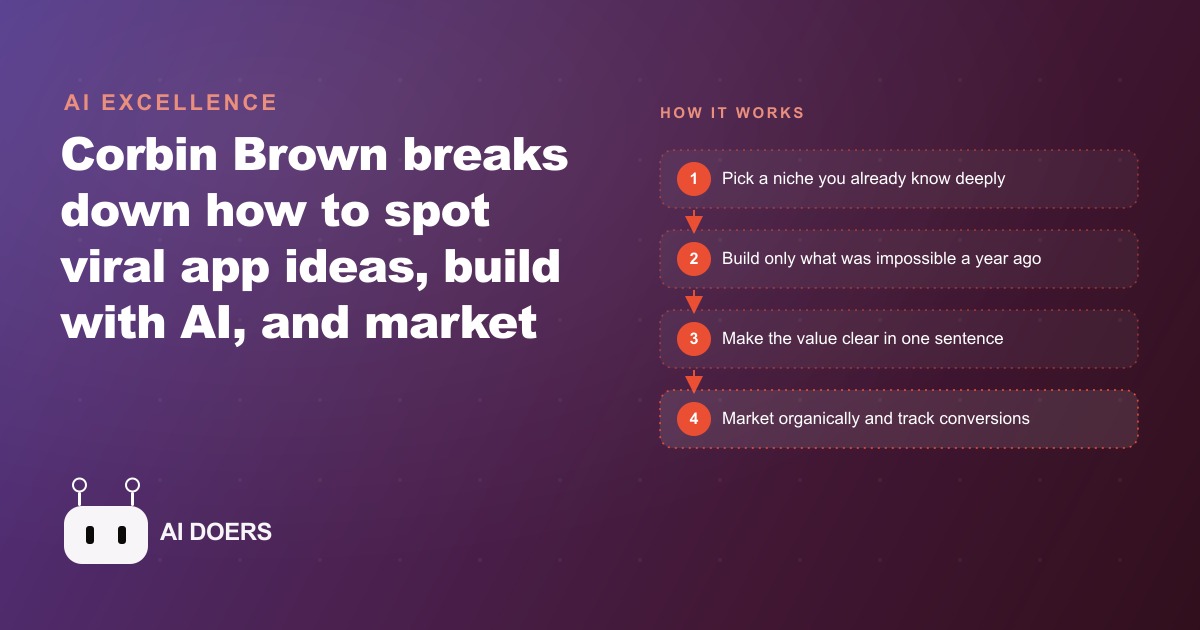
Ten thousand dollars a month from a piece of software you built yourself, in a niche you already understand, is no longer a fantasy reserved for engineers. I am Madhuranjan Kumar, and this is a practical playbook for getting there. The premise is blunt: you can build a real application by describing what you want in plain language, and the old line that AI written code is trash is simply out of date. What actually changed is that you can now point several AI agents at different parts of a product at once, so work that took a junior developer two weeks can finish in roughly two hours. Here is the path, stage by stage.
Stage 1: Mine your unfair advantage before you write a line of code
The biggest mistake beginners make is chasing a trendy idea they do not understand. The playbook does the opposite. You build into the niche where you already have years of lived experience, because that knowledge is the one thing a generalist cannot copy quickly. If you have spent three years making YouTube thumbnails, you know exactly which thumbnails get clicks and where the people who need them hang out. If you have run a salon for a decade, you know precisely how clients agonize over a new look and how many no shows wreck a day.
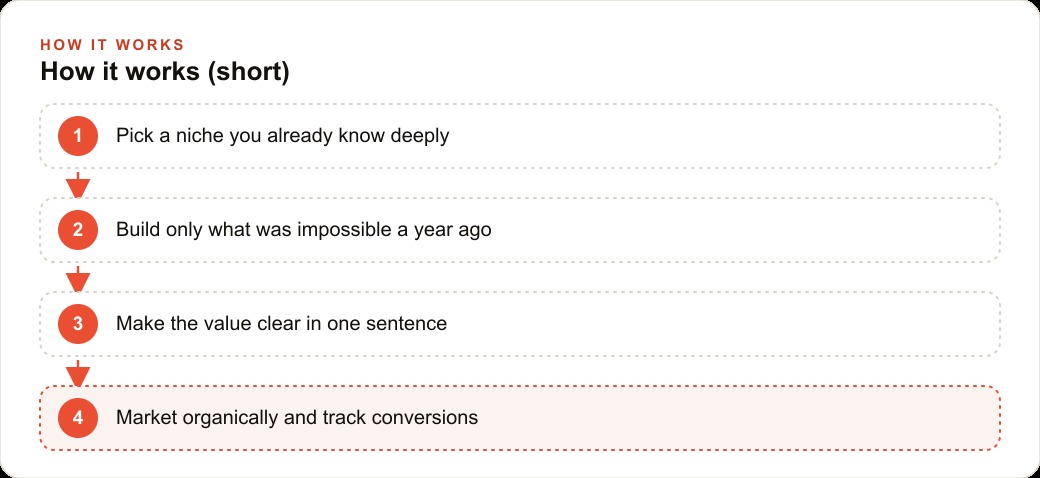
Write down the single most repetitive, painful task your customers or your own team face. Not ten tasks. One. That one task, the thing everyone in your world quietly hates doing, is your product. This stage takes an afternoon with a notebook, and it is the most important afternoon in the whole playbook. The information edge you carry into it is your real moat, because a competitor can copy your interface but not your years of judgment about what actually matters.
Stage 2: Niche down until the market feels almost too small
As a solo founder or a tiny team, you do not build the next giant social network. You solve one very specific problem for one very specific group of people. When beginners hear this they worry the market is too small. That worry is backwards. A narrow niche makes finding users easy, because you know exactly who they are and where they gather, and it makes your product obviously the right choice for that group instead of a vague option for everyone.
The thumbnail tool in the source was not a general design app. It was for one job, thumbnails, for one audience, creators. That focus is why the founder could talk directly to the exact people who needed it. Narrow the target until you can describe your ideal user in one sentence. If you cannot, you have not niched down hard enough yet.
Stage 3: Time the build to a fresh capability with the one year test
Timing is the quiet lever most people ignore. When a model leaps forward, it opens a fresh plane of use cases that were flat out impossible a month earlier, and for a short window very few people are building on it. That window is where the opening lives.
Apply one simple test to your idea before you commit to it. Could you have built this exact thing a year ago. If the answer is yes, pivot, because the opening is already crowded and gone. If it only became possible in the last month, because of a new image model or a new capability, you may have found the real window. This test protects you from pouring months into an idea that a hundred other people could have shipped last year. It forces you toward the fertile ground where a new model just changed what is possible and the market has not caught up.
Stage 4: Build the first version with parallel agents
Here is where the recent shift does the heavy lifting. Instead of building your product one screen at a time, you point several AI agents at different parts of it at once. One agent works on the homepage, another on signup, another on authentication, all in parallel. The task that used to take a junior developer two weeks compresses into roughly two hours of directed work.
You do not need a traditional coding background to do this, but you do need to be clear. Describe each part of the product in plain, specific language, review what comes back, and correct it in small loops. The goal at this stage is not a perfect product. It is a working first version you can put in front of real people. Ship it even if it splutters. A live, rough tool teaches you more in a week than another month of polishing in private ever will.
Stage 5: Make the value obvious in one sentence
When a visitor lands on your page, they must understand exactly what they get in the first moment, or they leave. Confusion kills conversions. The example page said make thumbnails, get clicks, with no jargon and no ambiguity. That is the bar. Your landing page should state the outcome, not the mechanism, in a single plain sentence a distracted person grasps at a glance.
This is where your marketing instinct matters more than your code. The clearer your promise, the more of your Facebook and Instagram ad campaigns traffic actually converts, because people who click already know what they are getting instead of bouncing in confusion. Strip every clever tagline that makes someone stop and think. Clever is the enemy of clear here.
Stage 6: Learn your clicks to conversion number and remove every roadblock
Every product has a number: how many clicks or steps a typical user takes before they pay. In the source, the founder knew a user converted after about ten clicks on the platform, measured with analytics and pixels. Once you know your own number, every product decision becomes simple. You are hunting for and deleting the roadblocks between landing and paying.
Set up basic tracking so you can see where people drop off. Then attack the drop off points one at a time. Can a mobile user finish the core action in a single tap instead of three. Can you remove a signup step. Can you show the result before asking for money. This is not glamorous work, but it is where a product that gets clicks turns into a product that gets paid. Feed what you learn here back into your CRM and website stack, so follow up automation catches the people who almost converted and pulls them back.
Stage 7: Market where organic reach is still cheap
You do not need a big ad budget to start. Right now, plain text posts on the platform that rewards small creators can reach a lot of people at the lowest barrier to entry in years. Post what you are building daily. Show the messy progress, the wins, and the results your early users are getting. This builds a warm audience that trusts you before you ever spend money.
Once that audience exists, a little paid traffic goes much further, because you are retargeting people who already know you rather than cold strangers. And here is the part beginners rush: give paid traffic months, not a weekend, before you judge it. The founder who quits after three days of ads has learned nothing. The one who lets it run and reads the data actually finds out what works. The same organic content that fuels this also feeds SEO and organic search over time, so a single stream of build in public posts pays off on more than one channel.
Stage 8: Get on the ladder before you worry about giants
The last stage is a mindset shift, and it stops more people than any technical problem. Beginners talk themselves out of building because a big company might copy them. Large companies are slow, and they very often just buy the first movers instead of out building them. Getting absorbed is an outcome, not a threat. Your job is to get on the ladder, reach ten thousand dollars a month, and let acquisition be a happy ending rather than a fear that keeps you from starting.
A worked example: turning a salon owner's judgment into a product
Let me put the stages together for a salon. The owner has years of unfair knowledge no outside developer has: exactly how clients pick a style, the back and forth over what will suit them, and the no shows that ruin a day. That is stage one and two done, a clear niche and a painful task.
For stage three, I would build a tool that lets a client upload a selfie and preview a few suggested cuts or colors before they ever sit in the chair. Run the one year test: this only became possible with the newest image models, so it sits squarely in the fertile window. For stage four, parallel agents build the upload flow, the preview screen, and the booking handoff at once, so a rough first version exists in an afternoon rather than a month.
For stage five, the landing page says one thing, see your new look before you book. For stage six, we track how many steps it takes before someone books and delete every extra tap, letting a phone user drop their face onto a starter style in one motion. For stage seven, the owner posts daily before and after previews and the real results clients are getting, growing a warm local audience, then retargets it with a small paid budget. If a competitor down the street copied the interface, they would still lack the years of styling judgment baked into the suggestions, which is the real moat.
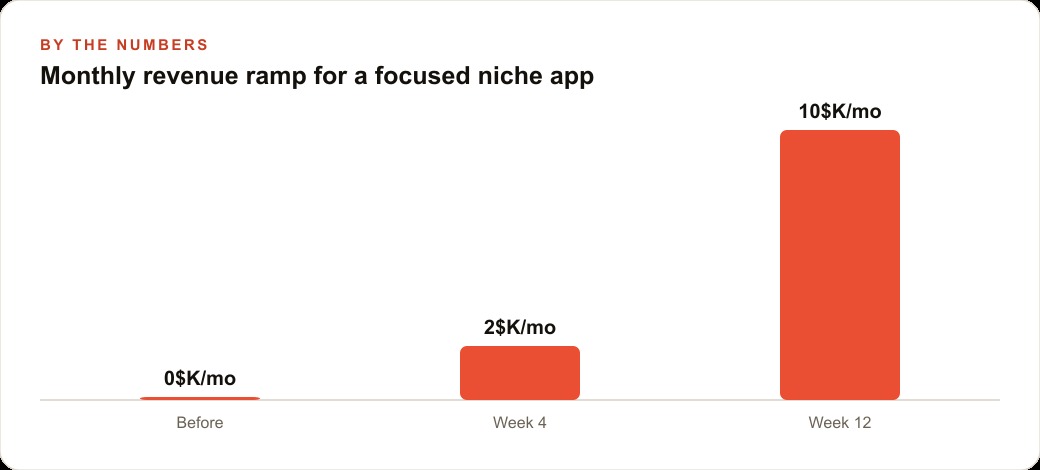
Now the numbers, framed as illustrative. Imagine the tool starts at zero paying users. By week four, a handful of regulars and a few new bookings driven by the previews bring in around two thousand dollars a month. By week twelve, with the funnel tightened and the daily posts compounding, it reaches roughly ten thousand a month. Those figures are a shape, not a promise, but the shape is exactly what the playbook is built to produce: a slow zero, a small proof, then a compounding ramp once the niche, the timing, the clarity, and the marketing all line up.
The traps that quietly kill beginner apps
Before you start, know the four ways this playbook usually fails, because avoiding them is half the battle. The first is building for a niche you do not actually live in. When you chase a trendy market you do not understand, you cannot tell a real problem from a fake one, and you end up polishing a product nobody asked for. Stay inside the niche where you have earned scars, because that judgment is the thing you cannot fake and a competitor cannot copy.
The second trap is building something the world already had. If your idea would have been possible a year ago, dozens of people have already tried it, and you are entering a crowded fight with no edge. The one year test exists to catch this. Run it honestly, and if your idea fails it, pivot toward the capability that only just appeared.
The third trap is a confusing landing page. Founders fall in love with clever taglines and hide the actual value behind wordplay. A visitor who has to think about what you do has already half left. State the outcome plainly and let the cleverness live somewhere else. Clarity is not the boring option, it is the option that converts.
The fourth trap is quitting the marketing too early. People post for a week, see little, and conclude organic reach does not work, or they run ads for a weekend and declare paid traffic dead. Both channels reward patience. Daily posting compounds slowly and then suddenly, and paid campaigns need weeks of data before they tell you anything true. Give both the runway they actually require, and judge them on months, not days.
What to do this week
Pick the niche where you already have years of experience. Choose the one painful task inside it. Run the one year test on your idea to make sure it sits in a fresh window. Build a rough first version with parallel agents, state the value in a single clear sentence, wire up tracking so you know your conversion number, and start posting what you are building every day.
You can walk this path yourself with the steps above. If you would rather have the idea validated, the product built on the right model, and the funnel and tracking set up so it actually converts, that is exactly the kind of work I help businesses with, and you can bring me in to do it with you.
That is exactly what we do at AI DOERS. Book a private 30-minute call with Madhuranjan Kumar and we will map the fastest path to it for your specific business.
Book your call →
Madhuranjan Kumar
Madhuranjan Kumar brings 20 years of performance-marketing experience and has managed over $200 million in Facebook ad spend for brands across the United States and beyond. His expertise spans the full modern marketing stack: Meta, Google Ads, TikTok, email automation, CRM, and the websites that hold it together. At AI DOERS he turns that track record into lead-generation systems for businesses across every industry.