
The AI Launch That Crashed The Market: Why Anthropic's Plugins Spooked Software Stocks
Anthropic added industry plugins to Claude Co-work for sales, finance, data, marketing, and legal, and software stocks fell on fears that the rented SaaS subscription can now be replaced by a plugin or a tool you build yourself. Here is what that actually means for your tool budget.

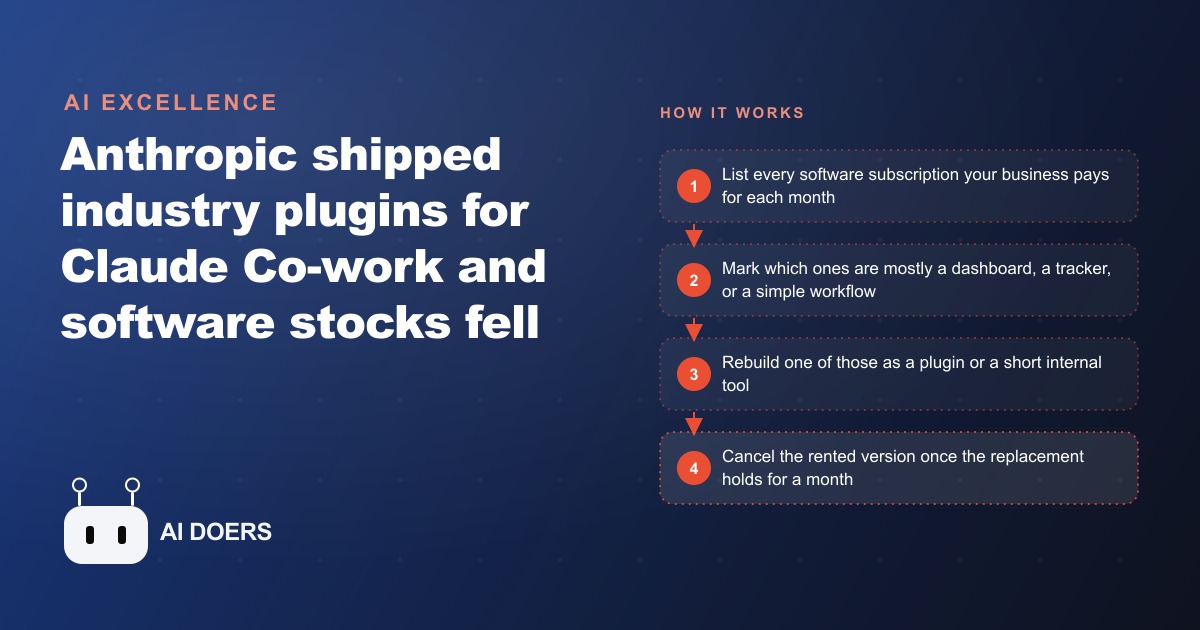
The day Anthropic added industry plugins to Claude Co-work, software stocks slid. That is not a coincidence, and it is not a headline built for clicks. Investors read the release notes and quietly asked the same question every small business owner should be asking this quarter: if a plugin can do what my rented software does, why am I still paying for the subscription?
I am Madhuranjan Kumar, and I have watched this fear build for two years while most owners ignored it. The coding models finally got good enough that everyone noticed on the same afternoon. Here is what actually shipped, why the market reacted the way it did, and the concrete move to make before your next renewal date.
Anthropic just made a stack of subscriptions look optional
The launch that moved the market was simple on paper. Anthropic added industry specific plugins inside Claude Co-work, built for clear business functions like sales, finance, data, marketing, and legal. The important word is functions, not chat. These plugins do multi step work. One plugin can carry several skills, connect to outside services through their APIs, and chain the steps together instead of stopping at a text reply.
Think about what a huge slice of business software actually is. A dashboard that shows you numbers you already own. A tracker that moves rows from one column to another. A reminder tool that sends a templated email on a schedule. Each of those is a monthly fee, and each of those is exactly the kind of narrow job a plugin can now reproduce. The moment installing a plugin can replace a reporting tool you rent, the subscription that funded the entire software industry starts to look like a line item you could cut. That is the whole fear compressed into one sentence, and it is why the ticker moved.
OpenAI answered within the hour, and the timing is the real story
The competitive response tells you how serious this is. The same week, OpenAI shipped a standalone Codex app, described as a command center for agents, where you run several coding agents in parallel, each on its own project, all from short prompts. Codex even borrowed the skills idea, where a skill is a reusable bundle of instructions and scripts you invoke by name. Someone used the app to spin up a space game, a portfolio site, and a Pomodoro timer at the same time from a single short prompt.
Then two coding focused models landed within minutes of each other. Anthropic released Claude Opus 4.6 across the Claude app, web, Co-work, and Claude Code at once, with extended thinking as a toggle for harder problems. OpenAI shipped GPT 5.3 Codex, tuned for the same agentic work, roughly fifteen minutes later. When two of the largest AI labs release competing coding tools inside the same hour, they are not fighting over hobbyists. They are fighting over the budget that businesses currently spend renting narrow software, because they can both see that building a tool now costs a prompt and an afternoon instead of a developer and a quarter.
The number that spooked investors was subscription revenue
Wall Street does not sell off because a demo is impressive. It sells off when a business model looks exposed. The classic software company sells one narrow capability, charges a recurring fee for it, and counts on that fee renewing forever. That predictable renewal is what the stock price is built on. Plugins and parallel coding agents attack the renewal directly. If a mid sized firm can rebuild a dashboard or a workflow tool in house and cancel the rented version, the vendor does not lose a sale, it loses a stream.
Now, the honest read matters here, because I do not want any owner acting on panic. Big enterprises will keep their established vendors for years because of contracts, compliance, and integration debt. The exposure is at the small and mid sized level, where one owner signs every renewal and personally feels every fee. That is precisely the layer the market is worried about, and it is also the layer that stands to save the most. The threat to the software company is the opportunity for the buyer.
Where the savings actually land: a small accounting firm
Let me make this concrete with one worked example using illustrative numbers, because the stock chart is abstract and a bill is not. Picture a small accounting firm that pays for a stack of single purpose tools. A client reminder service at 60 dollars a month. A document collection portal at 90 dollars. A reporting dashboard at 120 dollars. A proposal builder at 45 dollars. Across a busy season those fees add up to a few hundred dollars a month that nobody questions because each one is small on its own.
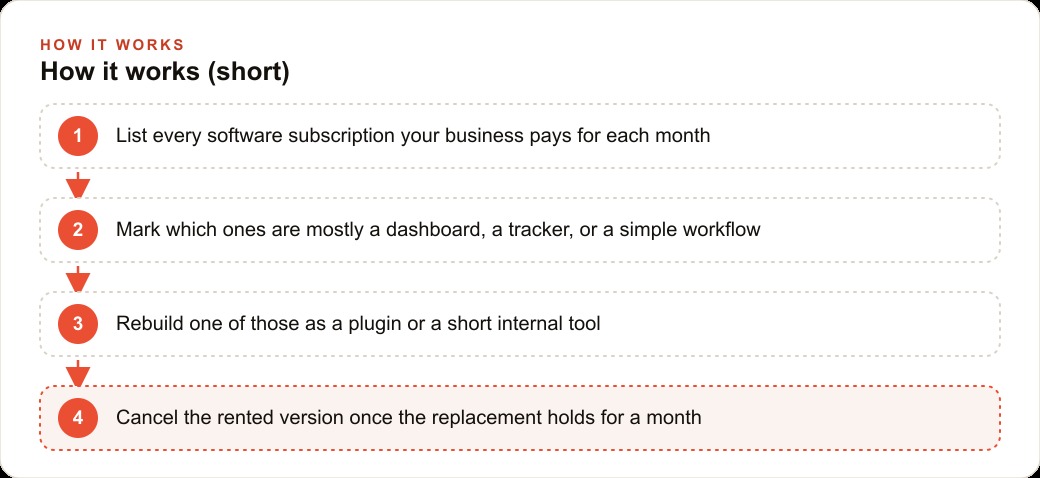
The first move is not a rebuild, it is an inventory. I would write down every subscription and describe in plain language what it actually does. Most of them turn out to be a form, a tracker, or a templated document. Then I would pick the simplest one, say the client reminder and document chasing tool, and rebuild that single workflow as an internal tool the agent runs. It pulls the list of clients with missing paperwork, drafts the reminder in the firm's voice, and logs who has responded. That is the same job the rented app did.
Once that internal version holds steady for a full month, the firm cancels the 60 dollar subscription. Next I would look at the reporting dashboard, since a model that can read a spreadsheet can produce the same client facing summary without a separate 120 dollar license. Two cancellations already trim 180 dollars a month, or roughly 2,160 dollars a year, and the firm's deliverables to clients never changed. The tax and bookkeeping work is identical. The software bill quietly shrinks. Multiply that discipline across a full stack and the saved spend easily funds the afternoons it took to build the replacements.
The rest of the launch wave points the same direction
The plugins were the headline, but the same stretch of releases told a consistent story, and reading them together is more useful than reacting to any one. On the media side, xAI shipped Grok Imagine 1.0 for ten second clips, and Kling 3.0 raised the bar on realism with fifteen second clips and noticeably better lip sync, currently the strongest video model in the pack. That matters to an owner because the cost of producing a usable promotional video keeps falling, which feeds directly into how cheaply you can test creative.
Perplexity, meanwhile, shipped a model council that routes a single query across Claude Opus 4.6, GPT 5.2, and Gemini 3.0 at once, then uses a synthesizer model to resolve conflicts and return one answer that shows where they agree. The signal there is not the feature, it is the quiet admission that no single model is reliably best, so checking a high stakes decision against more than one is becoming standard practice rather than paranoia.
On the cost floor, Mistral dropped Voxtral Transcribe 2, an open source speech model that runs locally for pennies, and ElevenLabs shipped a text to speech model that seventy two percent of testers preferred in blind comparison. Both push the same point the plugins made, that capabilities which used to be a monthly bill are turning into a one time setup on hardware you already own.
Even the marketing noise fit the theme. Anthropic teased Super Bowl ads with the line that ads are coming to AI but not to Claude, Sam Altman called the framing dishonest, and his reply pulled more views than the ad itself. Entertaining, but the substance under the sniping is that these labs are now fighting for mainstream attention, which is exactly what happens right before a technology stops being a specialist tool and becomes a default expectation. For a business owner, the whole wave says one thing. Rented capability is getting cheaper to replace, faster than the vendors would like you to notice.
The move to make before your next renewal date
The launch that crashed the market is really an instruction to audit your own stack. Spend one hour listing every software subscription your business pays for, what each one does, and what it costs per month, because you cannot replace what you have not named. Sort that list into two piles. One pile holds tools that carry genuine complexity, deep integrations, or compliance you do not want to touch. The other pile holds the dashboards, forms, and simple workflows.
Pick one item from the simple pile and rebuild just that job as a plugin or a short internal tool, then run it alongside the paid version for a few weeks until you trust it. The same wave of launches also surfaced free and on device options worth testing while you are at it, like an open source transcription model that runs locally for pennies instead of a monthly speech to text bill, and a multi model check that routes a high stakes question to more than one model before you act on the answer. Cancel the rented tool only once the replacement has held for a full cycle, then move to the next line item.
This is also the moment to connect the savings to growth instead of just pocketing them. The hours you free from babysitting narrow tools are hours you can point at demand. If you run Facebook and Instagram ad campaigns, a custom internal tool can assemble your creative reporting in the exact shape you test against, without a third party dashboard fee. If you spend on Google Ads, an in house build can pull the numbers that matter to your billing cycle and skip the rented analytics layer entirely. And the leads those channels produce still need a home, so the CRM and website stack is usually the last place to touch, because that is where follow up automation earns its keep and where a botched migration hurts most.
Why this is not hype, and why it is not doom either
The stock reaction was real, but the takeaway is not that software is dead. Established vendors with deep moats, hard integrations, and regulatory approval will be fine for a long time. What changed is the floor. Building a functional internal tool used to require a developer and a budget, which meant most owners rented instead. That barrier is now a prompt and an afternoon, so renting a narrow tool is a choice rather than a necessity, and a market that runs on the assumption of forced renewals had to reprice that.
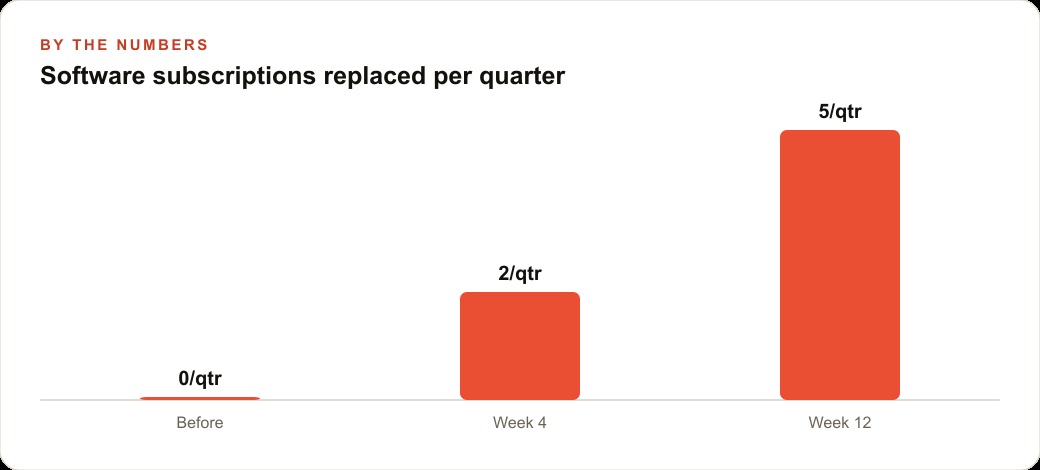
For an owner, the correct posture is neither panic nor denial. It is a calm audit. Name your subscriptions, separate the complex from the simple, rebuild one simple thing, prove it for a month, and cancel with confidence. Do that four times across a year and you will have quietly reclaimed thousands of dollars and, more importantly, the ability to build the exact tool your business needs instead of bending your business to fit someone else's software. The vendors selling those subscriptions understand this shift better than their customers do, which is why they are racing to bolt AI features onto their own products before buyers realize they could build the same thing themselves. Use that window while it is open. The businesses that audit their stack now, while the tools are new and the savings are large, will spend the next few years operating lighter and faster than competitors who keep signing renewal after renewal out of pure habit. That head start is the real prize, and it is available to any owner willing to spend one honest hour with their list of subscriptions.
You can absolutely run this audit yourself, and I would encourage any owner to start by listing their subscriptions this week. If you would rather have someone map your specific stack, flag which tools are safe to rebuild, and stand up the first replacement so it works on day one, that is the kind of build I do for clients, and you can bring me in to handle it.
That is exactly what we do at AI DOERS. Book a private 30-minute call with Madhuranjan Kumar and we will map the fastest path to it for your specific business.
Book your call →
Madhuranjan Kumar
Madhuranjan Kumar brings 20 years of performance-marketing experience and has managed over $200 million in Facebook ad spend for brands across the United States and beyond. His expertise spans the full modern marketing stack: Meta, Google Ads, TikTok, email automation, CRM, and the websites that hold it together. At AI DOERS he turns that track record into lead-generation systems for businesses across every industry.