
The 3-Level Map for Actually Getting Good at AI
There is a simple three level path to real results with AI: use it for answers, build it into a daily work partner, then let it work for you. Skipping levels is why most people stall.

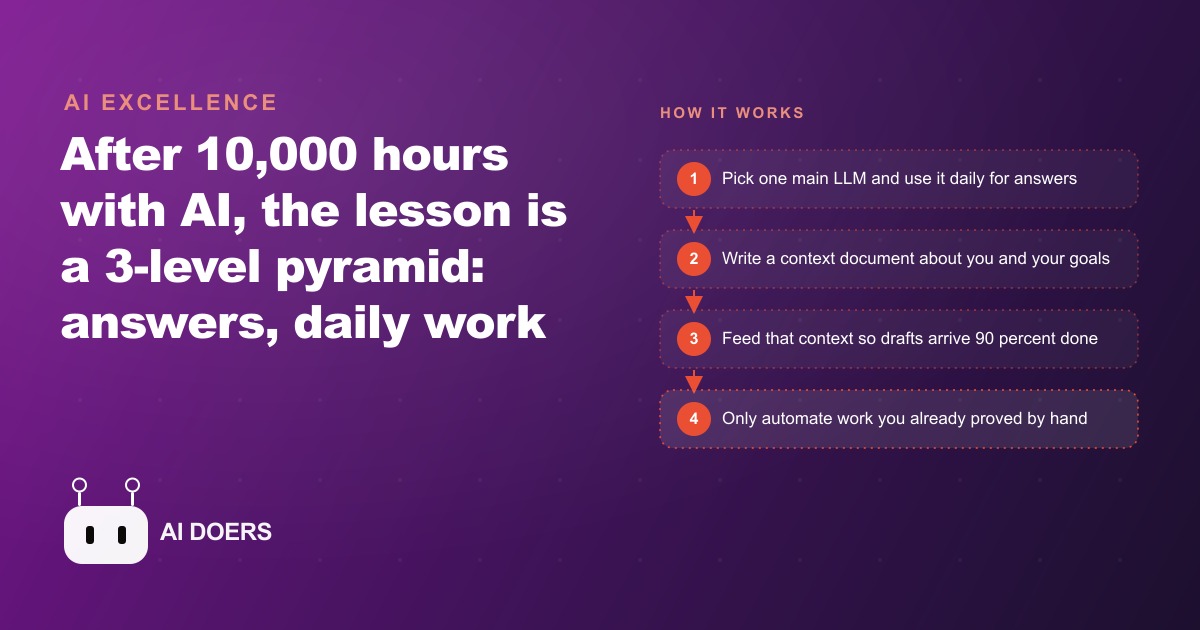
Consuming AI content has become its own form of procrastination. The people who are extracting real value from AI tools in their work are not the ones who watch the most demos, subscribe to the most newsletters, or follow the most accounts. They are the people who chose one tool, built one consistent daily practice with it, and stopped watching other people use it while waiting for a better version to arrive. The gap between the AI enthusiasts who cannot name a single hour they saved this week and the quiet professionals who reclaimed two hours every day from their calendar is not a capability gap. It is a behavior gap.
I am Madhuranjan Kumar. I have watched this pattern long enough to say it plainly: the content about AI productivity is now more popular than AI productivity itself, and the content is the trap. The framework I want to describe here is not about which tool to use. It is about the behavior that makes any tool pay off, and why most people skip the hardest part of it because it does not look impressive from the outside.
The people winning with AI are boring about it
The most productive AI users I observe are boring about it. They use one tool, Claude or ChatGPT or Gemini, whichever one they started with and got comfortable with, and they use it for real tasks every single day. They do not switch when a new model releases benchmark scores. They do not start over when a new interface ships. They do not post about what they tried. They just use it.
This is counterintuitive because the AI content ecosystem rewards novelty. Every new release generates engagement. Every new capability generates tutorial videos. Every benchmarking comparison generates comment threads. The people producing that content are not necessarily the people getting the most done. They are the people who found that reporting on new AI tools is itself a productive activity in their specific business model. That is fine for them. It is not useful for you unless your business is reporting on AI tools.
The behavior that produces results is daily repetitive use of one tool in a consistent context. Not daily exploration of five new tools in five new contexts. One tool, one context, used until the interaction pattern becomes a reflex rather than a decision. The productivity gains from AI compound with familiarity. The tool becomes more useful the more it knows about your work, and it can only know your work if you give it your work repeatedly over time. Switching tools resets that compounding.
The boring practitioners also share a characteristic in how they describe what they use AI for. They use it for specific, concrete, recurring tasks: drafting the same type of email they send every week, pulling the key points from a document before a meeting, generating the first draft of a report from notes rather than starting with a blank document. Nothing that sounds like a revolution. Everything that sounds like having a capable assistant handle the parts of a job that drain attention without requiring judgment.
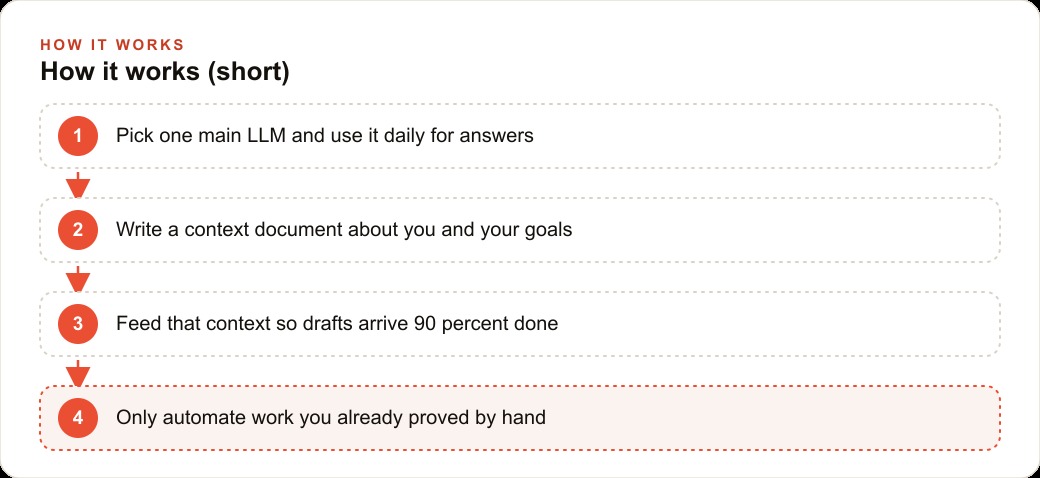
Level 1 is where most people get stuck because the result feels too small
The first level of AI use is asking questions and getting answers. You open ChatGPT or Claude, type a question that would have taken you 20 minutes to research, and get an answer in 30 seconds. You draft an email you were dreading and the AI produces a usable first version in two minutes instead of the 15 minutes you expected to spend on it. These are real time savings and they are available to anyone who tries the tool.
The problem is that the result feels too small relative to the hype. You save 15 minutes on an email and you have seen demos of AI agents running entire businesses. The gap between what you experienced and what you were promised makes the thing you actually accomplished feel like a disappointment rather than a starting point. Most people in this position do one of two things: they conclude AI is overhyped and stop using it, or they conclude they must be using it wrong and go looking for the real use. Both responses lead to the same place, which is back to watching tutorials.
The correct interpretation of the 15-minute email savings is not that the tool is underwhelming. It is that one 15-minute saving per week, applied consistently, is 13 hours per year recovered from email drafting alone. If you do the same with 5 recurring tasks that each take 10 to 20 minutes and AI cuts them to 2 to 5 minutes, you are looking at 60 to 80 hours reclaimed over a year from a free tool you already have access to. That number does not feel exciting in a demo. It feels significant when it shows up as calendar time you can use for something else.
The other thing that keeps people stuck at level 1 is the absence of context. The AI knows nothing specific about your work, your clients, your voice, your industry, or your recurring challenges. It produces generic outputs for generic questions. The 60 percent quality output people report from AI tools is almost always a context problem. The tool gave a generic answer because it received a generic question from someone it knew nothing about. The fix is not a better tool. It is a better input.
Daily partnership is harder than automation and that is exactly why it pays more
The second level is daily use with rich context, and it is where the real leverage lives for most business owners and professionals. It is also where most people do not spend enough time because it does not look as exciting as level 3, which is autonomous agents and automated pipelines running while you sleep.
Daily partnership means using one AI tool every single day for real work tasks, building a context document that tells the tool everything it needs to know about you and your work, and loading that context into every conversation. The context document is not a complex technical artifact. It is a plain text file that describes who you are, who your clients or customers are, what you offer, how you communicate, what you are trying to accomplish, and any specific preferences the tool should apply to its outputs. Loading that document changes the quality of every interaction that follows.
The output difference between a conversation with context and a conversation without it is not subtle. Without context, a client email draft is at roughly 60 to 70 percent of the quality you want, meaning you spend more time editing it than you would have spent writing it yourself. With a well-built context document loaded, the same draft arrives at 90 to 95 percent, and the remaining 5 to 10 percent of polish takes two minutes. That gap, 60 percent versus 90 percent, is the difference between a tool that costs you time and a tool that saves it.
The daily practice is what builds the context over time. You notice that a certain type of output never quite lands the way you want and you add a clarification to the document. You realize the tool keeps using a word or phrase you never use and you specify your vocabulary preferences. You discover that loading the context of a specific project type produces much stronger outputs than a generic prompt and you add a project-type template. The context document grows from daily use in ways it never does from weekly or occasional use.
This level is harder than automation for one specific reason: it requires you to show up every day and do the work of giving the tool what it needs to help you. Automation feels passive because once it is running, it runs without you. Partnership requires active daily participation. That active daily participation is exactly why it pays more: the tool accumulates knowledge of your specific context, your voice, your preferences, and your recurring tasks in a way that automation built on no foundation never can.
The third level is not for everyone and that is fine
The third level is autonomous systems: pipelines that trigger without your involvement, agents that work while you sleep, workflows that handle tasks end to end without a human in the loop. The content ecosystem spends most of its time here because it is the most visually impressive and the most shareable. A screenshot of an agent completing a task automatically generates more engagement than a screenshot of someone writing a better email.
The honest truth about level 3 is that it only amplifies what you proved at level 2. An autonomous pipeline that runs a workflow you have never personally done well with the AI produces bad results faster. The automation scales the quality of the underlying process. If the underlying process produces 60 percent quality outputs, the automation produces 60 percent quality outputs at three times the volume, which is three times the problem rather than three times the value.
The businesses that get genuine value from level 3 are the ones where a specific workflow was already producing 90 percent quality outputs at level 2 consistently, over weeks of daily use. The automation of that specific workflow is then a genuine multiplier because it scales a process that already works. Building automation before building the level 2 foundation is building the runway before the plane exists.
Not every business needs level 3 at all. A professional services firm whose main deliverable is judgment, advice, or relationship management may find that daily level 2 use produces most of the available leverage with minimal additional return from automation. The goal is not to reach level 3 as a status symbol. The goal is to find the level where the return on your attention is highest and operate there. For some businesses that is level 3. For many it is a well-maintained level 2 with one or two carefully tested automations for the most predictable recurring tasks.
The trap of chasing level 3 before you are ready is not just that the automations fail. It is that the failure teaches you the wrong lesson. When an agent produces garbage because it has no foundation of context or proven process to work from, it looks like evidence that agents are not useful. It is actually evidence that agents amplify what exists beneath them. Building the foundation first changes what the agent amplifies.
One worked example with illustrative numbers
A marketing manager at a mid-size company spent six months consuming AI content. She followed 12 AI-focused accounts, watched several tutorials per week, subscribed to three newsletters, and saved dozens of prompts she planned to try. At the end of six months her practical AI use consisted of occasional ChatGPT questions when she was stuck, generating perhaps one useful output per week. Her actual work rate had not changed. Her AI content consumption had become its own recurring task on an already full schedule.
She stopped consuming and started using. She picked one tool and used it every day for one week on real tasks. Day one: draft the weekly campaign status email she spent 25 minutes on every Monday. The draft arrived in three minutes. She spent five minutes refining it. Net time saved: 17 minutes on one email. Day two: pull the five most important points from a 40-page agency report she needed to present to leadership. Two minutes of prompting, clean output, no full reading required until the presentation itself. Day three: write three ad copy variations for a campaign she was behind on. Eight minutes instead of 45.
By the end of the week she had built a context document with information about her company, her team, her communication style, and her recurring task types. She loaded it at the start of every conversation. The outputs in week two were noticeably better than the outputs in week one, not because the model changed, but because it now knew who she was working with and what she was trying to accomplish.
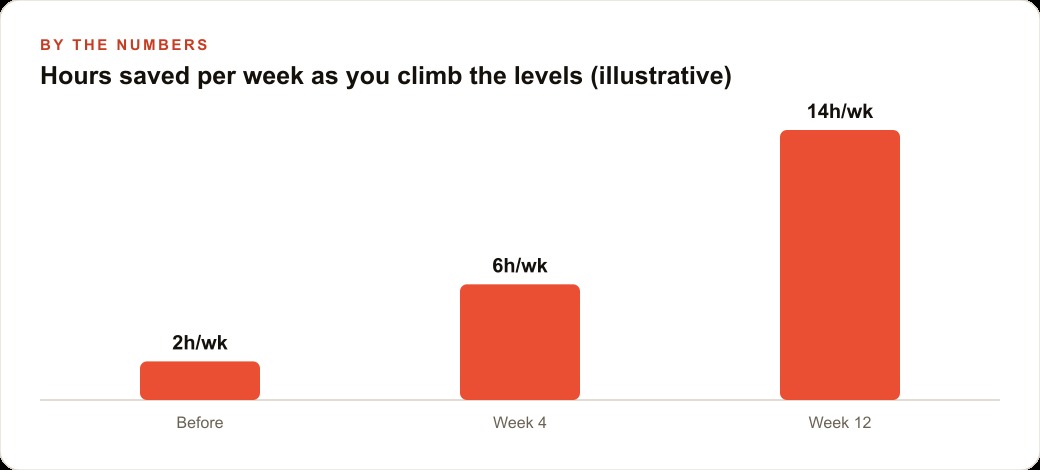
After one month of daily use, she estimated she was recovering 6 to 8 hours per week from tasks that previously consumed that time in full. The marketing output her team produced in that month was roughly 40 percent more than the previous month: more drafts produced, more campaigns tested, more reports reviewed before they reached leadership. The six months of AI content consumption had produced zero measurable output change. The one month of daily AI use had produced a change visible in the work product.
These numbers are illustrative of the pattern rather than a specific individual case, but the direction holds: the input that produces results is daily use with building context, not more content consumption. The content about AI is the most available thing. The disciplined daily practice is the scarce thing, which is exactly why it pays more.
How to apply this
Pick one tool and use it every day this week for tasks you actually have to do. Not demo tasks. Not tutorial tasks. The real work sitting on your task list. Notice where the outputs land in quality. Build a plain text document describing everything the tool should know about your work and load it in every session. Keep the document updated as you learn what makes the outputs better.
After two weeks of daily use, identify the one workflow where the tool is most consistently reliable. Test it ten times. If it produces 90 percent quality or better on nine of ten runs, consider whether scheduling it to run automatically is worth the setup time. If not, keep it as a daily manual use case and find the next workflow to strengthen.
The practice that produces results is boring. The people getting the most out of AI right now are not the most enthusiastic consumers of AI content. They are the most disciplined daily users of one AI tool, with a context document that knows their business and a habit that does not require a new tutorial to maintain. That is the whole thing.
That is exactly what we do at AI DOERS. Book a private 30-minute call with Madhuranjan Kumar and we will map the fastest path to it for your specific business.
Book your call →
Madhuranjan Kumar
Madhuranjan Kumar brings 20 years of performance-marketing experience and has managed over $200 million in Facebook ad spend for brands across the United States and beyond. His expertise spans the full modern marketing stack: Meta, Google Ads, TikTok, email automation, CRM, and the websites that hold it together. At AI DOERS he turns that track record into lead-generation systems for businesses across every industry.