
An Honest Take on Agents, Cheap Models, and the Compute Wall
Agents are set to become a core part of how we use the web, but the smart rollout starts on first-party data, leans on cheap Flash-class models to control cost, and treats compute, not ideas, as the real bottleneck.

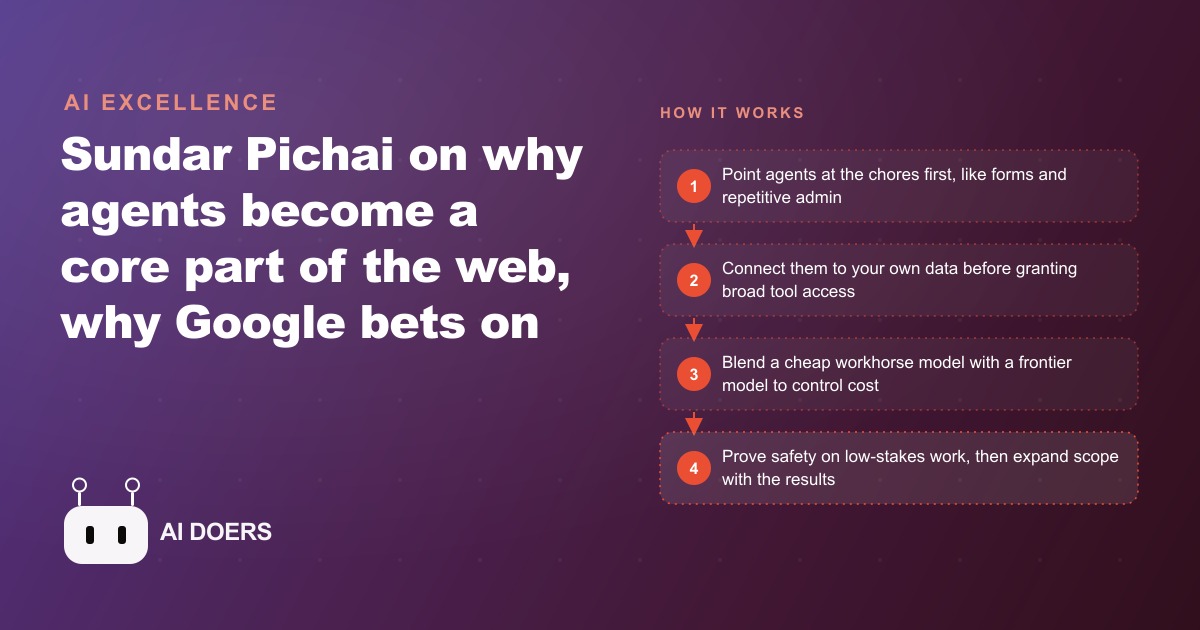
Sundar Pichai told an interviewer directly: agents are going to be a fundamental part of how people use the internet. He said it without hedging, not in a product launch where enthusiasm is expected, but in a sit-down interview where the questions were pointed and the answers were notably precise. I tracked down the full transcript, watched it twice, and I want to share what the actual news is here, because most of the coverage missed the piece that matters for any business trying to decide what to do next.
Pichai's agent thesis reframes every AI discussion happening inside your business right now
The argument Pichai built is grounded in a distinction that most AI commentary collapses into vagueness. He separated the web into two layers: the chore layer and the value layer. Search was built to serve both. Agents are built specifically to dissolve the chore layer. He gave a concrete example: renewing a driver's license involves navigating roughly eighteen form fields with zero judgment required at any step. The person needs the renewed license. Nobody needs the experience of filling out the forms. An agent handles the forms and delivers the outcome, and the person's attention stays on everything that actually requires them.
This is not a technology roadmap item sitting somewhere in the future. It is a reframe of what AI infrastructure is for, and it comes from the chief executive of the company that more people touch daily than any other technology company in the world. The practical consequence for any business is that the question has shifted from whether agents will be useful to when your business will be the one deploying them versus the one losing hours to a competitor that already has. Developers already live in this future. Pichai was explicit: the coding workflow has moved from autocomplete assistance to full agentic loops where code is written, tested, and deployed with minimal human intervention at each step. The expansion from developers to everyone else is the active roadmap, and the window for early-mover advantage is open right now.
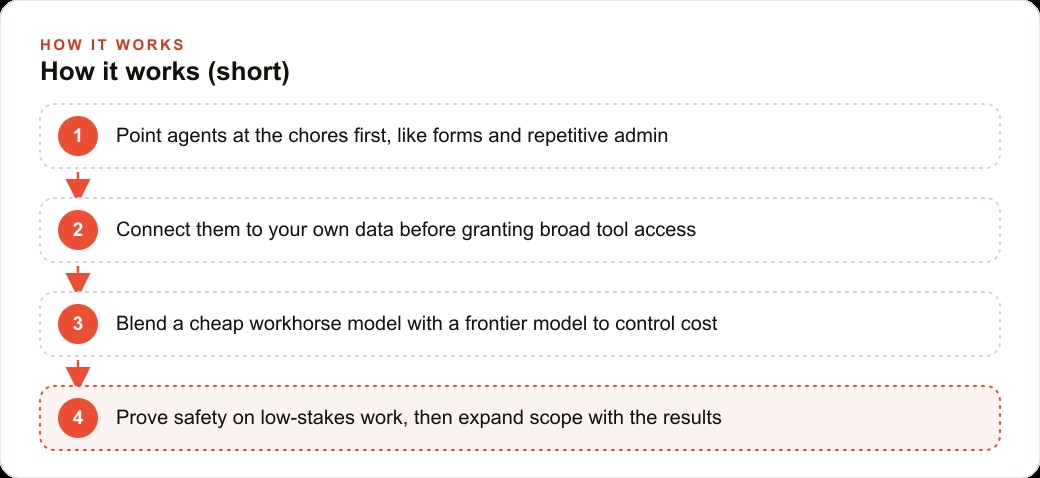
The piece of the agent thesis that most coverage ignored was the user-control condition Pichai attached to it. Agents do not get to take over everything from day one and ask users to accept it. Users need a persistent sense of control, agency over what the agent is doing, and enough transparency to trust the results without supervising every step. That condition shapes the entire rollout strategy. It is the reason the recommended starting point is not a broad, high-access agent but a narrow, contained one pointed at a single, well-defined task where the risk of a mistake is low and the consequences are recoverable. Satisfaction with that narrow agent is what earns the right to expand its scope. Every organization that has deployed agents at real scale has learned some version of this lesson. The ones that started narrow expanded confidently. The ones that started broad pulled back.
The Flash model bet is not about accessibility, it is about keeping agentic costs from compounding past sustainability
This was the section I read three times, because it is the most important and least covered thing Pichai said. CIOs are blowing through AI budgets. He said this directly, without softening. And the reason is architectural, not because organizations are being careless. In an agentic loop, a single completed task involves many individual model calls. Checking a status, composing a reply, formatting an output, confirming a result: each step calls the model separately. If every call uses a frontier model priced at frontier rates, the cost of a high-volume agentic deployment scales in ways that most budget approvals did not anticipate.
Google's answer is a deliberate two-tier approach. Flash-class models are built to be very capable, very fast, and cheap enough to run on every routine step in an agentic loop without hitting budget ceilings. The frontier model gets reserved for the reasoning steps where the quality difference between a cheap workhorse and a capable model is actually visible and consequential: the synthesis, the judgment calls, the outputs humans evaluate critically. Pichai said Google uses this blend internally, and the blend is what makes high-volume agentic use economically sustainable at scale.
The business implication applies at any size. A small business running a customer-inquiry agent that handles a hundred responses per week faces the same structural question as a large enterprise, just at different numbers. If every step in that agent's loop uses a frontier model, the cost will eventually become the reason the agent gets throttled or turned off at exactly the moment it has proven its value. Building the model-blending discipline into the first workflow, rather than applying it retroactively after a budget spike, is the practice that keeps agentic workflows running as they scale. This is not an optimization to consider later. It is a design decision that shapes whether the system is sustainable from the first month of real operation.
The related point about open-source models reinforces this. Strong open models now run at or near frontier quality for many routine business automation tasks, and they come with licenses that allow commercial use. For agentic loops where the task is well-defined and the stakes per call are low, running a capable open model locally keeps sensitive internal data off third-party servers and keeps per-token costs predictable at any volume. This is the same efficiency logic that drives the Flash bet, applied at the infrastructure level rather than the API pricing level.
The compute constraint Pichai named is the ceiling above every AI roadmap, including yours
One sentence in the interview did not make most headlines, and I think it is the most important context for anyone planning an AI initiative over the next twelve months. Pichai said Google has more demand than compute capacity to serve. The constraint is not ideas, not safety research, not regulatory friction. It is physical: data center permitting timelines, power infrastructure, memory bandwidth, and specific chip components in constrained supply. He noted that these bottlenecks shift between categories over time but do not disappear. They are the actual ceiling above which no AI company can deliver at scale, regardless of what their models achieve in benchmark conditions.
This matters for businesses building AI roadmaps because it reframes the planning question. The right question is not which frontier capability will be available when, because the compute constraint means the delivery timeline is genuinely uncertain even to the people building it. The right question is how to build workflows that extract real value at current capability levels, so the business compounds returns now rather than waiting on a future state the compute wall may delay or make more expensive than expected. The teams already getting compounding returns from AI are doing it by being narrow, deliberate, and efficient. They are not waiting for the capability ceiling to rise. They are building under the current ceiling and iterating.
The security dimension Pichai raised belongs in this account too, because it is directly relevant to any business thinking about deploying agents with access to real systems. AI is being used at Google to find and patch vulnerabilities around the clock, and the same agentic capabilities that make workflows efficient also make attack patterns more sophisticated. An agent that has access to real data and real systems has permissions that can be exploited if scope is too broad. Constraining access to exactly what each task requires, and keeping human review in place for any action with irreversible consequences, are practices being applied at organizations running agents at real scale. The security layer is not an optional step to add after the system proves its value. It is the step that makes every subsequent expansion safe to attempt.
Trust in agents gets built the way Waymo built it, through demonstrated performance on real work over time
The Waymo analogy was the most practically useful part of the interview for anyone thinking about rollout strategy. Pichai made the point that people did not learn to trust autonomous driving because a company announced it was trustworthy. They learned through observed performance across millions of real miles, with a track record that was visible and verifiable over time. Email spam filters work the same way. Nobody thinks of the spam filter as an AI agent making consequential decisions on their behalf all day, but that is exactly what it is, and people trust it completely because it has been right far more often than wrong for years, without drama or incident.
The lesson for any business deploying agents is that the trust-building timeline is itself the rollout strategy. You do not deploy a broad, high-access agent on day one and ask users to accept it. You deploy a narrow, low-risk agent on one contained task, run it long enough to collect evidence of its reliability, and use that evidence to justify the next expansion of scope. Gemini itself follows this deliberately. It connects to Gmail and Calendar first, first-party surfaces where the consequences of a mistake are recoverable and the data exposure is contained. Third-party tools, broader connectors, and full browser access come later, after the behavior in the contained environment has been observed and confirmed. The patience in that sequence is a product decision, not a technical limitation. Any business rollout should follow the same logic.
Pichai also addressed the AGI race dynamic explicitly, and the point extends directly to business deployments in a useful way. He said perception of who leads in AI shifts every four to six weeks. Racing to be first in deploying the most capable possible system at every moment is not a coherent strategy at any level, because the frontier itself is moving faster than any organization can stably build on top of it. The organizations extracting durable value are the ones deploying reliable systems at well-understood capability levels, improving those systems incrementally, and not betting critical operations on capabilities that are still in rapid flux. That is as true for a twelve-person service firm as it is for a large enterprise.
The concrete first move, with specific numbers
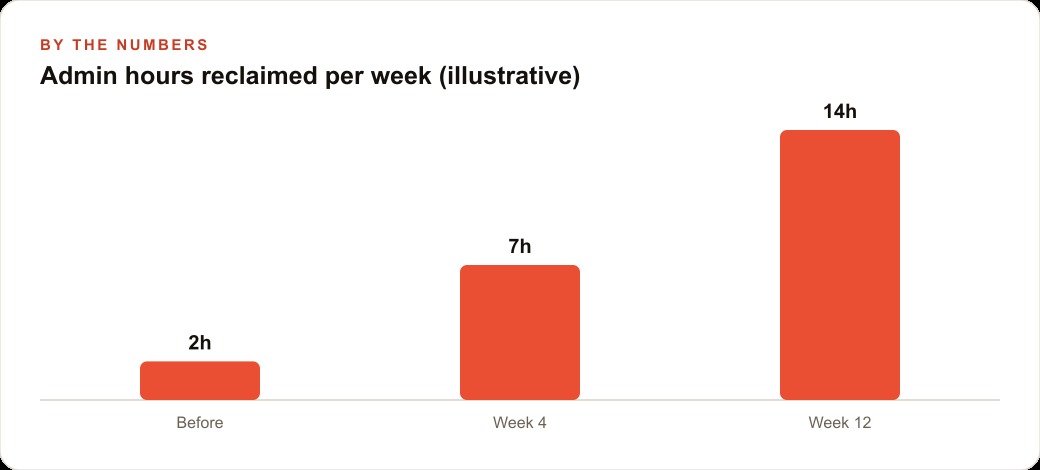
Here is how this plays out in practice. Consider a law office handling forty client status inquiries per week. The questions are predictable: where is a document in review, when to expect a draft, what the next step in the process is. Before any agent, two people collectively spend about five to six hours per week on these, answering the same questions in slightly different forms for different clients. The information already exists in a shared calendar and a document status tracker. The task is pure chore layer.
A narrow agent, connected only to that calendar and tracker and nothing else, handles approximately eighty percent of those inquiries automatically. It has no access to financial records, case strategy, or anything sensitive. Its scope is precisely one task: match the inquiry to the existing data, compose a reply in the firm's voice, send it. The twenty percent it cannot handle confidently it flags for a person rather than guessing. In the first month, the agent runs on a workhorse-class model for every step because nothing in this task requires frontier reasoning. The weekly model cost at typical inquiry volume is under five dollars. The five-plus hours freed per week are redirected toward work that actually requires professional judgment. At a modest professional hourly rate, those freed hours represent forty to sixty times the weekly model cost in recovered capacity. The payback on the setup investment arrives in days, not months, and compounds every week the agent runs reliably.
Trust is built the way Pichai described. The agent runs on this one task for four weeks. Logs are reviewed. Accuracy is confirmed. Then, and only then, a second task is considered. The model blend keeps cost predictable: a cheap workhorse for the routine status-check steps, with a more capable model reserved for any task later in the expansion that genuinely requires synthesis or judgment. The sequenced expansion keeps risk manageable. The whole approach is the Waymo model applied to a twelve-person law office. The compute constraint in Pichai's world becomes an efficiency discipline in this firm's world, and the result is the same: real returns compounding on a sustainable foundation that earns rather than assumes the right to expand.
The businesses that begin this cycle now will have weeks of observed reliability data and a tuned workflow by the time the businesses that waited are still evaluating where to start. That lead compounds. The first agent you deploy and prove is the foundation for every subsequent agent. The foundation built now is worth more than the foundation built six months from now, because the compounding has already started.
That is exactly what we do at AI DOERS. Book a private 30-minute call with Madhuranjan Kumar and we will map the fastest path to it for your specific business.
Book your call →
Madhuranjan Kumar
Madhuranjan Kumar brings 20 years of performance-marketing experience and has managed over $200 million in Facebook ad spend for brands across the United States and beyond. His expertise spans the full modern marketing stack: Meta, Google Ads, TikTok, email automation, CRM, and the websites that hold it together. At AI DOERS he turns that track record into lead-generation systems for businesses across every industry.