
Studio-Quality Marketing Images for Almost Nothing, Thanks to New AI
Google's new image model renders clean text, real infographics, and consistent product shots, and it is landing inside the tools you already use to sell. Here is how a small business should put it to work.

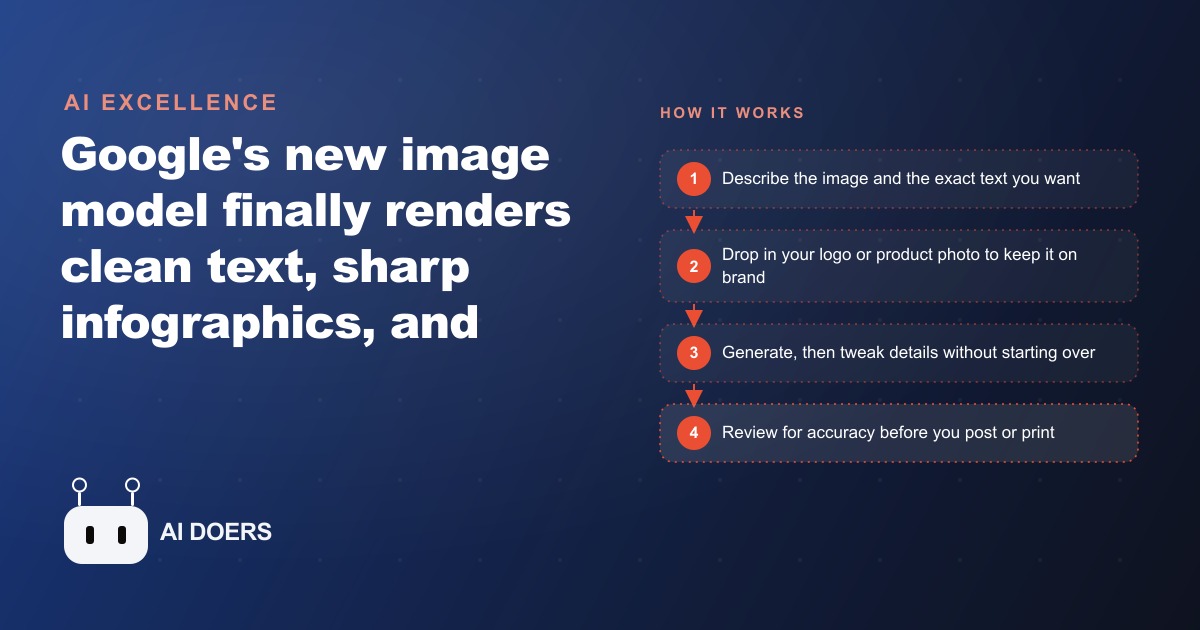
Google's new image model can spell. For small business marketing, that single capability change opens more practical use cases than any other AI image upgrade in the past three years. I am Madhuranjan Kumar, and this is a thorough breakdown of why readable text in AI images matters more than any other technical improvement in this category, how the model achieves it, and what it specifically unlocks for a business that cannot afford a design agency or a monthly photographer.
Why the inability to render readable text was a complete practical ceiling for every prior AI image tool
Text inside images has been the functional limit of AI image generation for every major model until now. The pattern was consistent across tools and generations: generate a beautiful, photorealistic scene, then observe garbled, misspelled, illegible characters wherever words were supposed to appear. For hobbyist image generation, this was a minor inconvenience. For business marketing, it was a complete blocker on the most common use cases.
Consider what a business actually needs a marketing image to do. A restaurant promotion needs the dish name and the current price readable. A medical practice announcement needs the appointment hours accurate and legible. A retail sale graphic needs the discount percentage clearly stated. A service firm's process diagram needs each step labeled in plain language. A gym membership offer needs the monthly rate and the signup deadline visible in the image itself.
In every one of these cases, the core purpose of the image is communication, and if the text is garbled or unreadable, the image fails its purpose regardless of how beautiful the background looks or how impressive the AI generation quality is. A gorgeous sunset behind an unreadable price is not a marketing asset. It is a failed attempt at one.
For years, businesses working with AI image tools faced two options, neither of which was good. They could generate the background image with AI and then open a separate tool to add the text as an overlay, which required design skill, a subscription to a design platform, and time that often negated the speed advantage of AI generation. Or they could accept that AI images were only useful for decorative purposes and hire a designer for anything that needed readable text. The new model collapses both of those workarounds into a single generation step that requires no design background and no secondary tool.
How the model actually achieves typographic accuracy where every prior generator failed
The technical reason earlier AI image models could not reliably render text is that they were trained to predict what pixels look like statistically, without a structural understanding of what specific characters mean or how they relate to the words and sentences they form.
A standard diffusion model learns that the letter A tends to look like a triangular shape with two angled strokes and a crossbar, based on having seen many examples of A in training images. The model has no compositional understanding of the word the letter belongs to, the sentence the word is in, or the meaning that sentence is supposed to convey. When it attempts to generate a word, it is producing what a word tends to look like as a visual pattern, not spelling the actual word character by character with correct spacing, alignment, and kerning. The result is text that looks plausible from a distance and breaks down on closer inspection.
The new model was trained with a fundamentally different emphasis on the relationship between text content and its spatial representation in an image. The model develops an understanding of characters as units of meaning with specific visual structures that must be preserved exactly, not as pixel patterns to approximate. That understanding extends to how characters combine into words, how words fit within the available space in a composition, and how text placement relates to the other visual elements in the scene.
The result is that the model can place the word "Welcome" on a storefront sign, render each letter correctly, maintain readable spacing and consistent baseline alignment, and integrate the text naturally into the scene around it as if the sign were part of the physical environment. That is a qualitatively different capability from generating a plausible-looking sign shape with garbled letters on it.
The same technical shift enables the infographic capability. Building an accurate diagram requires not just drawing arrows and boxes but placing accurate labels on each component, where the label text is spatially associated with the correct element and each word in the label is readable. Prior generators could draw the structural elements. They could not fill those elements with accurate, readable labels. The new model can do both simultaneously from a plain description.
What consistent product photography unlocks for businesses without studio budgets
A commercial photo shoot is a significant investment for a small business. At standard market rates, a half-day product shoot can range from several hundred dollars to several thousand depending on the photographer, the number of products, and the post-processing required. Many small businesses can afford this once or twice a year at most, which means having a very small set of professional images that get reused across every platform until they go stale. The visual presence becomes static, and static visual presence signals a business that is not actively engaged with its marketing.
The new model's consistency capability changes that calculation. A business owner can provide one reference photo of their product and describe a scene, and the model places that product into the scene with consistent lighting and visual treatment. Drop a product into a lifestyle scene for a social ad. Place it on a seasonal promotional background for an email campaign. Put it in a clean, white studio environment for the product listing page. All from one base image, with the brand's visual identity maintained across the batch.
The consistency across a set of images matters as much as the per-image quality. A marketing campaign made up of images with inconsistent lighting, varying color treatment, and drifting stylistic feel looks amateurish regardless of how good any individual image appears in isolation. The model maintains stylistic consistency across a batch generated in a single session, which means a month of social media images can be produced coherently and look like they came from a single coordinated shoot.
The translation capability adds another dimension that is particularly valuable for businesses serving multilingual markets. The same product image with English text can have its text translated and rerendered in French, Spanish, or Portuguese in seconds. One creative asset serves multiple audience segments without any additional design work. For a business in a city with a significant second-language population, or for an online store selling to multiple countries, that capability changes what is cost-effective to produce in different languages.
How a 90-second infographic changes how service businesses explain what they do
The infographic capability matters most for the large category of businesses that sell work rather than physical objects. Agencies, law firms, medical practices, consulting firms, accounting offices, repair services, and educational providers all share the same marketing challenge: they sell something invisible, and explaining what they do requires a diagram, a process illustration, or a comparison chart that a potential client can understand quickly.
Before this model, producing a clean infographic required either hiring a designer, spending hours learning a design tool, or settling for generic stock infographics that did not reflect the actual service offered. None of these options scaled well for a business that needed to produce explanatory content regularly. The designer was expensive and required briefing time. The design tool had a learning curve. The stock infographic looked generic and did not build trust with a specific audience.
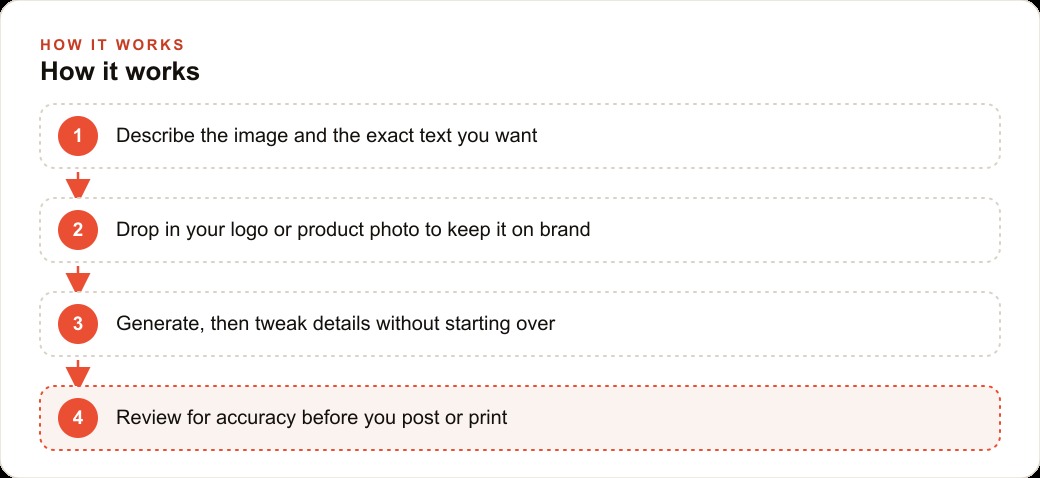
The new model generates a clear process diagram from a plain text description of the steps. Describe your client onboarding process in a sentence per stage, ask for a horizontal flowchart with each step labeled and connected with arrows, and the model produces a visually clean diagram with accurate, readable text in each label. That diagram takes about 90 seconds to generate from description to finished image.
The business value is concrete. A patient intake process explained as a clean four-step diagram on a practice website builds more trust faster than three paragraphs of text describing the same process. A consulting firm's methodology illustrated as a visual framework on a landing page makes an abstract offering tangible in a way that text alone cannot. A plumber's service guarantee laid out as a simple three-column comparison chart answers the most common pre-purchase question without requiring a phone call. Each of these marketing assets can now be produced in the time it takes to write a description of what you want, rather than requiring a designer engagement or hours in a design tool.
Where the model actually lives and how it enters the tools you already use
The new model is not available only as a standalone image generator. It is being integrated directly into advertising platforms and shopping tools, which is where the practical business impact becomes structural rather than optional.
For a business running paid ads, the ability to generate and localize product images is being built into the ad creation workflow itself. Instead of generating an image in one tool, downloading it, uploading it to the ad platform, and configuring the ad separately, the whole process is collapsing into a single interface. That matters because every step in a workflow where you change tools has friction, and friction reduces the rate at which you try new creative variations. When generating a new ad image requires four separate steps across three tools, you do less testing. When it requires one step inside the platform you are already in, you test more, and testing more creative variations is one of the highest-leverage activities in paid advertising.
The integration into shopping platforms means product listing images can be varied programmatically without leaving the platform. A product with one hero photo can have five variations generated and loaded: the product on a white background for the catalog listing, the product in a lifestyle scene for the social ad, the product with a seasonal promotional message for the email campaign, the product on a branded background for the story format, and the product with translated labels for a second-language audience. All from one base image, inside the platform, without a designer or a separate tool.
This structural integration is what separates the new model from prior generators that required a separate workflow. When the capability lives inside the platform you already use to sell, adoption friction drops to near zero and the rate of use scales with your normal activity.
What the realistic limits are and the one habit that prevents them from becoming problems
The model is significantly more capable than every prior generator but it is not infallible, and in a business context the specific places where it fails have real consequences.
Text rendering is much better but not perfect in every case. Long sentences, very small type, specialized terminology that appears rarely in training data, and handwriting-style fonts are all areas where accuracy may drop. A short, clear label on a diagram renders reliably. A dense paragraph of fine print may render with errors that are subtle enough to miss on a quick glance. The practical rule is simple: every text element in every image that will be used publicly requires a human reading each word before the image is posted or printed.
Photorealistic human faces remain an area of inconsistency. The model handles scenes, products, backgrounds, infographics, and text-on-image tasks well. Specific human faces in specific emotional states or poses, the kind used in patient testimonials, team portraits, and personal brand photography, are still better handled by real photography. The right mental model is to use AI image generation for the large category of marketing imagery that does not require photorealistic human faces, and to continue using real photography for the category that does.
The one habit that protects you from both failure modes is building a review step into every image production workflow. After generating each image, read every word in it, confirm every number, and check every face or logo before the image is published or printed. For a single image, that review takes under two minutes. For a batch of ten images, it takes about 15 minutes. That investment eliminates the large majority of the risk that comes with using AI generation at any scale.
Worked example: a week of social content without a photographer or a designer
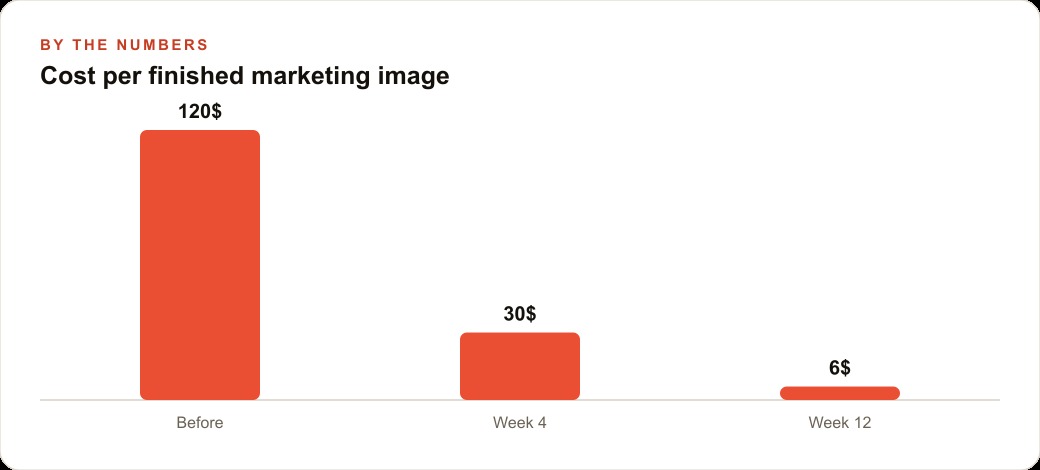
A bakery owner posting three to five times per week to Instagram and Facebook has a content production problem. Before this model, the options were: hire a photographer for a quarterly shoot at 800 to 1,500 dollars, pay a designer a monthly retainer for social graphics at 300 to 600 dollars, take their own phone photos and accept inconsistent quality, or post generic stock images that convey nothing specific about the bakery. Total annual creative cost at the professional end: 5,000 to 8,000 dollars, plus briefing time, revision rounds, and the delay between having an idea and having an image ready to post.
With the new model, the owner sits down on Monday morning and describes the visual for each post that week. Monday is a warm overhead shot of croissants with a handwritten-style label showing the price and availability. The label text is accurate and readable in the generated image. Tuesday is a process infographic showing the four stages of their sourdough, each step labeled clearly with accurate text. Wednesday is a seasonal promotional graphic announcing a Friday special with the correct price, the exact date, and the product name visible in legible type on a designed background that matches the bakery's colors. Thursday is a lifestyle image of the display case with a weekend availability message in clean, readable text across the bottom. Friday is a behind-the-scenes graphic with a simple two-step process for ordering custom cakes, labeled in clear type.
All five images are generated in under 90 minutes from text descriptions and two or three reference photos to maintain the brand's visual style. The owner reviews every text element in every image for accuracy, which takes about eight minutes across the full set. Every image in the week looks stylistically consistent because the same visual style reference was used across all five generations. The week's social content is ready before the first customer arrives.
The cost comparison is direct. The monthly tool cost for access to the model is a small fraction of even a single professional shoot. Over a full year, the creative cost for a consistent, on-brand, frequently updated social presence drops by the large majority of what it previously cost to produce at any professional standard. The savings are large enough to absorb the tool cost many times over and still represent a meaningful reduction in total marketing spend. The one practice to maintain: read every text element in every image that will be published, especially any image that shows a price, a date, a product name, or any health or regulatory claim.
That is exactly what we do at AI DOERS. Book a private 30-minute call with Madhuranjan Kumar and we will map the fastest path to it for your specific business.
Book your call →
Madhuranjan Kumar
Madhuranjan Kumar brings 20 years of performance-marketing experience and has managed over $200 million in Facebook ad spend for brands across the United States and beyond. His expertise spans the full modern marketing stack: Meta, Google Ads, TikTok, email automation, CRM, and the websites that hold it together. At AI DOERS he turns that track record into lead-generation systems for businesses across every industry.