
Why You Keep Hitting Your AI Limit and How to Fix It
Hitting your usage cap fast is almost never a plan problem. It is a context hygiene problem, and a few simple habits can stretch every session two or three times further.

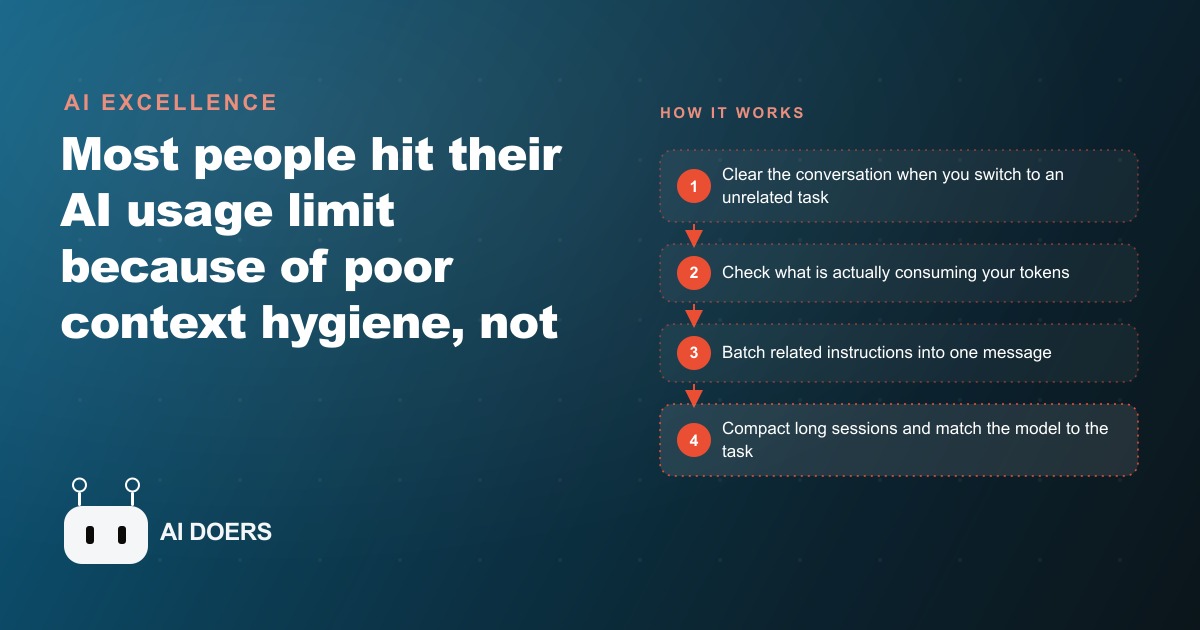
I have worked with enough teams using AI tools daily to recognize the pattern immediately when someone tells me they are hitting their usage cap halfway through the month. Before I ask anything else I ask one question: do you start a new conversation when you switch to a different task? The answer is almost always no. That single habit, or its absence, explains the majority of AI usage complaints I encounter. The underlying problem is almost never the plan size. It is context hygiene.
Here is what context hygiene means in practice. Every message you send to an AI assistant requires the system to read the entire conversation from the beginning before it responds. Not just your latest message. The whole thread: message one, its response, message two, its response, all the way down to the current prompt. Cost does not add with each message. It compounds. By message 30 in a long thread, the model is processing many times more text per response than it did on message one. On top of that, connected tools, memory files, and system prompts reload on every single message, contributing invisible overhead you are paying for constantly.
The good news is that fixing this does not require a bigger subscription. The following eight habits address the most common sources of wasted budget and together routinely stretch a session two to three times further than it goes with default behavior.
Start a new conversation every time you switch to a different task
This is the single highest-impact habit and the one most people resist because starting fresh feels like losing the context you built. In practice, the context built up in a previous task is almost never useful for the next one. It is overhead you are paying to drag into a conversation where it contributes nothing.
If you spent an hour writing a marketing email in one thread and now need to analyze a spreadsheet, carrying that hour of email conversation into the spreadsheet analysis means every response in the analysis session costs more because the model is processing the email context too. The email context contributes nothing to the spreadsheet analysis and inflates the cost of every subsequent message.
The practical rule is that each distinct task type gets its own conversation. A new email draft, a new conversation. A new data analysis, a new conversation. A new piece of research, a new conversation. The cost reset from starting fresh is typically the largest single improvement available in any usage situation and it costs nothing except the thirty seconds it takes to open a new chat and provide a brief opening sentence.
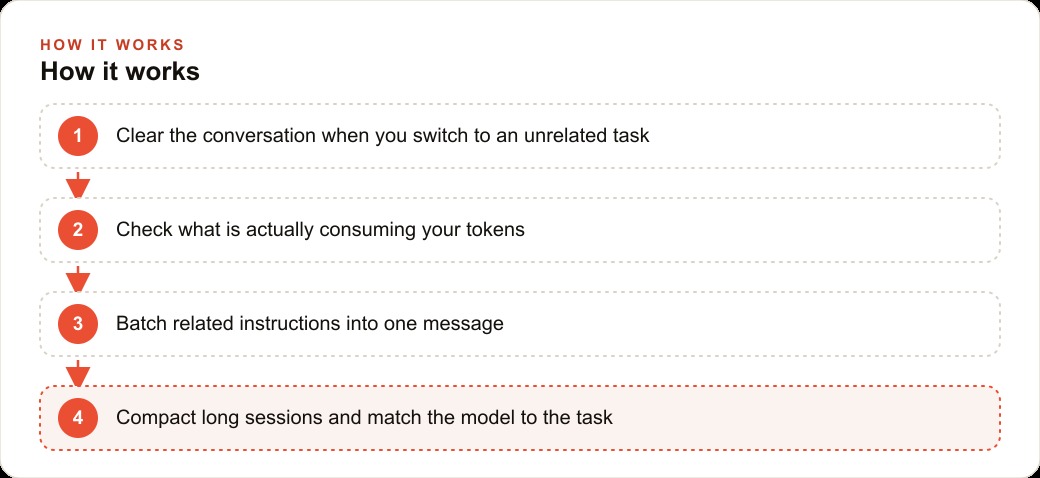
Check what is actually loaded before your first message of the session
Most people have no clear picture of what is consuming their budget at any given moment. Connected tools, memory files, and system prompts all add to the context processed on every message, and they do so invisibly unless you look. Making the invisible visible turns a guessing game into something you can actually fix.
Before sending your first substantive message in a session, take thirty seconds to check what is loaded. Are tools connected that you do not need for this specific task? Is a memory file active that is large or contains information irrelevant to the current job? Is there a system prompt loaded from a previous configuration that still runs in this session? Each of these items costs tokens on every message. Disconnecting the ones you do not need before you start can meaningfully reduce the overhead on every subsequent exchange.
This habit also builds accurate intuition over time. Once you can see what is loaded at the start of each session, you develop a real sense for which configurations run lean and which are expensive. That intuition is more useful than any abstract rule about token counts.
Map the approach before building anything
The biggest single waste of AI budget is not inefficient prompting. It is going down the wrong path, generating a pile of work, and then scrapping it and starting over. That mistake can consume the equivalent of an entire session's budget in a few exchanges, and it happens when you ask the AI to produce output before you have confirmed the approach matches what you actually need.
The habit that prevents it takes almost no time: ask one planning question before any build. Something like "before we start, what information do you need from me and what approach would you take for this?" takes a few seconds and often surfaces a misunderstanding or a missing piece that would have derailed the session twenty messages in. A minute spent redirecting the approach based on that answer is worth far more in saved budget than a correction prompt sent after the model has already gone the wrong direction.
For longer or more complex tasks, spend the first exchange getting a brief outline of the plan before committing to it. Review the outline, correct any assumptions that are wrong, and confirm the structure before asking the model to start producing content. That sequence adds one to three messages to the session and frequently saves ten to twenty by preventing a dead end.
Batch related instructions into a single message
Three separate messages cost three times what one combined message costs. That arithmetic is straightforward and most people violate it constantly. Each time you send a correction, an addition, or a follow-up as a separate message, you are paying for the model to reread the entire conversation one more time before it responds. Grouping related instructions together eliminates that repeated cost.
The habit is to hold your corrections and additions until you have several, then send them together. If you read a draft and see five things you want changed, write all five into one message rather than sending them one at a time as you notice them. If you have a follow-up question and a refinement request ready at the same time, send them together. The model handles multiple instructions in one message and handles them more efficiently than five separate exchanges covering the same ground.
This habit tends to produce better outputs as well. When you send all your refinement criteria at once, the model can balance them against each other and produce a result that addresses all of them simultaneously rather than zigzagging toward them one correction at a time.
Replace long document pastes with a short purposeful reference file
Pasting a full document into a conversation when you only need one section is like bringing an entire filing cabinet to a meeting when you need one page. The model processes every word you paste, and those words cost tokens on every subsequent message in the session.
The habit is to maintain a short reference document for any context you reuse across sessions. A one-to-three page document covering your brand voice, standard pricing, key business rules, typical disclaimers, and any other recurring reference material is far cheaper than re-explaining the same background every conversation or pasting a long document that buries what you need inside a lot of what you do not.
When you need specific information from a long document, paste only the relevant section. If you need one paragraph revised in a twenty-page contract, paste that paragraph, not the full contract. If you need a policy explained from a forty-page handbook, paste the relevant section. The model does not need the surrounding material to handle the specific task, and you are paying for every word it processes.
Maintaining a lean reference file also forces clarity about what your recurring context actually is. The exercise of distilling your key business information into two pages often surfaces things you had been re-explaining redundantly for months, and the resulting file tends to produce cleaner outputs because the model reads a curated brief rather than hunting through a large document for relevant details.
Compact a long session at the midpoint instead of letting it bloat
Any session running more than an hour or covering complex ground will accumulate significant history. That history compounds the cost of every message after it, and much of it, the early exploratory exchanges, the iterations that were replaced, the questions you asked while getting oriented, is no longer relevant to where the work stands.
The habit is to compact the session at roughly the halfway point by asking the model to summarize where things stand, what has been decided, what still needs to happen, and what the key reference points are. Take that summary, clear the conversation, and open a new session starting from the summary. You preserve everything that matters and drop the overhead that has accumulated from the early work.
This habit feels like extra effort and saves significant budget over the course of a long work session. A session that continues to grow without compaction becomes exponentially more expensive per message as the history grows. A session that resets from a summary every hour or so stays closer to its early-session efficiency for much longer.
Match the model to the complexity of the specific task
Premium AI models are better at hard reasoning. They are not better at formatting a list of phone numbers, changing a font in a document, or drafting a short standard reply to a common question. Using a premium model for simple tasks is the same as hiring an expensive specialist to do routine work: you pay for capability you are not using.
Most platforms now offer a choice of models at different price points and capability levels. The habit is to identify which of your recurring tasks actually require the premium model's reasoning capability and which ones do not, then route accordingly. Research, analysis, complex writing, problem-solving, and multi-step reasoning benefit from the best available model. Formatting, simple drafts, short standard responses, data cleanup, and template filling can run on cheaper, faster models without any noticeable difference in output quality for those specific tasks.
Building the model-routing habit takes a few days of conscious attention at the start of each task. After a week, the right model for each task type becomes automatic.
Schedule the heaviest work for off-peak hours
Demand affects how fast your usage window drains. At peak hours, when large numbers of users are all making requests simultaneously, the system processes requests more slowly and sometimes less efficiently. Your heavier, more computationally demanding tasks perform better and use your allocation more effectively when they run during quieter periods.
The practical application depends on your workflow. If you run a large weekly data analysis, running it early in the morning or late at night typically gets the same work done with fewer interruptions and further within your allocation than running it at midday during peak load. If you batch content generation for the week, the early morning or late evening is generally quieter than Tuesday afternoon.
This is a marginal improvement compared to the habits higher on this list, but it is a free one. For heavy users who have already adopted the other habits and are still bumping against limits, timing is often the next place to look.
The worked example: a real estate brokerage with a predictable Monday afternoon wall
A real estate brokerage with eight agents, each on a mid-tier AI subscription at around 100 dollars per user per month, is spending 800 dollars per month on AI tooling. Each agent keeps one long chat open all day and piles every task into it: listing descriptions, contract summaries, follow-up email drafts, buyer question responses, comparative market analyses. By early afternoon every Monday and Wednesday, every response is dragging hours of unrelated history and the limit hits. Agents stop getting useful replies right when deal activity is highest.
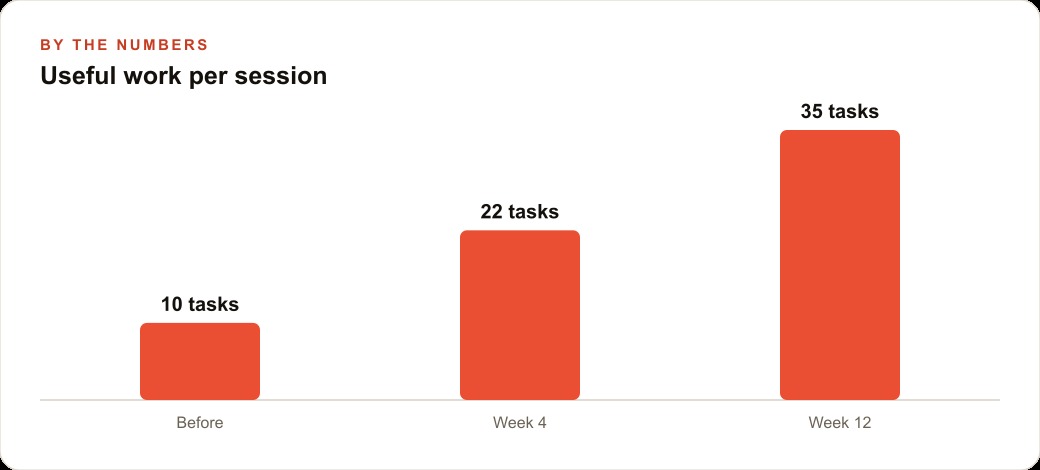
Applying the first habit alone, starting a fresh conversation for each distinct task type, extends most agents' sessions past end of day. Adding the batching habit, the planning step, and a lean reference file containing the brokerage's voice guide, standard disclaimers, and neighborhood descriptions, the effective capacity of the same 800 dollar monthly spend handles roughly twice the volume it handled before. Two or three agents find they can drop to a lower plan tier entirely, saving 200 to 300 dollars per month as a direct result of context hygiene that costs nothing to implement.
The habits are not complicated and they do not require learning new tools. They require a small amount of attention at the start and middle of each session until they become automatic, which for most people takes about a week of deliberate practice. The return on that week, in budget extended and outputs improved, is one of the better investments available to any team using AI tools as a central part of their daily work.
That is exactly what we do at AI DOERS. Book a private 30-minute call with Madhuranjan Kumar and we will map the fastest path to it for your specific business.
Book your call →
Madhuranjan Kumar
Madhuranjan Kumar brings 20 years of performance-marketing experience and has managed over $200 million in Facebook ad spend for brands across the United States and beyond. His expertise spans the full modern marketing stack: Meta, Google Ads, TikTok, email automation, CRM, and the websites that hold it together. At AI DOERS he turns that track record into lead-generation systems for businesses across every industry.