
Sora 2 for Small Business: Cinematic Video From a Sentence
OpenAI's new video model produces realistic short clips from text. Here is where it shines, where it slips, and how a roofing company can use it without faking anything.

The cost of a professional-looking marketing video for a local business dropped this month. Not incrementally: structurally. OpenAI's Sora 2 can generate short clips from a text description with synchronized sound, realistic physics, and visual quality that closes a meaningful portion of the gap between what a freelance videographer produces and what a small business with no production budget can generate on its own. I am Madhuranjan Kumar, and I want to think through what this actually means for a roofing company, a cleaning service, or any local business that has been producing static image ads because video felt financially out of reach.
The demonstration clips for Sora 2 circulating this week are the obvious ones: dramatic nature scenes, celebrity reimaginings, conceptual art. Those generate attention but they are not the use case. The use case is a roofing company that wants a ten-second social clip of heavy rain sheeting off a clean, well-sealed roof while warm light glows from the windows below. The use case is a cleaning service that wants a clip of a spotless kitchen with morning light coming through the window and steam rising from a freshly made coffee. The use case is a plumbing company that wants a slow push toward a house with the message that there is someone reliable available when something goes wrong. These are the shots that make the services feel trustworthy before a prospect has ever called, and they used to require a film crew, a location, and a post-production budget that most local businesses cannot justify.
Sora 2's realism jumped meaningfully in this release. Water behaves like water. Smoke moves realistically around objects. Reflections in curved surfaces bend the room correctly. Light changes over the course of a clip in a way that matches how light actually changes. These physical simulation improvements are not cosmetic. They are the specific elements that make a clip of rain running off a roof look like actual footage rather than like a video game rendering. The Cameo feature, which generates a personalized presenter from a single facial scan, adds the option to put the business owner in the frame as a consistent on-screen presence without scheduling a shoot.
The limitations are real and knowing them is what separates good use from embarrassing use. Fine hand movements consistently produce unnatural results. Text that appears in the generated video, a price chart, a phone number, a product specification, comes out jumbled or wrong. The same prompt generates meaningfully different results on different runs. Faces sometimes shift slightly between shots in a way that is detectable if you are looking for it. And the model does not distinguish between atmospheric content, which it handles well, and factual content, which it does not handle at all.
The framework for a roofing company, or any local service business, is: use Sora 2 for atmosphere and use real footage for proof. Never the reverse.
Atmosphere is what the generated clips provide. A storm approaching a neighborhood. Rain running off a roof in close-up detail. A wide establishing shot of a house at sunset with a clean roof line against the sky. An interior shot of a cozy room while weather moves outside the window. None of these make a claim about the specific company, the specific work quality, or any specific job. They set a scene that activates the viewer's emotional sense of what the company protects. That is exactly what the model does well.
Proof is what real footage provides. A before-and-after sequence showing an actual job. A photo of the crew who will show up. A review from a real past client with their name and location. A drone shot of a completed roof with identifiable neighborhood context. These are the elements that convert atmospheric interest into a specific business decision, and none of them can be generated by a text-to-video model without introducing misleading content. A viewer who watches a generated clip of a crew installing a roof and believes they are looking at the company's actual crew has been misled, and that misleading erodes the trust the content was supposed to build.
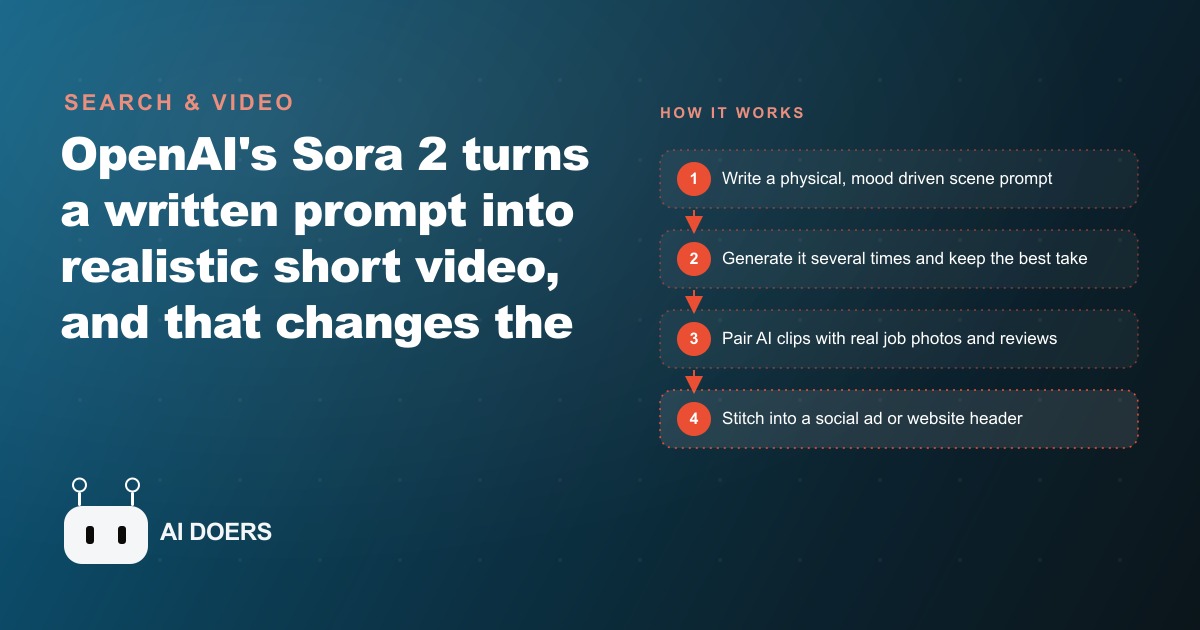
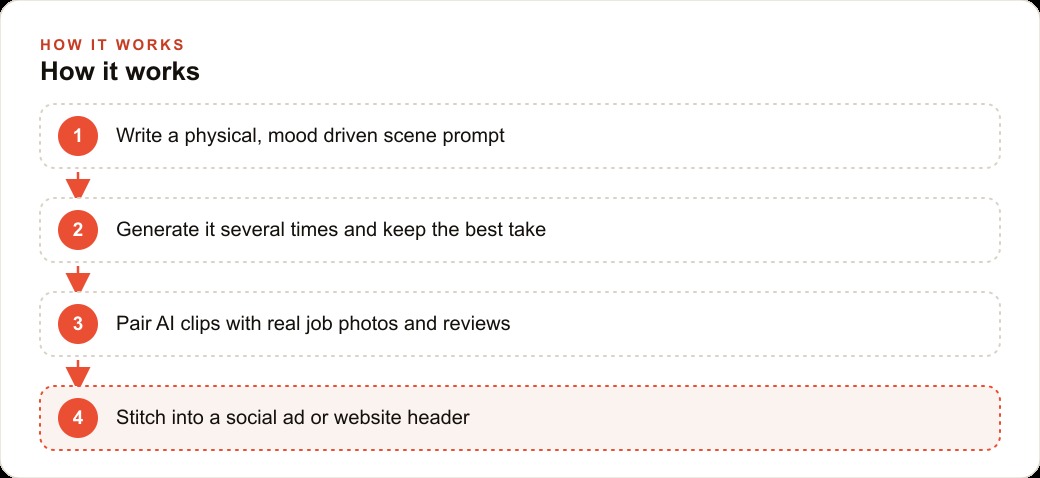
The production workflow that works for a roofing company has four steps, each taking under thirty minutes.
Step one: write scene descriptions for three atmospheric clips. Keep them physical and mood-driven. Rain sheeting off metal flashing. A wide shot of a house exterior on a clear autumn day with the camera slowly rising to show the roofline against a blue sky. A close-up of gutters running clear during heavy rain while the surrounding landscape is wet and dark. These descriptions work with Sora 2's strengths: weather, water, camera motion, natural light.
Step two: generate each description three to four times and select the best version. The variance between runs is high enough that multiple generations are worth the time. A clip that looks artificial in one run may look nearly cinematic in another from the same prompt, simply because the model's stochastic generation process found a better interpretation on the second or third attempt.
Step three: assemble real materials. Three actual job photos showing representative work quality. One or two customer review excerpts with attribution. The company phone number and service area. These pieces do not need to be generated. They need to be pulled from the business's existing documentation.
Step four: stitch the atmospheric clips with the real materials in a simple editing tool. The generated clips provide the visual hook and the emotional context. The real materials provide the specific credibility that converts the hook into a call. The combination is more persuasive than either alone, because atmosphere without proof generates curiosity that does not convert, and proof without atmosphere generates information that does not engage.
For a roofing company running Facebook and Instagram ad campaigns, the atmospheric clips provide the creative variety that campaign testing requires. Static image ads and atmospheric video clips can run against each other in the same campaign, with the testing framework determining which format produces better cost per lead at a given budget level. The generated clips cost nothing beyond the subscription to produce, which means the testing library is limited only by the time spent writing descriptions and reviewing outputs.
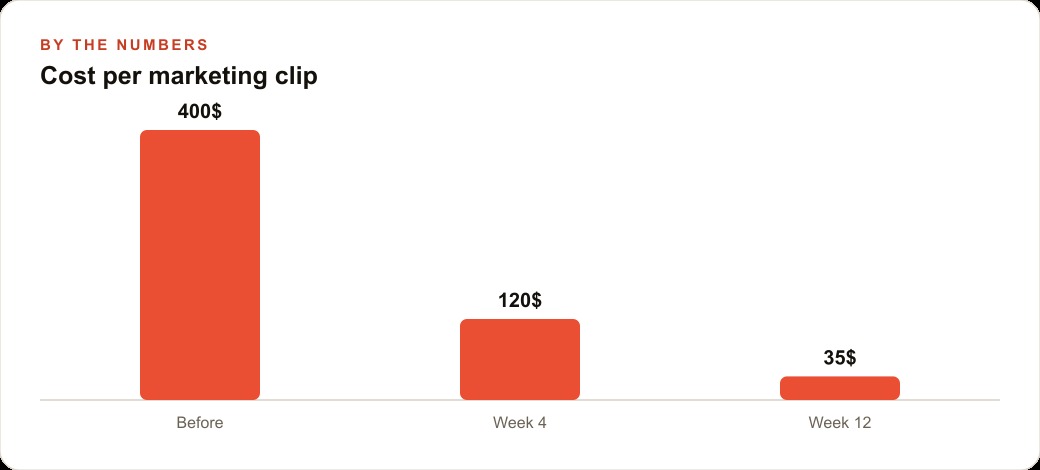
The comparison to a freelance video production budget makes the economics clear. A short atmospheric clip produced by a freelance videographer typically costs between one hundred fifty and five hundred dollars depending on location, complexity, and turnaround time. Producing ten atmospheric clips through Sora 2 at the forty-dollar-per-month subscription tier costs four dollars per clip in subscription costs plus whatever time the generation and selection takes. The quality ceiling of the generated clips is currently below professional production at its best, but it is above what most local service businesses were previously producing because they were producing nothing, and nothing costs attention and revenue every week it persists.
That is the actual change this week. Not that AI video is better than a production crew, which it is not yet. Not that every local business should immediately overhaul their marketing, which would be premature. But that the category of business for which professional-quality atmospheric video content is financially accessible just expanded significantly, and a roofing company that understands the framework above can produce better social content this weekend than it produced last month, at a cost that rounds to zero, using tools that require no production expertise to operate.
Whether you build this workflow yourself this weekend or bring someone in to build it for you and test it against your Google Ads campaigns and organic social channels is a question about how you want to spend your time. The workflow is genuinely learnable in an afternoon. The first three sessions produce noticeable improvement in generation quality as the prompting instinct develops. By the fourth session, the workflow is fast enough to produce a week of atmospheric social content in under two hours. Both paths to that outcome are available. The one that is not available is doing nothing and hoping the competitive gap does not widen.
That is exactly what we do at AI DOERS. Book a private 30-minute call with Madhuranjan Kumar and we will map the fastest path to it for your specific business.
Book your call →
Madhuranjan Kumar
Madhuranjan Kumar brings 20 years of performance-marketing experience and has managed over $200 million in Facebook ad spend for brands across the United States and beyond. His expertise spans the full modern marketing stack: Meta, Google Ads, TikTok, email automation, CRM, and the websites that hold it together. At AI DOERS he turns that track record into lead-generation systems for businesses across every industry.