
Sora 2 Is Here and It Will Change How You Create Video Content: What Every Business Owner Needs to Know
OpenAI's Sora 2 can generate near-commercial-quality videos from a text prompt. For businesses that rely on video marketing, this changes the economics of content production completely, but the platform design introduces risks you should understand before diving in.

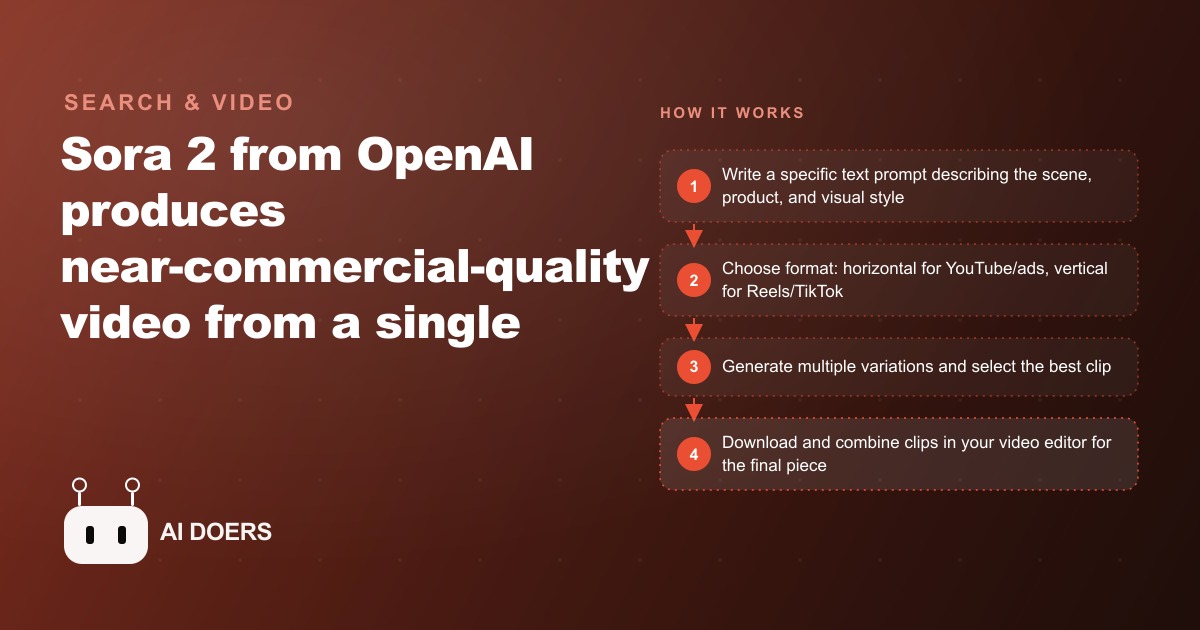
OpenAI's Sora 2 launched this week with capabilities that change what a business owner without a video production team can produce. I am Madhuranjan Kumar, and I want to tell the story of this tool the way its commercial implications actually play out rather than the way most coverage has framed it, which is mostly the ethics controversy around AI avatars and the entertainment novelty of photorealistic video generation. Both of those are real dimensions of the story. Neither is the most important one for a business evaluating how this tool changes what they can do with video content.
Text Prompts Now Generate TV-Quality Commercial Video, and the Production Team Requirement Is Gone
The baseline capability that defines Sora 2's commercial relevance is this: a business owner can describe a video in natural language, and the system produces footage that, in favorable conditions, is visually indistinguishable from professionally produced commercial video. Not always. Not for every type of scene. But often enough, and for a wide enough range of common commercial video types, that the tool represents a genuine production path for businesses that could not previously afford video production at all.
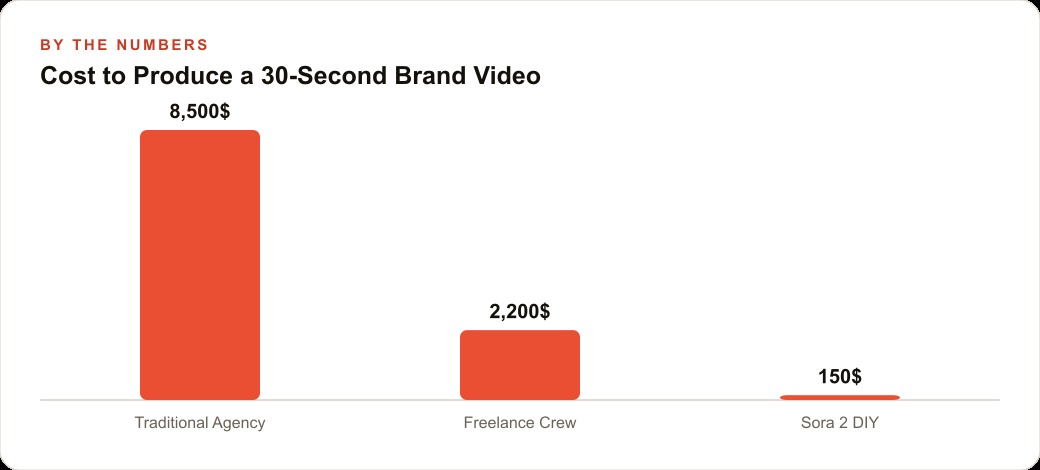
The cost comparison that makes this concrete is not Sora 2 versus a fully equipped video production studio. The relevant comparison is Sora 2 versus the realistic alternative for a small business: no video, or very low-quality video shot on a phone with no production value. Between those three options, Sora 2 produces content at a quality level that was previously only accessible to businesses with either in-house video capability or a production budget of several thousand dollars per video. The tool does not replace a professional video team for complex narrative production. It replaces the default no-video or low-quality-video path that most small businesses are currently on.
The scenarios where current AI video generation works most reliably for business use are product showcase videos where the product exists as a well-documented physical object, atmospheric brand videos that convey a visual identity without complex narrative, educational explainer content that uses visual metaphor rather than scripted action, and testimonial-style content where the visual treatment is secondary to the spoken content. The scenarios where it remains unreliable are complex multi-person interactions, precise physical demonstrations with specific procedural accuracy requirements, and content where fine emotional nuance is critical. Knowing which category your specific video need falls into determines whether Sora 2 is usable for that need right now or whether it requires waiting for the next capability iteration.
Sora Is Also a Social Feed, Not Just a Tool, and the Discovery Dimension Is New
One aspect of the Sora launch that most coverage treated as a secondary detail is that the platform includes a social feed where user-generated AI video content is discoverable and shareable. For a business creating content on Sora, the feed provides a distribution channel within the platform itself rather than requiring every piece of content to be exported and re-uploaded to a separate platform for any distribution to occur. The Sora feed is currently small relative to established social video platforms, but it is populated by an audience that is specifically engaged with AI-generated video, which represents a more receptive early adopter environment than trying to build an AI video presence on platforms where AI content is competing with years of established organic video.
For a business experimenting with AI video content, seeding a presence in the Sora feed during the early adoption period is the same strategic move as building a presence on any social platform before it reaches mass scale. The return on early content accumulation compounds when the platform grows, because older content continues to surface to new users discovering the platform and searching for content in a business's category. The businesses that dismissed Instagram video in 2013, TikTok in 2018, and YouTube Shorts in 2021 on the grounds that the platform was too small to justify production investment are the ones that had to catch up later at higher cost and with less advantage.
Cameos Allow Consent-Based AI Avatars, and the Business Consent Workflow Matters More Than the Technology
One of Sora 2's specific capabilities is Cameos, which allows a user to upload a consented video of a real person and generate new video featuring that person in different settings or scenarios. The capability is framed in OpenAI's documentation as requiring explicit consent from the person depicted, and the platform includes workflow elements designed to support consent verification.
The business relevance of Cameos is specific to use cases where a business needs more video content featuring a specific person than it can efficiently produce through traditional filming. A founder who has filmed one strong testimonial segment can potentially extend that content to multiple settings, backgrounds, or presentation formats. A customer who has provided a video testimonial can appear in different contextual placements without requiring them to return for additional filming sessions. The consent workflow required by Cameos creates a business process requirement: before using anyone's likeness in AI-generated video, the consent collection and documentation must exist, and the business must maintain that documentation in case the consent is later questioned.
The liability dimension of any AI video featuring real people is the part that most coverage mentions briefly and moves past quickly. For a business creating marketing or advertising content, the liability for using someone's likeness without valid consent is real regardless of whether the generation method was AI or traditional production. The AI generation method does not create new consent requirements. It removes the natural friction of traditional production that previously made generating unsanctioned likeness content more difficult. The consent requirements that existed before Sora 2 remain, and businesses that skip them face the same liability they would have faced with any other production method.
Photo to Video Removes the Filming Requirement for Many Standard Commercial Video Types
The feature with the most immediate practical application for businesses that already have a library of professional photography is Photo to Video: uploading still images and having the system generate motion content around them. A product image becomes a product showcase clip. A location photo becomes an atmospheric brand clip. A team photo becomes an introductory clip for the company's website or social profiles. The generation adds motion, simulated camera movement, ambient elements, and atmospheric lighting to the still, creating video content from visual assets the business already has.
For a business that has invested in professional product photography for an e-commerce catalog or for advertising creative, the photo-to-video feature is an immediate path from existing assets to video content without any new photography investment. The quality of the generated motion depends heavily on the quality and composition of the source photograph: images with clean backgrounds, strong lighting, and uncluttered composition produce better motion output than images with complex or busy backgrounds. For businesses whose existing product photography was shot against a clean studio background, the photo-to-video conversion rate from still to usable video is higher than businesses working with lifestyle photography in complex environmental settings.
Vertical and Horizontal Formats Both Supported, Which Means One Asset Can Serve Multiple Channels
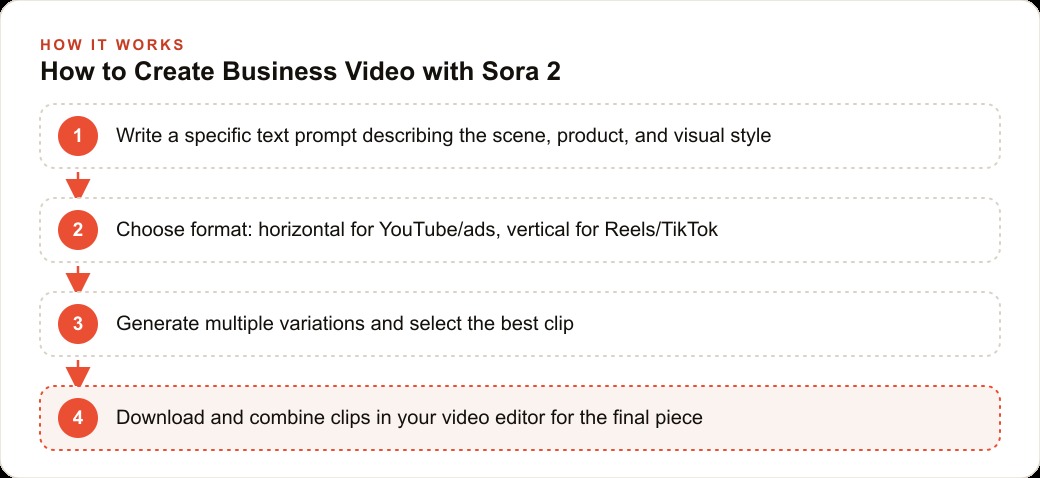
Sora 2 generates video in both vertical and horizontal formats, which matters for businesses creating content for multiple distribution channels simultaneously. A horizontal format video is appropriate for YouTube, website embedding, and television-style advertising placement. A vertical format video is appropriate for TikTok, Instagram Reels, YouTube Shorts, and Facebook Stories. The ability to generate in both formats from the same prompt means a single creative concept can be executed in both orientations without running two separate production processes.
For a business managing a social media content calendar across multiple platforms, the format flexibility reduces the production work required to maintain presence across all channels simultaneously. A single ideation session for a brand video can produce a horizontal version for YouTube and website use and a vertical version for short-form social platforms, with the total generation time for both being less than traditional production for either one individually.
Invite-Only at Launch Limits Early Access, and That Constraint Is Temporary
Sora 2 launched in invite-only mode, which means immediate access requires a waitlist or an existing relationship with OpenAI. This constraint is standard for high-demand launches and is temporary rather than permanent. For a business that wants to evaluate the tool before making any content investment decisions, the practical path is to request access now and use the waiting period to develop a clear set of test prompts drawn from the business's actual video content needs, so that when access arrives, the evaluation can be focused and efficient rather than exploratory.
The businesses that use the waiting period productively, by defining what they need from AI video before they have access to it, are the ones that can evaluate the tool quickly and make a clear adoption decision rather than spending the first weeks of access in unfocused exploration. A focused evaluation with five to ten specific test prompts drawn from real content needs produces a clear answer about whether the tool fits the business's requirements. An unfocused evaluation produces a general impression of the tool's capability that does not translate into a clear operational decision.
Business Use Cases Outweigh the Controversy, and the Controversy Will Fade Faster Than the Use Cases
The AI video controversy, primarily centered on the potential for misuse through deepfakes and non-consensual likeness use, received significantly more coverage than the legitimate commercial use cases at launch. That coverage distribution reflects how media cycles work around new technology with dual-use potential rather than a proportional assessment of where actual impact will occur. The proportion of Sora 2 usage that goes toward legitimate business video production versus misuse will become clear over the months following launch, and based on the pattern of every previous AI generation tool, the overwhelming majority of actual usage is for legitimate creative and commercial applications.
For a business evaluating whether to invest time in learning and using Sora 2, the controversy-to-legitimate-use ratio of launch coverage is not the signal to optimize on. The signal is whether the tool can produce content that improves your specific video outcomes at a cost of time and money that makes sense for your business. That evaluation is done with test prompts on your actual content needs, not with editorial assessments of AI video's potential for misuse. The potential for misuse is real and worth the attention it receives in policy and ethics discussions. It is irrelevant to the business decision about whether to use the tool for legitimate commercial video production, which has been the use case of every video production technology that existed before AI and will continue to be the dominant use case of every AI video tool that exists after Sora 2.
The most direct business application is to start with a single campaign where video content has been a gap in your current marketing, identify the specific type of video that would address that gap, write three to five detailed prompts for that video type, and test them through Sora 2 once access arrives. Evaluate the outputs against the specific quality standard required for your distribution channel and your audience. If they meet that standard, you have a production path for that video type that is available at a fraction of traditional production cost. If they do not, document what the specific gaps are and re-evaluate in three to six months as the tool continues to improve.
The Competitive Window for Early AI Video Adopters Is Open Right Now and Will Close
The period in which producing AI video content creates a genuine competitive differentiation is finite. Early adopters of any production capability have a window during which the capability signals sophistication and investment that most competitors lack. Once a capability becomes standard practice, the differentiation disappears and the business that adopted early is simply maintaining parity with the field rather than leading it. For AI video, that window is currently open. Most small businesses are still not producing regular video content, and most of those that are producing video are not yet using AI generation as part of the production workflow. A business that begins building an AI video presence now, and accumulates content and audience during the early period, will be ahead of competitors who start the same effort when AI video has become as standard as having a website. The content and audience built during the early period cannot be retroactively acquired when the window closes. It can only be built during the window while it is still open.
That is exactly what we do at AI DOERS. Book a private 30-minute call with Madhuranjan Kumar and we will map the fastest path to it for your specific business.
Book your call →
Madhuranjan Kumar
Madhuranjan Kumar brings 20 years of performance-marketing experience and has managed over $200 million in Facebook ad spend for brands across the United States and beyond. His expertise spans the full modern marketing stack: Meta, Google Ads, TikTok, email automation, CRM, and the websites that hold it together. At AI DOERS he turns that track record into lead-generation systems for businesses across every industry.