
Solo Founder Money Machines: AI Micro-Business Lessons for Owners
One-person digital businesses are earning real money, and AI agents now handle much of the research and build. Here is the pattern behind them and how an owner can add a profitable side stream.

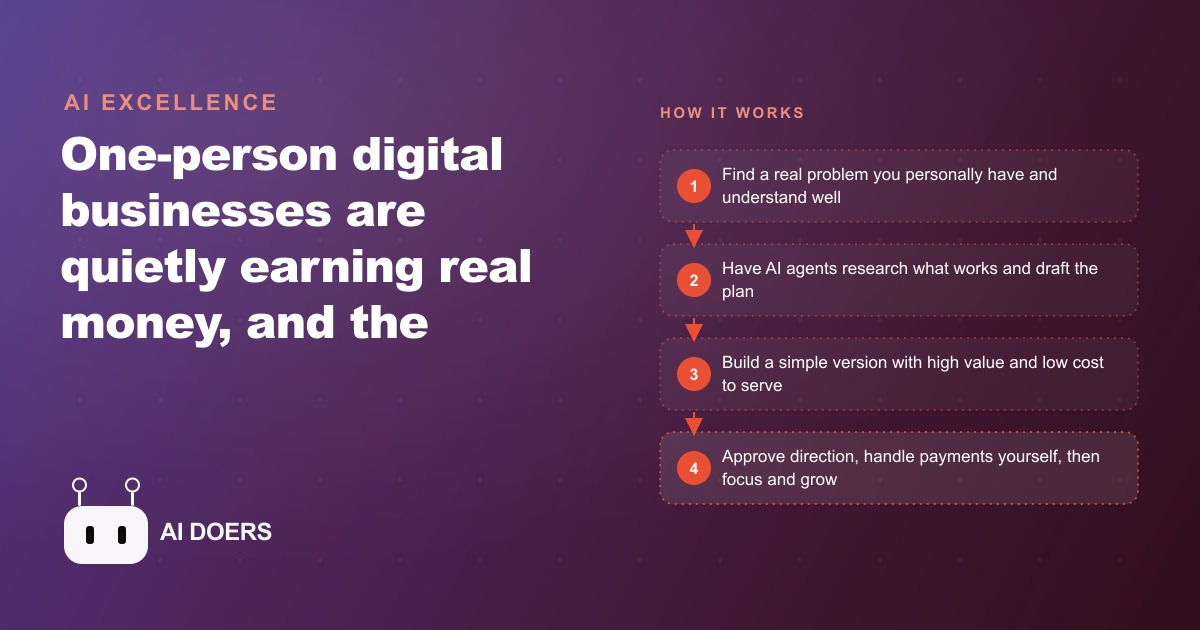
Several one-person digital businesses are pulling in five figures a month, and most of them were built in months, not years, because AI agents did the heavy lifting on research and the initial build. The founders are not engineers with decades of experience. They are people who understood one problem well enough, in one market well enough, to recognize that the tool for solving it did not exist yet. That is the repeatable pattern. This article is about the six lessons behind those businesses, and how a local business owner can apply them to build a real side revenue stream without quitting their main operation.
I, Madhuranjan Kumar, have spent time studying how these businesses work, not to copy any of them, but to extract the structure underneath them. The lesson is not the product. It is the shape of the business: high value to the customer, very low cost to serve each new user, and AI agents handling the research and the first build so the founder can focus on the part that only a human can do.
Lesson 1: High value per customer, near-zero cost per additional user
The most striking thing about the solo businesses that work is that the unit economics are completely different from a traditional service business. When a dentist sees one more patient, it costs real time and real labor. When a software tool serves one more user, it costs a tiny fraction of a cent in server resources. That asymmetry is the engine behind every successful solo digital business, and it is the first thing to look for when choosing an idea.
The businesses worth studying solve a need where the customer's willingness to pay is high because the cost of not having a solution is also high, but the cost of delivering the tool to one more person is near zero. A tool that helps a professional service firm avoid a costly regulatory error has high value because the mistake it prevents is expensive. A tool that helps a landscaping company generate quotes faster has value because each unbilled delay costs real money. In both cases, serving the hundredth customer costs essentially nothing more than serving the first.
This is why the businesses in this category can stay small and still earn meaningful revenue. They are not limited by how many hours the founder can work, because the product does not require founder hours for each additional user. That is the shape to aim for when you are choosing what to build.
Free online tools supported by ads and a small paid tier, narrow apps that do exactly one thing well, and databases that aggregate information in a specific niche have all demonstrated this pattern. One person, one product, high value, near-zero marginal cost. The economics that look impossible in a traditional service business are the default in a well-designed digital product.
Lesson 2: The data moat that takes years to copy
Several of the strongest solo businesses started as simple tools and became defensible not because the software was hard to copy, but because the data they collected over years was hard to copy. A directory that has been curating and updating listings in a specific niche for four years has something a well-funded competitor cannot buy: four years of corrections, user engagement signals, and refined categorization that came from actual use.
Data moats build slowly and become visible only in retrospect. The tool that a founder launches today as a simple lookup utility might be an authoritative industry database in three years, and the business value of that database is qualitatively different from the original tool. Major clients will pay for access to the database in ways they would not pay for the original tool.
The lesson for a business owner thinking about a side product is to choose a problem where the act of solving it generates useful data. If your repair estimate explainer tool processes five thousand estimates over two years and logs what customers accepted versus what they questioned, that log is a market intelligence asset with real value beyond the tool itself. The database that forms over time is the thing your competitors cannot recreate quickly, even if they can copy the software overnight.
This is also the long-term case for building rather than buying. Licensing someone else's data gives you access to what they collected. Building the tool that collects data gives you proprietary access to everything that accumulates from your specific users in your specific market.
Lesson 3: Solve a problem you personally live with
The strongest ideas in this category come from founders who were their own first customer. Not because personal pain makes a good story, but because understanding a problem deeply enough to design the right solution requires the kind of intimate familiarity you only get from living with the problem yourself.
An auto repair shop owner who has spent ten years explaining repair estimates to nervous customers knows exactly what a good explanation looks like. They know which parts customers misunderstand, which pricing explanations get pushback, and what a customer actually needs to understand before they feel comfortable approving the work. That knowledge is the core intellectual asset behind a good repair-estimate tool. No amount of user research replaces it.
This is also a natural quality filter. If you would not use the product yourself, that is important information. Products founders do not use tend to drift in ways the market does not value, because there is no internal signal about what actually matters. Products founders use every day stay calibrated because the founder notices immediately when something stops working.
For businesses thinking about a CRM and website stack investment or a new internal tool, the same principle applies: the tool you build out of your own frustration with an existing solution is the one most likely to solve the problem correctly, because you are the most informed critic of your own workflow.
Lesson 4: Let AI agents do the research and the first build
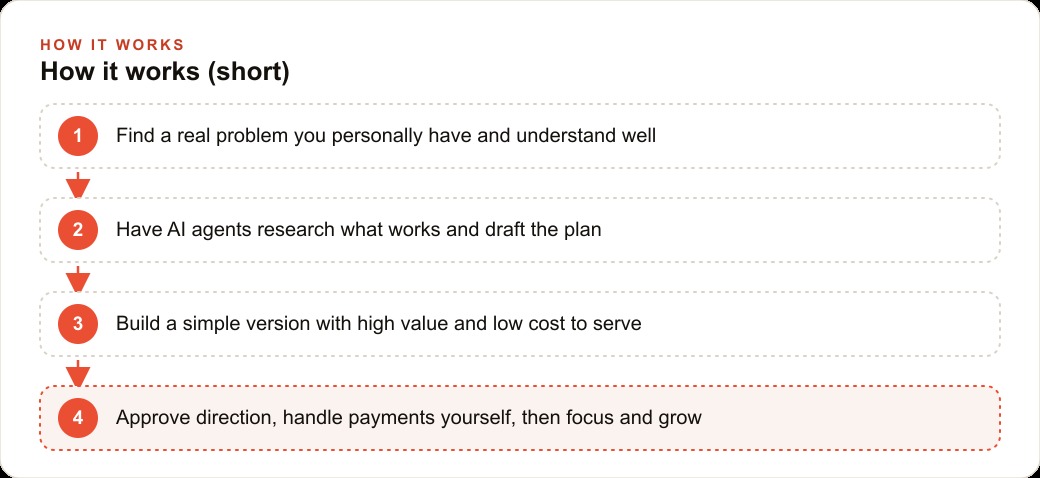
The economics of building a solo digital product changed when AI agents became capable enough to handle research, planning, and a large portion of the initial build. The founder's job is now more about steering than executing, and that shift is what makes the solo model viable for people who do not have coding backgrounds or large amounts of free time.
An AI agent can research which tools already exist in a niche, identify what they do well and where they fall short, draft a product roadmap, sketch an architecture, and generate a working prototype. The founder reviews each output, corrects the direction when it is off, and approves the next step. That division of labor would have required a team of three people two years ago. Today it is one person and an agent that works through the night.
The practical implication is that the barrier to starting is lower than it has ever been, and the time from idea to working prototype is shorter. A business owner who can describe a problem clearly and evaluate whether a proposed solution actually solves it has the core competency required. They do not need to know how to write code, run a server, or manage a database schema. The agent handles those tasks while the owner approves the output at each stage.
For businesses already running Facebook and Instagram ads to generate leads, the same agent-delegation model applies to the marketing workflow: use AI agents for drafting, research, and variant generation, while the business owner approves the final creative and the budget decisions. The pattern transfers across every part of the business.
Lesson 5: A human keeps the keys to payments and final approval
Every solo digital business that scales safely has one clear guardrail: the founder holds the keys to payments, banking, and the final approve-or-reject decision on anything consequential. AI agents handle the work. The human handles the accountability.
This is not a limitation of the current tools. It is a deliberate structural choice that protects the business. When an agent makes a mistake in the build, the founder catches it in review. When an agent drafts a pricing structure that misunderstands the market, the founder recognizes it before it ships. The agent does not make the decision; it produces the options and the analysis that inform the human decision.
For payment infrastructure specifically, maintaining human control over refunds, pricing changes, and subscription terms is both a legal and a practical necessity. The business owner signs the contracts, owns the merchant account, and is accountable for the product's promises to customers. Delegating that layer to an autonomous system creates legal and reputational risk that does not show up until it does, and by then it is too late.
The practical setup is straightforward. Agents build, research, and draft. Humans review the output, approve the go-forward, and handle anything involving money or legal commitment. That division runs well in practice and keeps the founder in a position of real oversight rather than theoretical oversight.
Lesson 6: Double down on one good idea instead of chasing five mediocre ones
Every founder who has built a solo digital business to real revenue has a version of the same story: there was a period when they were tempted to start something else and chose not to. A different niche. A different tool. A different distribution channel. The businesses that worked are the ones where the founder resisted the chase and stayed focused on compounding the one thing that was getting traction.
This is the hardest lesson because the early stage of a new product is uncomfortable. There are not many customers yet. The few you have are asking for features you have not built. The revenue is modest. That discomfort is what makes other ideas look attractive, because a new idea feels like possibility while a current product feels like a list of problems. The businesses worth studying are the ones where the founder stayed in the discomfort long enough for the compounding to become visible.
For a business owner building a side stream, this means choosing one idea carefully, committing to it for a defined period, and measuring the result before deciding whether to continue or pivot. The evaluation period matters: it needs to be long enough for the product to find its customers and for the customers to give feedback that informs the next iteration. A month is usually not enough. Three months in most cases starts to reveal whether the idea has legs.
The side stream that works is almost never the one you designed perfectly from the outside. It is the one you stayed with long enough to redesign based on what real customers told you.
A worked example: the repair estimate tool from month zero to month six
An auto repair shop owner builds a simple side tool that turns a repair estimate into a plain-language explanation a customer can trust. The owner has been explaining estimates verbally for ten years and knows exactly which parts customers misunderstand and which explanations produce confident approvals rather than hesitation and pushback.
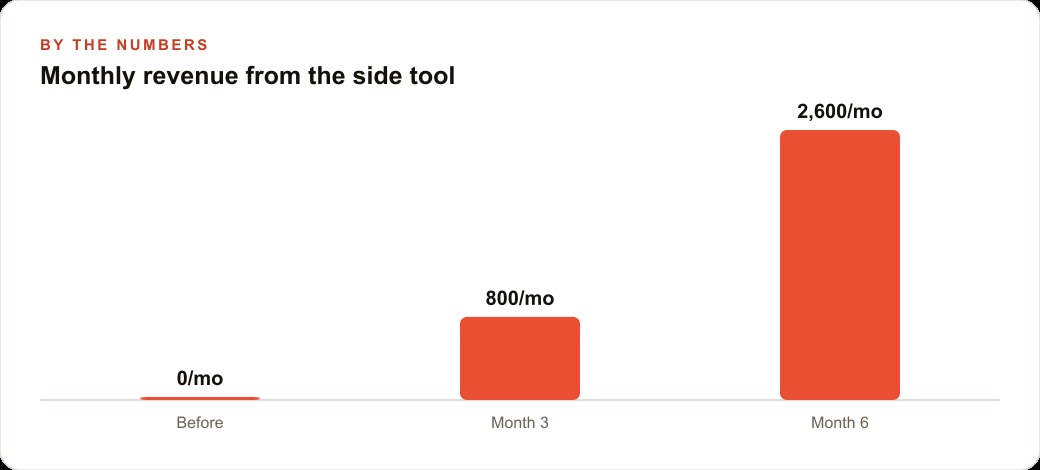
In month one, an AI agent researches what similar tools exist and where they fall short, drafts a simple architecture, and builds a working prototype. The owner tests it against the estimates that came in that week and corrects three explanations that are technically accurate but miss the customer's actual concern. The prototype goes to five regular customers as a trial. Four of them say it is clearer than any explanation they have gotten from a shop.
In month two, the tool goes live as a simple web page with a monthly subscription of twenty-five dollars. The first month ends with twelve paying customers, all of them local shop owners who heard about it through an industry group. Revenue: three hundred dollars. The owner spends about four hours total on customer feedback conversations and one small iteration on the explanation logic for diesel engines.
By month three, word has spread to a regional trade forum and subscriptions reach forty. Revenue: one thousand dollars. The owner has not touched the codebase since month two. The AI agent handles the one support ticket per week. The owner approves refunds personally.
By month six, subscriptions are at one hundred four. Revenue: twenty-six hundred dollars per month. The database of accepted versus questioned explanations, now covering several thousand estimates, is starting to look like a pricing benchmark dataset that larger industry players have expressed interest in licensing. The data moat is forming. The owner has not opened the code editor in three months, and the shop is still running normally.
The owner's Google Ads budget for the repair shop has stayed flat. The side tool has become a second revenue line that grows without consuming the time that belongs to the main business. Six lessons applied in order, one idea held through the uncomfortable early months, and a data asset forming quietly in the background. That is the pattern.
That is exactly what we do at AI DOERS. Book a private 30-minute call with Madhuranjan Kumar and we will map the fastest path to it for your specific business.
Book your call →
Madhuranjan Kumar
Madhuranjan Kumar brings 20 years of performance-marketing experience and has managed over $200 million in Facebook ad spend for brands across the United States and beyond. His expertise spans the full modern marketing stack: Meta, Google Ads, TikTok, email automation, CRM, and the websites that hold it together. At AI DOERS he turns that track record into lead-generation systems for businesses across every industry.