
How to Make AI Think Slowly: Multi-Agent Review Loops That Catch Mistakes
Single AI models rush to an answer and get hard problems wrong. Here is how a solver and reviewer setup forces careful reasoning, with a worked example for a financial advisor.

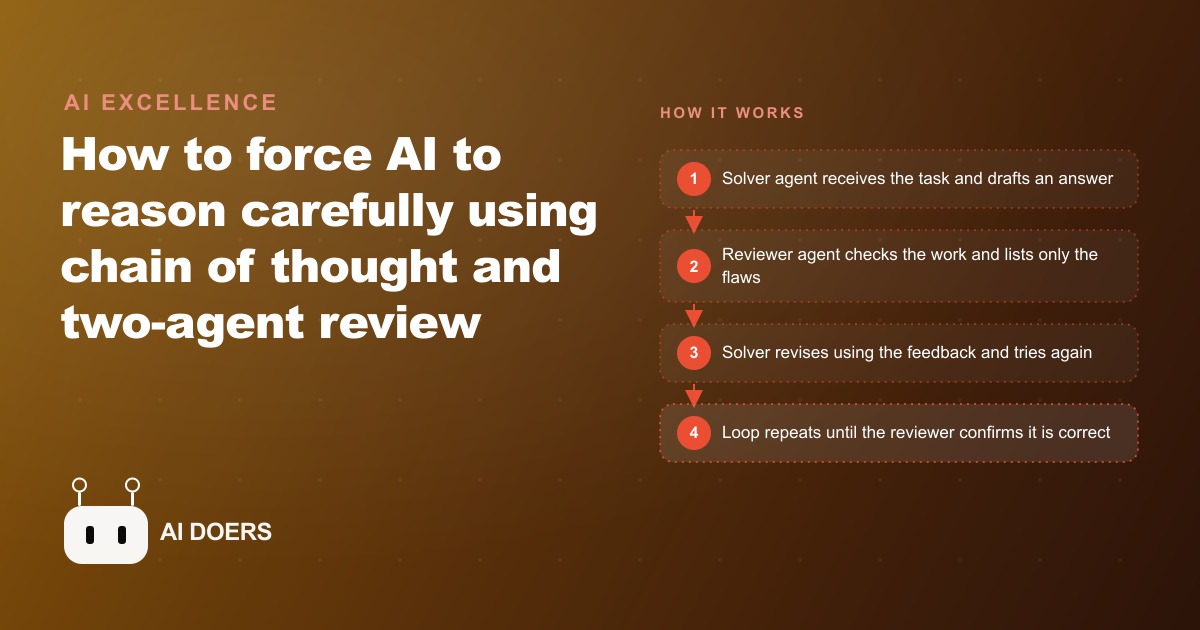
A single AI model, asked a hard question, will confidently give you the wrong answer at the same speed it gives you a right one. That is the quiet problem underneath a lot of disappointing AI output, and the fix that is now spreading through serious AI workflows is deceptively simple, stop letting one model answer alone, and make two of them argue until the work holds up. The shift from single-model prompting to multi-agent review loops is one of the most practical developments for anyone using AI on work where accuracy actually matters.
The change: from one fast guess to a deliberate second opinion
Here is what actually changed in how people get reliable output from AI. For a long time the default was to ask one model a question and take its first answer. That works fine for easy tasks and fails quietly on hard ones, because a language model, by default, predicts the next words quickly and treats a simple question and a genuinely difficult one with the same shallow effort. It does not naturally slow down when a problem deserves it.
The borrowed insight is from how people think. We have a fast, intuitive mode for things like one plus one, and a slower, careful mode for a long calculation. Most mistakes happen when we run the fast mode on a problem that needed the slow one. There is a well-known trick question about a bat and a ball costing a dollar and ten cents together, where the bat costs a dollar more than the ball. Almost everyone blurts out ten cents, and almost everyone is wrong. The answer is five cents, and you only reach it if you slow down and do the math. Today's models have the same weakness, and the news is that the workarounds have gotten good enough to build real workflows on.
Why the obvious fixes only go halfway
The first workaround people reach for is chain-of-thought prompting, and it genuinely helps. You add a line telling the model to think step by step, and it works through the problem in stages instead of jumping to a conclusion. That one small change fixes a surprising number of errors, because it mimics the careful, stepwise way people reason through something hard. For a lot of tasks it is enough, and it costs nothing to try.
But it has a real ceiling, and understanding the ceiling is what makes the next step click. Chain-of-thought explores only one line of thinking. When a problem is genuinely tricky, that single path can still be wrong, and asking the same model to reflect on its own answer often does not rescue it. In practice, a model will reread its work, declare the reasoning sound, and repeat the exact same mistake. It is genuinely hard for one model to catch its own blind spots, for the same reason it is hard for a person to proofread their own writing. The eyes that made the error are the eyes reviewing it.
The real move: a solver and a reviewer that do not trust each other
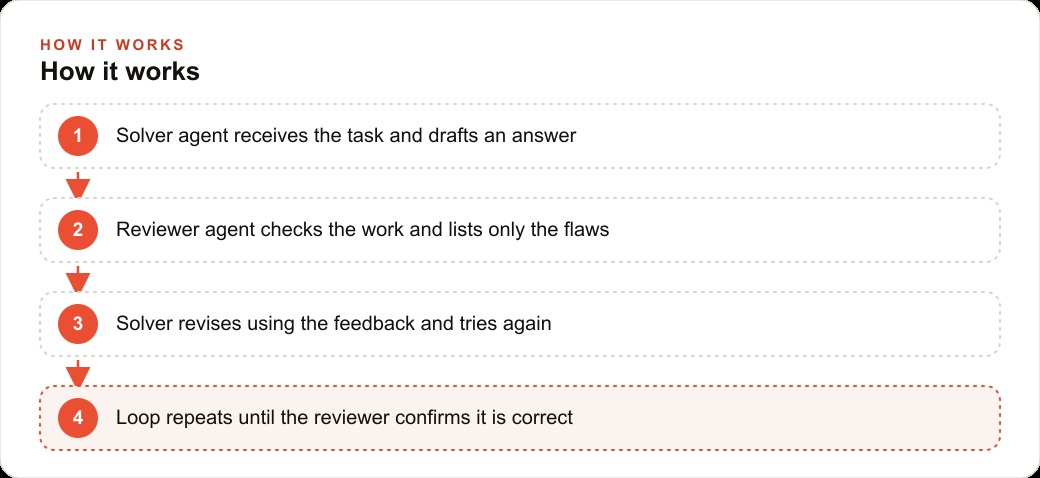
This is where the interesting development lands. The strongest practical approach uses more than one agent. You set up a solver whose only job is to produce the answer, and a reviewer whose only job is to find flaws. The reviewer is explicitly told to point out problems and refuse to hand over the solution, so the pressure stays on the solver to fix its own work. They go back and forth until the reviewer is satisfied.
Why this beats a lone genius model is the important part. Models are much better at judging whether an answer is right than at producing a right answer on the first attempt. Evaluation is easier than generation, for machines just as for people. A dedicated critic, with no stake in the original answer and a mandate to be skeptical, catches errors the solver glossed over. The refusal to give the solution is not a gimmick. It is what forces the solver to keep reasoning rather than just copying a correction, which is how the final output ends up genuinely stronger rather than just patched.
Who this changes things for
This matters for almost any business that has work where accuracy is non-negotiable and a second set of eyes already adds value. The tell is simple, any process where one person normally drafts something and another checks it before it goes out the door has exactly the shape of this pattern. A law office reviewing contract clauses, an accounting firm checking a return, a marketing team fact-checking a claim, a consultancy validating a recommendation. All of them map cleanly onto two cooperating agents.
The reason it travels so well is that the structure is generic. One agent does the work, another stress-tests it, and a loop keeps them honest until the output meets a standard. You are not building a bespoke AI for each new task. You are reusing the same review loop and swapping the instructions and the source material. That reusability is what turns this from a clever demo into something a small business can actually run across several different jobs.
A worked example: a financial advisor's retirement projection
Let me make the pattern concrete with numbers. Say a client asks a financial advisor for a retirement savings projection. Madhuranjan Kumar would set up the solver agent with the client's inputs, their age, savings rate, target retirement date, and risk tolerance, and ask it to produce a step-by-step plan with every assumption written out explicitly. The solver drafts a projection, contributions of a set amount per month, an assumed growth rate, a target balance at retirement.
Then the reviewer agent reads that plan with a single mandate, find what is wrong or weak. Did the solver use an unrealistic growth rate? Did it ignore inflation entirely? Do the numbers actually add up to the stated goal, or is there a gap the solver quietly buried? When the reviewer flags that inflation was left out, it does not rewrite the plan. It pushes back and tells the solver to try again. The solver reworks the projection with an inflation adjustment, the reviewer checks once more, spots that the new growth assumption is now too aggressive, and sends it back again. The loop continues until the math reconciles and the assumptions are defensible.
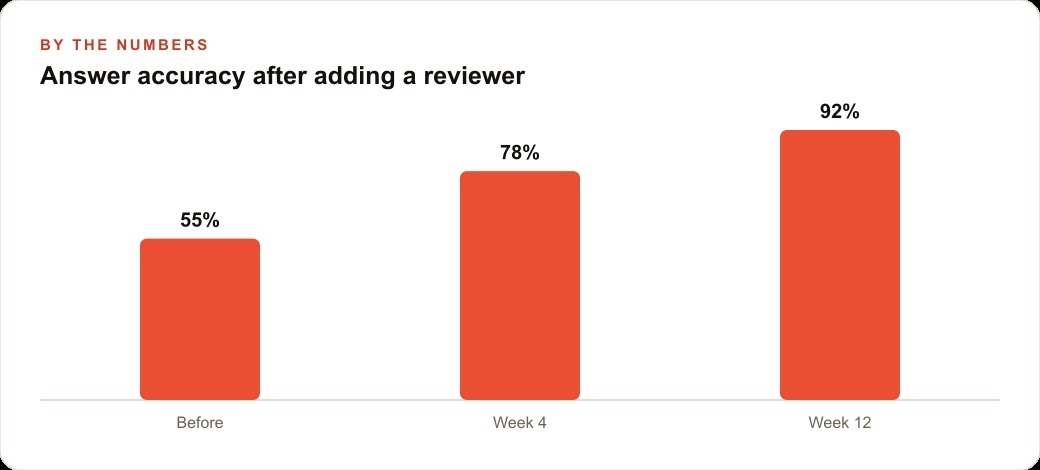
What the advisor finally reads is a draft that has already survived a tough internal critique, instead of a first guess with a bad assumption hidden inside it. Picture the accuracy climbing across that process, from a shaky first draft to something that holds up to scrutiny after a few rounds. The advisor still makes the final call and signs off, because judgment and client relationship are not the machine's job. But the grunt work of catching errors is done before a human ever opens the file. That is the shift, the review that used to happen after a person finished now happens before they even start.
Where the review loop earns its keep, and where it is overkill
A pattern this useful invites overuse, so it is worth being honest about its costs and its limits, because knowing when not to reach for it is part of using it well. A solver-and-reviewer loop is not free. It runs the model more times than a single answer would, so it costs more and takes longer, and every extra round the two agents go back and forth adds to both. On a simple task, that overhead buys you nothing, because a simple task did not need slow thinking in the first place. Firing up a two-agent debate to answer a question a single model gets right instantly is effort spent for no gain.
The loop earns its keep in a specific zone, work that is hard enough to trip a single model but important enough that an error is expensive. That zone is exactly where the retirement projection lived, numbers that have to reconcile, assumptions that have to be defensible, and a client on the other end who will be hurt by a mistake. Contract clauses, tax positions, medical-adjacent summaries, financial models, anything where a confident wrong answer causes real damage, all sit in that zone. Casual drafting, brainstorming, and quick lookups do not, and forcing them through a review loop just makes them slow.
There is a second limit worth naming plainly. The loop makes errors much rarer, but it does not make them impossible. Two agents can share a blind spot, especially if both were given the same flawed assumption in their instructions. The reviewer is skeptical by design, but it is not omniscient, and a subtle domain error that neither agent was equipped to catch can still slip through. This is precisely why the human stays at the end. In the worked example, the advisor still signs off, because the review loop is a powerful filter, not a replacement for professional judgment and accountability. The machine does the tireless first-pass checking. The human owns the final call, which is exactly the right division of labor.
Used with that discipline, the loop changes the economics of careful work in a real way. The expensive part of accuracy has always been the human hours spent double-checking, and those hours do not scale, because there are only so many of them and the person doing them gets tired and misses things late in the day. A review loop scales the tedious part without getting tired, so a small firm can apply a level of checking that used to require a second senior person. The cost is a bit more compute and a bit more latency on the tasks that deserve it. For the right tasks, that is a trade almost any business should take, as long as it remembers to reserve the loop for the work that actually warrants it.
The move to make now
The setup is more approachable than it sounds. You define two agents and let them talk in a shared conversation, and tools like AutoGen Studio give you a no-code interface for exactly this. You create a solver with instructions to attempt the task and hand it off, and a reviewer with instructions to critique only, refuse to give answers, and approve only when the work is correct. You cap how many times they can reply to each other so the conversation cannot run forever, and you add a rule that the solver cannot quit until the reviewer signs off.
Start small and prove it before you scale it. Pick one repeatable task in your business where a draft normally gets checked by hand, and build the solver and reviewer for just that one thing. Test it on real examples where you already know the right answer, so you can actually see the loop improving quality rather than just assume it. Then expand, adding a third agent like a manager that breaks a big goal into smaller tasks once the basics are solid.
The same review-loop discipline pays off in the parts of the business that face customers, too. The claims and offers going into your Facebook and Instagram ad campaigns are exactly the kind of thing a reviewer agent should check before spend goes live, and the qualified leads that come back belong in a CRM and website stack where accuracy and consistent follow-up matter just as much as the pitch. A pattern that catches errors before they ship is valuable everywhere a mistake is expensive.
You can absolutely build this yourself with a free afternoon and some patience. If you would rather have an expert design the agents, write the prompts, and wire the loop into your existing workflow so it runs cleanly from day one, that is a straightforward engagement. Either way, the lesson from the shift is clear. One model is a confident first guess. Two models, one solving and one refusing to accept a weak answer, is a second opinion that catches what the first would have missed.
That is exactly what we do at AI DOERS. Book a private 30-minute call with Madhuranjan Kumar and we will map the fastest path to it for your specific business.
Book your call →
Madhuranjan Kumar
Madhuranjan Kumar brings 20 years of performance-marketing experience and has managed over $200 million in Facebook ad spend for brands across the United States and beyond. His expertise spans the full modern marketing stack: Meta, Google Ads, TikTok, email automation, CRM, and the websites that hold it together. At AI DOERS he turns that track record into lead-generation systems for businesses across every industry.