
Six ChatGPT Features Where Other AI Models Now Win
ChatGPT still leads with 700M weekly users, but on six specific jobs other models now beat it. Here is where to open a second tab, with a dental clinic example.

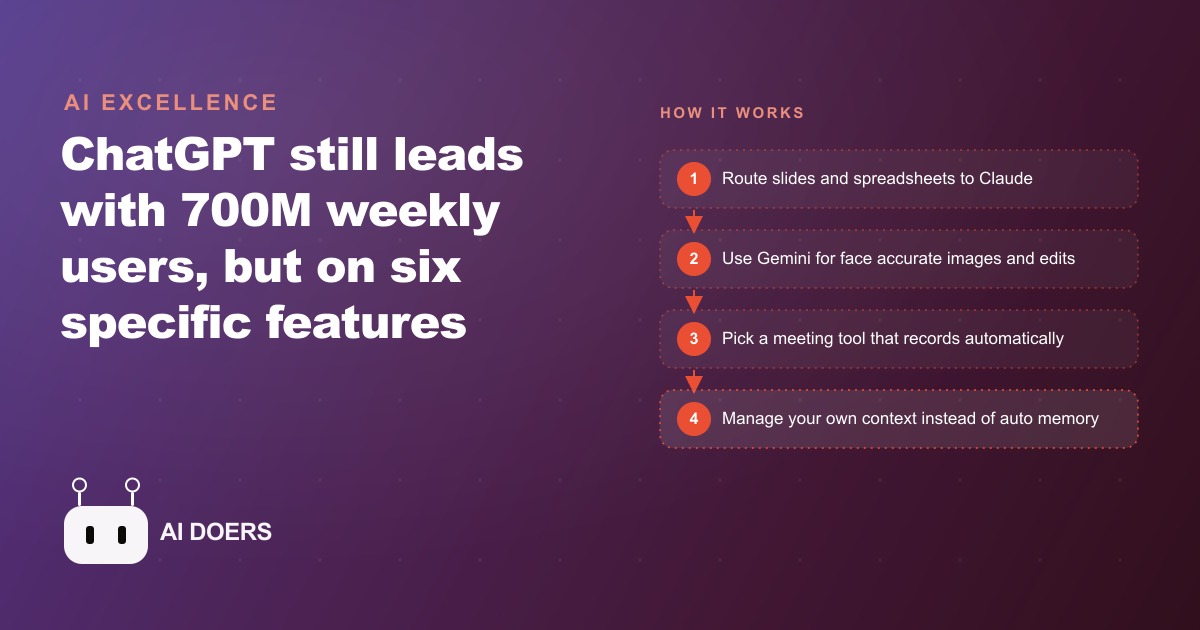
ChatGPT still holds roughly 80 percent of the AI assistant market with around 700 million weekly active users. I am Madhuranjan Kumar, and I want to take apart a specific idea that most coverage of AI tools handles poorly: the idea that tool loyalty is a coherent productivity strategy. It is not. The competitive landscape has produced a situation where six specific task types have a genuinely better alternative than the market leader, and understanding why each gap exists is more useful than knowing that the gaps exist. The mechanism behind each one tells you what to do and, more importantly, why doing it will produce a different result on your actual work.
Why Market Share and Task Performance Stopped Moving Together Years Ago
Market share reflects distribution, brand familiarity, and the friction cost of switching, not a continuous measure of which tool produces the best output on any given task. A product earns dominance by being meaningfully better than what existed before it at the moment users are making adoption decisions. Maintaining dominance requires continuous investment in every capability dimension simultaneously, which becomes harder as the number of well-funded competitors increases. ChatGPT earned its position by being the first tool to make advanced AI assistance accessible and reliable at consumer scale. What is different now is that the competitive landscape includes several well-capitalized alternatives designed to exceed it on specific capability dimensions rather than compete across the entire surface area at once.
The internal response OpenAI reportedly made to competitive pressure from open-source models and Anthropic's lineup suggests that the company recognizes the specific challenge. A dominant player declaring a competitive alert is a signal that the gaps are real and visible internally, not just in external benchmark comparisons. For a business owner, the practical conclusion is simple and non-dramatic: the right tool for each task is the tool that produces the best output on that task, regardless of which brand makes it. Building loyalty around a single tool when alternatives have measurable advantages on specific tasks is paying for the familiar rather than the effective. Loyalty to a brand is reasonable for consumer preferences. Loyalty to a tool when better alternatives exist for your specific tasks is operational waste.
The Document Gap: What Native Office Output Means for Weekly Productivity
The most visible and practically consequential performance gap between ChatGPT and Claude appears in structured document generation. When asked to build a presentation from a brief, ChatGPT has ranked third in direct comparisons behind Claude and one other alternative, while Claude has produced output that opens directly in PowerPoint with proper slide formatting, consistent visual structure, and appropriately chunked content per slide, requiring minimal editing before being genuinely presentation-ready. The difference is not primarily about the reasoning quality of each model. It is about how each model understands the structural conventions and file-format requirements of the specific document type being requested.
Claude's outputs for structured documents write into native formatting rather than producing a block of text that the user then has to rebuild inside a presentation tool. For a business that produces client decks, training materials, quarterly reviews, or investor updates on any kind of regular schedule, the editing time difference per document compounds significantly. Consider three people on a team each building two decks per week, each requiring forty-five fewer minutes of post-generation editing because the first draft came out structurally correct. That is four and a half hours of combined team time recovered per week, approximately 234 hours per year, from a single routing change that costs nothing to implement other than the decision to use a different tool for this specific task type.
The spreadsheet gap follows the same pattern. A quarterly marketing report template requested from ChatGPT has returned output rated around two out of ten for immediate usability in direct comparisons, requiring significant reformatting before the template functioned correctly for real data input. The same request to Claude has returned a structured, complete, immediately functional template. For any business whose work involves producing regular reporting documents that have to be presented internally or externally, this is a daily workflow decision with daily quality and time consequences.
The Image Gap: Face Accuracy as the Specific Practical Capability Businesses Actually Need
Gemini's image generation leads on a use case that is common for any business creating branded social content, branded marketing materials, or team-facing communications: maintaining accurate facial resemblance when placing a real person's face into a generated scene or visual. When a photo is uploaded and the model is asked to generate a scene with that person in it, the fidelity of the facial resemblance varies significantly between models. ChatGPT's image generation frequently produces a result where the facial features do not clearly match the uploaded photo reference, requiring additional regeneration attempts to approximate the match. Gemini's output on the same task maintains the resemblance at a level that makes the result immediately usable rather than requiring a round of correction.
For a business running Facebook and Instagram ad campaigns where team member faces, founder photos, or customer testimonial visuals appear in ad creatives, the difference between a model that requires three to four regeneration attempts to maintain facial accuracy and one that achieves it on the first attempt is a real weekly time cost. Multiplied across the volume of ad creative a growing business produces in a month, the difference between first-pass success and multiple regeneration rounds is a material amount of time. Follow-up image editing tasks, adding a text overlay, changing a background element, modifying clothing color, showed the same accuracy and speed gap in direct comparisons. Gemini returns more accurate and more quickly usable results on face-inclusive image tasks, which means less time between starting an image request and having a result that can go to review.
The Meeting Gap: Why Silent Failure Is Categorically Worse Than Visible Failure
ChatGPT's desktop application includes a meeting recording feature. In a direct demonstration, that feature returned a no-dialogue-detected error after what appeared to be a successful recording session, producing nothing from a conversation that had just taken place. That specific failure mode, where the tool appears to be functioning normally but produces no output, is worse than a tool that fails visibly and loudly. A visible failure tells you immediately that you need to capture the record another way. A silent failure allows you to believe the record was captured until you need it and discover it was not, which is the worst possible moment to find out.
Transcription tools built into meeting platforms rather than run as separate recording applications capture audio automatically as part of the meeting infrastructure, without requiring a manual button press before each meeting begins. They cannot silently fail in a way that goes undetected because the transcript either appears at the end of the meeting or a visible error notification appears during it, while you still have the opportunity to take manual notes or ask the group to repeat key points. For any business where meeting records matter, whether those records are client calls where commitments were made, team meetings where decisions were reached, or vendor negotiations where terms were discussed, the reliability of capture is more important than which AI assistant brand the transcription tool belongs to.
The Memory Gap: How Auto-Accumulation Becomes a Source of Context Drift Over Time
ChatGPT's memory feature saves details from your conversations over time and injects them into future conversations automatically. The design intention is persistent helpful context that makes the tool feel aware of your work history and ongoing projects. The practical failure mode is that old context accumulates in the memory store and begins appearing in new conversations in ways that are subtle enough to cause errors without being obvious enough to catch immediately during a quick review. A completed project that ended months ago can still appear in memory, causing the model to apply outdated assumptions to a current task. A former client's details can persist alongside current client details, producing bleed-through in communication drafts or analytical outputs.
Claude's memory architecture updates on a defined schedule and organizes entries into labeled sections that separate recent context from foundational background information, making the most recent context explicitly distinct from the accumulated background. That structural separation reduces the bleed-through problem compared to a flat automatic accumulation approach. The fix for context drift in any tool, however, is ultimately to take active control of context management rather than relying on any automatic accumulation system. Export your accumulated memory into a document, organize it by project or client, and load the relevant section deliberately into conversations where that context applies. That deliberate approach is more reliable than automatic accumulation, regardless of which tool is managing the memory behind the scenes.
The Routing Discipline in Practice Is Simpler Than It Sounds
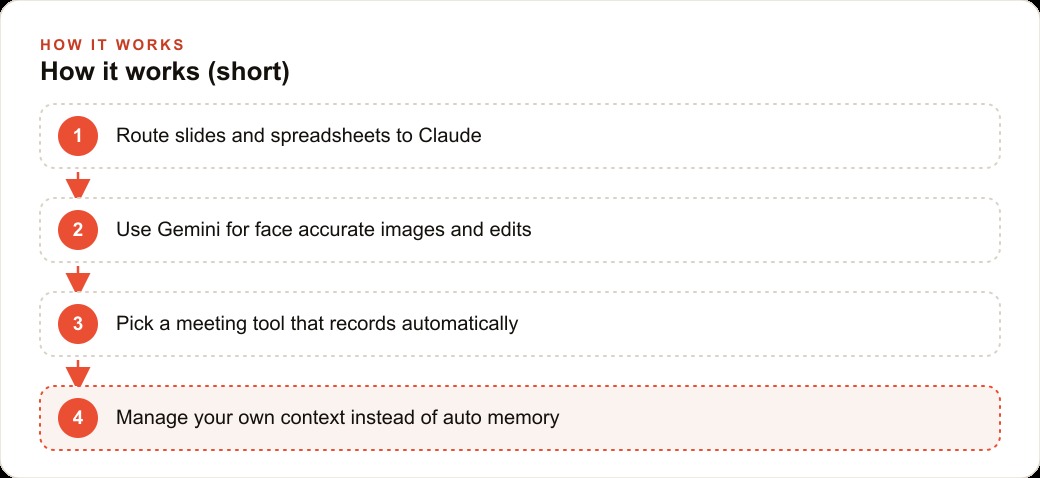
The practical implementation of task-based routing is significantly simpler than the concept sounds when first described to someone accustomed to single-tool workflows. It requires three browser bookmarks and a personal convention about which one to open for which task type. For structured documents and spreadsheets, Claude opens in one tab. For face-accurate image generation and quick edits on existing images, Gemini opens in a second tab. For meeting transcription, the tool is configured inside the meeting platform and runs automatically without any routing decision at the time of the meeting. Context for whichever tools are used is managed deliberately rather than left to auto-accumulation.
A team that writes down the routing convention and includes it in onboarding documentation for new members extends the benefit across the full team rather than leaving it as a personal productivity habit that only one person uses. For any business producing SEO and organic search content with AI assistance, the same routing logic applies: test each model on your specific content format, measure editing time per piece from first draft to publication-ready, and route to the model that consistently produces drafts that require the least editing work on your specific content type.
The Deeper Principle Is That Competitive Markets Produce Differentiated Performance Distributions
The deeper principle behind all six of these gaps is that competitive markets produce differentiated performance rather than uniform rankings as a category matures. As more well-funded alternatives to any dominant product mature and refine their specific capabilities, the performance distribution across task types spreads rather than concentrating in one winner. Understanding where each tool actually leads, tested on your own work rather than on benchmarks designed by the tools themselves, is the operational intelligence that determines which hours of your team's time get recovered per month through better tool routing.
Every business that uses AI assistance regularly has a set of task types it performs most frequently. Those task types are the only relevant benchmark. Running a comparison on five of your most common AI tasks, using the three or four tools you are considering, takes an afternoon and produces a routing table you can act on immediately. The investigation cost is bounded. The ongoing time saving compounds indefinitely once the routing table is established and becomes team convention.
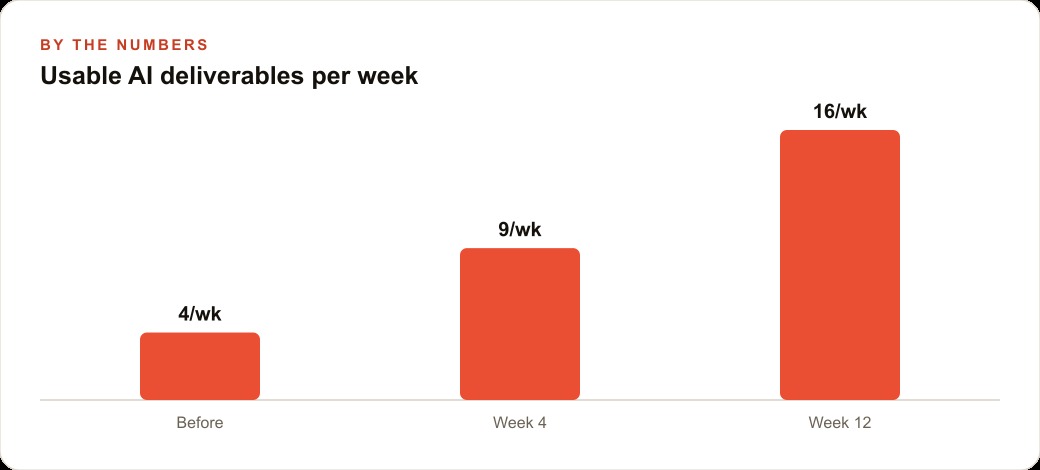
The compounding nature of small daily improvements is what makes this worth doing even when the individual task-level time differences seem small. Forty-five minutes saved per document, fifteen minutes saved per image edit, and meeting records that are actually reliable rather than occasionally lost add up to several hours per week at modest usage volumes, and tens of hours per month at the scale of a team actively using AI across multiple workflows. That recovery is happening regardless of whether the market leader improves, because the improvement comes from routing to the right tool rather than from any specific model upgrade. ## The Measurement Habit Is the Foundation Everything Else Builds On
The gap between businesses that successfully adopt multi-tool AI routing and businesses that stay locked to a single tool is almost never a knowledge gap about which tool performs better on which task. It is a measurement habit gap. Businesses that measure outputs, even informally and quickly, from multiple tools on the same task develop accurate routing intuitions within a few weeks of starting. Businesses that never run the side-by-side comparison never build those intuitions, and instead rely on brand preference or the tool they happened to try first. The measurement habit requires fifteen minutes and produces a routing insight that pays back compound returns over every subsequent month. The businesses that build this habit earliest are not smarter or better resourced. They are simply the ones who started measuring before it felt urgent, rather than waiting until the performance gap became obvious from missed deadlines or client feedback.
That is exactly what we do at AI DOERS. Book a private 30-minute call with Madhuranjan Kumar and we will map the fastest path to it for your specific business.
Book your call →
Madhuranjan Kumar
Madhuranjan Kumar brings 20 years of performance-marketing experience and has managed over $200 million in Facebook ad spend for brands across the United States and beyond. His expertise spans the full modern marketing stack: Meta, Google Ads, TikTok, email automation, CRM, and the websites that hold it together. At AI DOERS he turns that track record into lead-generation systems for businesses across every industry.