
7 Tools That Added AI Agents: How to Use Them to Do in Minutes What Used to Take Hours
AI agents are now embedded inside the tools you already use every day. Instead of just generating content, these agents can operate the software on your behalf, making changes, doing research, and formatting everything from a single conversational instruction.


Eight hours of manual layout work per quarter, spread across Thursdays the front-office manager had quietly come to dread, dropped to ninety minutes the first time she typed a single sentence to an AI agent inside Gamma.
This is the story of how a dental practice's content production changed when embedded AI agents moved from a concept to a practical daily workflow. The numbers are real and the chapters are in order.
The formatting problem that consumed the manager's Thursdays
The practice publishes a quarterly patient newsletter covering new service offerings, seasonal oral health tips, and a rotating featured provider profile. On its face the document is not large, eight to ten pages, but assembling it manually was the kind of work that devoured a full Thursday afternoon every quarter: pulling text from three or four sources, pasting sections into the layout tool one at a time, adjusting fonts and line spacing section by section, resizing images until they fit the allocated space without distorting, and then iterating through revisions after the dentists reviewed the draft and asked for adjustments.
Each revision round added ninety minutes or more to the total. The dentists would review the assembled draft, suggest moving a section earlier in the newsletter, softening the color accent on the headers, or shortening a photo caption to one line. Every requested change required going back into the layout tool, locating the specific element, editing it manually, and re-exporting the file. A single round of revision on a twelve-page document consumed ninety minutes because every requested change was a separate manual operation applied to a separate element, not a global command that propagated through the document automatically.
Across a full year, the newsletter alone was costing the manager approximately thirty-two hours of productive labor time. Adding the quarterly social media post calendar, the monthly promotional flyer for the featured service, and the new-patient welcome packet updated twice yearly pushed the total document production burden past sixty hours annually. That is more than a full work week spent on layout and formatting tasks requiring no professional medical or administrative judgment, time that could otherwise go toward patient coordination, phone coverage, reactivation outreach, and the dozens of operational tasks that kept the front desk running at full capacity.
The problem was not skill. The manager was competent in the tools she used. The problem was that those tools required her to be the operator of every individual change. There was no mechanism for saying "apply this adjustment everywhere" and having it execute across the whole document at once. Every change, no matter how small, was a separate manual step.
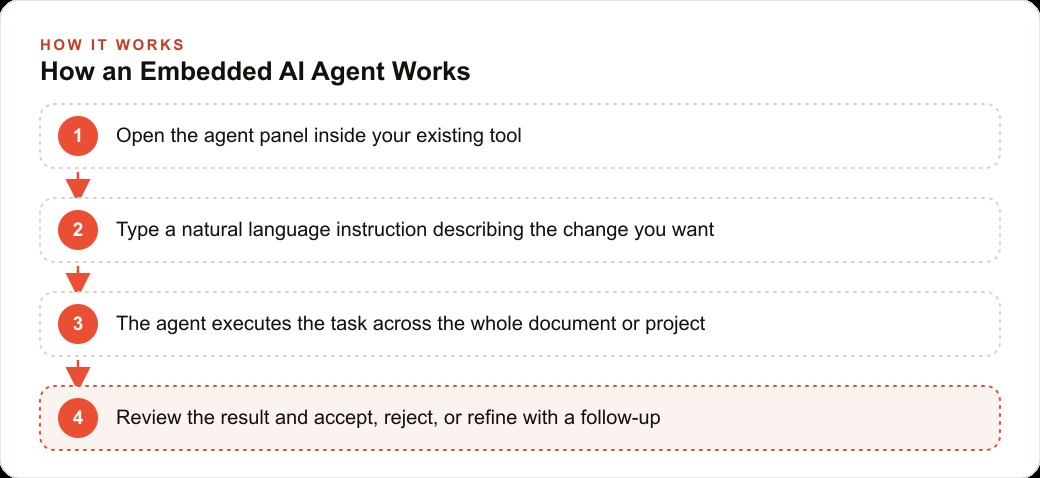
What Gamma's agent could do from a single natural-language instruction
The workflow changed fundamentally when the manager started using the embedded agent mode inside Gamma for the quarterly newsletter. The shift happened in the first session.
Instead of pasting content and formatting it manually section by section, she opened the agent panel in Gamma, uploaded the newsletter content as a single text document, and typed: "Format this into a professional eight-page dental practice newsletter. Use a clean clinical layout with the practice's teal brand color on section headers. Include a clear call-to-action at the bottom of each section pointing patients to schedule an appointment."
The agent produced a structured draft in under two minutes. The layout had consistent spacing throughout, properly sized content blocks for each section, styled headers in the brand color, and a call-to-action element at the bottom of every major section. It was not a finished document. The font size on the featured provider bio was slightly too large relative to the body text, and one section had noticeably too much white space between paragraphs. But it was a coherent, structured draft that replaced the ninety-minute starting-from-scratch layout work with something that needed only targeted refinements.
The manager typed a follow-up: "Reduce the font size on the provider bio to match the body text size, and tighten the paragraph spacing in the oral health tips section." The agent applied both changes simultaneously across every instance of those elements in the document. A ten-minute manual fix for each note became a fifteen-second instruction that executed globally. What used to be two separate operations on two separate elements in two different sections of the tool was now a single conversational exchange.
Agent mode inside Gamma does not remove manual control. After every change the agent makes, the interface displays the before and after version of the document side by side, with a single click available to revert to the prior state. The manager never felt like she was surrendering control of the document. She was directing a very fast executor and maintaining final approval on every output. That combination of speed and preserved control changed how she thought about revision cycles, because the cost of trying a design choice and reverting it if it did not work dropped from ten minutes to thirty seconds.
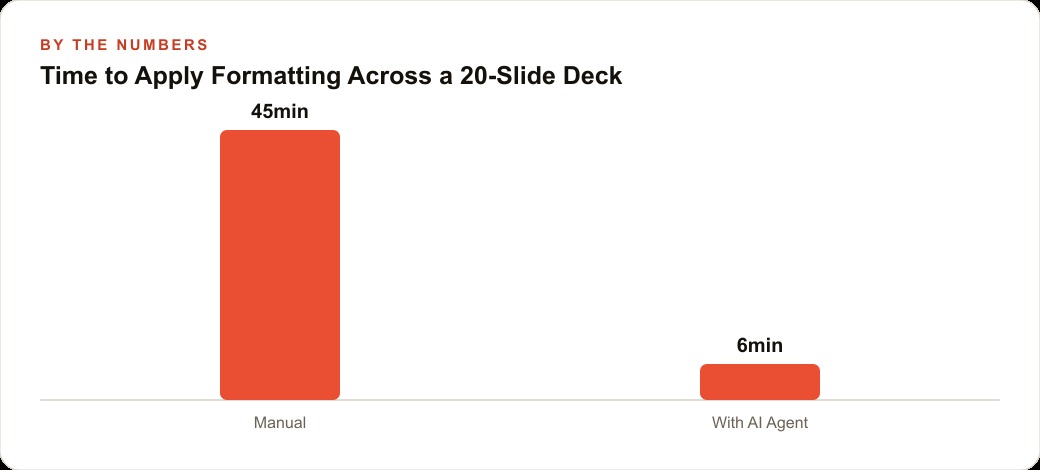
The time for initial layout on the newsletter dropped from two hours to twenty minutes. Each round of dentist-requested revisions that used to take ninety minutes now took under ten.
The first time the agent searched the web and inserted cited evidence
The second quarter newsletter included a section on the documented link between gum disease and cardiovascular health risk. The head dentist wanted to include this information to reinforce to patients the systemic importance of regular cleanings, not just cosmetic dental health. Previously, adding research-backed content like this required either asking the dentist to provide the source directly, or the manager spending time searching for a credible study herself, copying the relevant finding, formatting the citation, and inserting everything into the document at the correct position.
With Gamma's agent mode, the instruction was different: "In the gum disease section, add a paragraph citing recent published research on the connection between periodontal disease and cardiovascular health risk. Include a source citation."
The agent searched the web during the task execution, located relevant published research, extracted the key statistical finding, and inserted a paragraph into the newsletter with the source cited inline. The manager reviewed the inserted paragraph, confirmed both the content and the source were accurate and appropriate for a patient-facing document, and the section was complete. The entire step took under three minutes from instruction to reviewed output.
The practical change this produced was significant. Previously, adding a research-backed claim to any patient communication required either a clinical decision by the dentist or a research step by the manager. Both created friction that led to most newsletters being written in general terms without specific citations. With the agent handling the search and insertion step, adding cited evidence became as easy as any other formatting instruction. The friction dropped low enough that it was no longer a reason to skip it.
Over the following year, the practice started consistently including cited health statistics in newsletters, social media posts, and the new-patient welcome packet. The content quality improved in a way that patients noticed and occasionally commented on. That improvement was a direct result of the friction reduction, not a deliberate quality initiative. The agent made including evidence easy enough that it became a default rather than an exception.
How the before/after comparison changed the revision cycle
One of the least expected benefits of working with embedded AI agents turned out to be the before/after comparison Gamma displays after every agent action. When the agent applies a change, the interface shows exactly what the document looked like before and exactly what it looks like after, in a side-by-side view, before committing permanently to the new version.
This comparison changed how the manager and the dentists collaborated on revisions in a specific and measurable way. Previously, when a dentist requested a change, the manager made it, re-exported the updated document, and sent it over for another review round. The dentist was reading the entire document again to find the change and evaluate it in full context. Each review round consumed time on both sides and the cycle could run three rounds or more before the document was approved.
With agent mode and the side-by-side comparison available immediately after each change, the collaboration changed. The manager would apply a dentist-requested change through an agent instruction, take a screenshot of the before/after view, and share only that comparison for approval. The dentist saw the specific modification with immediate context, responded with approve or adjust, and the revision was finalized. The review cycle that previously ran three rounds over two days compressed to one round in under thirty minutes for most newsletters.
The before/after view also changed the manager's willingness to try design choices that she previously hesitated to attempt manually because reverting would cost her time. With the agent, trying a more visually assertive treatment for the header section and reverting it if the dentists did not like it took under a minute. That freedom to experiment without cost produced a better final document because more design options were explored and compared before committing to the version that went to patients.
Over four quarters of using this workflow, the average number of revision rounds on the newsletter dropped from 3.2 to 1.4. That alone recovered more than two hours per quarter in combined manager and dentist time.
What a full quarter of content production now looks like in hours
With the agent-assisted workflow established across all content types, the quarterly production cycle for the practice now looks like this.
The patient newsletter takes ninety minutes from raw text to final approved file, including one round of dentist review. That compares to eight hours before the agent workflow was in place. The quarterly social media post calendar, covering five platforms at twelve posts each, takes two hours to draft, format, and export from a single content outline written in advance. The monthly promotional flyer for the featured service of the month takes twenty minutes to produce, down from ninety. The new-patient welcome packet update, done twice yearly, takes forty-five minutes.
Total document production time per quarter has dropped from approximately twenty-two hours to under six. Over a full year, the manager has recovered more than sixty hours that previously went to layout, formatting, and manual revision tasks that required no professional judgment. Every one of those hours is now available for work that does require human skill: direct patient phone calls, reactivation outreach, scheduling coordination, and managing the front desk relationships that no tool can replace.
The sixty recovered hours did not disappear into general overhead. The practice directed a specific portion of them toward a lapsed-patient reactivation program. The manager calls or sends a personal message to a targeted list of patients who have not scheduled a cleaning in over eighteen months, a task she simply had no capacity for before. In the first quarter of the new workflow, the practice reactivated forty-three lapsed patients who had not visited in more than a year and a half. At the practice's average cleaning revenue per visit, those forty-three reactivations produced more revenue than the Gamma Pro subscription costs for multiple years.
That downstream result is the real argument for embedded AI agents: the efficiency gained in mechanical production freed a human being for relationship-building work that only a human can do effectively. The agent handled the layout, formatting, research, and revision mechanics. The manager handled the patient relationships. Both became more productive because the work was matched to the right kind of intelligence.
The monthly cost of the Gamma Pro plan that enabled the advanced agent features: approximately fifteen dollars. The value of sixty recovered hours per year redirected toward direct revenue-generating work: multiples of the subscription cost in the first quarter alone. That ratio makes adoption not a matter of experimentation but of straightforward arithmetic.
For any business considering where to start, the advice is to pick the single document type your team produces most often and bring agent mode into that workflow first. Spend two sessions exploring what the agent can do with a real document from your actual queue. The learning curve is short, the cost is low, and the first session usually recovers its own time investment before it ends. From there, each additional document type you bring into the workflow adds to a compounding efficiency library that keeps widening the gap between what the team can produce and what it could produce before.
That is exactly what we do at AI DOERS. Book a private 30-minute call with Madhuranjan Kumar and we will map the fastest path to it for your specific business.
Book your call →
Madhuranjan Kumar
Madhuranjan Kumar brings 20 years of performance-marketing experience and has managed over $200 million in Facebook ad spend for brands across the United States and beyond. His expertise spans the full modern marketing stack: Meta, Google Ads, TikTok, email automation, CRM, and the websites that hold it together. At AI DOERS he turns that track record into lead-generation systems for businesses across every industry.