
Running Local AI Models: Private, Free, and Powerful Enough for Real Work
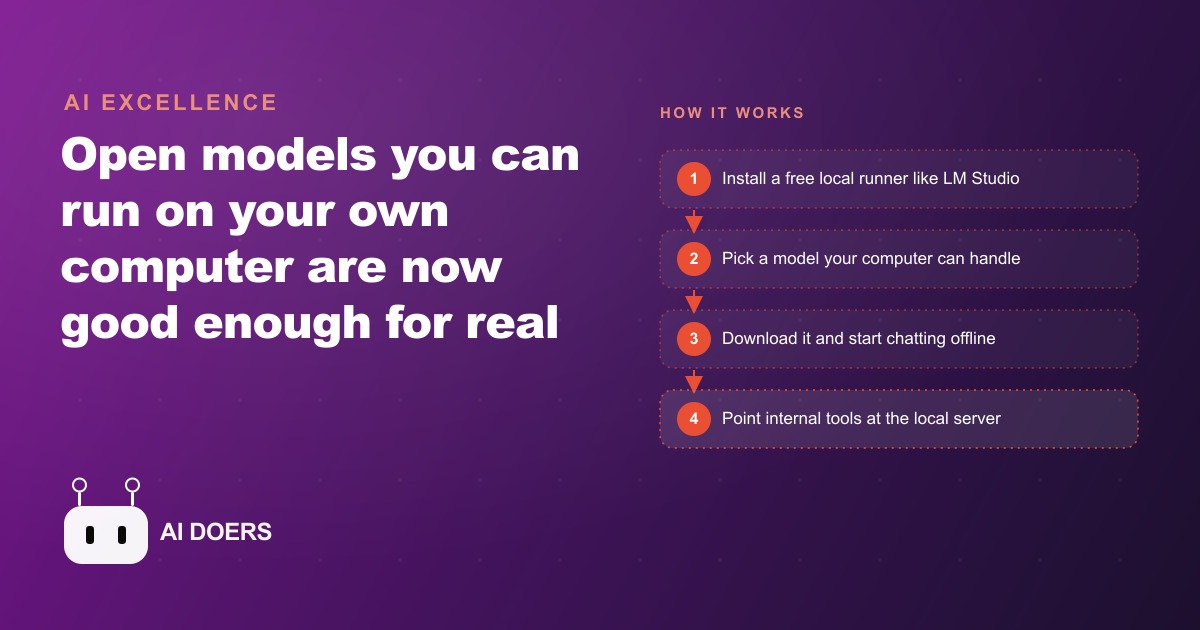
Most people default to a cloud chatbot, but open models you can run on your own computer are now strong enough for real work, cost nothing per query, and keep every file private. Here is how I would set one up for a business.

The most honest thing I can say about cloud AI subscriptions is this: the monthly number on your invoice is not the real cost, and for a meaningful slice of businesses, the right tool is already sitting on their own hardware for free.
I am Madhuranjan Kumar, and I want to make a careful argument here rather than a sweeping one. Cloud AI is the correct default for most people. It is easy, the quality is high, and the zero-setup path has real value. But there is a specific category of business where that default has quietly become the wrong answer, and the category is bigger than you might think.
The cloud AI bill compounds in ways the monthly number does not show
The visible cost is simple: a per-seat subscription, typically somewhere between forty and two hundred dollars per month per user. The invisible cost takes longer to notice.
The first invisible cost is token lock-in behavior. When every query costs money or burns against a monthly limit, people self-censor. They write shorter prompts, skip the verification step, and avoid pasting the full document when a summary would do. This is rational given the incentive structure, and it quietly limits how much value the tool actually delivers. A local model with zero marginal cost changes the calculus: paste the whole document, run the verification, try the alternative phrasing, because it costs nothing.
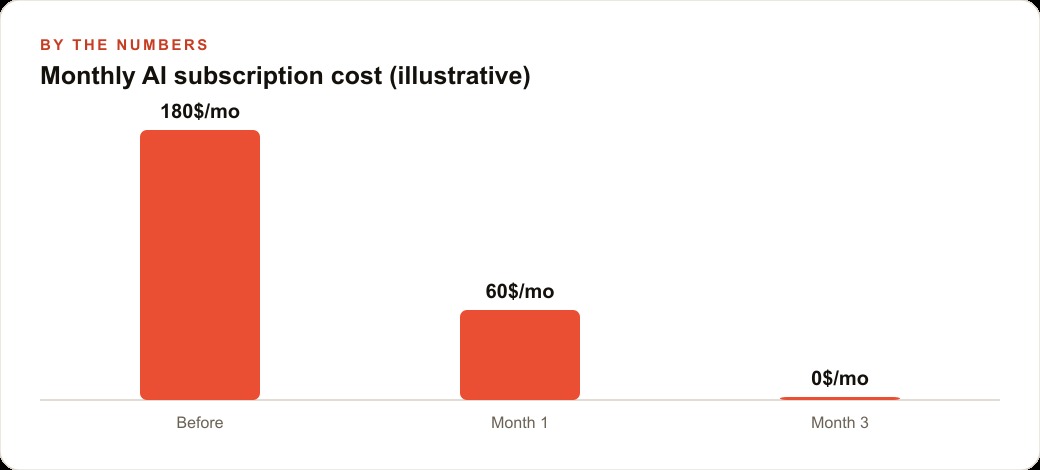
The second invisible cost is integration overhead stacked on top of the base subscription. The raw language model subscription is layer one. Layer two is the orchestration platform that connects it to your documents. Layer three is the storage that holds the indexed versions of those documents. Layer four is the activity logging that your compliance officer requires. Each layer has its own monthly price, and they stack. An accounting firm that started paying forty dollars a month for a single AI seat often finds itself at a hundred and eighty dollars per seat once everything required to use it seriously is factored in.
The third invisible cost is retraining time when the provider updates the model without notice. That is the topic of the next section, but it belongs in the cost ledger: hours spent debugging prompt behavior that changed without warning are hours not spent on client work.
Silent model updates are the risk the subscription pricing never mentions
Cloud AI providers update their models continuously. Sometimes a minor version bump. Sometimes a full replacement. The model you tuned your prompts against in January is rarely the model running them in September. This is framed as an improvement, and it often is, but for a business that spent weeks writing careful prompts and workflows, a silent update is a rework event dressed as a feature.
Here is what actually happens in practice. A firm builds a workflow: paste client intake notes, run a specific prompt, get a structured output that feeds into the next step. The prompt took two weeks to get right. The model update changes how the model interprets one phrase in the middle of the prompt, the output shifts, and the next step in the pipeline breaks. The team does not notice for three days because the output still looks roughly right. By the time they trace it back, they have re-reviewed work they thought was done.
A local model is version-pinned by default. You download a specific version, it runs that version until you choose to update, and updates are entirely under your control. You can run the update on a staging copy of your workflow first and confirm the output is still what you need before switching the production setup. That is a genuinely different operational posture, and for any business where consistent, predictable AI output is part of a professional deliverable, it matters considerably.
The capability gap that justified cloud AI closed faster than anyone expected
Twelve months ago, the honest answer to "can I use a local model for real work" was "for simple tasks, yes, but for anything that requires judgment, probably not." That answer is no longer accurate.
The open model ecosystem has moved fast. Models that required a flagship cloud provider to run a year ago are now competitive quality from a laptop, particularly for the tasks that represent the majority of business AI use: drafting, summarizing, explaining, reformatting, and answering questions over a specific document set. The frontier has moved, but so has the open model tier sitting below it.
What does "competitive quality" actually mean in practice? It means that for everyday writing and reasoning tasks, a well-chosen local model produces output that a professional reviewer cannot reliably distinguish from a cloud model's output. This is not a theoretical benchmark comparison. It is the lived experience of teams that have tried both and measured what they could tell apart.
The tasks where cloud models still have a meaningful edge are narrow and specific: very long context windows that exceed what local hardware can handle, real-time data access, and the top tier of creative reasoning where the frontier models have genuine leads. For a business doing its operational AI work in writing, analysis, and document handling, local models have crossed the threshold.
What the accounting firm can do locally that it could not do six months ago
Six months ago, setting up a local model for professional use required meaningful technical skill. You needed to understand the command line, manage model files manually, and figure out how to configure a server for internal tools. The barrier was not impossible, but it was real.
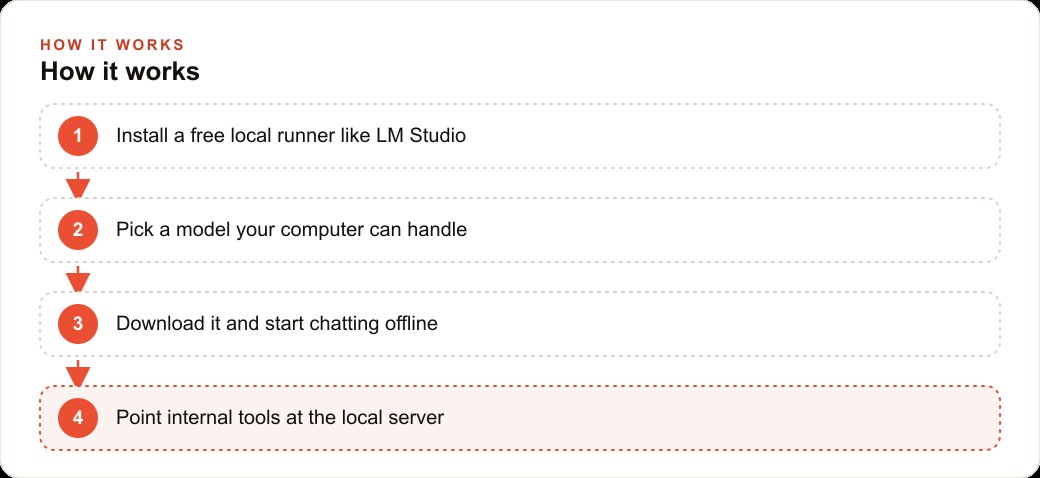
Today, tools like LM Studio remove most of that barrier. It installs like any app, presents a familiar chat interface, lets you browse and download models from inside the UI, and handles the configuration automatically. A non-technical partner at an accounting firm can have a working local model in an afternoon without touching a terminal.
Here is what that change means concretely. Consider a ten-person accounting firm paying one hundred and eighty dollars a month for a cloud AI subscription across three seats. Every client financial summary, every draft memo, every engagement letter clarification has been running through a third-party server. The partners were aware this was technically a data-handling question, but the subscription agreement said "we do not train on your data" and that was enough for a while.
Then two things happened. First, a client specifically asked whether their financial information was being processed by a third-party AI system, and the honest answer was yes. Second, the team calculated that over twelve months the subscription had cost just over two thousand dollars, and the use was primarily drafting and summarizing.
Switching to a local model costs nothing in software. The time investment is one afternoon to install LM Studio, download a capable medium model that fits the firm's machines, and run twenty test prompts against real but non-client documents to confirm the quality is adequate. The outcome: the monthly bill drops to near zero, the honest answer to the client's question becomes "your information never leaves our network," and the quality for the majority of the firm's AI tasks is indistinguishable from what they had before.
Over a year, the savings are roughly two thousand dollars. The privacy upgrade is structural. The team now uses the model more freely because there is no per-query cost tempting them to shorten prompts. Writing tasks that used to take thirty minutes now take twelve, and the team runs the full document through rather than a compressed version.
The time mathematics are worth spelling out. If three staff members each recover twenty minutes per day on drafting and summarizing tasks by using the AI without hesitation, that is sixty minutes of time per day across the team. Over two hundred and fifty working days, that is two hundred and fifty hours of productive capacity returned to the business per year. The one-time setup cost was an afternoon.
The practical library that makes this compound over time is simple: write a tested prompt for each high-frequency task, save it in a shared folder, and let everyone on the team use it. The model runs locally, the prompt library grows over time, and each new hire starts with a set of already-tested workflows rather than figuring it out from scratch. That compounding is the part that most cost-of-AI calculations miss entirely.
The honest limits of local AI and when the cloud is still the right call
A contrarian position is only useful if it is honest about its limits, so here is where local models fall short.
Very long documents are the first limit. Most local models handle context windows of eight thousand to thirty-two thousand tokens reasonably well. Cloud models offer context windows in the hundreds of thousands of tokens, which matters for very long legal contracts, full-year financial reports, or research synthesis across many documents at once. If your use case regularly involves documents that run to hundreds of pages or require simultaneous access to a large library of files, the cloud wins on that dimension.
Real-time information is the second limit. A local model knows nothing after its training cutoff and has no access to the web. For work that requires current information, current prices, current regulations, or current news, a cloud model with web access is the better tool.
Speed on large concurrent workloads is the third limit. A local model on normal business hardware runs slower than a cloud API, and it can only handle one request at a time on a single machine. For a team that needs simultaneous queries at high volume, the throughput of a cloud API is hard to match without dedicated hardware. A single user doing one task at a time rarely notices this constraint.
Finally, the most demanding creative reasoning still lives at the frontier of cloud models. If your task requires the absolute leading edge of AI capability and the difference between an eighty-five and a ninety-five benchmark score is visible in the output you produce, the frontier cloud models have an edge that local models have not yet fully closed for all use cases.
The sensible approach for most businesses is not an either-or choice but a deliberate division of labor. Use a local model for the daily drafting, summarizing, and document work that makes up the majority of AI usage and where privacy matters most. Keep a cloud subscription for the specific tasks where context length, real-time access, or frontier capability genuinely makes a difference. The total bill drops, the privacy footprint shrinks for the work that most needs privacy, and the cloud subscription is used intentionally rather than as a default for everything.
The businesses that figure this out first will spend the next year operating with a structural cost and privacy advantage over those still piping all queries through a cloud subscription by default. The tools to make the switch are already installed as easily as any consumer app. The only thing left is the decision.
How to run a first test week before committing
The practical path to a confident decision is a one-week parallel test. Keep the cloud subscription running. Install LM Studio, pick a model that matches your hardware, and run every AI task you do that week through both tools. At the end of the week, compare the outputs. Do not compare them in the abstract: compare the actual drafts, the actual summaries, the actual rewrites.
For the accounting firm example, this looks like pasting the same client meeting notes into both tools and asking each one to produce a draft memo. Then pasting the same set of transaction notes and asking each to summarize them for a client update. Then asking each to explain a specific tax concept in plain language suitable for a client who is not an accountant. Read both outputs side by side and judge whether the local model's output is adequate for your standard.
Most people who run this test find that the local model passes on seventy to eighty percent of tasks on the first try, without any tuning. The remaining twenty to thirty percent often fails not because the local model is incapable but because the prompt needs to be more specific than it was. A cloud model at the frontier can often compensate for a vague prompt. A local model benefits more from a well-structured prompt. Tightening the prompt typically closes the gap.
After the test week, the decision is a data-driven one rather than a theoretical one. You saw the actual outputs, you know which tasks the local model handles well, and you can make the switch with confidence rather than hope. That one-week investment is the difference between a confident switch and a reversal two months later.
That is exactly what we do at AI DOERS. Book a private 30-minute call with Madhuranjan Kumar and we will map the fastest path to it for your specific business.
Book your call →
Madhuranjan Kumar
Madhuranjan Kumar brings 20 years of performance-marketing experience and has managed over $200 million in Facebook ad spend for brands across the United States and beyond. His expertise spans the full modern marketing stack: Meta, Google Ads, TikTok, email automation, CRM, and the websites that hold it together. At AI DOERS he turns that track record into lead-generation systems for businesses across every industry.