
Running a Lean, Location Flexible Business: What a Young Founder's Year Teaches Anyone
You can run a small, focused, AI powered business from almost anywhere if you build what the market wants, move decisively, and learn faster than the field shifts. Here is how those principles apply to a real business.

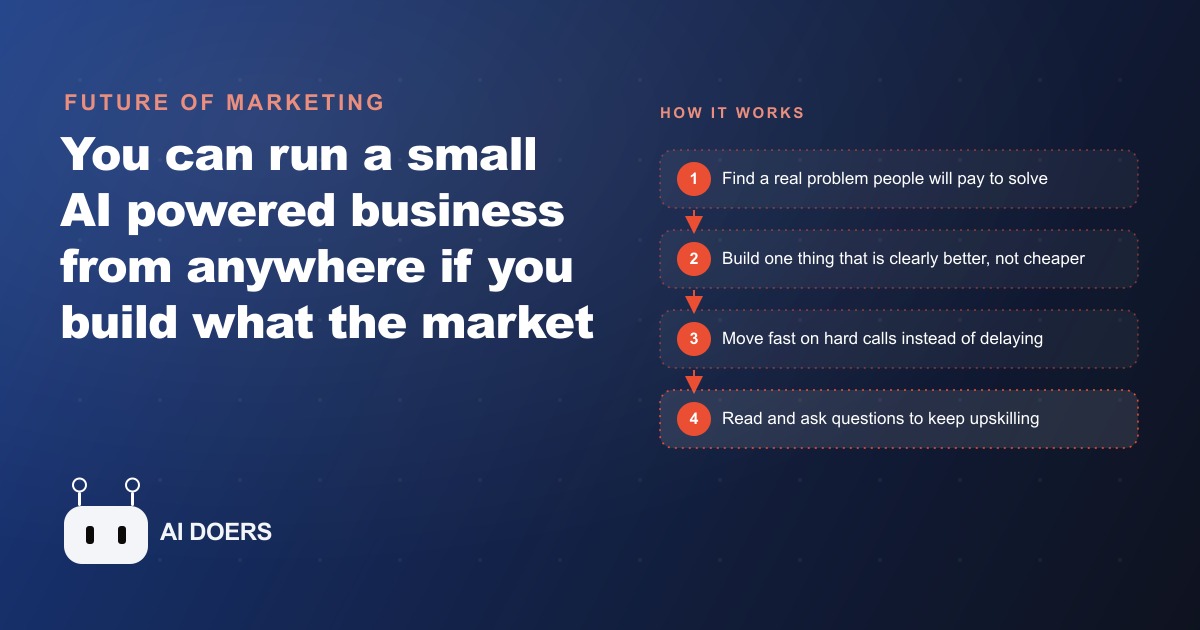
You do not need a big team, an office, or a fixed location to run a real business anymore. You need one strong offer, the nerve to decide fast, and the habit of learning quicker than your market shifts. That is the whole shape of a lean, location flexible operation, and the lessons behind it came out of a year of actually building rather than theorizing.
I am Madhuranjan Kumar, and this is the practical playbook I would hand any owner who wants to build something small, focused, and hard to knock over. Work the stages in order. Each one is a discipline, and they compound, so skipping an early stage weakens everything that follows.
Stage 1: Build what the market already wants to pay for
Start here, because getting this wrong makes every later stage pointless. The most common trap is falling in love with clever technology nobody actually needs. The job is the reverse. Find a real problem people will pay to have solved, and let that demand decide what you build. Do not guess in a vacuum and hope customers show up.
In practice this means talking to potential buyers before you build, watching what they already spend money on, and paying attention to the complaints they voice without prompting. Demand is a signal you collect, not a thing you invent. If you cannot point to people who will pay for the specific problem you want to solve, you do not have a business yet, you have a hobby with ambitions. Nail this stage and the rest of the playbook has something solid to stand on.
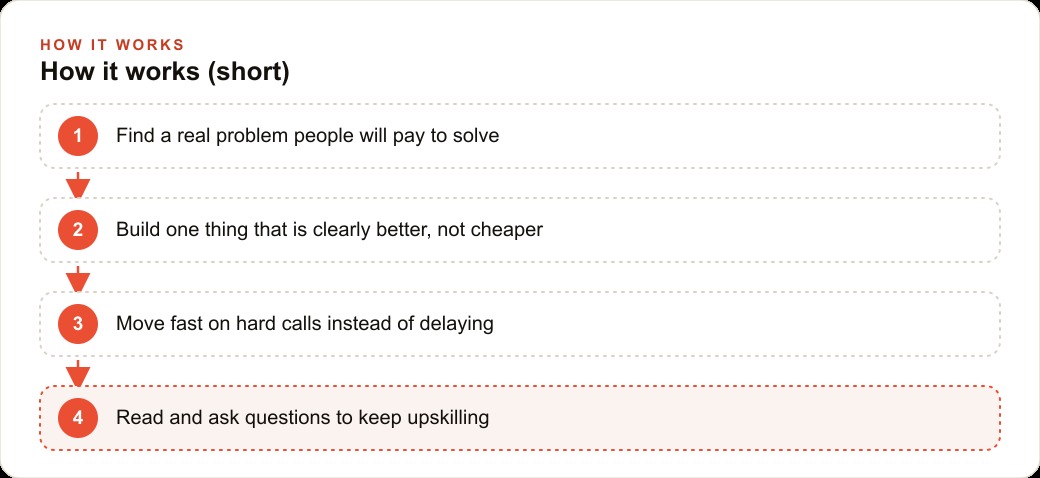
Stage 2: Aim to be ten times better at one thing, not cheaper
Once you know the problem, decide how you will win, and do not choose price. Profit comes from being clearly, obviously better at one specific thing, not from undercutting everyone around you. The moment you compete only on price, you start a race that grinds the whole market's margins to nothing, and nobody in a price war makes real money, least of all the small player.
So pick the one thing you will be excellent at and make it genuinely superior, not marginally nicer. Ten times better is a useful mental bar because it forces a real gap rather than a cosmetic one. A customer choosing you should feel the difference immediately, not squint to find it. This focus also keeps a lean team sane, because being great at one thing is achievable, while being slightly better at ten things is not.
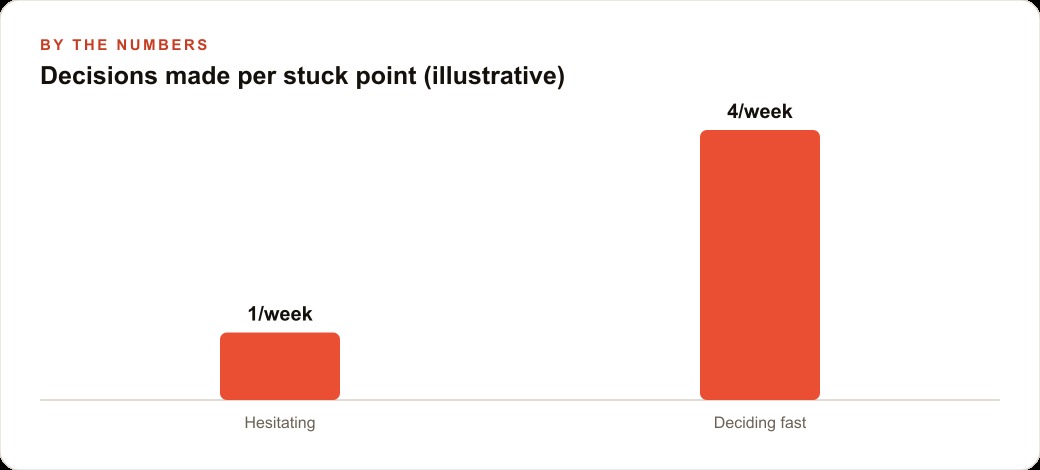
Stage 3: Move fast on hard calls instead of letting them sit
This is the stage where most owners quietly lose, and it has nothing to do with strategy. You will constantly face moments with two ugly choices, where both options look bad and neither is obviously right. The costly mistake is not picking the wrong one. It is refusing to pick, delaying, and pushing the problem aside to fester. Indecision compounds. A wrong call made quickly can usually be corrected, but weeks lost to hesitation never come back.
Build the habit of gathering the facts you reasonably can, setting a deadline, and deciding. A specific version of this shows up when revenue stalls, the persevere or pivot moment, where you must choose whether to push harder on the current path or change direction. There is rarely a clean answer, which is exactly why drifting is so tempting and so dangerous. Decide, then adjust. Momentum comes from deciding, not from waiting for certainty that never arrives.
Stage 4: Treat your product like something to prune, not just grow
Shipping fast is good, and most lean businesses are proud of it, but there is a hidden cost. Every feature you add that customers ignore creates drag, clutters the offer, and quietly raises the cost of maintaining the whole thing. So make pruning a regular discipline, not a one time cleanup. Track what customers actually use, and remove the rest without sentiment.
This applies far beyond software. A restaurant with a bloated menu, a service business with twelve packages nobody can choose between, a shop with dead stock, all suffer the same drag. The lean move is to watch real usage, keep what earns its place, and cut what does not. A tight, focused offer is easier to sell, easier to deliver, and easier to be excellent at, which loops right back to stage two.
Stage 5: Learn by reading plus active questioning
The market changes every few months, so your ability to learn is a core operating capability, not a side hobby. When you hit a big problem, do not muddle through on instinct alone. Read the best three or four books on it, and here is the part that makes it stick: use a strong AI model to ask questions as you read. Active questioning beats passive reading by a wide margin, because it forces you to test the ideas against your own situation instead of letting them wash over you.
This turns learning from a slow, vague activity into a fast, targeted one. You hit a concept you do not understand, you interrogate it immediately, you connect it to your specific business, and it lodges. An owner who learns this way stays ahead of a shifting field, while one who relies only on what they already know slowly falls behind it.
Stage 6: Shape your environment and team around focus
The last stage is about protecting output, because all the strategy in the world fails if you cannot execute through long days. Two levers matter. First, the team setup. Remote can absolutely work, but bringing a locked in team into one room for a stretch of hard work can raise focus when you need a push, so choose the arrangement that fits your current stage rather than dogmatically insisting on either. Second, your own energy. After a long block of deep work you get drained, and a simple change of scenery, moving to a cafe or a new spot, can reset you and let you do more in a day. Small environment changes are a cheap, reliable productivity lever that most owners underuse.
The traps that quietly kill lean businesses
Following the six stages is the plan. Avoiding a few predictable traps is what keeps the plan from unraveling, because lean businesses fail in recognizable ways, and none of them announce themselves loudly.
The first trap is confusing lean with underinvested. Lean means every dollar and every hour points at the one thing you are great at. It does not mean starving the parts of the business that actually drive revenue. Owners sometimes cut the marketing budget, the very thing bringing in demand, in the name of staying lean, and then wonder why growth stalls. The discipline is to cut waste and drag, the unused features, the vanity tools, the meetings that decide nothing, while protecting and even doubling down on the handful of activities that produce customers. Lean is about focus, not deprivation.
The second trap is mistaking motion for progress. A small team can feel busy all day, shipping features, answering messages, tweaking the website, and still move nowhere, because none of that activity is tied to the one problem the market pays to solve. This is where stage three and stage four earn their place. Every week, ask whether the work actually advanced the core offer or just felt productive. Deciding fast on a hard call moves the business. Reorganizing your task list for the third time does not. The lean owner has to be ruthless about the difference, because busyness is the most convincing disguise failure wears.
The third trap is scaling the tools and team before the offer is proven. It is tempting, once a little money comes in, to add staff, add software, and add complexity, on the assumption that growth requires it. More often it just adds drag and slows the decisiveness that made the business work in the first place. The right sequence is to prove the offer is genuinely ten times better and that demand is real, then add only the specific capacity that the proven demand requires, one deliberate addition at a time. Keeping the team and tools lean is not just a starting condition, it is an ongoing choice that preserves your ability to change direction without a six month rebuild. The businesses that stay adaptable are the ones that resist bloating the moment things go well.
A boutique hotel, worked through the stages with illustrative numbers
Let me run the whole playbook through one business. Picture a boutique hotel competing against larger chains and quietly losing on price. Applied in order, the stages turn into concrete moves.
Stage one, build what the market wants. Instead of copying the chains, the owner studies real guest reviews and booking patterns to find the one experience travelers in that location will pay a premium for, say a quiet, design led, remote work friendly stay. Stage two, be ten times better at that one thing rather than competing on nightly rate, because a price war against bigger hotels is unwinnable. Stage three, decide fast on the ugly calls, like whether to drop an underdelivering tour partner or renovate this season versus next. Stage four, treat the offering like a product, tracking which guest extras actually get used and cutting the ones that just add cost and clutter. Stage five, the owner reads deeply on hospitality positioning and interrogates it with an AI model to adapt it to their property. Stage six, the small team runs the front desk, inbox, and marketing with a handful of AI assistants drafting replies and summarizing reviews, while the owner shifts between guest experience in the morning and marketing from a different spot in the afternoon to keep energy up.
Now the numbers, illustratively. Suppose the hotel stops discounting and instead commits to its one premium experience, lifting the average nightly rate by 20 percent while occupancy holds because the positioning attracts the right guest. That premium flows almost entirely to the bottom line. The AI layer that handles routine inbox and review work saves the equivalent of a part time salary. To fill rooms on that positioning, the owner runs targeted Facebook and Instagram ad campaigns aimed at the exact traveler the hotel is now built for, captures every enquiry in a simple CRM and website stack so no booking request slips through, and lets the steady stream of guest reviews and location content strengthen SEO and organic search so direct bookings climb and the commission the hotel pays to booking platforms falls. Lean does not mean small ambition. It means every dollar and every hour points at the one thing the business is great at.
Start by writing down the one problem your business solves better than anyone nearby, and be brutally honest about whether customers actually pay for it. List the decisions you have been delaying and force one this week. Audit your offering and cut whatever customers do not use. Pick the biggest gap in your own knowledge and read the best few books on it while questioning a strong AI model as you go. Keep the team and tools lean enough to change direction without a six month rebuild.
Honestly, a focused owner can apply all of this in a month, and the AI layer that handles the routine inbox and review work can be stood up in an afternoon. The harder part is the judgment, choosing the one thing to be great at and deciding fast when the calls are ugly, which is where most people stall. No tool decides that for you, which is precisely why it stays your job as the owner. You can take the do it yourself path above, or if you would rather have the lean, AI powered side built and handed over working, that is exactly the kind of setup I do for clients, and you can bring me in to handle it.
That is exactly what we do at AI DOERS. Book a private 30-minute call with Madhuranjan Kumar and we will map the fastest path to it for your specific business.
Book your call →
Madhuranjan Kumar
Madhuranjan Kumar brings 20 years of performance-marketing experience and has managed over $200 million in Facebook ad spend for brands across the United States and beyond. His expertise spans the full modern marketing stack: Meta, Google Ads, TikTok, email automation, CRM, and the websites that hold it together. At AI DOERS he turns that track record into lead-generation systems for businesses across every industry.