
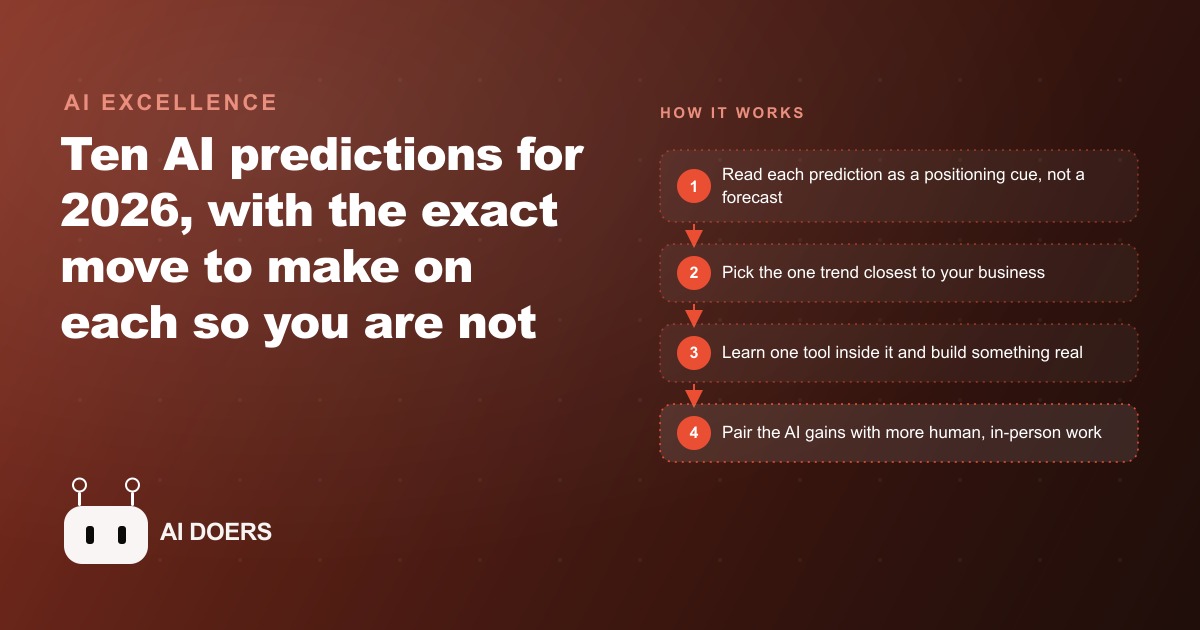
10 AI Predictions for 2026, and the Move to Make on Each
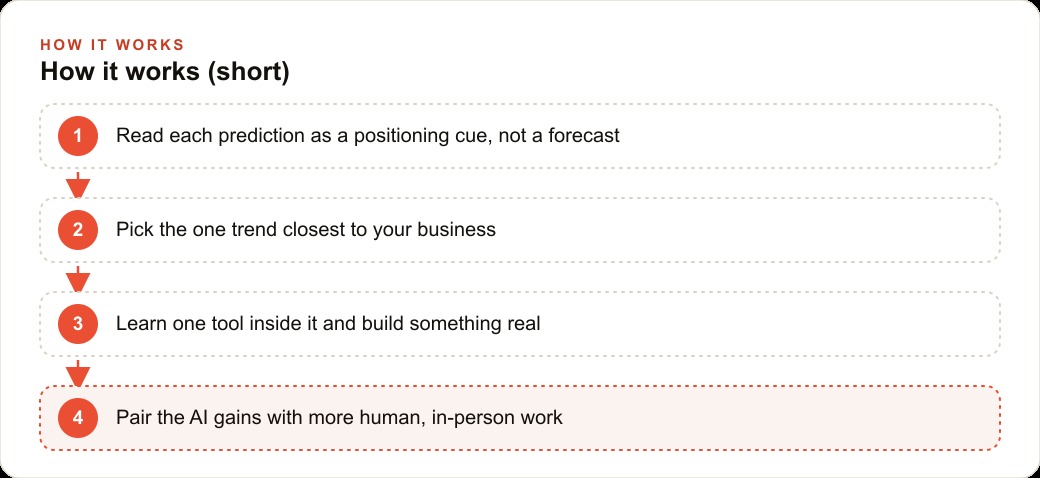
The fastest way to not fall behind in 2026 is to position, not panic. Learn one Google tool deeply, ship a vibe-coded app, get fluent in Claude Code, and test the new agent builders, because these are the trends most likely to compound for a small business.

Two Forces, Not Ten Predictions
The most dangerous mistake a founder can make heading into 2026 is treating AI as a single trend moving in a single direction. What is actually happening is two completely opposite forces accelerating simultaneously, and most people watching the space are tracking only one of them.
Madhuranjan Kumar has spent several years building a seven-figure business at the intersection of AI and marketing, and the predictions that emerged from that vantage point for 2026 split almost perfectly in half. On one side sit predictions about capability expanding: models getting more powerful, tools getting more embedded, creation becoming radically more accessible. On the other side sit predictions about human beings actively rejecting the output of those tools in favor of something rawer, more real, and harder to replicate with a prompt.
Most commentators pick the camp that confirms their existing worldview and build their argument from there. The people who will actually position correctly in the next twelve months are the ones who understand that these two forces are not competing to produce a single winner. They are compounding each other, growing simultaneously, and creating two distinct market opportunities that require two completely different responses.
The Acceleration Side: Seven Dynamics Compressing What Is Possible
Start with Google, because it is the most underestimated shift in the current moment.
The assumption a year ago was that OpenAI owned the consumer AI market and the competitive battle was between ChatGPT and whoever could build a better standalone chat product. That assumption has been overtaken by a simpler and more powerful dynamic. Google did not try to build a better chat product. It embedded its AI into the products hundreds of millions of people were already using every day and had no intention of switching away from.
Gemini inside Google Docs, Sheets, and Slides does not require anyone to open a new tab. It does not require a new habit, a new login, or a new subscription decision. It requires a single click in a document that was already open. That friction difference is more decisive than any benchmark comparison. Someone who has to open a separate browser tab and write a prompt is performing a deliberate act. Someone whose spreadsheet already offers to analyze the data they just pasted is simply clicking yes. The consumer market share that ChatGPT held near ninety percent is now below seventy-five and declining, not because a competing chat product outperformed it, but because Google figured out distribution at the workflow level.
Google's image editing capability has followed the same logic. Tools that produce genuinely competitive outputs against the standalone apps professionals have used for years are now baked into the same productivity suite where the work already lives. Video generation is next on the same curve. This is not a story about Google's models being the best in isolation. It is a story about the most powerful distribution channel in consumer software activating a category it previously ceded to challengers.
The second structural dynamic on the acceleration side is what happens when any app can host mini-applications inside itself without the overhead of the traditional developer account model. The hundred-dollar annual fee is a real but modest barrier. The larger costs are the review process, the approval uncertainty, and the technical baseline that the current submission system assumes. When those constraints lift, the people who can now distribute useful software directly to audiences jump from a narrow technical elite to anyone who can build something that works.
This is the software equivalent of what happened when smartphones, consumer video editing apps, and algorithmic distribution platforms converged within a few years of each other. The camera was already in everyone's pocket. The editing software became trivially accessible. The platform handled distribution. The result was a generation of creators who had no formal training in film production and out-performed television professionals in specific engagement metrics because they understood their audiences in ways the professionals did not. The same dynamic is about to unfold in software. The person who builds a useful tool quickly and iterates based on direct feedback will, in specific categories, out-perform the professionally built equivalent, not because the code is more elegant, but because the feedback loop is tighter and the audience understanding is more specific.
Vibe coding is the phase where this happens, and the evidence that it is becoming a genuine professional skill rather than a novelty is not anecdotal. The largest AI model providers are now competing specifically on coding performance. Anthropic's Claude holds the strongest coding model by a noticeable if narrow margin, and that margin is what Anthropic is betting its near-term commercial position on. When companies with access to the same compute, data, and talent as every other major lab choose to optimize their flagship model around code generation quality, it reveals where they believe the professional value is concentrating. The skill for humans in this world is not just the ability to prompt. It is the ability to recognize what correct output looks like, catch the subtle errors that pass a surface-level review, and understand enough about software architecture to steer the agent toward something that will still work six months from now.
The final piece of the acceleration side, and the one with the most immediate operational relevance for business owners, is the agent builder problem. Tools that allow complex workflow automation exist. They are powerful. They are also, by the assessment of most non-technical users who try them, demanding enough to be a genuine barrier. The gap between "I described what I want the automation to do" and "I actually have a running automation" remains wide enough that most business operators who start the process abandon it before seeing results. The prediction for 2026 is that this gap closes meaningfully, not because the underlying technology changes dramatically, but because the interfaces around it finally catch up to the actual capability. When building an agent requires roughly the same effort as describing a task to a competent employee, adoption accelerates in a way that no amount of marketing has been able to produce.
The Backlash Side: Three Dynamics That Are Market Signals, Not Nostalgia
Every time the acceleration side of this picture gets coverage, the backlash side gets characterized as nostalgia or technophobia. That framing is wrong in a way that costs founders real money and real positioning accuracy.
The craving for genuine human connection is not a sentiment held by a fringe demographic. It is a market signal backed by measurable purchasing behavior. Dumb phones, stripped of social apps and AI assistants, are generating a consumer market that did not exist three years ago. In-person events across almost every category are running at highs that would have seemed implausible during the period when remote-everything appeared to be permanent. The people actively seeking experiences that feel unmediated and human are not a small community of purists. They are a large and growing segment with disposable income, strong word-of-mouth behavior, and significant brand loyalty once earned.
A zero-AI social platform is not a niche product for a few thousand early adopters. It is a category waiting to be claimed at scale. The concept is simple in a way that is deceptively easy to underestimate: raw video only, captured live, no uploads, no AI enhancement, no filters, no retrospective editing. The value to the viewer is something that has become genuinely rare, which is proof that what they are watching was actually happening when it was recorded. The anti-AI platform is not defined by what it rejects. It is defined by what it can guarantee that no AI-augmented platform can.
This matters because the cost of producing convincing synthetic content has dropped to near zero. That cost reduction is the direct cause of the signal problem that the anti-AI platform solves. When every video can be generated, every voice can be cloned, every face can be composited, the audience is not being irrational when it begins to discount AI-adjacent content. It is applying a rational response to a genuine signal degradation problem. The zero-AI platform offers a solution that is structural rather than merely claimed.
The substance-over-slop movement inside the AI industry itself is the most telling indicator that this backlash has real purchasing power. Anthropic has made the deliberate choice to position itself as the company building AI that is not designed to maximize engagement at the expense of user judgment. Whether that commitment survives competitive pressure is a separate question. The fact that a company with access to the same capabilities as every other major lab chose this positioning as a commercial differentiator tells you something specific about where the customer pressure is coming from, and who is paying enough attention to respond to it.
Why Each Force Makes the Other Stronger
Here is the insight that most summaries of these predictions completely miss: the acceleration side and the backlash side are not competing to determine which trend wins. They are each making the other more powerful.
The mechanism is direct. As AI capability becomes more deeply embedded in more surfaces, the conspicuousness of anything unmistakably human increases. A handheld video with ambient noise and imperfect framing does not read as low quality to a viewer who has spent the prior week watching five thousand AI-enhanced outputs. It reads as rare. The signal value of imperfection increases proportionally to the baseline of polish that surrounds it. The more perfect the AI-generated content becomes, the more the market value of obviously human content rises.
The reverse dynamic is equally real. The more visible and vocal the backlash becomes, the more shareable the backlash itself becomes, which drives more people to discover and participate in the anti-AI category. A zero-AI social platform grows through the same social mechanics that AI-native platforms use. Interesting content circulates. People share it because it is distinctive. The distinctiveness comes from its position relative to the AI-generated mainstream. The backlash is inherently self-amplifying precisely because the thing it is reacting against is self-amplifying.
By the end of 2026, the world described by these predictions will have AI more deeply embedded in workplace productivity software than at any prior moment in the history of that category, and simultaneously will have a cultural premium placed on unmediated human experience that is higher than at any prior moment in the social media era. Both statements will be simultaneously true. This is not a paradox. It is the predictable result of two forces that amplify rather than cancel.
The Positioning Framework That Survives Either Outcome
The strategic error that many founders make when they encounter this split is to believe they must choose a camp. The accelerationist goes all-in on AI tools, automating every visible touchpoint and publishing at scale. The humanist performs a conspicuous rejection of AI in their customer-facing identity, leaning into the raw and the handcrafted. Both of these positions work for specific audiences. Neither works as a general strategy for anyone whose customer base spans multiple segments.
The businesses that position correctly in 2026 are not the ones who correctly predict which force will dominate. They are the ones who make a clear decision about which force their specific customers are responding to, and then align what those customers see with that decision. The tools operating behind the customer-facing layer can belong entirely to the acceleration side even when the brand sits firmly in backlash territory. And the reverse is equally available: a business that serves a customer base hungry for AI-augmented speed and efficiency can communicate that capability clearly and build trust through transparency rather than hiding it.
The key question is not "what do I believe about AI?" The key question is "what is my customer buying, and which force describes that purchase?"
A Business That Used Both Forces Correctly
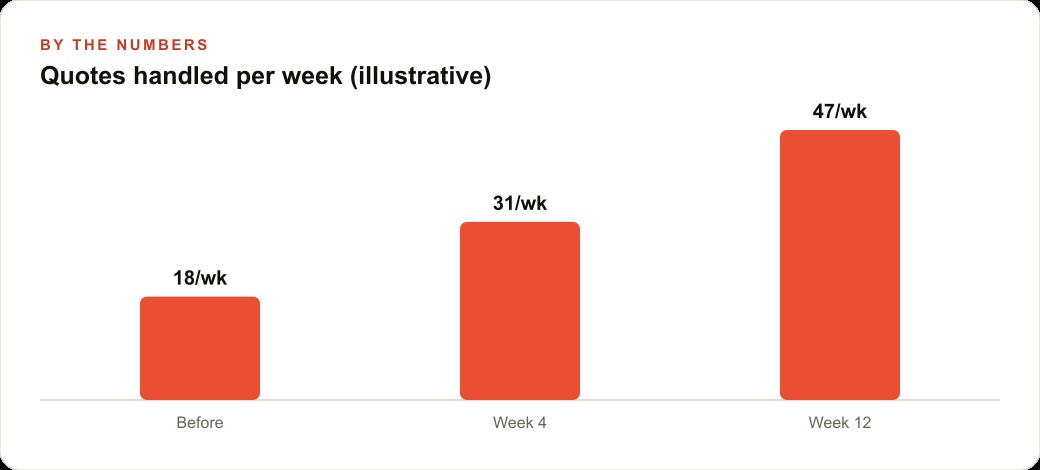
Consider a small food photography studio run by one owner with two part-time contractors, handling roughly twelve commercial clients per month. On the back-end operations side, the owner uses AI tools to draft client briefs, generate prop sourcing lists from the session notes, automate the invoice follow-up sequence, and handle scheduling confirmations without manual intervention. These workflows save approximately seven hours per week and have zero effect on the customer experience.
On the customer-facing side, the social content strategy moves in precisely the opposite direction. Behind-the-scenes footage from active shoots, captured on a phone, handheld, with natural ambient sound and the visible imperfections of a working studio. No color grading applied later. No AI-generated captions describing what appears in the frame. The aesthetic is deliberately raw in the specific ways that signal authenticity in a category where every competitor's portfolio page looks like a controlled render. The inquiry rate from that content consistently out-performs the studio's polished portfolio, because prospective clients can see the process rather than only the result.
The two forces are not competing inside that business. They are each operating in their correct domain. The back-end runs on acceleration tools. The front-end sends backlash signals. The result is a business that is simultaneously more operationally efficient than its competitors and more trusted by the clients who are specifically hiring it for evidence of human craft.
The predictions for 2026 are not a list of ten separate bets on which companies will capture market share. They are a map of a structural split in how AI is reshaping behavior across two different populations that are both growing. Reading the map correctly means understanding that you do not have to pick the winning force. You have to pick the force your customers belong to, and then align what they experience with that reality. Do that clearly and the noise around which model is the best and which platform is rising becomes secondary. The positioning decision is the one that actually compounds.
That is exactly what we do at AI DOERS. Book a private 30-minute call with Madhuranjan Kumar and we will map the fastest path to it for your specific business.
Book your call →
Madhuranjan Kumar
Madhuranjan Kumar brings 20 years of performance-marketing experience and has managed over $200 million in Facebook ad spend for brands across the United States and beyond. His expertise spans the full modern marketing stack: Meta, Google Ads, TikTok, email automation, CRM, and the websites that hold it together. At AI DOERS he turns that track record into lead-generation systems for businesses across every industry.