
The One Sentence Prompt That Reverse Engineers Any Image in ChatGPT
Most people struggle to describe the image in their head. The smarter move is to start with a picture you like and let ChatGPT write the prompt that recreates it, which also teaches you how to prompt.

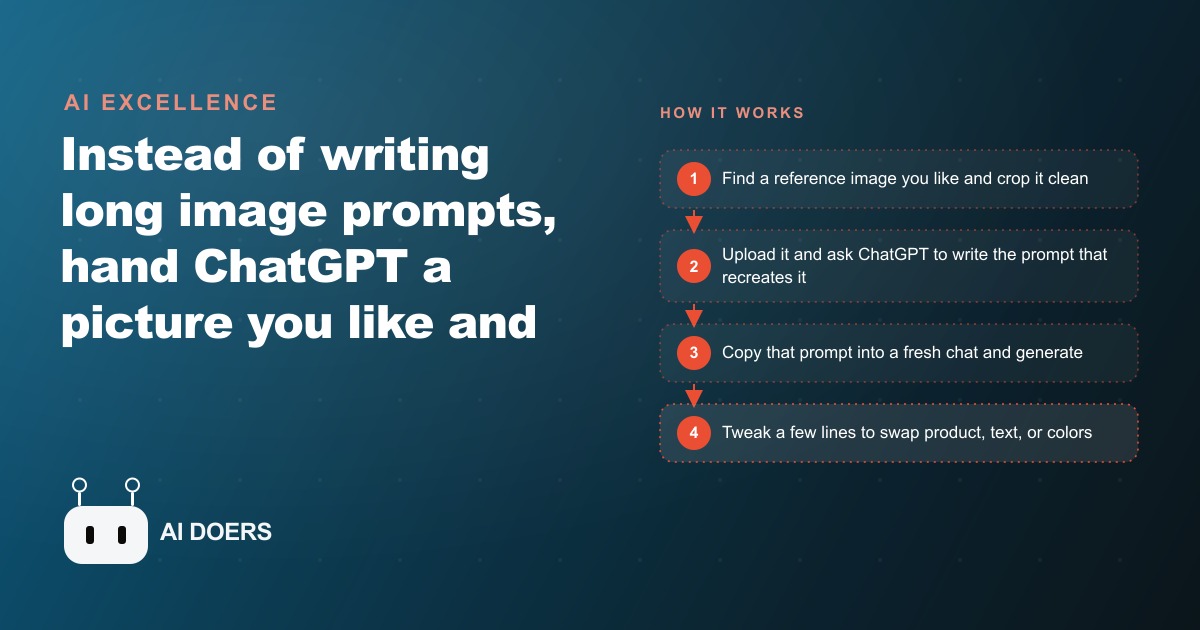
Most advice about AI image generation has the workflow backwards. The standard tutorial tells you to study vocabulary lists, practice writing technical descriptions, and iterate through dozens of failed attempts until your text description finally produces something close to the image in your head. This approach works eventually, for some people, after significant time investment. There is a smarter path that starts at the other end.
Instead of describing an image you have never seen in the vocabulary of a tool you are still learning, start with an image you already know is right and let the model write the prompt for you. Upload the reference, ask the model to analyze it and write the prompt that would recreate it, and use that output as your starting point. The result is accurate on the first attempt, you own a repeatable template immediately, and you learn the model's vocabulary by reading it rather than guessing at it in advance.
Why prompt-writing tutorials set you up to waste time
Prompt-writing tutorials have a structural problem that becomes apparent the first time you apply their advice and do not get the result you expected. The vocabulary in a tutorial is a human's best approximation of what they think the model responds to. The vocabulary in a reverse-engineered prompt is the model's own description of a specific image in its own terms. The difference in reliability between those two sources is significant.
The deeper issue is that the model's visual vocabulary is not static or universal. Different model versions respond to different phrasings. Terms that reliably produce a specific look in one version may produce something subtly different in a later release. Tutorials written three months ago may already have outdated vocabulary because the models they describe have been updated. The reverse-engineering process stays current by definition because you are always asking the model you are currently using to describe what it sees in the language it currently understands.
There is also a specificity problem. A tutorial might tell you to write "high-key lighting with soft shadows" and show you the general category of image that phrase produces. But your reference image has a specific warmth of tone, a specific relationship between the lit subject and the background, a specific typographic weight that you recognized as right when you saw it. The tutorial gives you a category. The reverse process gives you the precise terms for the precise visual qualities in the precise image you chose. For a business owner who needs to reproduce a consistent look across dozens of posts, that precision is not a minor advantage.
Learning to write prompts through tutorials also places the learning cost entirely upfront. You invest time and effort before producing a single usable image, and the quality of what you produce depends on how accurately you absorbed the tutorial's vocabulary and applied it to a specific goal the tutorial did not describe. Most people who try this route produce inconsistent results and eventually stop. The barrier is not the concept, it is the friction between general instruction and specific execution.
For a small business producing marketing images consistently over months, prompt-writing tutorials require you to invest in the skill before you see the return. The reverse process delivers the return first and builds the skill as a side effect, because every reverse-engineered prompt you read teaches you which specific terms produce the visual qualities you wanted. The investment and the output happen simultaneously.
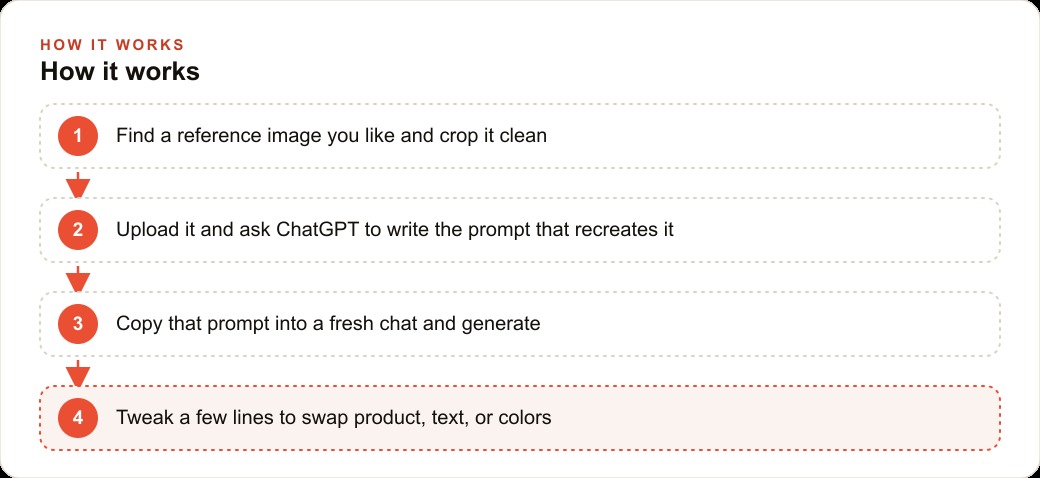
What the model reads when you hand it a reference image
When you upload an image and ask a model to reverse-engineer the prompt that would recreate it, the model processes the image as a set of separable visual attributes rather than a single unified whole. It reads the background color and texture as distinct from the subject. It reads the lighting direction and softness. It reads the typographic weight and placement of any text. It reads the composition: where the primary subject sits in the frame, how much negative space surrounds it, whether the image is centered or offset. It reads the overall color temperature and whether the palette is warm, neutral, or cool.
Each of these attributes becomes a distinct clause in the returned prompt. A clean promotional card for a salon service might produce a description that includes: a soft cream background with minimal texture, a product or treatment name centered in the upper third of the frame, warm directional lighting from the upper left creating a gentle highlight, a serif headline in charcoal set at medium weight, small tagline text in a lighter weight below, and an overall palette of warm neutrals with no saturated accents. That description is a map of the visual qualities that made the reference image work.
Every clause in that map is independently adjustable. You can change "serif headline in charcoal" to "sans-serif headline in white" and observe how that single change affects the output. You can change "warm directional lighting from the upper left" to "flat even lighting" and compare. You can swap the service description entirely and keep every other visual attribute constant. These are targeted, predictable edits to a working description, and they produce changes you can observe and learn from.
This is what distinguishes the reverse process from prompt-writing from scratch. Writing from scratch requires you to reconstruct a full visual description from memory and produce it in the right sequence of terms, hoping that your reconstruction lands close enough to what you want. Editing a reverse-engineered prompt requires you to change one clause and observe the result. The cognitive load is lower, the iterations are faster, and you build working knowledge of which specific terms matter most by watching what happens when you change them one at a time.
The other thing worth noting is that the quality of the reverse-engineered prompt depends on the clarity of the reference image. A reference with one dominant subject, a consistent background, and a clear typographic hierarchy gives the model plenty of distinct visual signals to describe accurately. A busy collage with competing subjects and overlapping text gives it less signal, and the output prompt reflects that complexity. Starting with the cleanest possible reference image, one where each visual element is distinct and legible, sets the whole chain up for a stronger result on the first generation.
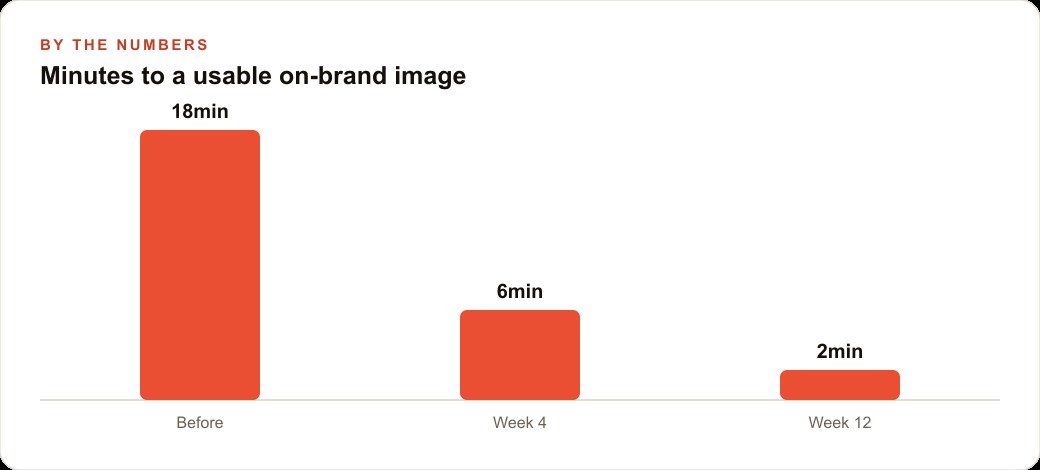
Editing one line of a working prompt beats writing a fresh one from scratch
The most useful thing a reverse-engineered prompt gives you is not a one-time image. It is a stable starting point for every image you will want in the same visual style going forward. Every time you need a new marketing image, you open the saved prompt, change the elements specific to the new use case, and generate. The elements that define the visual style remain constant. Only the content-specific details change.
For a single reverse session that produces a strong result, the adjustable variables fall into a predictable set. The headline text changes for each promotion. The product or service description changes for each offer. The seasonal or contextual detail changes for each campaign period. Everything that defines the look, the background tone, the lighting quality, the typographic hierarchy, the composition structure, stays fixed.
This means a single reverse session of perhaps forty minutes, covering finding a good reference, running the reverse, testing the output, and saving the prompt, sets up a content production process that runs for months. Each new image takes a few minutes: open the base prompt, change three or four clauses for the specific post, generate two or three variants, select the strongest. That is not a meaningful time commitment relative to the visual quality it produces.
The alternative of writing a fresh prompt for each post creates a different and more persistent problem: visual inconsistency across the content feed. Posts generated with independent fresh prompts each time have no shared vocabulary and therefore no shared visual identity. A content library built from different starting points each time looks like work from a dozen different creators. A content library built from a single reverse-engineered base prompt, with only the content variables changed, looks like it was produced by someone with a deliberate and consistent visual brand. Audiences register that consistency as competence and intention, even when they cannot articulate what they are responding to.
There is also a practical confidence benefit. When a prompt is known to work because it was derived from an image you already approved, you approach the generation session with a different mindset than when you are writing from scratch and hoping. You know the style will be close. Your attention shifts from "will this look right?" to "which of these three variants is strongest?" That shift is small but it adds up across dozens of generation sessions over a month of content production.
A hair salon that built five weeks of content from a single reverse session
Madhuranjan Kumar would approach a hair salon's content problem in the following way. The salon has a clear sense of the visual quality it wants, warm, editorial, elegant, not the oversaturated promotional look that most local businesses default to. The owner had seen a competitor's promotional card and thought that is exactly the look we want for our feed. That image is the starting point.
She uploads the reference card and asks the model to reverse-engineer the prompt. The result describes the image in detailed visual terms: warm amber toning over a softly blurred background, a focused subject in the center of the frame against generous negative space, a medium-weight serif headline in off-white positioned in the upper quarter of the image, a secondary service label in a lighter weight below, and an overall palette of warm neutrals with no cool tones or saturated accents. That description belongs to the salon now.
To announce the autumn color menu, she changes the headline to the specific service name, adjusts the secondary label to mention the seasonal offer, and adds a brief description of a color treatment in the content clause. Every other element stays exactly as the reverse produced it. The resulting image carries the same editorial warmth, the same typographic hierarchy, the same negative space composition that caught her attention in the original.
To promote bridal packages, she adjusts the content description to reference the occasion and swaps the secondary label to mention booking timelines. The warm amber toning stays. The serif headline stays. The composition stays. A customer who follows the feed sees images that feel consistent, intentional, and designed rather than assembled at random from different moods on different days.
Over five weeks, using the same base prompt with only the content-specific lines changed for each promotion, the salon produces thirty posts covering different services, seasonal specials, and occasion-based campaigns. Each post takes under ten minutes to generate, review, and select. The total time invested in production is a fraction of what commissioning individual design for that volume would cost, and the visual result is more consistent than what most design contractors produce across that many pieces.
There is a secondary benefit that accumulates quietly alongside the content library. By reading the prompt the model produced for the reference image, the owner now understands the specific vocabulary that generates the visual qualities she wants. She knows that "warm amber toning" produces the editorial color quality she chose. She knows that "medium-weight serif headline in off-white" produces the typographic feel that distinguishes her feed from competitors using default sans-serif. She did not need a tutorial to acquire this knowledge. She acquired it by reading the description of an image she had already decided was right, which is a more reliable path to useful vocabulary than memorizing terminology in the abstract.
The standard advice asks you to build the skill first and hope the results justify the investment. The reversed workflow delivers a usable result in the first session and builds the skill in parallel, because every prompt you read teaches you something specific about the visual qualities that produced the image you chose. Starting with an image you already know is right is not a shortcut. It is the more rational starting point, and for a business that needs to produce consistent visual content across months without a design team, it is the only approach that reliably delivers both the quality and the consistency that make a content feed worth following.
That is exactly what we do at AI DOERS. Book a private 30-minute call with Madhuranjan Kumar and we will map the fastest path to it for your specific business.
Book your call →
Madhuranjan Kumar
Madhuranjan Kumar brings 20 years of performance-marketing experience and has managed over $200 million in Facebook ad spend for brands across the United States and beyond. His expertise spans the full modern marketing stack: Meta, Google Ads, TikTok, email automation, CRM, and the websites that hold it together. At AI DOERS he turns that track record into lead-generation systems for businesses across every industry.