
How to Repurpose One Video Into Posts for Nine Platforms with Claude Code
A reusable Claude Code skill turns a single video into finished, on brand posts and visuals for every social channel, with you approving each one before it ships.

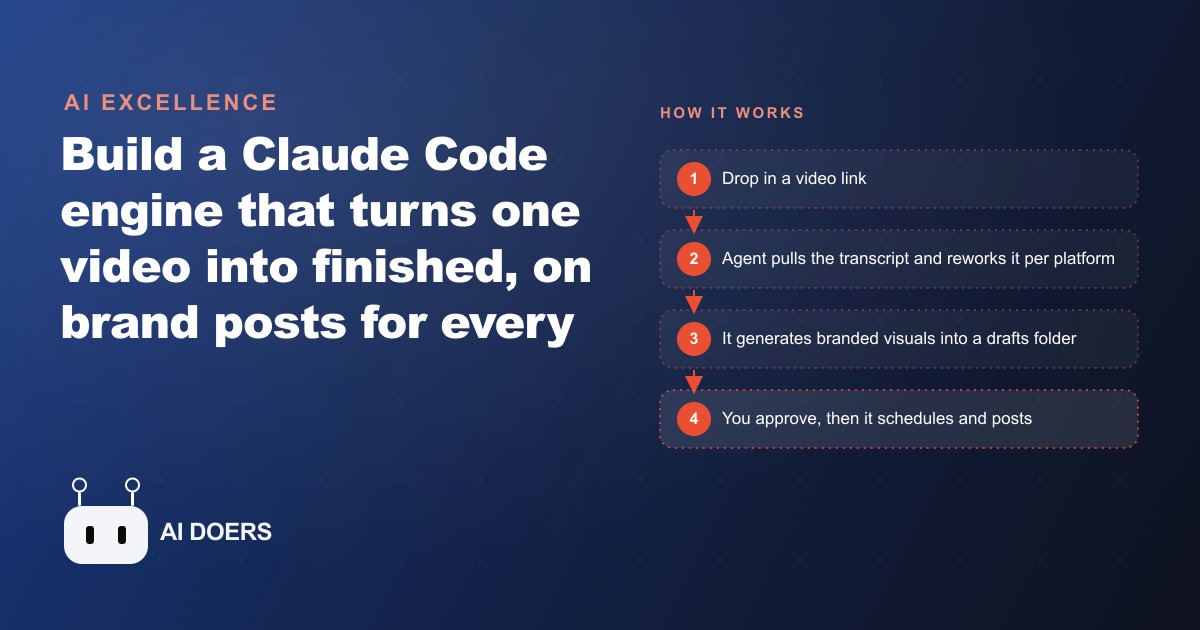
One piece of content is an untapped asset until it exists on every channel it fits
Most businesses treat a video as a single output. They record it, upload it to one platform, wait to see how it performs, and then record another one. This breakdown exists in one place for its entire life. That treatment misunderstands what a video actually is: a structured collection of ideas, demonstrations, and explanations that were assembled once and can be restated, reformatted, and republished many times. The effort of creating the source content does not belong to a single channel. It belongs to every channel the content fits.
The reason this matters practically is not philosophical. It is arithmetic. A recording that lives on one platform reaches one audience. The same recording adapted for nine platforms reaches nine audiences, many of whom are on only one of those platforms and would never find the original. The business that consistently shows up on all nine channels builds a presence that is virtually impossible for a competitor to replicate by hand, because the manual effort of creating nine distinct platform-native pieces from a single source is prohibitive at scale. A Claude Code skill that extracts a transcript, rewrites it for each channel, generates branded visuals, and queues drafts for approval turns one recording session into a full week of professional-quality content across every channel that matters.
I want to walk through exactly how that skill works, layer by layer, because each layer has a design decision embedded in it that determines whether the output is actually useful or just technically produced.
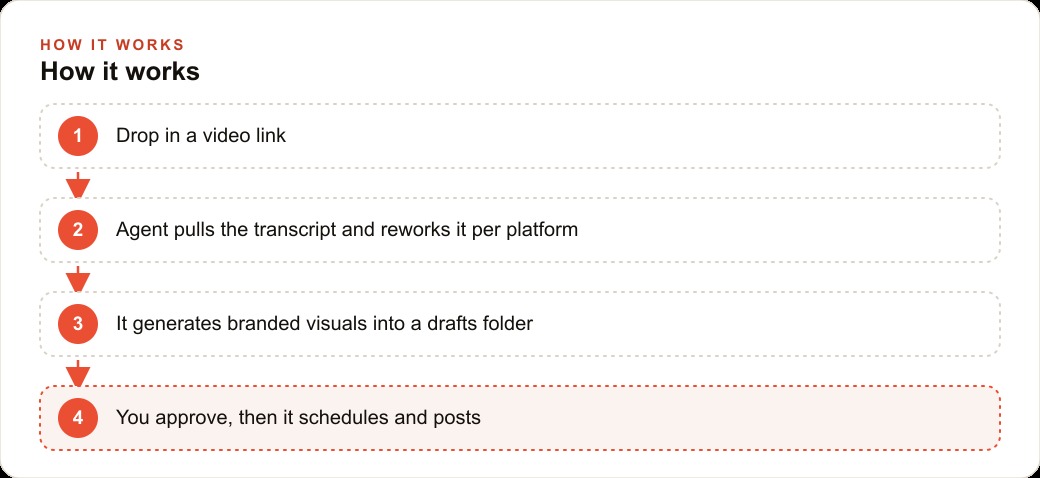
The transcript extraction layer: where the repurposing actually begins
The skill begins not with writing, but with reading. Before any post is drafted, the agent needs the raw material in a form it can work with, and for a video that means the transcript. Extraction pulls the auto-generated or manually uploaded captions from this breakdown platform and cleans them into a readable document. That cleaning step matters more than it sounds. Auto-generated captions contain timestamp artifacts, filler words, and formatting noise that are harmless for human reading but degrade the quality of downstream drafts. A transcript passed to the rewriting layer without cleaning produces posts that read like cleaned-up subtitles rather than platform-native content.
The extraction layer also identifies structure within the transcript. A ten-minute video rarely holds a single undifferentiated stream of ideas. There are usually three to five distinct points, a story or example in the middle, and a call to action at the end. The agent identifies those breaks and stores them as structured sections rather than processing the entire transcript as a flat block of text. That sectioning is what makes platform-native writing possible at the next layer, because different platforms favor different sections of the same source material.
A LinkedIn post performs best when it leads with a single insight and develops it methodically. An Instagram carousel performs best when each slide makes a standalone point that works without the previous slide as context. An X post performs best when it captures a surprising claim in the first sentence and then earns that claim quickly. None of those formats maps cleanly onto the same portion of a ten-minute transcript. The extraction layer's job is to present the transcript's structure clearly enough that the rewriting layer can draw from the right sections for each channel.
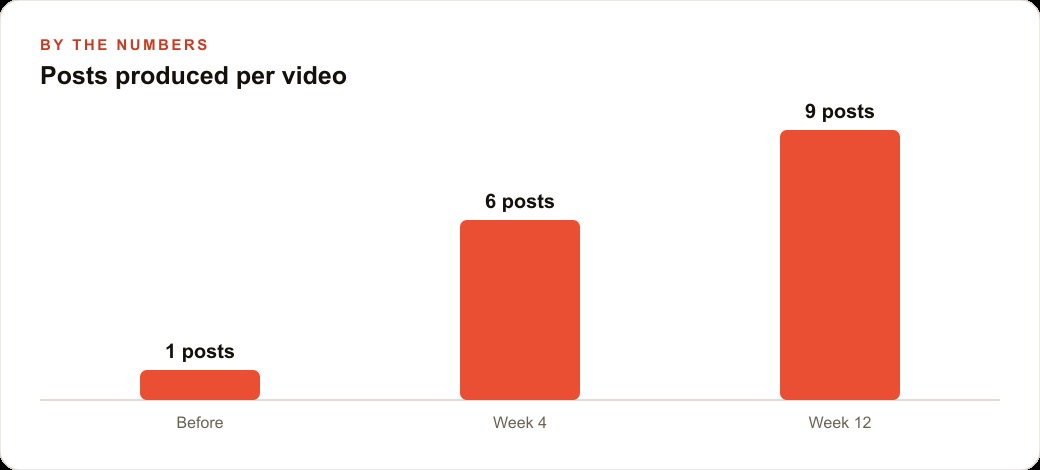
Platform-native rewriting is not copy-paste with a character limit
This is the layer where most automated content tools fail. They treat platform differences as character limits and strip the text down to fit. LinkedIn gets 700 characters. Instagram gets 300. X gets 280. What they produce reads like truncated versions of the same content, and truncated content does not perform because it does not fit the distinct reading patterns of each platform's audience.
Platform-native rewriting is something different. It starts from the same source ideas but reconstructs them in the native voice and format of each channel. LinkedIn's audience reads long-form analysis and rewards content that builds an argument step by step, so a LinkedIn draft from a video about customer retention might open with a counterintuitive claim about churn, develop it with three supporting points drawn from the middle of the transcript, and close with a direct question that invites the professional audience to share their own experience. That post reads like something written for LinkedIn by someone who understands LinkedIn.
Instagram's audience scrolls fast and decides in the first half second whether to stop. A carousel draft from the same source video might open with a bold number or a surprising before-and-after, use each slide for a single point that makes visual sense on its own, and close with a save-worthy checklist that earns a bookmark. That content reads like something built for Instagram by someone who understands what Instagram users actually look for.
X performs best when it challenges something, surprises someone, or makes a point with a kind of blunt economy that is rare in long-form content. The same video might produce an X post that opens with a counterintuitive claim and then delivers three short punchy sentences before inviting a reply. That reads like something written for X by someone who knows how threads perform.
The skill contains platform-specific writing instructions for each of the nine channels it supports. Those instructions are not character limits. They are voice profiles, structural templates, and engagement patterns derived from what actually performs on each platform. When the agent rewrites for a channel, it references those instructions and produces a draft that could plausibly have been written by a dedicated social media manager who spends all their time on that specific platform.
Branded visuals are not optional; generic output does not compound
Text alone is not enough for most platforms. Instagram essentially requires a visual. LinkedIn posts with images or carousels significantly outperform text-only posts. Pinterest is visual by definition. The skill includes a visual generation layer that produces platform-formatted images for each channel using the brand's own assets: logo, color palette, and a profile photo for context recognition.
Generic visuals, the kind that could belong to any brand, do not compound. They do not build recognition over time because there is nothing distinctive to recognize. A viewer on Instagram might see a well-formatted carousel, read the content, and have no lasting memory of which brand produced it. Branded visuals solve that problem because the logo, the color palette, and the overall aesthetic create a consistent visual signature that becomes more recognizable with every post. After ten posts, a viewer starts to identify content before they read the caption. After fifty posts, they associate the aesthetic with a specific expertise or personality. That association is the foundation of organic audience growth.
The visual generation layer also handles the format variations that differ by channel. A square image formatted for Instagram does not work natively on Pinterest, which expects a vertical format with a roughly two-to-three ratio. A horizontal image formatted for X does not work on Instagram stories. The skill generates each visual in the correct dimensions for each channel rather than producing one image and letting the platform crop it unpredictably.
The approval gate that makes automation trustworthy
Every draft produced by the skill lands in a review folder before anything reaches a live channel. That approval gate is not a technical afterthought. It is the feature that makes the system trustworthy enough to use at scale.
The early runs of any content skill will produce drafts that are close but not quite right. The voice might be slightly too formal for a brand that sounds casual in its videos. The visual might use a font weight that looks fine on a large screen but reads poorly on a phone. A specific phrase might be technically accurate but inconsistent with how the brand has positioned itself on a sensitive topic. None of those issues would be caught by a system that posts automatically without review, and any of them could become a public embarrassment or a customer confusion that takes real effort to address.
The review folder gives the brand owner or marketing lead a moment to read each draft, check each visual, and approve or adjust before any content goes live. After the first few rounds of adjustment, the drafts need fewer changes per run, and eventually the review becomes a quick scan rather than an edit session. But the gate should stay in place even then, because the cost of skipping a review is not measured in time saved on a quiet day. It is measured in the one post that went out with a tone-deaf message during a news cycle that made it particularly inappropriate.
The self-correcting loop that builds quality with every run
When a step in the skill fails, the agent does not stop and ask for help. It reads its own error, diagnoses the cause, adjusts the approach, and retries. When the retry succeeds, the fix is written back into the skill so the same failure does not occur on the next run. That loop is what makes the system improve with use rather than requiring constant manual maintenance.
The most common failures are format-specific. A visual generation step might fail on a specific platform's dimensions because the template referenced the wrong aspect ratio. The agent catches the failure, identifies the wrong ratio, corrects it, retries successfully, and updates the template so all future runs for that platform use the correct dimensions. Over time, the skill accumulates a library of caught-and-fixed failure modes. Each one represents a category of error that will never recur, which means the failure rate decreases with every run and the review burden shrinks as the skill matures.
The self-correcting loop also handles the platform-specific variations that change over time. Social platforms update their API specifications, their image requirements, and occasionally their character limits. A skill that does not self-correct will silently produce outputs that no longer match current platform requirements until someone notices a formatting problem in the review folder. A skill with a functioning self-correcting loop detects the mismatch when it occurs, adapts, and updates its own instructions without requiring a developer to diagnose and patch the problem manually.
A moving company that turned one walkthrough video into a month of trust-building posts
Consider a local moving company whose owner films a five-minute walkthrough explaining how to pack a kitchen so nothing breaks during a move. On its own that clip reaches whoever finds the original upload. Run through the repurposing skill, it becomes something considerably more useful.
For LinkedIn, the skill extracts the most professional insight from the walkthrough: the systematic approach to fragile items that reduces damage claims and protects the company's reputation with office managers planning corporate relocations. The LinkedIn draft opens with a statistic about moving damage claims, develops the kitchen-packing methodology in three points, and closes with a question inviting office managers to share their own experience. It reaches the people most likely to book a commercial move.
For Instagram, the skill builds a carousel: slide one is a bold headline about the single thing most people pack wrong, slides two through five each cover one packing tip with a simple visual, and the final slide is a save-worthy checklist branded with the company's logo and colors. It reaches people actively planning a residential move who save the post for when they pack.
For X, the skill drafts a short, punchy post that opens with a surprising claim from this breakdown and then earns it in three sentences. That reaches a different audience that spends time on X rather than Instagram.
Over one month, the moving company posts consistently across nine channels from a single filming session per topic. The visuals look intentional. The voice is adapted to each platform. The brand becomes recognizable across channels because the logo and palette are consistent across every format. The owner spends thirty minutes reviewing drafts each week instead of the eight to ten hours it would take to create that volume of content manually. The compound effect over three months is a social presence that a competitor maintaining one channel manually cannot match without hiring a dedicated social media team.
The compound reach that manual posting cannot achieve
The arithmetic of content repurposing compounds in ways that are easy to understate. In the first week, nine channels means roughly nine times the potential reach of a single-channel strategy. After three months of consistent posting, the compounding effect is larger than the raw multiplication suggests, because consistent presence on multiple channels builds the algorithm trust that causes platforms to show content to more people organically. A brand that posts three times a week on Instagram for twelve weeks is shown to a meaningfully wider audience than a brand that posts sporadically on the same timeline, because the algorithm reads consistency as a quality signal.
The cross-channel recognition compounds separately. A viewer who sees the brand's content on LinkedIn and then encounters it again on Instagram develops a stronger association with the brand than a viewer who sees it on only one platform. That recognition effect is why media buyers have always valued reach across multiple channels over depth on a single one. The repurposing skill delivers that multi-channel reach at a cost that is within reach of small businesses that would never have the budget for a dedicated social media manager per channel.
The skill is set up once, tuned over a few runs, and then requires only the review step to operate. Each new video feeds the same pipeline. The upfront investment is one afternoon of configuration and a few weeks of providing feedback on drafts until the skill knows the brand's voice well enough that review is a scan rather than an edit. After that point, the only variable cost is the thirty minutes per week of final approval before content publishes.
That trade deserves serious consideration from any business already investing in video content that currently lives in only one place. The source material exists. The effort to create it has already been spent. The repurposing skill extracts the remaining reach from that investment at a fraction of the cost of creating nine separate pieces of content from scratch, and it does so consistently across every piece of source material the business produces going forward.
That is exactly what we do at AI DOERS. Book a private 30-minute call with Madhuranjan Kumar and we will map the fastest path to it for your specific business.
Book your call →
Madhuranjan Kumar
Madhuranjan Kumar brings 20 years of performance-marketing experience and has managed over $200 million in Facebook ad spend for brands across the United States and beyond. His expertise spans the full modern marketing stack: Meta, Google Ads, TikTok, email automation, CRM, and the websites that hold it together. At AI DOERS he turns that track record into lead-generation systems for businesses across every industry.