
How to Replace a Marketing Team With AI Agents and Workflows
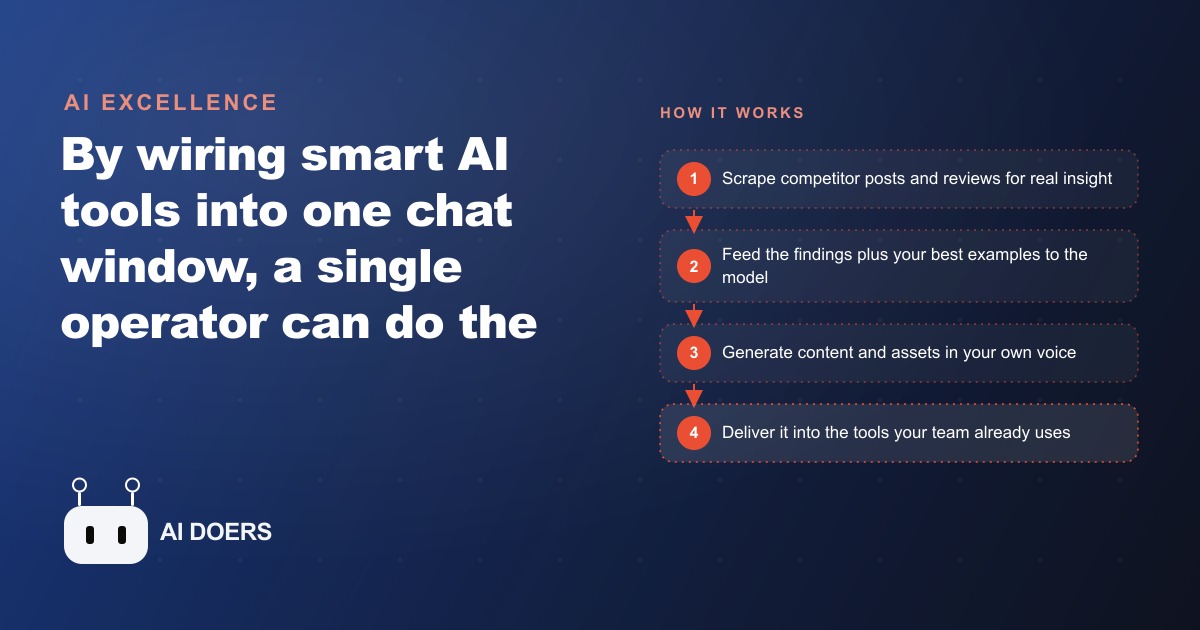
Wiring a few smart tools into one chat window lets one operator out-produce a team of ten. Here is how the workflows fit together and how a real business would put them to work.

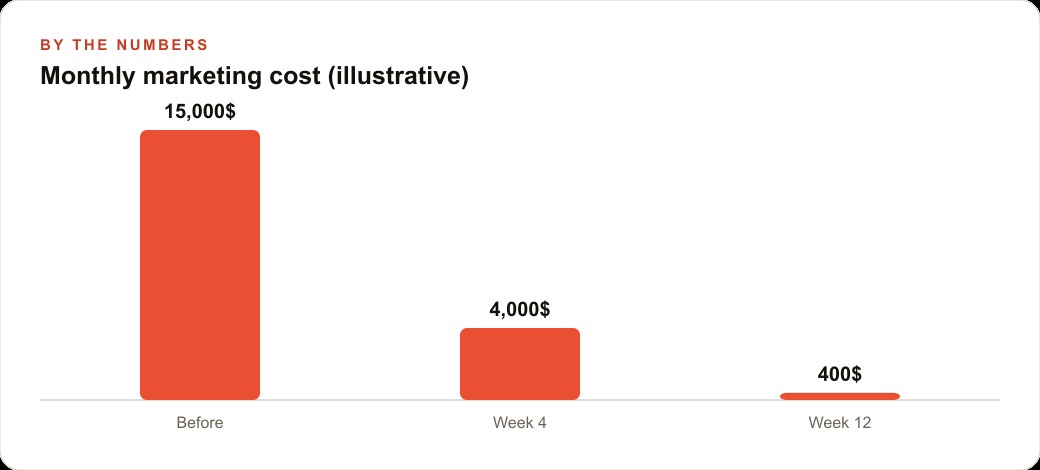
Monthly marketing costs can fall from fifteen thousand dollars to under four hundred when one operator wires the right AI tools together, and output climbs rather than drops. That figure describes real implementations, and the path to reach it follows a specific order that most operators reverse.
The Crucial Difference Between Workflow Thinking and Agent Thinking
Marketing automation sits on a spectrum. At one end is a fixed workflow: a predetermined sequence of steps that runs automatically. Feed it an input, and it processes each step and produces an output. Workflows are powerful for tasks with a clear recipe. Take a video transcript, extract the key claims, rewrite them as a newsletter in a specified voice, and route the result to a shared document. Every step is predictable. You wire it once and run it indefinitely without watching.
An agent is something different. An agent has access to a set of tools and decides which to use based on what it observes at each step. It can loop back, try a different approach, correct itself, and recognize when it has reached a satisfactory stopping point. Where a workflow follows a script, an agent navigates a situation. The practical difference matters whenever the path to completion is not fully known in advance. Researching a competitive landscape, finding a specific pattern in unstructured data, or managing a task where the input varies unpredictably all require an agent rather than a rigid sequence.
The combination that replaces a marketing team is not a workflow alone or an agent alone. It is a workflow that provides structure, with an agent running inside it at the steps that require judgment. The workflow handles the predictable frame: collect the data, route it to the agent, receive the output, deliver it to the destination. The agent handles the decisions: which data points are relevant, which patterns matter, when the output meets the bar for delivery. This combination handles both the predictable and the unpredictable within the same operational system, which is what lets one person manage work that used to require several.
This distinction also explains why most first attempts at marketing AI stall. The operator builds a workflow for a task that actually requires judgment, or tries to run an agent without enough structure around it to keep outputs consistent. Getting the assignment right, workflow for predictable steps and agent for judgment steps, is the foundational design decision that everything else depends on.
Why Research Is the First Workflow to Build, Not the Last
Every operator starting a marketing AI build wants to begin with content generation. That instinct is expensive. Content generated without a research foundation is generic. Generic content competes on volume, and volume is no longer an advantage when AI tools are available to every competitor at a flat monthly rate. The only marketing content that builds a durable edge is content grounded in a specific insight: a real gap in what the market is getting, a real frustration that competitors are not addressing, or a real question that nobody is answering clearly. That insight requires research, which is why research must be the first workflow you build, not the last.
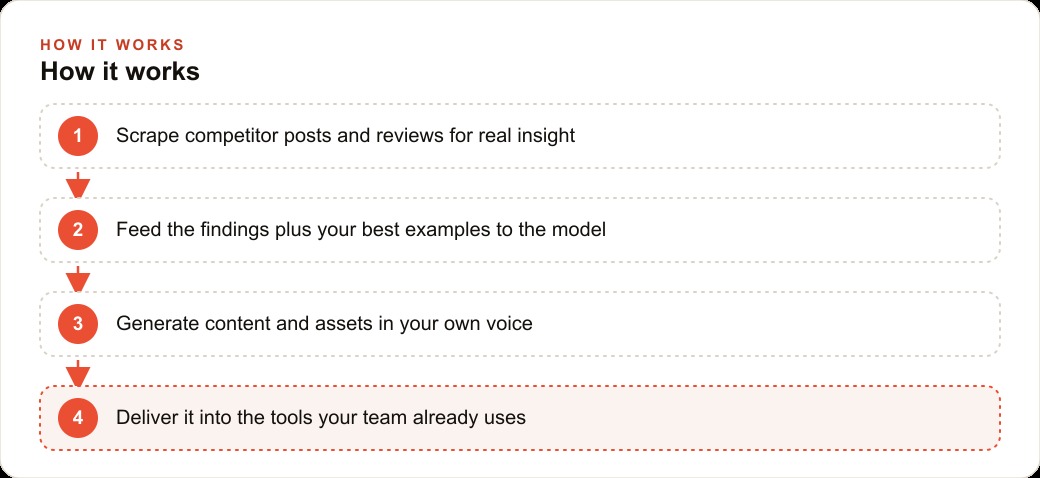
The most valuable research workflow available to almost any business analyzes competitor reviews. You point a scraping tool at the public reviews left for competitors across platforms: Google Business profiles, industry forums, Reddit threads, app stores, anywhere customers express unfiltered opinions. The workflow collects those reviews in bulk, and an agent identifies the patterns: which frustrations appear most frequently, which complaints show up even in otherwise positive reviews, which comparisons to alternatives come up repeatedly, and which words customers use to describe the problem they were trying to solve. Doing this analysis manually across a meaningful sample takes an experienced marketer most of a day. The workflow surfaces the same result in minutes.
The output is a genuine competitive wedge: a map of the distance between what the market wants and what it is currently getting from the available options. Every piece of content built after this research is answering a real question, not an invented one. Every landing page is addressing a frustration that real customers have expressed in public. Every ad angle is rooted in language customers actually use, not language a marketer imagined they might use. The grounding changes everything that follows.
Competitors who skip this step produce content that reflects what they think customers care about. The operator who starts with research produces content that directly addresses what customers demonstrably do care about, in the specific words they use to describe their own problem. That difference is not subtle in results over a six-month horizon.
The Example-Beats-Instructions Principle
The most time-wasting mistake in AI content workflows is writing long, detailed prompt instructions instead of gathering real examples. Descriptions produce the statistically average version of what is described. Examples produce something that matches the specific target, because examples show the model the actual pattern directly rather than asking it to infer the pattern from an abstract description.
The mechanism is worth understanding clearly. When you describe what you want in abstract terms, the model produces the most statistically typical version of that description. When you provide concrete examples, the model extracts the actual pattern from those examples, including dimensions of the pattern you never thought to describe: sentence length distribution, paragraph structure, level of abstraction, ratio of concrete examples to general statements, characteristic vocabulary, use of qualifiers. Replicating a pattern from examples is precisely what these models do well. Executing an abstract specification is where they produce average, unremarkable results.
The implementation adds ten minutes to the setup of any content workflow and measurably improves output quality from the first run. Before running the workflow, collect three to five pieces that represent exactly the output you want: newsletters that performed well, proposals that clients praised, articles that drove high engagement, social posts that generated significant discussion. Put those examples in a reference document and give the workflow explicit instruction to match the pattern in the examples rather than follow an abstract style description. Editing time on the output drops immediately.
Voice is where this matters most. A written voice is far easier to demonstrate than to describe. Telling a model to write in a direct, concrete style with short paragraphs and specific examples is imprecise instruction that produces imprecise results. Showing it five paragraphs that embody that voice gives it the actual template to work from. For any operation where content needs to sound like a specific person or represent a specific brand, examples are not optional polish. They are the core input that determines whether the output is usable or requires extensive rewriting before it can go anywhere.
The Repurposing Pipeline as a Force Multiplier
A single substantive asset contains enough material to generate six to eight derivative pieces without repeating itself. A recorded conversation becomes a newsletter, three social posts, a blog article, a website FAQ entry, and a set of pull quotes for future promotional use. A detailed written briefing becomes a short-form summary, a long-form explainer, and a question-and-answer article for the website. Done manually by a skilled writer, that spread requires several hours of focused writing time. A wired repurposing workflow produces it in minutes from a single trigger, with the voice calibration built in from the example reference.
The workflow structure has four steps. First, convert the source asset to text. Second, create a structured intermediate document that captures the key claims, the supporting evidence, the concrete examples used, and any quotable statements. Third, pass that structured document with the voice-example reference to the agent separately for each output format, with format-specific instructions for each. Fourth, route all finished outputs to the appropriate destination folder or queue where the team or operator receives them. Once wired, the entire process runs from one trigger with no monitoring required.
The compounding effect makes this the most impactful single workflow after the research layer. An operation that consistently processes every substantive asset through this pipeline builds a content library at six to eight times the rate of a manual operation working with the same raw material. After twelve months of consistent use, the differences in keyword coverage, audience reach, and content depth between a team running this workflow and one that is not become visible in organic traffic, engagement patterns, and qualified lead volume. Each piece of content reinforces the others, links back to related pieces, and addresses a different point in the customer's decision process. The value does not add sequentially. It compounds.
The Delivery Layer: The Step Most Teams Skip
The research is complete. The content is generated. The output sits in a queue. And nobody uses it, because it landed somewhere the team does not habitually check. This is where most marketing AI builds quietly stall, and it is the design decision that receives the least planning attention before the system goes live.
The delivery layer is the connection between what the AI system produces and where the people who need it already look. For most teams, that means a specific shared folder, a board column in the project tool the team reviews daily, or a notification in the communication channel where daily work gets discussed. For a solo operator, it might be a specific folder that feeds directly into a scheduling tool, or a weekly summary delivered to the operator's inbox on Friday morning with that week's content ready for a final look before posting.
The operating principle is that output must land where humans already look, not where the system found it convenient to route it. Any workflow that delivers output to a new tool requires the team to develop a new checking habit. New habits fail more reliably than they succeed in a busy operation, which means the workflow gets ignored even when the output is genuinely good. A workflow that delivers into an existing tool the team already checks every day gets adopted immediately, without any training or change management. Getting the delivery layer right is what converts a technically functional system into one that actually changes the operation permanently.
This step also requires thinking about format, not just location. An output that arrives as a raw text dump in a shared folder requires more effort to use than one that arrives pre-formatted in the template the team will publish from. The closer the delivered output is to publication-ready, the lower the friction to using it, and the higher the probability that it gets used rather than set aside for later review.
Building One Workflow at a Time: A Worked Example With Numbers
Operators who try to build the full system in a single sprint reliably abandon it. Each workflow requires two to three weeks of adjustment to produce reliable, low-edit output for a specific business's voice and market. Adjusting several workflows simultaneously while also doing the actual work is not practically possible. The right sequence is always: one workflow, run until it is reliable and routine, then the next.
Here is what that sequence looks like with real numbers. The operator is a solo management consultant billing twelve thousand dollars per month in fees, currently spending fourteen hours per week on marketing tasks: researching what to cover, writing content, updating the website, and managing outreach. At the operator's effective hourly value of one hundred and fifty dollars, that fourteen hours of weekly marketing time represents over eight thousand dollars per month in implicit opportunity cost.
In week one, the competitive research workflow goes live. It collects reviews from comparable consulting firms and related service providers in the operator's specialization every two weeks, surfaces the top five recurring client frustrations, and delivers a one-page brief to a shared document. Setup time is three hours. Ongoing time cost is under ten minutes per cycle. The first brief surfaces a clear pattern: competing firms are consistently praised for technical expertise but repeatedly criticized for unclear pricing structures, slow follow-up on proposals, and deliverables that arrive without a plain-language summary the client can share internally. Those three insights immediately reshape the operator's positioning language and content priorities.
In week three, the repurposing workflow is added. The detailed client briefing the operator already writes each week for internal reference feeds into the workflow, which converts it into a newsletter and two social posts, calibrated to the voice pattern extracted from the five strongest historical newsletters. Review time is fifteen minutes on Friday. Content writing time drops from four hours per week to fifteen minutes per week.
In week seven, a website content workflow is added. Each competitive research brief feeds a workflow that generates one question-and-answer article per week targeting a specific frustration from the research. The operator reviews and approves each draft in twelve minutes. The site receives four new substantive articles per month with no manual writing.
After twelve weeks, the operator's weekly marketing time is down from fourteen hours to under one hour. The recovered time, at one hundred and fifty dollars per hour, represents over nineteen hundred dollars per month in reclaimed capacity. The tools cost approximately one hundred and sixty dollars per month. Net monthly gain from the subscription cost is over seventeen hundred dollars in recovered time, plus a content library growing at roughly five times the previous pace, grounded in real competitive intelligence rather than invented topic lists.
The full annual marketing cost shifts from over ninety thousand dollars in time spent to under two thousand dollars in tool subscriptions plus the reduced time to review and approve outputs. That is the real figure behind the fifteen-thousand-to-four-hundred comparison at the top. It does not come from cutting quality. It comes from removing the mechanical steps, research, formatting, scheduling, routing, from the operator's day and keeping judgment, approval, and strategy exactly where they belong.
What Compounds After Month Twelve
The most important thing to understand about a wired marketing system is what happens after the initial setup period. The content library grows each week and links back on itself. The competitive research accumulates and begins revealing longer patterns in how market preferences shift. The voice calibration improves as more examples are added to the reference set each month. The repurposing workflow produces better output in month six than it did in month two, because it has a deeper example set and a more refined voice pattern to work from.
By month twelve, an operator running these three workflows has a content library of several hundred pieces, a clear and evidence-based picture of what competitors are consistently getting wrong, and a weekly content operation that costs under an hour of review time. The operator who began this build in month one is twelve months ahead of the operator starting now, and the gap does not close at the same rate it opened, because the accumulated library, research intelligence, and calibrated patterns make the established system more effective each additional month it runs.
Madhuranjan Kumar's consistent observation across business owners who complete this build is that the most valuable shift is not the cost reduction, though the reduction is both real and substantial. The most valuable shift is in what the operator pays attention to. With the mechanical work running automatically, attention moves to the decisions that only a human can make: which insights from the research are genuinely actionable this quarter, which content angles align with current business goals, which signals from the audience suggest an emerging opportunity. The operator moves from content producer to strategist, and that shift is what creates a compounding advantage that a competitor running the same tools but without the accumulated system cannot easily close.
That is exactly what we do at AI DOERS. Book a private 30-minute call with Madhuranjan Kumar and we will map the fastest path to it for your specific business.
Book your call →
Madhuranjan Kumar
Madhuranjan Kumar brings 20 years of performance-marketing experience and has managed over $200 million in Facebook ad spend for brands across the United States and beyond. His expertise spans the full modern marketing stack: Meta, Google Ads, TikTok, email automation, CRM, and the websites that hold it together. At AI DOERS he turns that track record into lead-generation systems for businesses across every industry.