
Why Reliability and a Human in the Loop Decide Whether AI Is Safe for Your Business
The loudest AI disputes keep circling two principles: do not trust an unreliable model to act alone, and do not let it surveil people without limits. Those same two rules are the practical guardrails that make AI safe to put inside a small business. Here is how I apply them.

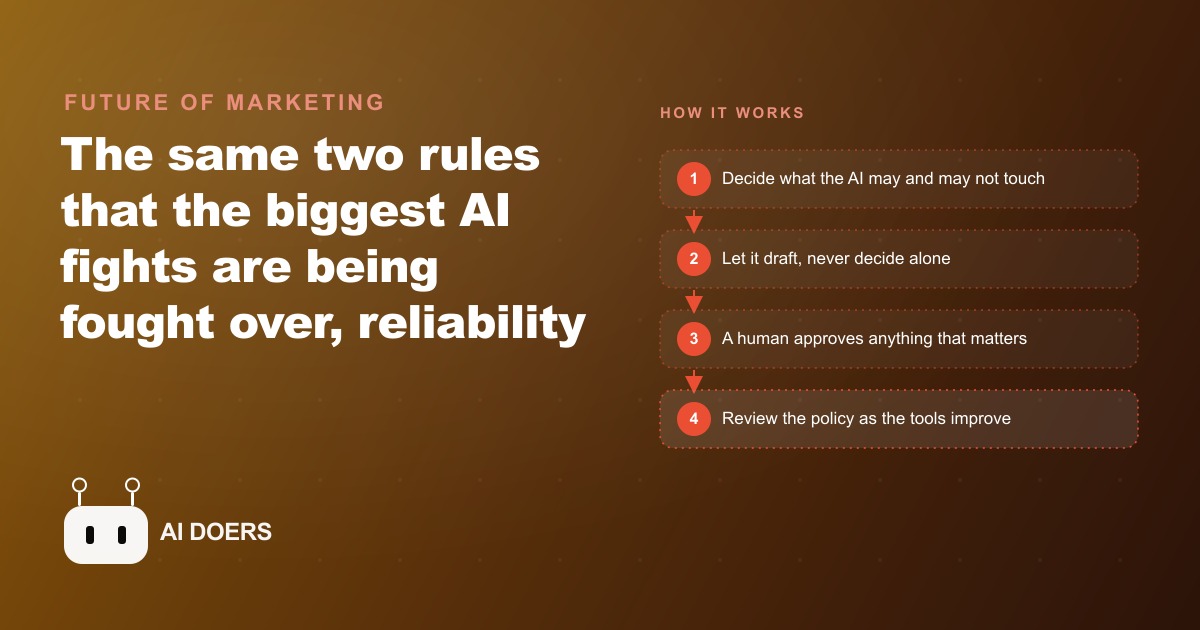
The biggest AI arguments happening right now, in congressional hearings, in lab safety reports, in ethics journals, circle back to two problems: models that act on unreliable outputs without a human catching the error, and models that collect or process information about people without adequate limits. These arguments look abstract when academics debate them. They are not abstract at all. They are the exact operational problems that every business deploying AI is already managing, often badly, and calling something else.
I am Madhuranjan Kumar, and my position is this: the businesses that treat AI safety as a philosophical debate will make the same class of mistakes that the big labs are being criticized for. The businesses that treat it as an operations checklist will avoid those mistakes, move faster with less exposure, and be better positioned when the regulations currently being drafted arrive as enforceable rules.
The AI safety debate is not abstract. It is your to-do list.
The core of the academic AI safety debate right now is about two failure modes. The first is a system that acts on outputs it produced without sufficient checking, producing downstream consequences that no human reviewed before they happened. The second is a system that collects, infers, or acts on information about people beyond what those people agreed to or expected.
Both of those failure modes have exact business analogs that are happening right now, in companies that have never used the phrase AI safety in a serious context. The first analog: an AI drafting system sends a customer a quote with an error, because no one put a human approval step before the draft went out. The second analog: an AI tool connected to customer data is collecting more than the business intended or the customer agreed to, because the integration was wired quickly without a documented policy about what the tool was allowed to read.
Neither of those business failures requires a malevolent AI or a rogue system. They require only that the tool was used without the guardrails that the safety debate is pointing at. The guardrails are not exotic. They are a human review step and a data policy. Both are available to any business this week at zero cost. Both are being skipped because the tools feel benign and low-stakes when you are setting them up.
The safety debate is not telling you to fear AI. It is describing, in high-stakes terms, the consequences of deploying capable tools without thinking carefully about what they touch and who approves their outputs. At the lab level, the stakes are civilizational. At the business level, the stakes are a client relationship or a compliance fine. The lesson transfers directly and the fix is the same: build the approval step in and define what the tool is allowed to touch before you wire it in.
Why reliability is a harder problem than it sounds when the stakes are real
"Today's models are not reliable enough to act unsupervised" is a sentence that sounds obvious until you watch a model produce a confident, well-formatted, completely wrong answer in a business context where no one catches it before it matters.
The reliability problem is not that models fail obviously. A model that produced clearly broken output would be easy to catch and safe to use with light oversight, because anyone reading the output would notice the failure. The reliability problem is that models fail confidently. They produce polished, plausible-looking output that contains a factual error, a calculation mistake, or a misreading of context, presented in the same tone and format as their correct outputs.
A human reading a first draft can usually tell when something feels off. A human who is not reading the draft at all, because the process was set up to skip the review step in order to move faster, cannot catch anything. The speed gain from removing the review step is real. The risk introduced is also real, and it scales with how consequential the output is.
Here is how this plays out with specific numbers. A small financial advisory firm uses an AI assistant to draft the quarterly performance summaries it sends to clients. The tool is accurate on 91 out of every 100 summaries it drafts. On 9 out of 100, it makes an error in a calculation or misidentifies a holding. Without a review step, 9 percent of client summaries go out with errors. For a firm with 80 clients, that is about 7 incorrect summaries per quarter. Each one is a potential client dispute, a trust problem, or depending on the regulatory context, a compliance violation.
Adding a 10-minute review step per summary, totaling 800 minutes or about 13 hours per quarter, catches those 7 errors before they reach clients. The cost of 13 hours of a staff member's time is far less than the cost of one serious client dispute. The review step is not a slowdown on the AI. It is the operational logic that makes the AI safe to use.
The lesson scales in both directions. For low-stakes, reversible outputs, such as first-draft social media captions or internal meeting notes, a quick scan is appropriate because the cost of an error is low and easy to correct. For high-stakes, client-facing, or regulated outputs, the review needs to be proportionally thorough. Calibrating the review depth to the cost of a wrong output is the operationally correct behavior.
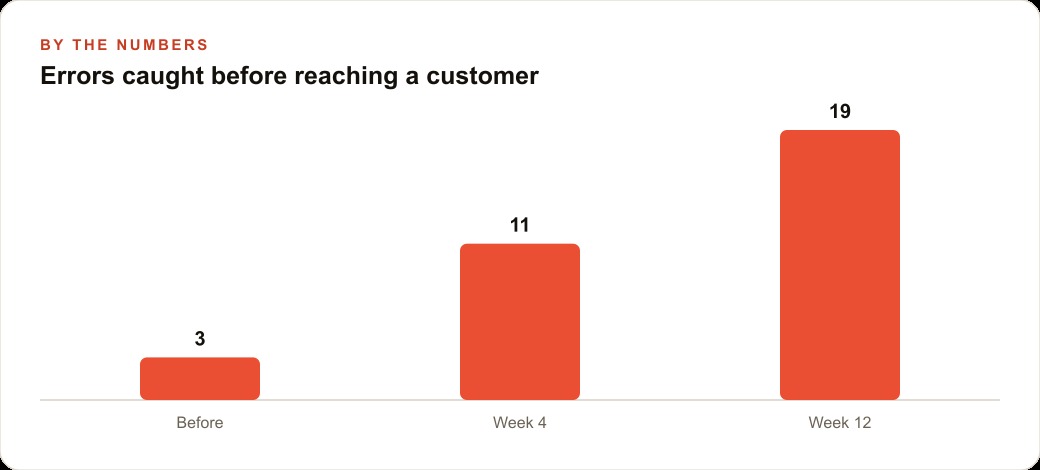
Human oversight is not a slowdown. It is the only feedback loop that actually works.
The argument against human oversight in AI workflows is always some version of: it defeats the point of automation. If a human reviews every output, you are just paying for AI to draft things a human then has to check, so you have not actually saved time.
That argument misses what oversight is for. The goal of a human review step is not to verify every output forever. The goal is to verify outputs during the period when you are still learning whether the model handles your specific use case reliably on your specific data, and to maintain ongoing verification for any output where the cost of an undetected error is high.
The distinction matters because the review step changes over time. In the first month of using a new AI tool for a specific task, reviewing every output is how you find out where the failure modes are and what edge cases the model handles poorly. In month three, if the error rate on certain output types has proved to be below your tolerance threshold and the errors it makes are minor and easily caught, you can reduce the review frequency on those outputs. For outputs where a rare but serious error would be costly, the review step stays.
A business that treats human oversight as permanent bureaucracy and looks for ways to remove it entirely will eventually have a failure that a review step would have caught. A business that treats it as an active feedback loop, which is what it actually is, will learn the model's boundaries on its specific work, calibrate the review to the risk of each output type, and operate both faster and safer than either alternative.
This is not a theoretical position. The AI labs under the most scrutiny right now are the ones that deployed systems into high-stakes contexts without building in adequate feedback loops to catch consequential failures before they propagated. The pattern at the lab level and the pattern at the business level are structurally identical. The difference is the scale of the consequences, not the nature of the mistake.
The businesses that treat safety as philosophy will repeat the labs' mistakes at their own scale
The labs currently under the most criticism for safety failures are not incompetent organizations. They are organizations that moved faster than their oversight processes could keep up with, believed their systems were reliable enough to deploy into consequential settings before they had sufficient evidence that this was true, and set up pipelines that made it difficult to catch errors before they mattered.
Small businesses deploying AI without documented policies, without approval steps, and without a clear understanding of what data each tool can access are replicating those decisions at a smaller scale. The consequences are smaller, but the structure is the same: capability deployed without proportionate oversight.
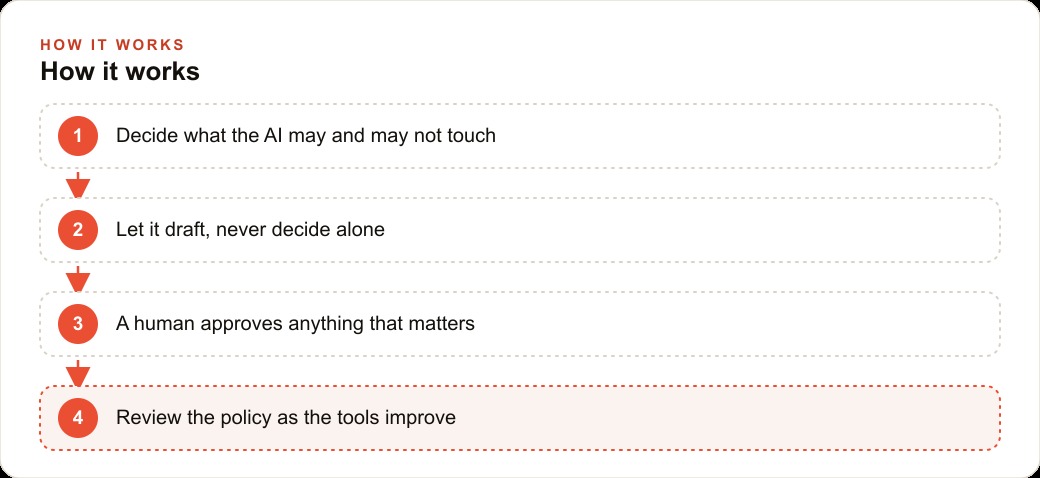
The practical steps to avoid this are genuinely simple and take less time to implement than the failures take to repair. Before deploying any AI tool in a business context, write down three things: what the tool is allowed to touch, what kinds of outputs require a human to approve before they go anywhere, and who is responsible for reviewing those outputs. Post those three things somewhere the whole team can see them. Review them every time you add a new tool or extend an existing one's scope.
That is not a compliance framework. It is two paragraphs and a named person. It is the operational version of the lessons the safety debate has been trying to extract from high-profile failures, translated into something a business can implement on a Tuesday afternoon.
The businesses that do this early, while the tools are still novel and the habits are still forming, will find that the review steps become fast and reliable as the team develops a trained eye for what correct output looks like. The businesses that skip it will eventually have a failure that prompts them to implement these things under pressure, which is always more expensive than implementing them deliberately.
A practical example makes this concrete. A marketing agency uses an AI tool to draft client ad copy. The volume is high: 40 drafts per week across eight clients. Without a review step, drafts go directly to the client portal. In one week, the tool produces copy for a healthcare client that makes a clinical claim the agency does not have approval to make. The claim sounds plausible and the copy is well formatted. It goes to the client who approves it, goes live, and three days later the platform flags it and pulls it down for violating healthcare advertising rules.
The fix is not complicated. A single review step, one person spending about 30 seconds per draft flagging any claims that need a senior review before the draft is approved, would have caught this. That is 30 seconds times 40 drafts, or 20 minutes per week. The failure cost the agency a day of crisis management, a difficult conversation with the client, and the time to rebuild and resubmit the campaign. The math is not close.
There is also a privacy dimension that compounds this argument. Every day, cameras, phones, and connected devices shed small threads of information. For years those threads were harmless because nobody could assemble them into anything coherent. AI changes that fundamentally. It can now stitch scattered signals together and make accurate inferences about a person from a pile of small inputs. The practical step is to decide in advance what data your AI tools are allowed to collect and keep, rather than discovering the answer after something has already been gathered and stored in a system you do not fully control.
Setting a data policy before you wire in a new AI tool is not overcaution. It is the same discipline that the safety debate is calling for from the labs, applied at the scale where you actually have control and where the consequences of getting it wrong are still containable.
Madhuranjan Kumar works with businesses at the point where these tools are being adopted, and the pattern that shows up most often is not malice or carelessness. It is enthusiasm without process. The tools are impressive enough that the impulse is to wire them in and let them run. The businesses that add two paragraphs of policy and one named reviewer between the wire-in step and the live-run step will learn the tools' actual limits safely. The ones that skip it will learn them the hard way.
That is exactly what we do at AI DOERS. Book a private 30-minute call with Madhuranjan Kumar and we will map the fastest path to it for your specific business.
Book your call →
Madhuranjan Kumar
Madhuranjan Kumar brings 20 years of performance-marketing experience and has managed over $200 million in Facebook ad spend for brands across the United States and beyond. His expertise spans the full modern marketing stack: Meta, Google Ads, TikTok, email automation, CRM, and the websites that hold it together. At AI DOERS he turns that track record into lead-generation systems for businesses across every industry.