
Reinforcement Learning, Explained Simply (And What Q* Hype Was Really About)
A plain English walk through of how AI learns from trial and error, why the Q* rumor got everyone excited, and how the same learning loop applies to a real local business.

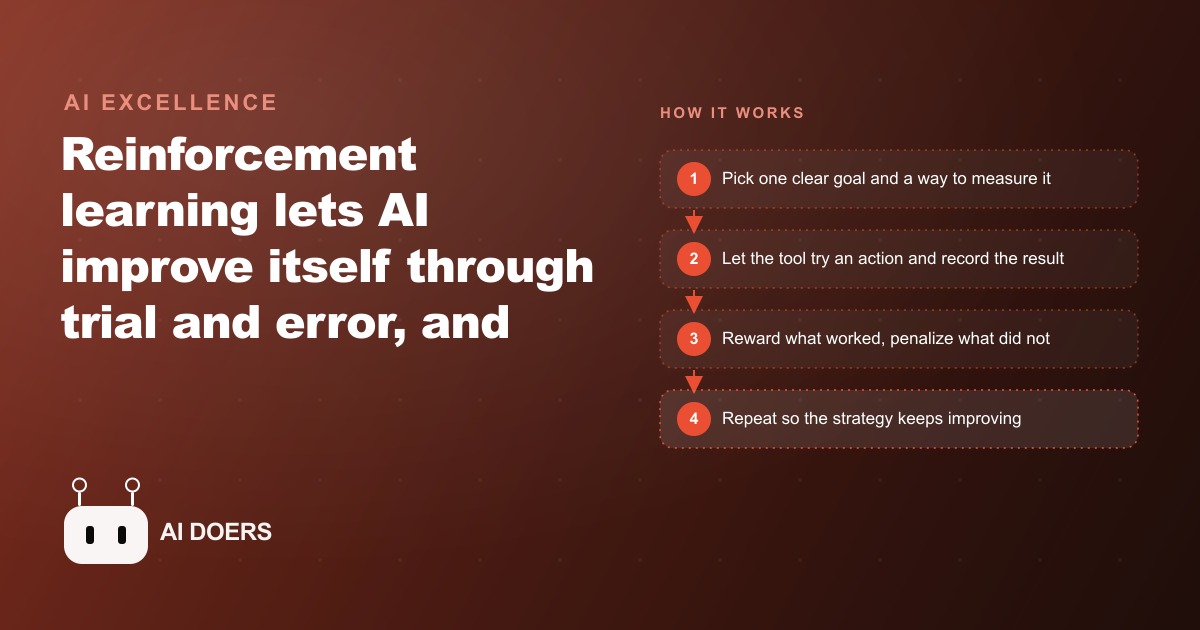
The rumor that set off the Q* frenzy told us almost nothing, but the mechanism underneath it can quietly make a small business better every month. When word leaked that a major lab might have made a breakthrough, the exciting guess was that researchers had bolted a game-playing style learning loop onto a language model to sharpen its reasoning. Nobody outside the lab really knew, and most of the noise was speculation. I am Madhuranjan Kumar, and I do not care about the rumor. I care about the loop, because reinforcement learning is a mechanism you can copy in your own business without owning a research lab. This is a practical playbook for doing exactly that. First I will make the mechanism clear, then I will walk the stages that turn it into a working system for a real company.
Understand the loop before you copy it
Reinforcement learning is a way of training AI by letting it learn from its own trial and error instead of from a fixed set of answers. The everyday version is teaching a dog a trick. You give a treat when it does the right thing and withhold the treat when it does not, and over many repetitions the dog figures out the behavior that earns the reward. AI learns the same way. It tries something, sees whether the result moved it closer to a goal, and adjusts.
The loop has a few simple parts, and naming them helps because you will map your own business onto them in a moment. There is an agent, the thing making decisions. There is an environment, which in a game is the board and in your case is your sales process or your marketing. The agent takes an action, lands in a new state, and receives a reward or a penalty that signals whether the action helped. Then it repeats. Two helpers make this practical. A policy proposes which action to take in a given situation. A value estimate judges how much future reward that action is likely to bring. At the start both are weak, so early moves look almost random, but after each round the value estimate improves based on what actually happened, and the policy uses those better estimates to make smarter choices. Run that enough times and a real strategy emerges. That is the whole engine, and every stage below is just a way of installing it in a business.
Name one goal you can actually count
The first stage is choosing your single measurable goal, and it has to be a real number, not a vibe. Booked jobs, repeat customers, revenue per visit, booked jobs per dollar of ad spend. The loop cannot improve toward a target it cannot measure, so a fuzzy goal like more growth is useless here. Pick one thing you can count at the end of every week or month, and resist the urge to optimize five things at once. A single clear goal is what lets the feedback signal mean something, because every action can be judged by whether it moved that one number.
Choose a tool that already runs the loop for you
You do not need to build the math. This is the stage where people wrongly assume they need an AlphaGo of their own, and they do not. Software already wraps the reinforcement learning loop in the areas that matter to a small business: ad bidding, email send times, pricing tests, lead routing. The platform tries a variation, measures the result, and shifts budget or timing toward what performs. That is reinforcement learning in everyday clothing. Your job at this stage is to pick a tool that already supports automatic testing and optimization, so the agent and the loop are handled for you and you supply the goal and the signal. The optimization inside a good ad platform behind your Facebook and Instagram ad campaigns is exactly this loop, quietly reallocating spend toward whatever converts.
Feed the loop an honest reward signal
A reward loop is only as good as the feedback you give it, so this stage is about tagging reality accurately. If your goal is booked jobs from quoted leads, then every lead that actually books has to be marked as a win, and every one that goes cold has to be marked as a loss, cleanly and consistently. This sounds trivial and is where most setups quietly fail. If the data going in is sloppy, the loop optimizes toward the wrong thing with great confidence. The place this signal lives is your CRM and website stack, where a booked job gets tagged, a dead lead gets closed, and the truth about what worked flows back to the tool doing the optimizing. Get this stage right and everything downstream improves. Get it wrong and no amount of clever optimization saves you.
Respect the delayed reward problem and give it time
Here is the stage people skip out of impatience, and it comes straight from the mechanism. In chess or Go you only know whether you won at the very end, so the value estimate has to learn to judge a move long before the outcome is clear. Your business has the exact same problem. Today's marketing choice pays off in booked jobs weeks later. That means early performance always looks random, because the loop has not yet gathered enough completed outcomes to judge its own actions. The stage here is simple to state and hard to obey: let it run long enough to gather real results before you judge it. Killing a test in week one because it looks messy is like grading a chess engine on its opening move. The strategy only emerges once enough rewards have flowed back through the loop.
Review on a schedule and double down on what the data favors
The final stage is the human part of the loop, which never fully goes away. Every couple of weeks, look at the numbers and shift toward what the feedback favors. If emergency jobs in two neighborhoods book at twice the rate, more budget should flow there. If follow ups sent within ten minutes close far more often than ones sent the next day, the window tightens. You are playing the role of the value estimate improving over time, reading what actually happened and steering the policy toward it. The point is not to chase a research breakthrough. It is to copy the loop: define a goal, measure honestly, reward what works, repeat. The same discipline sharpens your Google Ads spend and your email timing, because both are environments where measured feedback can steer the next decision.
What this looks like for a plumbing company
Let me run the whole playbook through an unnamed plumbing company, because a service business is where this loop turns guesswork into a system you can watch improve. The goal is booked jobs per dollar of ad spend. The agent is the ad platform plus a simple follow up tool. The actions are which neighborhoods to target, which service to feature, and what time to send a follow up text to a quoted lead. The reward is a booked job, and the penalty is a lead that goes cold.
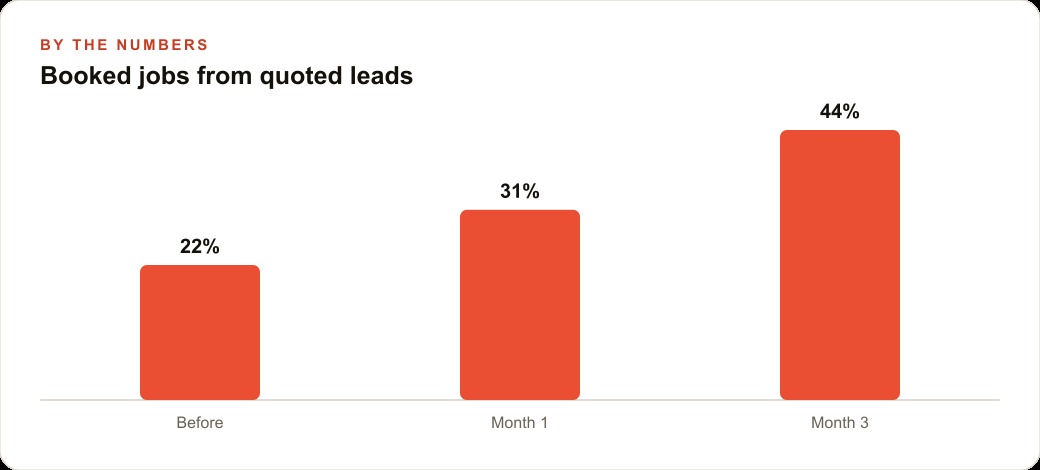
Start with a real baseline. Say that before any of this, the company books about 22 out of every 100 quoted leads. In week one the system spreads budget evenly and sends follow ups at loosely varied times, so the results are mixed and honestly a little disappointing, which is the delayed reward problem doing its thing. But every week the company records what actually converted. Emergency drain jobs in two ZIP codes book at roughly twice the rate of everything else. Follow up texts sent within ten minutes close far more often than ones sent the next day. Because the reward signal is honest, the tool shifts spend toward those neighborhoods and tightens the follow up window automatically, and the owner reinforces the same moves in the couple-of-weeks review.
By month one the booked rate from quoted leads has climbed from around 22 percent toward 31 percent. By month three it is closer to 44 percent, because every cycle feeds the next exactly like the policy and value estimate reinforcing each other. The illustrative math is worth sitting with. Doubling the booked rate from roughly one in five to nearly one in two, on the same flow of leads and the same ad budget, is a transformation of the business economics, and the owner never wrote a complex rulebook. They named a clear goal, fed the loop an honest signal, gave it time, and let measured feedback do the steering.
Put that improvement in dollars and it lands harder. Say the company was spending a fixed 200 dollars a day on ads and getting those 22 booked jobs per 100 quoted leads. Nothing about the spend changed. The only thing that changed was where the money went and when the follow ups fired, both steered by the loop reading real outcomes. Yet the booked rate roughly doubled, which means the cost to win a job nearly halved without adding a single dollar to the budget. That is the quiet power of the loop. It does not ask for more money or more staff. It asks for a clear goal, honest feedback, and patience, and then it compounds, because each cycle's better estimate feeds the next cycle's better choice. The owner's job shifted from guessing which neighborhood or which follow up time might work to simply reading what already worked and letting the system lean into it.
The mistake that quietly wastes the whole effort
Before you start, know the one failure that ruins this. It is not picking the wrong tool. It is feeding the loop a dishonest or lazy reward signal and then trusting the confident output anyway. If booked jobs are tagged inconsistently, or leads are marked won when they only inquired, the loop optimizes hard toward a target that is not real, and it does so with total confidence. The whole method rests on the feedback being true. That is why the honest reward stage above is not a formality. It is the foundation, and it is the human discipline that no amount of automation replaces.
Copy the loop, do not chase the breakthrough
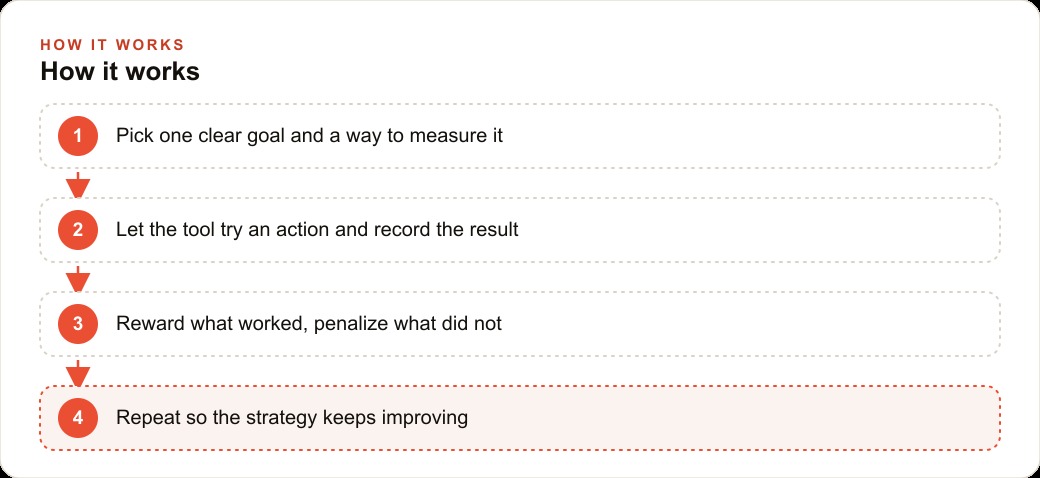
Pull the playbook together and it is short enough to hold in your head. Name one goal you can count. Choose a tool that already runs the optimization loop. Feed it an honest reward signal from your own records. Respect the delayed reward and give it time before you judge it. Review on a schedule and double down on what the data favors. That is reinforcement learning stripped of the mystique and installed in a business. The Q* rumor was exciting precisely because it hinted at this loop making a language model smarter. You do not need to know what happened in the lab to use the same idea, because the mechanism is public, proven, and already wrapped in tools you can adopt this month.
You can absolutely do this yourself with patience and a willingness to read the results honestly. The hard parts are the ones the playbook keeps returning to: choosing the single right goal, tagging the reward signal cleanly, and holding your nerve through the early random-looking weeks. If you would rather have someone build the goal, the tracking, and the feedback loop so it runs cleanly from day one, that is the kind of setup an expert can stand up for you quickly. Either way, stop waiting for the breakthrough and start copying the loop, because the loop is where the real, compounding improvement actually lives. The labs will keep chasing the next headline, and that is their job. Yours is simpler and, honestly, more reliable: pick a number, feed it the truth, and let trial and error do quietly for your business what it did loudly for the game engines that beat the champions.
That is exactly what we do at AI DOERS. Book a private 30-minute call with Madhuranjan Kumar and we will map the fastest path to it for your specific business.
Book your call →
Madhuranjan Kumar
Madhuranjan Kumar brings 20 years of performance-marketing experience and has managed over $200 million in Facebook ad spend for brands across the United States and beyond. His expertise spans the full modern marketing stack: Meta, Google Ads, TikTok, email automation, CRM, and the websites that hold it together. At AI DOERS he turns that track record into lead-generation systems for businesses across every industry.