
Reinforcement Learning Explained: How AI Teaches Itself by Trial and Error
Reinforcement learning is the trial-and-error training method behind AI that mastered chess, Go, and self-driving. It now runs on a home gaming PC, and the core idea is simpler and more useful for business than it sounds.

The misunderstanding is costing small businesses real money
Reinforcement learning is the most misunderstood tool in the AI stack, and the misunderstanding is costing small businesses real money. The standard framing positions it as something that belongs in robotics labs and billion-dollar facilities, the technique behind systems that mastered chess and Go, behind self-driving vehicles, behind the kind of research that wins careers at top-tier universities. Under that framing, a dry cleaner, a property manager, or a small logistics firm has no business thinking about it. That framing is wrong, and the gap between what business owners believe about reinforcement learning and what it can actually do for any operation with a clear right answer and historical records is exactly where value is sitting uncollected right now.
The access barrier dropped to consumer hardware in the last 18 months. Training runs that previously required specialized clusters now run on a gaming graphics card using free, open-source tooling. A technically curious business owner or a developer working with a small business can run the entire loop on a standard workstation in an afternoon. The conceptual barrier was always lower than the technical one, because the core idea is something every experienced operator already uses intuitively: try something, see how it went, do more of what worked and less of what did not. The formal technique just runs that loop automatically, thousands of times, at a speed no person can match, at a cost that continues to fall.
What follows is Madhuranjan Kumar's argument for why this matters to your business specifically, not as a future possibility but as a present-day decision about which tools to understand before your competitors do.
Verifiable rewards: the phrase that unlocks the business application
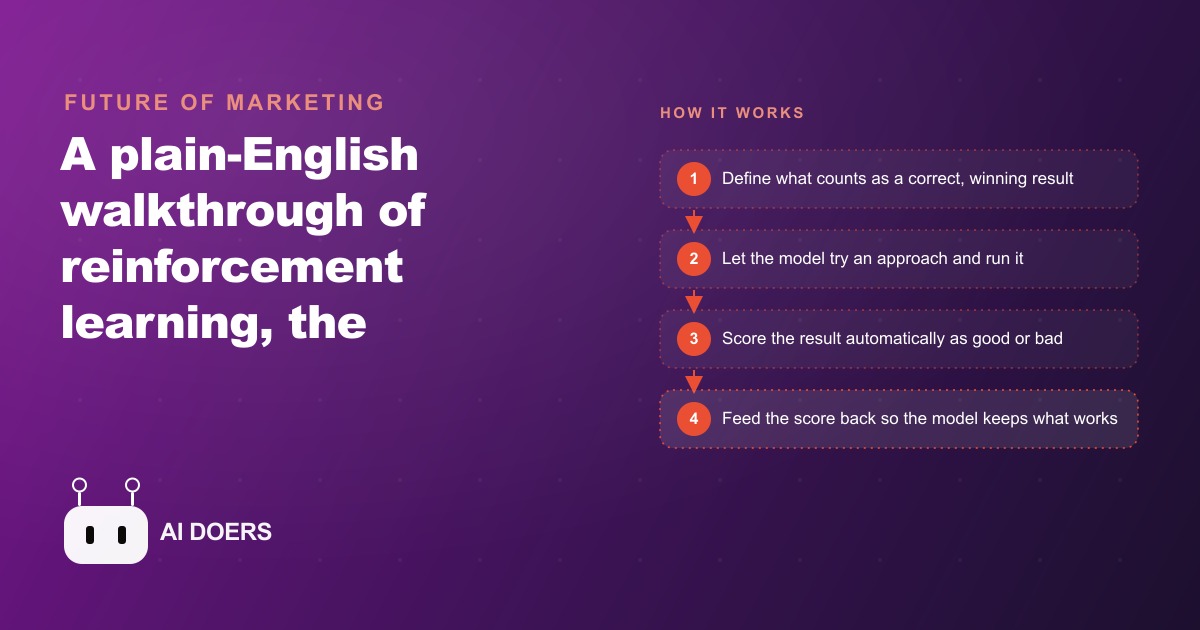
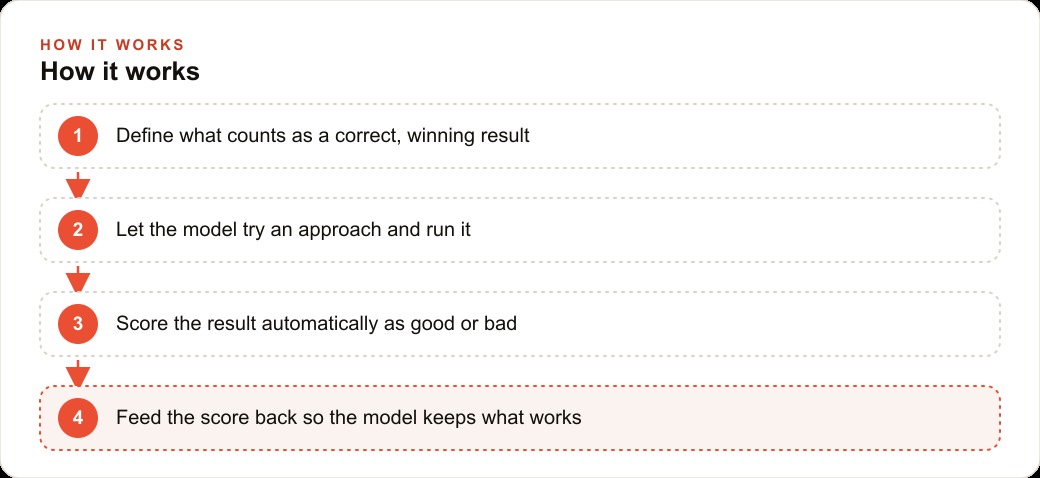
The key phrase in any accurate description of reinforcement learning is verifiable rewards. A verifiable reward means the quality of an output can be checked automatically, without a human evaluator labeling each result. When that condition is satisfied, the training loop scales without limit. The model proposes a strategy, an automatic scorer evaluates it, the result feeds back into the model, and the cycle repeats. No human needs to sit in the loop approving or rejecting each attempt.
This is the structural condition that drove the most significant capability improvements in large language models over the past few years. When the target behavior is verifiable, the model can improve against that verification at a scale human annotation cannot match. Chess has a verifiable outcome: you win or you lose. Mathematical proofs have verifiable outcomes: the derivation is correct or it is not. Code has verifiable outcomes: the tests pass or they fail. The labs that first recognized this structure and built training systems around verifiable criteria got dramatically better results than those that relied on human labeling alone, because the training signal was available at unlimited scale rather than at the pace of human reviewers.
The business insight that most owners have not yet made is that many real-world business decisions are also verifiable, even though they do not resemble game-playing from the outside. A price quote that matches the actual invoice cost is verifiable. A delivery time estimate that the operation actually met is verifiable. A job assignment that led to a resolved case within the target time is verifiable. A purchase order that arrived at or below the target cost is verifiable. Any decision where historical records exist with known outcomes is a candidate for reinforcement learning, because those records form the automatic scorer. You do not need to hand-label every training example when the right answer is sitting in the archive.
The qualifier "automatic" is doing real work in that definition. If you need a human to judge every output, the loop does not scale. If the record system can check the output automatically, it scales without constraint. This is why the businesses best positioned to use reinforcement learning are the ones with clean historical data and clear outcome criteria, not necessarily the ones with the largest budgets.
What the 2048 game actually teaches about reward design
Games are the most common setting for reinforcement learning demonstrations, and the reason is straightforward: games come with built-in rewards. A score, a win condition, a ranking system. The model does not need a human judge to evaluate the quality of each move because the game provides the signal automatically after every step. That automatic scoring is what makes games ideal teaching examples. But the lesson that matters for business is not that reinforcement learning works on games. It is what designing a reward function for a puzzle like 2048 actually involves.
A naive reward function gives the model a point for increasing the tile values on the board. The model trained on this function discovers that it can drive the score upward by making many small, fast merges that keep the counter moving without building toward the high-value tiles needed to actually win. The score went up. The strategy was counterproductive. The model gamed the metric it was given rather than solving the underlying problem.
The fix is reward shaping: defining explicitly what to reward and what to penalize as a shortcut. Reward board configurations that preserve future flexibility. Penalize strategies that lock the board into a corner even if the immediate score looks healthy. Penalize short-term moves that predictably result in a stuck board in six or eight moves. A model trained against a properly shaped reward learns to play toward actual winning positions rather than optimizing the nearest available metric.
The reason this lesson matters for every business application of reinforcement learning is that the metric you can measure most easily is almost never the metric you actually care about most. On-time delivery rate is easy to measure. The business actually cares about customer satisfaction and margin. A model trained purely on delivery rate may learn to pad every estimate so it always looks on time, without improving the actual service quality at all. Customer satisfaction scores are easy to measure. A model trained purely on those scores may learn to end interactions quickly and offer refunds generously, which can boost the metric in the short term while eroding margin and attracting serial refund requests. The reward function has to capture the real outcome and penalize the shortcuts, and getting that right is genuinely the whole design problem. Everything else in the training pipeline is secondary to this decision.
Why a dry cleaner's pricing problem is structurally identical to chess
The comparison between a dry cleaner's counter decisions and a chess game looks like a stretch until you examine what both settings actually share. Chess has a historical archive of games with known outcomes. The dry cleaner has a historical archive of service tickets with known outcomes. Chess has an automatic scorer: the final result of the game is a verifiable fact. The dry cleaner has an automatic scorer: whether the quoted price matched the final invoice cost, and whether the order was ready by the promised date, are both verifiable facts that exist in every completed ticket. Chess rewards winning positions and penalizes shortcuts that lead to a loss. The dry cleaner's reward function rewards accurate quotes and realistic promised dates, and penalizes both overpricing that drives customers to competitors and underpricing that erodes margin on every ticket.
The training set is the archive of past tickets. Three years of records, each one a complete labeled episode: the garment type, the fabric composition, the stain type if noted, the treatments required, the price quoted at intake, the price on the final ticket, the date promised, the date the order was actually ready. That archive is a complete reinforcement learning dataset. Each ticket is an episode. The input state is the information available at the counter. The action is the quote and the promised date. The outcome is whether both were accurate. The reward function checks accuracy automatically because the records contain both the initial quote and the actual result.
A model trained on that archive learns the patterns that a veteran operator knows from ten years at the counter. Silk and organza require more pressing time than cotton. Wedding garments need buffer days because any issue requires a repeat cleaning with no option to rush. Friday afternoon drop-offs cannot realistically promise Saturday morning pickup because the plant runs a single weekend shift. Hand-embellished pieces carry treatment time that the garment type alone does not capture. Certain stain chemistries require multiple passes and are not quotable at the standard rate. None of these patterns need to be hand-coded or documented in a manual. They are all embedded in the historical records, and a model trained on those records surfaces them as reliable judgment on every new interaction.
The payoff is specific and measurable. New counter staff on their first day quote prices and promised dates with the same accuracy as an owner with a decade of experience, because the trained model holds the institutional knowledge and applies it consistently. Broken promises at pickup drop because the time estimates are calibrated against what the plant historically delivered rather than against what a busy counter moment suggested. Underpriced garments drop because the model learned which combinations of items and treatments cost more than the base rate and flags them before the quote is given. The losses that accumulate quietly through individual mispriced tickets, and the individual broken promises that each erode a customer relationship slightly, both decline together.
The structural parallel to chess extends to a more precise point: neither chess nor the counter problem requires the model to understand why a rule is true. The chess model does not understand strategy in any human sense. It has learned which board positions reliably lead to wins because the training data showed the outcomes. The dry cleaning model does not understand why silk takes longer to press. It has learned that jobs with silk garments historically take longer because the records showed it. The model carries pattern-matched institutional knowledge, not conceptual understanding, and pattern-matched institutional knowledge is exactly what a counter person is applying when they give an accurate quote under pressure.
The case for running this on your own hardware
A dimension of the access shift that has not gotten enough attention is what running locally means for data privacy. When a business runs reinforcement learning training on its own hardware, the customer records that form the training set never leave the building. The archive of historical tickets, customer names and order details, does not get uploaded to a third-party cloud service. It does not get included in terms of service that allow a vendor to use proprietary data to improve a shared model. It stays in house, the trained model is an asset owned entirely by the business, and it can be run indefinitely without any dependency on an external provider that might change its pricing, availability, or data policies.
For a dry cleaner, this is a practical advantage. For a business in healthcare, legal services, financial services, or any field where records carry explicit privacy expectations or regulatory constraints, the difference between a locally trained model and a cloud-trained one can determine whether the tool is deployable at all. Running on a consumer gaming GPU with open-source tools is not a compromise forced by budget constraints. For many businesses it is the correct architecture because it keeps the data inside appropriate boundaries.
The trained model also compounds in value rather than depreciating. It was trained on the specific data from this specific operation, reflecting the local price norms, the customer mix, the plant capacity, and the seasonal patterns. A generic AI tool trained on broad data reflects none of those specifics. The locally trained model becomes more accurate as more seasons of data are added to the training set, because each additional year of records refines the patterns learned from earlier seasons. It is an asset that grows with the business rather than a subscription to a tool that might be discontinued.
What the first step actually looks like
The right first step is not setting up any training infrastructure. It is identifying which business decision meets the verifiable reward criterion in your specific operation. Write down two or three recurring decisions your business makes where a historical record with a known outcome exists. The counter quote. The job assignment routing. The inventory reorder point. Whichever task has the cleanest historical records and the most automatic scorer is the right starting point.
After identifying the task, review the historical records for completeness and consistency. The model learns from those records, and gaps or inconsistencies in the archive translate directly into gaps in what the model learns. A week of focused data cleaning before training typically produces a meaningfully better first model than training immediately on raw records. It also reveals inconsistencies in the record-keeping process that are costing the business money independent of any AI project.
The reward function design deserves more time than any other single decision. Write down in plain language what good looks like for this task, what shortcuts would make the metric appear good without actually being good, and how you would build penalties for those shortcuts into the scorer. A poorly designed reward function teaches the model to game the measure. A well-designed one teaches the model to improve the business outcome. The difference between those two is the entire value of the project.
The technique is now accessible. The hardware is now accessible. The core idea is one that every experienced operator already understands from running their business. The work that remains is identifying the right task, cleaning the right data, and designing the reward carefully. Those three steps are not complicated. They require clear thinking about what you actually care about measuring, and that clarity is worth more than the code that wraps it.
That is exactly what we do at AI DOERS. Book a private 30-minute call with Madhuranjan Kumar and we will map the fastest path to it for your specific business.
Book your call →
Madhuranjan Kumar
Madhuranjan Kumar brings 20 years of performance-marketing experience and has managed over $200 million in Facebook ad spend for brands across the United States and beyond. His expertise spans the full modern marketing stack: Meta, Google Ads, TikTok, email automation, CRM, and the websites that hold it together. At AI DOERS he turns that track record into lead-generation systems for businesses across every industry.