
Proactive AI: How a Morning Briefing Beats the Daily Scramble
The biggest signal in the latest AI news is the shift to proactive tools. Here is how a landscaping company can turn that into a one screen morning briefing.

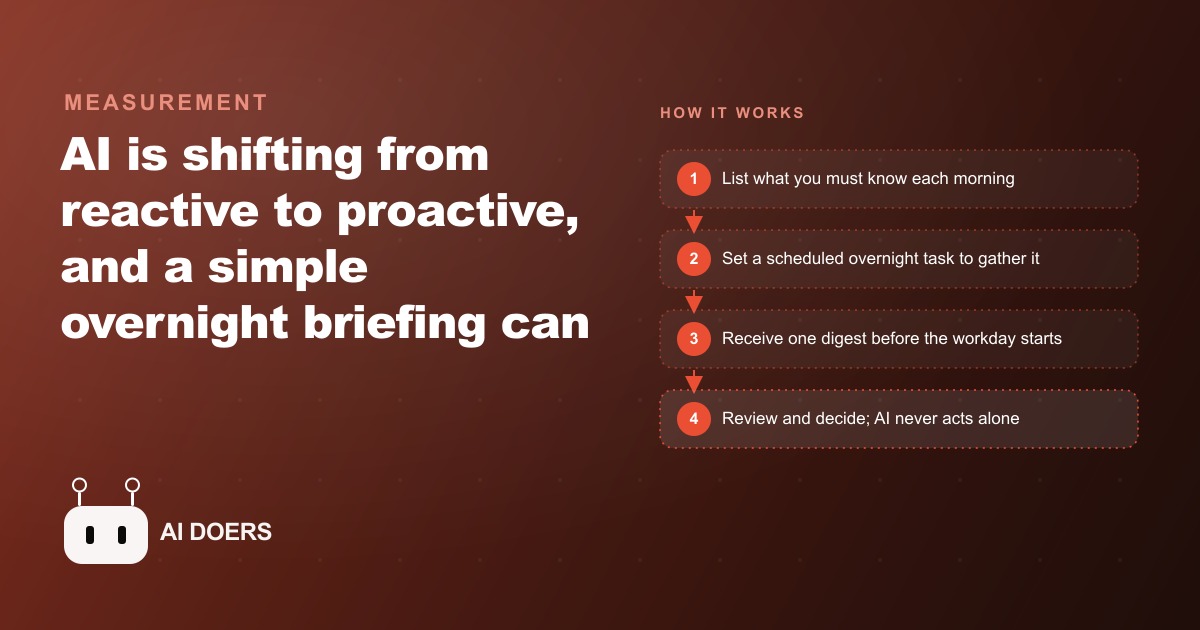
The single most useful idea buried in the latest wave of AI news is not a bigger model or a flashier video generator. It is that AI is shifting from reactive to proactive, from a thing you stop and query to a quiet assistant that preps your day before you ask. I, Madhuranjan Kumar, sifted a noisy roundup, ChatGPT Pulse, new open models from Alibaba's Qwen line, Google's Gemini robotics work, cheaper video generators, and massive data-center buildouts, down to the one shift that actually changes how a small business runs each morning. Here are eight things worth knowing about proactive AI and the morning briefing it makes possible, built around a landscaping company that lives and dies by the weather.
1. Proactive AI does work while you sleep
The core change is simple: AI that runs in the background and hands you useful results before you ask, instead of only answering when prompted. The clearest example from the roundup is ChatGPT Pulse. Overnight, while you are not using it, it reviews your past conversations and what it knows about your interests, then prepares a short personalized briefing for the morning. You open the app and a curated set of updates is already waiting, and you tell it what to keep showing and what to drop. The idea borrows from research on letting a model do prep work during idle time so the answer is ready the moment you want it. For an owner, that is the whole unlock: the prep happens on the machine's time, not yours.
2. The rest of the news is one pattern, not five stories
It is easy to drown in the roundup, so collapse it into a single sentence: capable AI is getting cheaper, more proactive, and easier to reach every month. Open models from Qwen now match leading tools for image editing and coding, which means strong AI keeps getting cheaper and more widely available. Google showed a robotics model that can reason about the physical world. Video generators got faster and less expensive. Enormous compute projects signal that all of it keeps scaling. None of those is the thing you act on today. The pattern behind them is, because it tells you the proactive setup you build now only gets cheaper and better to run.
3. A morning briefing beats the daily scramble
The practical shape of proactive AI, for a business, is a single overnight briefing that replaces the scattered scrolling most owners do before coffee. You decide what you need to know first thing, and the AI assembles it while you sleep so it is waiting for you on one screen. Instead of opening three apps and piecing together your morning, you read one digest. This is the difference between starting the day reacting and starting it informed. For a landscaping company, imagine opening your phone at six to today's forecast and rain risk, any new reviews or quote requests that came in overnight, and a reminder of which crews are scheduled where, all in one place.
4. It runs on scheduled tasks you can set up today
This is not a far-off promise. You can already set up scheduled tasks in common AI tools: tell the assistant to run something every morning and email you the summary, and it does. Proactive tools run on a schedule or in idle time, pull from what they know about you and your connected apps, and deliver a result without a fresh prompt each time. With Pulse you can connect a calendar or email, curate the topics, and receive a morning digest. The mechanism is boring in the best way. A scheduled job, a set of sources, and an email at the right hour is enough to turn AI from something you query into something that preps you.
5. It works best on timely information
Not everything belongs in a morning briefing. The sweet spot is timely information that changes daily and drives decisions: new reviews, new leads, weather, competitor moves, schedule conflicts, supply prices. Those are exactly the things owners scramble to check, and exactly what a proactive assistant is good at gathering overnight. Evergreen reference material does not need a daily digest. The rule of thumb is that the more your work depends on information that was different yesterday, the more a proactive setup pays off. For landscaping, weather is the obvious one, but new quote requests and fresh reviews sit right beside it.
6. Landscaping is close to a perfect fit
Some businesses benefit more than others, and weather-driven work is at the top of the list. A landscaping company's whole day can hinge on the forecast, so a proactive briefing does unusually heavy lifting. Here is how I would set it up for a client. I would build a scheduled morning task that pulls the local forecast, flags rain that could delay mowing or planting, summarizes any new online reviews so the owner can respond fast, and lists the day's jobs and crew assignments. It lands as one email before the workday starts, and it replaces checking three separate apps. That one screen helps the owner decide on the spot whether to push a job or send a crew out early.
7. The numbers show up as recovered minutes
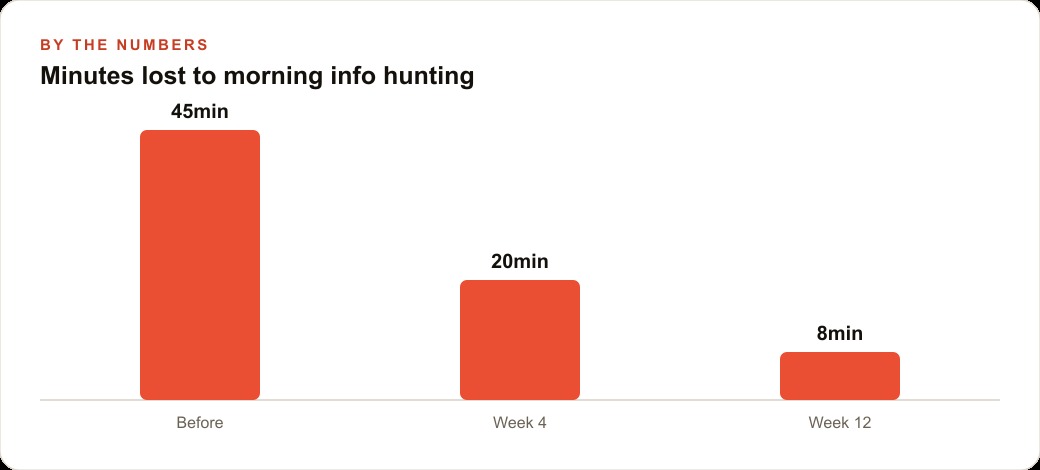
Put an illustrative measure on it. Before the setup, an owner might lose around forty-five minutes each morning hunting through apps, inboxes, weather sites, and the calendar to assemble a picture of the day. After four weeks of a tuned morning briefing, that scattered hunting drops to roughly twenty minutes, because most of the picture arrives pre-assembled. By week twelve, with the digest refined to include exactly the right sources and nothing extra, it falls to around eight minutes: a glance instead of a scramble. Those figures are illustrative, but the direction is real, and recovered morning minutes across a season add up to a meaningful amount of an owner's most decision-heavy time.
8. AI prepares, the owner decides
The most important rule is the one that keeps this safe: let AI prepare, not decide. Every action that follows the briefing, rescheduling a crew, replying to a review, adjusting a quote, still goes through the owner, so judgment stays human while the gathering is automated. A proactive assistant is most valuable precisely when it removes the morning scramble and hands you a clear picture, then gets out of the way. The moment you let it act alone on things that matter is the moment you inherit its confident mistakes. Keep its job to gathering and summarizing, and keep the decisions yours.
9. Start with one source and refuse to let it bloat
The fastest way to ruin a good briefing is to cram everything into it. The instinct, once a morning digest starts saving you time, is to keep adding sources until the briefing becomes its own scattered mess, which is the exact problem you built it to solve. Resist that. Begin with a single source that matters most, for the landscaping company that is the weather, and get it landing cleanly every morning before you add anything else. Then add the second source, new quote requests, and prove it earns its place. A briefing that shows you four things you actually act on beats one that shows you twenty you skim past. The discipline is to include only what changes a decision, and to cut anything you find yourself scrolling past two mornings in a row.
This is also how you keep the setup trustworthy. When every line in the digest reliably drives an action, you learn to trust the whole thing at a glance, which is the entire point. The moment the briefing fills with noise, you go back to double-checking it against the original apps, and you have lost the time you were trying to save. Tight and reliable beats comprehensive and ignored, every single time.
10. The real payoff shows up across a whole season
The value of a proactive briefing is easy to underrate day to day, because on any single morning it saves only a handful of minutes. The honest way to judge it is across a season. For a weather-driven business, the mornings compound. A digest that flags rain early lets the owner reschedule a crew before they drive across town, which saves fuel and a wasted trip. A digest that surfaces an overnight quote request lets the owner reply before a competitor does, which wins jobs that would otherwise have gone cold. A digest that catches a fresh review lets the owner respond while it still matters to the customer who wrote it.
None of those is dramatic in isolation. Stacked across three or four months of a busy season, they add up to real money and, just as valuable, to an owner who starts each day informed rather than scrambling. That shift in how the day begins is the quiet compounding benefit of proactive AI. It does not replace judgment or make a single flashy decision. It removes the friction that used to sit between waking up and knowing what the day requires, and it does that every morning, which is exactly the kind of small, repeated advantage that separates a smoothly run business from a frantic one.
How to put it to work, and where it connects
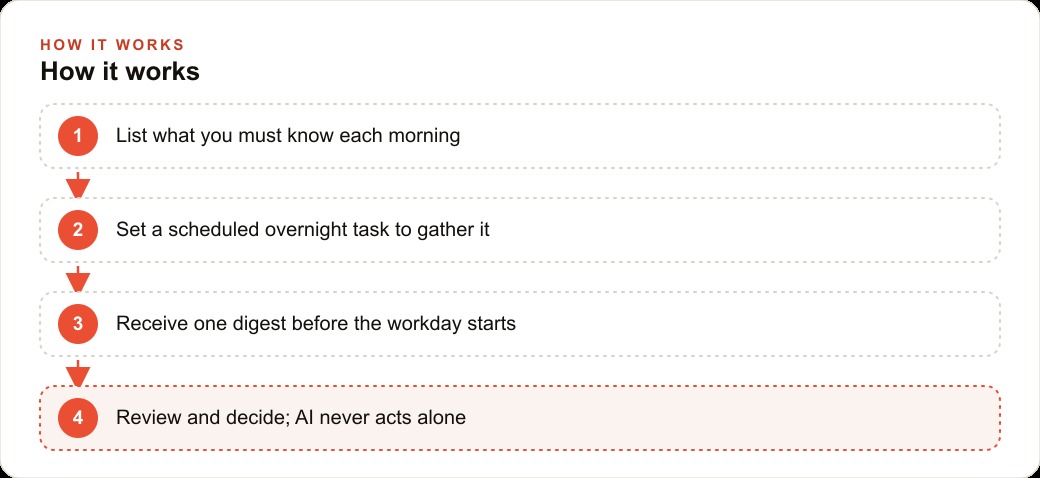
Start small. Decide what you most need to know each morning and write it down as a short list: weather, new leads, new reviews, schedule. Use a scheduled task in your AI tool to assemble those items and email you a digest before the day begins, and connect a calendar or inbox if the tool supports it so the briefing reflects your real day. Prove it saves you the daily scattered checking over one week, then expand into other timely information your business depends on.
The briefing also gets more powerful when it plugs into the systems you already run. If new quote requests and reviews live in your CRM and website stack, the digest can surface the overnight ones and flag who needs a fast reply, so no lead goes cold before breakfast. If you run Facebook and Instagram ad campaigns, a proactive feed can watch seasonal demand so your messaging stays timely, and the same awareness of what customers are searching for feeds SEO and organic search so your content tracks real local demand instead of guesswork. The briefing is the front door, and behind it the rest of your stack does the follow-through.
The mindset shift that makes all of this matter
Step back from the tactics and the real change here is philosophical. For its whole short history, AI has waited for you to come to it with a question. The proactive shift flips that relationship: the tool now comes to you with an answer before you thought to ask. That sounds small until you feel it, and then it reframes what an assistant is for. It stops being a smarter search box you visit and becomes a quiet presence that has already done the boring gathering by the time you wake up.
For a small business owner, that reframing is where the value lives, because the scarce resource is not information, it is attention at the start of a day when a dozen things compete for it. A proactive assistant spends the night collecting what you would have chased across three apps and hands it over as one clear picture, so your first decision of the day is made with the full context instead of a partial one. The discipline that keeps it healthy never changes: let it prepare, never let it decide, and keep every real choice with the person who owns the outcome. Held to that line, proactive AI is not a novelty or a threat. It is simply the difference between starting the day reacting and starting it already ahead.
If a proactive setup sounds genuinely useful but wiring it together is not how you want to spend your time, that is fair. You can absolutely build it yourself with a little patience, or hand it to someone who sets these systems up every day. Either way, AI that preps your morning before you even ask is no longer a future promise. It is something a small business can put to work right now.
That is exactly what we do at AI DOERS. Book a private 30-minute call with Madhuranjan Kumar and we will map the fastest path to it for your specific business.
Book your call →
Madhuranjan Kumar
Madhuranjan Kumar brings 20 years of performance-marketing experience and has managed over $200 million in Facebook ad spend for brands across the United States and beyond. His expertise spans the full modern marketing stack: Meta, Google Ads, TikTok, email automation, CRM, and the websites that hold it together. At AI DOERS he turns that track record into lead-generation systems for businesses across every industry.