
Powerful AI Is Coming Fast: A Small Business Guide to Adopting It Responsibly
Anthropic's founder warns that powerful AI may arrive within a few years and that we are not fully ready. For a business, the practical answer is steady adoption with clear values and human oversight.

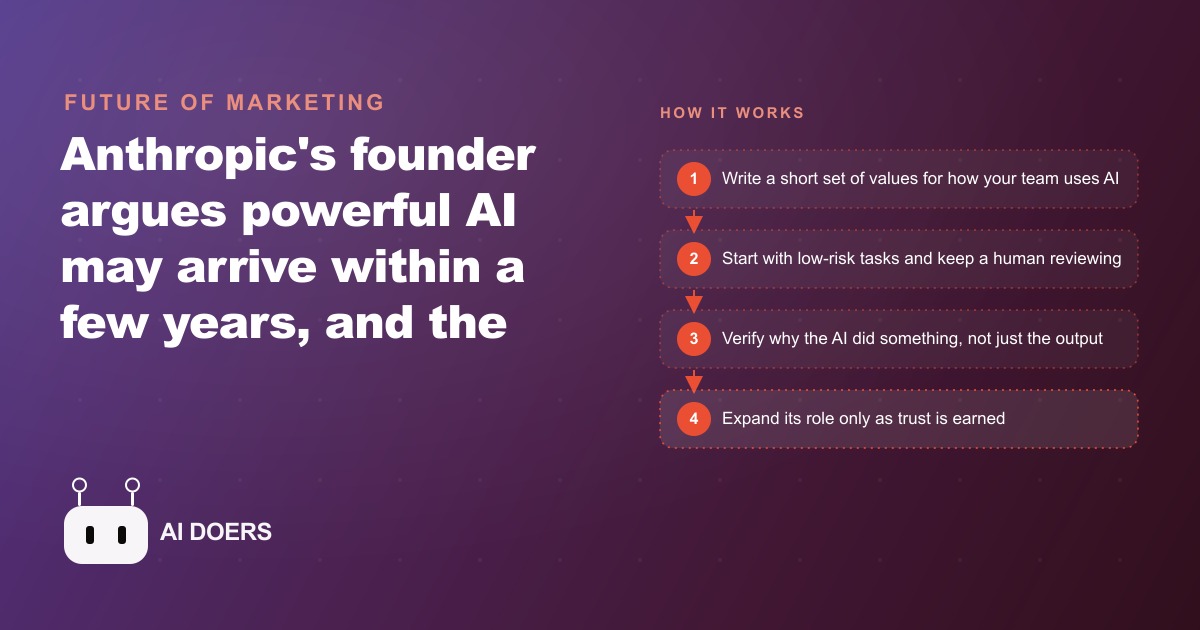
The most important sentence in the widely read essay from Anthropic's founder is not the timeline estimate. It is a single observation embedded underneath the predictions: we are not ready. Not the labs, not the companies building products on top of them, and not the businesses that will operate with these tools every day. He argues that highly capable AI could arrive in one to a few years rather than decades, pairs that claim with genuine optimism about the upside, and then plants a flag in something far more useful for a small business owner than a prediction: the preparation required is organizational, not technical. You do not need a computer science background to get ready. You need a clear set of values about how AI gets used in your business and a genuine habit of verification before anything AI-generated reaches a customer.
I am Madhuranjan Kumar. I want to make that concrete, because most coverage of this essay spends its energy on the timeline debate and almost none on what a business owner can actually act on this week.
The steady climb that noise obscures
Capability has risen steadily, month after month, on meaningful benchmarks. That pattern held through the hype cycles in both directions, through weeks when commentators declared AI finished and through weeks when they declared everything about to change overnight. A business that plans around that underlying trend rather than reacting to each individual announcement builds something durable. A business that swings between excitement and despair with each product release burns energy without accumulating anything of value.
The founder of Anthropic makes a point that gets less attention than the headline claims: despite people proclaiming the AI moment is over or the AI moment has finally arrived with each successive release, progress has been steady and smooth when you look at it across a meaningful timescale. His essay calls this the "we are so over" and "we are so back" cycle, and the lesson is not to be caught in either camp. Businesses that plan around the underlying trend rather than around the noise of any individual release are building durable advantages. The ones that react to the noise are not building anything.
The practical implication is to zoom out. Ask what organizational capabilities you want to have in place twelve to eighteen months from now, then work backward to what needs to start this week. That question produces a fundamentally different kind of action than asking which new model or tool was announced this morning. It shifts your attention from novelty-chasing to capability-building, and that shift is the foundation of every successful AI adoption story I have seen at the business level.
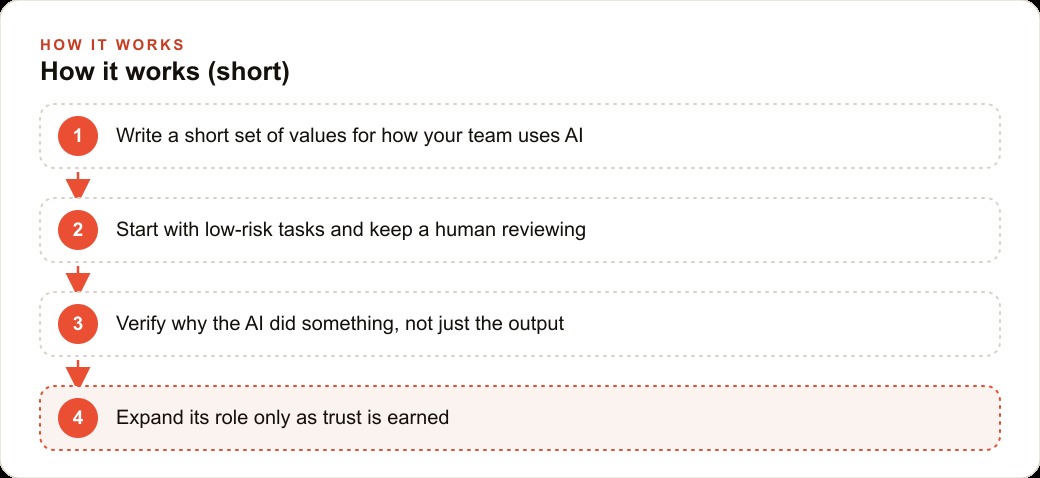
The businesses that absorb more capable AI well are not primarily the ones with the best technical setup. They are the ones with the clearest habits around how AI fits into their operations. A team that has spent six months building a disciplined workflow for one category of task, verifying outputs before anything reaches customers, and expanding the AI role only as trust accumulates, adapts to a more powerful tool in days because the organizational infrastructure is already in place. A team without established habits scrambles, because they are trying to build that infrastructure and use a more powerful tool at the same time. That is harder and produces more errors during the adjustment than doing it in the right order.
What "grown, not built" actually changes for how you operate
The distinction between grown and built is not a technical curiosity for engineers. It has a direct practical consequence for every business owner using these tools.
A programmed system does what its programmer specified. Every rule is explicit. Every case is anticipated and handled. A trained model works completely differently. It develops tendencies from exposure to enormous amounts of text, and those tendencies produce behavior that is usually useful but occasionally wrong in ways the developers did not anticipate and cannot always fully explain. The confidence of the output and the correctness of the output are completely separate properties. A model can produce a fluent, well-formatted answer that is simply wrong, and produce it with exactly the same tone it uses when it is right. There is no reliable signal in the surface quality of the language that tells you whether the underlying content is accurate.
That is why the founder of Anthropic invests seriously in interpretability, the discipline of understanding why a model produced a particular output rather than just accepting that output at face value. For a business, interpretability means something simpler but equally important: verification. Every AI output is a draft. Usually a useful draft, but one that someone with domain knowledge needs to check before it does anything consequential. The verification step is not optional and it is not bureaucratic overhead. It is how you convert AI output into something you can actually rely on in a professional context.
A moving company using AI to draft follow-up emails after an estimate visit should have a dispatcher reading each draft before it goes to the customer. Not because the AI is usually wrong, but because when it is wrong, it tends to be wrong in a way that sounds completely plausible and creates a real problem: a misquoted price, a commitment the business did not make, a detail invented to fill a gap in the information provided. A misquoted price in a follow-up email becomes a customer dispute at the time of service. The verification step catches that before it becomes a problem. Without the step, the problem reaches the customer and requires far more effort to resolve than the verification would have taken.
The constitution beats the rulebook
The founder of Anthropic does not steer his models with a long list of rules covering every possible situation. He steers them with a short set of values and trains the model to reason from those values the way a thoughtful, ethical person would. The same design principle works inside a business, and it is worth explaining why.
A rulebook covers situations someone anticipated in advance. It fails on situations outside the list, and the list is always incomplete because novel situations arise in real business operations every day. A values document covers every situation, because it gives the team a framework for reasoning through new cases rather than a lookup table for known ones. When a team member is not sure whether a piece of AI output is appropriate to send to a customer, the rulebook is usually not specific enough to answer the question. The values document almost always is. Does this match how we treat people? Does this represent something we can stand behind? Can we explain it if a customer calls to ask about it? Those three questions handle a remarkably broad range of situations, including ones that did not exist when the document was written.
For a moving company, the values document might be a single page: we are always honest with customers about what is included in a price; we never invent a commitment we did not make; we protect customer personal information at every step; we let a human approve anything that goes out to a customer. Short enough to remember. Clear enough for a new team member to follow on day one. Durable enough to apply to AI tools that did not exist when it was written. The rulebook gets outdated with each new tool. The values document stays relevant across every capability the business ever adopts.
A business that writes this document in a focused hour and trains the whole team on it has done the single most important preparatory work for responsible AI adoption. Everything else, the specific tools, the prompts, the workflow designs, comes later and is much easier to build when the values layer already exists underneath.
What compound adoption looks like in a moving company over a year
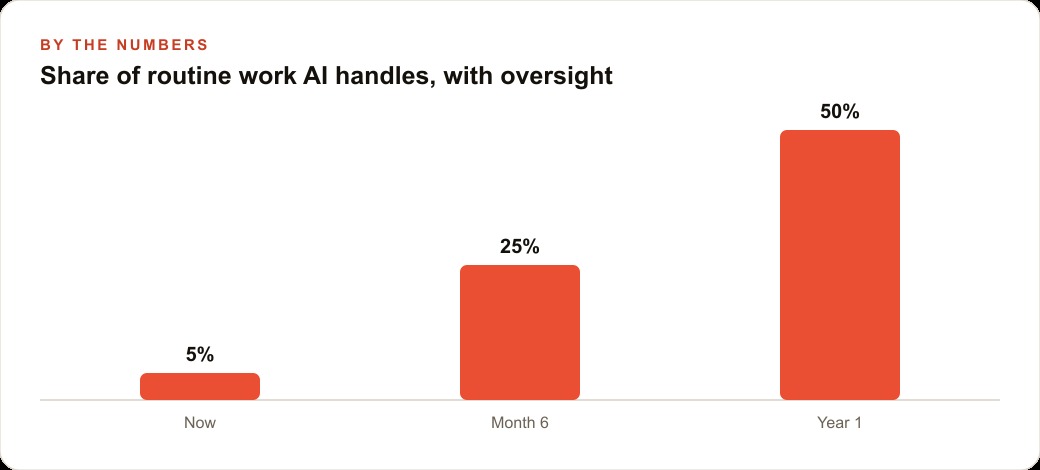
Let me make the compounding concrete. A moving company that started using AI for routine office work in January has, by July, learned exactly how to prompt for a useful first draft of a follow-up email after an estimate visit. It has learned which customer details need to be added manually, which types of errors the AI makes most consistently, and what to check before each email goes out. The dispatcher processes ten customer communications in an hour that previously took two hours, with a lower error rate than the manual baseline because the verification step catches things that tired humans overlook.
In numbers: the company sends 40 estimate follow-up emails per week. The AI-assisted workflow saves roughly 60 minutes per week at the dispatcher level. At an hourly cost of $22, that is $22 per week recovered, $1,144 over a year. The tool subscription runs $20 to $50 per month. Net annual savings over tool cost: $900 to $1,100, on a single use case, before expanding to anything else.
Over those six months the company has also expanded the AI role to drafting job completion summaries, answering routine customer questions about packing timelines and insurance coverage, and producing a weekly dispatch report from job records. Each new application follows the same pattern: start on a low-stakes version, verify consistently for the first month, expand as trust accumulates. The organizational knowledge built on the first application, which prompts produce reliable outputs, which edge cases need human review, which errors to watch for, transfers to every new application rather than having to be rebuilt from scratch.
The business now has operational AI experience across four distinct workflow types. When a more capable model arrives, it plugs into those existing workflows. The prompts improve. The automation gets deeper. But the habits, the values document, the verification practices, the team's calibration for when AI output is reliable and when it needs more checking, those carry forward and compound. They do not need to be rebuilt with each new generation of tools.
What the businesses that have not started are giving up
There is a compounding gap forming between businesses that are building AI habits now and businesses that have not started. The gap is not primarily about which tools each group has access to. Both groups can access the same tools at the same price. The gap is about organizational knowledge: which prompts produce reliable outputs for specific workflows; which tasks require human review; how to catch errors before they reach customers; how to train a new team member on the team's AI practices quickly and reliably.
That knowledge takes time to build and cannot be purchased or transferred in a single document. It is earned through real use, through real mistakes caught before they mattered, through real refinements to prompts and verification steps over weeks of actual operation. A business that has been accumulating it for six months has something a competitor cannot replicate in a week.
When more capable AI arrives, and the founder of Anthropic argues it is coming within a few years rather than decades, the businesses with organizational foundations adapt quickly because the infrastructure is already in place. The prompts need updating. The verification steps adjust. But the habits carry forward. The businesses without foundations face a steeper adjustment during a period when the stakes are higher than they were in the early, more forgiving period of adoption. They are building habits and using more powerful tools simultaneously, which is harder and produces more errors during the adjustment.
The essay's framing as a warning is accurate. But the more useful reading for a small business owner is as an invitation. The window for building careful, values-based AI adoption habits is open right now, during a period when the tools are capable enough to deliver genuine value but forgiving enough to learn from safely. The businesses that accept the invitation this week, write the values document, start two low-stakes workflows, build the verification habit, and expand steadily from there, are the ones who will absorb the next wave of capability as a compounding advantage rather than a disruption they were not prepared for.
That is exactly what we do at AI DOERS. Book a private 30-minute call with Madhuranjan Kumar and we will map the fastest path to it for your specific business.
Book your call →
Madhuranjan Kumar
Madhuranjan Kumar brings 20 years of performance-marketing experience and has managed over $200 million in Facebook ad spend for brands across the United States and beyond. His expertise spans the full modern marketing stack: Meta, Google Ads, TikTok, email automation, CRM, and the websites that hold it together. At AI DOERS he turns that track record into lead-generation systems for businesses across every industry.