
What a Pocket AI Device Would Mean for Your Small Business
A leaked ad for a rumored AI hardware device set off a debate about earbuds replacing the phone. The bigger story for owners is the always-on, hands-free assistant it points to, and how to get ready for it now.

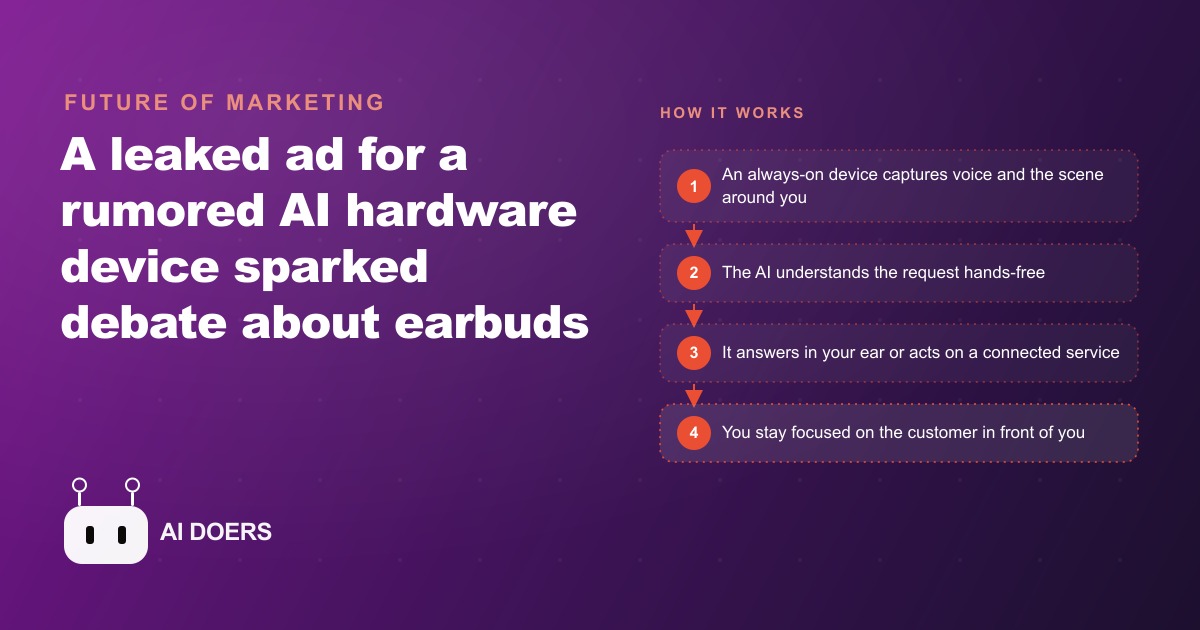
An advertisement for a rumored AI hardware device circulated online for a few hours, showing a stone-like companion device and wrap-around earbuds worn by a recognizable actor, then disappeared after the company denied it was real. The denial barely slowed the conversation, because the form factor resonated in a way that AI glasses never have. I am Madhuranjan Kumar, and the more useful question for a business owner is not whether this specific product will ship, but what an always-on, hands-free assistant would actually do for someone running a real shop or service, and how to start building toward that today with what you already own.
The argument the concept surfaced is simple: earbuds are a more natural interface for AI than glasses, because you speak and you hear the answer rather than staring at a tiny display strapped to your face. The limitation is that earbuds alone cannot perceive the world around you, so the concept adds a small pocket device with cameras and sensors. Critics correctly pointed out that a phone already does most of this, and that Apple and Android own that ecosystem. That observation is true, and it points to a practical conclusion: you do not need the new hardware to build the workflows it is designed to support. Start now, with what you have, so that when better hardware arrives, your habits are already there.
Build the voice habit before any device ships
The first and most important step is training yourself to capture work out loud the moment a task or idea arrives, rather than holding it in your head until you reach a free hand and a screen. This sounds simple and proves genuinely difficult for people who have spent years typing everything. The friction is behavioral, not technical. Speaking to an assistant in the middle of a busy shop or a job site feels awkward for the first few weeks, and then it becomes automatic.
Start with whatever earbuds you already own and your phone's built-in assistant connected to a simple notes or task service. The goal is not a sophisticated setup but a reliable reflex: something happens, you speak a ten-word capture, and you trust that it will be there when you look for it. The captures do not need to be polished. They need to be complete enough to act on. A reminder about a client who mentioned wanting a holiday event package, a note about the component that keeps running low, a follow-up for the wholesale inquiry that came in during a busy morning, these are the things that fall through the cracks when you are serving someone with both hands and cannot stop to type.
The reason this step comes first is that the value of an always-on assistant is not the hardware, it is the behavior. If you are already capturing thoughts by voice consistently, a better device is an upgrade in smoothness. If you have never built the habit, the best device in the world will collect dust, because the friction that stops you now is not technical. Fix the behavior first.
This is also where a good CRM and website stack becomes essential. The voice capture is only as valuable as the destination it feeds. An assistant that routes your spoken note directly into a CRM record or a follow-up queue is far more useful than one that drops it into a generic notes file you will read once and lose. Think about which system holds the truth about your customer relationships and connect the voice habit there from day one.
Connect the assistant to the moments that hurt most
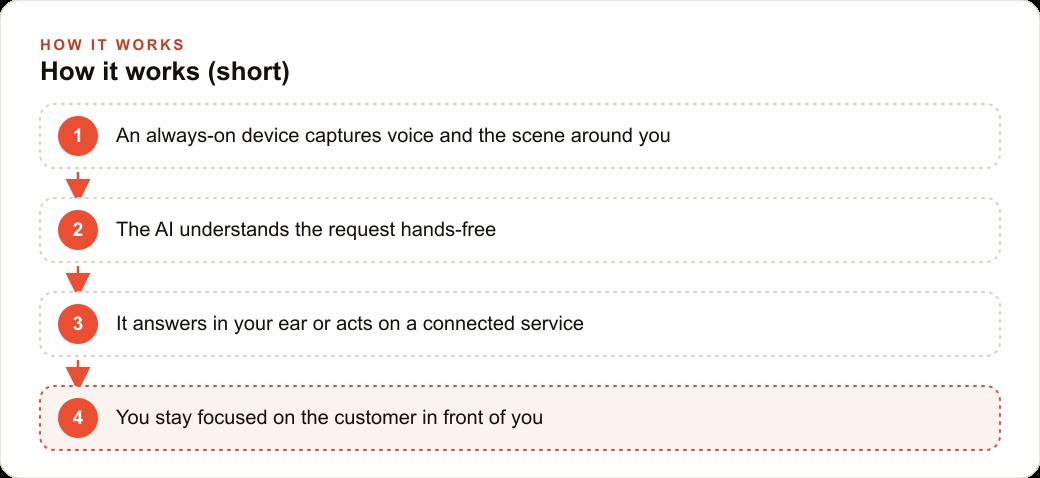
Once the voice habit runs reliably for a week or two, the second step is mapping which moments in your day benefit most from hands-free capture and wiring the assistant directly to those spots. This is where the setup becomes specific to your business and where it starts returning real time.
Consider a florist mid-arrangement when a regular customer calls to book the back room for a baby shower. If stopping to write the date means the arrangement gets rushed or the booking gets forgotten, you have a hands-free problem. A connected voice assistant turns that moment into a spoken sentence and a confirmed calendar entry. The arrangement continues, the customer feels handled, and the booking is captured. The same pattern repeats dozens of times a day across every service business: the most valuable capture moments are exactly the moments when stopping to type is most disruptive.
For a contractor on a roof noticing a section of damaged fascia that should be on the next estimate, speaking the observation takes three seconds. Pulling out a phone takes longer and uses both hands. For a barista whose regular asks about the loyalty program while three other customers are waiting, a quick voice note saves a conversation that would otherwise be forgotten by the end of the shift.
Mapping these moments is a half-hour exercise. Walk through a typical day and mark every point where you hold something in your head because you cannot safely put it somewhere right now. Those are your capture moments. The assistant is most useful at exactly those points, and each one you resolve is a task that used to drop.
The question of where each capture lands is also worth designing carefully before you automate it. The note about the booking request should reach your booking system, not a generic reminder. The low-stock observation should reach your reorder list. The customer feedback pattern should reach a shared log that the team can see. The specificity of the destination is what makes the capture valuable rather than just shifting the clutter from your head to a pile of audio notes.
Design the setup so the assistant serves the customer moment
The third principle is the one most technology advice misses: the assistant is supposed to protect the human moment, not interrupt it. The entire point of hands-free is that your attention stays on the person in front of you while the capture happens quietly in the background.
This means the captures during service should be brief and automatic, not conversational. A ten-word spoken note is appropriate in most business settings. A full back-and-forth conversation with an assistant while a client is sitting across from you is both rude and unnecessary. Design the most common captures to be as short as possible and test them until they feel natural rather than disruptive.
It also means being selective about what the assistant has access to. Start with the smallest useful set of connected services: your task list, your booking calendar, your reorder triggers, your notes. Avoid connecting it to sensitive financial records, detailed customer personal data, or internal staff communications unless you have a specific reason that justifies the access. The same principle applies to any well-run digital system, whether you are setting up a voice assistant or building out your Google Ads account structure: lean and targeted outperforms wide and unfocused.
The practical setup for most business owners right now is earbuds you already own, a phone with a reliable voice assistant, and two or three services where captures land correctly. That is enough to get the majority of the value that a dedicated always-on pocket device would eventually provide. The hardware would make it smoother and faster, but the leverage comes from the wired workflow, not the form factor.
One practical tip for this stage: give the connected services short voice-friendly names in your notes so that routing commands stay simple. The less you have to remember in the moment, the more likely you are to use the system when it counts.
Turn captured notes into patterns that improve the business
The fourth step is the one that converts a good habit into a compounding advantage. Voice capture is only useful if the captured items are reviewed, acted on, and used to inform decisions. A pile of voice notes that never gets cleared is just a more annoying version of the sticky note problem.
Set a fifteen-minute review at the end of each day. Go through what was captured, assign tasks to the right queue, close out anything done, and flag anything that reveals a pattern. This review discipline is what turns a stream of in-the-moment captures into a reliable system. Without it, the captures accumulate and the assistant stops feeling trustworthy.
The review also reveals patterns that are genuinely valuable. After a few weeks you will notice which types of requests come up most often, which moments in the workflow generate the most friction, and which connected services are actually useful versus which just add noise. That visibility is itself worth having, independent of the assistant, because it shows you your own workflow from the outside.
As the patterns become clear, you can start designing small automations around the most repetitive ones. The capture that always becomes the same follow-up email can become a template trigger. The reorder note that always leads to the same supplier check can become an automatic query. The booking request that always needs the same information from the customer can trigger a form the moment the note is captured. This is where voice-based capture starts connecting to the kind of operational leverage that frees up real time in the week.
The questions customers ask you out loud during service are also exactly what they type into search engines from home. A business that captures those questions through voice logging is building a real record of customer intent, and that record directly informs SEO content strategy and paid search targeting. Most competitors are not collecting this data in any systematic way, which means the business that does has an edge that is invisible to anyone looking at their marketing from the outside.
When the hardware arrives, you will be ready
The final observation is about timing. An always-on AI device in some form is probably coming within a few years, whether from the company being speculated about or from a competitor. When it does ship, the owners who will benefit immediately are not the ones who pre-order. They are the ones who have been doing voice-based capture consistently for six months and have already figured out which moments in their day it solves best.
The learning curve is in the habits and the connected services, not the hardware. A lighter, always-on device makes good habits faster and more seamless. It does not create the habits. The owners who understand this and start building now will have a genuine advantage, because that advantage compounds over every improvement in hands-free AI that arrives over the next several years.
You can build all of this today with no new purchases. If you want help identifying the exact moments in your business where hands-free capture closes the most gaps, and wiring the right services so captures land where they are actually useful, that is exactly the kind of practical setup worth spending a focused hour on with someone who has worked through it before. ## A concrete example: how one retail boutique owner built this over four weeks
A women's clothing boutique owner I work with runs a shop with three staff members. The busiest hours are weekend afternoons, and the quietest hours are weekday mornings from opening to noon. She had been frustrated for years by the same pattern: a customer would mention wanting to come back for a specific event, or ask about a style she did not carry yet, and by the time the rush ended the detail was gone. The staff's mental notes competed with each other and with the actual work of serving customers.
We set up a simple voice capture system over four days. She already owned AirPods. We connected them to her iPhone's notes and reminders app, which then synced to a shared team note where any staff member could see recent captures. The instruction was simple: any time a customer mentions something actionable, speak a ten-word capture the moment the customer leaves the counter. No longer, no more complex than that.
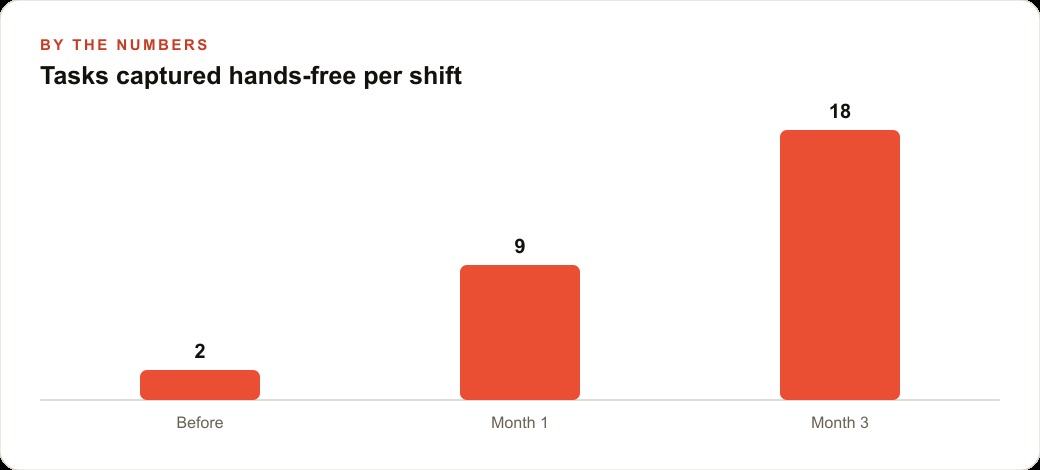
Week one was awkward. The staff felt self-conscious speaking aloud during slow moments when another staff member was nearby. By week two, it was automatic. By week three, the shared note had thirty new captures per week that previously would have been lost. Event booking requests, size requests for out-of-stock items, requests for specific brand names, all captured at the moment they happened rather than recalled imperfectly an hour later.
The review habit mattered as much as the capture habit. Every morning during the slow opening period, she spent ten minutes reading the previous day's captures, converting them to actual tasks or calendar entries, and clearing the completed ones. That ten-minute ritual turned a pile of raw spoken notes into a clean action list before the day started.
The numbers after four weeks: eleven new event bookings captured that would likely have been forgotten, four size-specific restock requests converted into actual orders that sold immediately when the stock arrived, and one repeat customer who had mentioned a specific wedding coming up in six months, who received a personalized message about a new collection three months later because her note was in the system. That repeat sale paid for the time spent on the whole setup several times over.
The staff now talks about the habit rather than the technology. The technology is just earbuds and a shared notes app. The habit is capturing the customer moment out loud, immediately, without breaking the service interaction. When better hardware eventually ships, the boutique owner will adopt it immediately because the behavior is already there. The device will just make the existing habit smoother.
That is the full picture of what building toward an always-on AI assistant actually looks like in practice: four days of setup, two weeks of habit formation, and a compounding return that grows as the captures accumulate into patterns the business can act on.
That is exactly what we do at AI DOERS. Book a private 30-minute call with Madhuranjan Kumar and we will map the fastest path to it for your specific business.
Book your call →
Madhuranjan Kumar
Madhuranjan Kumar brings 20 years of performance-marketing experience and has managed over $200 million in Facebook ad spend for brands across the United States and beyond. His expertise spans the full modern marketing stack: Meta, Google Ads, TikTok, email automation, CRM, and the websites that hold it together. At AI DOERS he turns that track record into lead-generation systems for businesses across every industry.