
Perplexity Computer vs Open Claw: Powerful, But Not Ready Yet
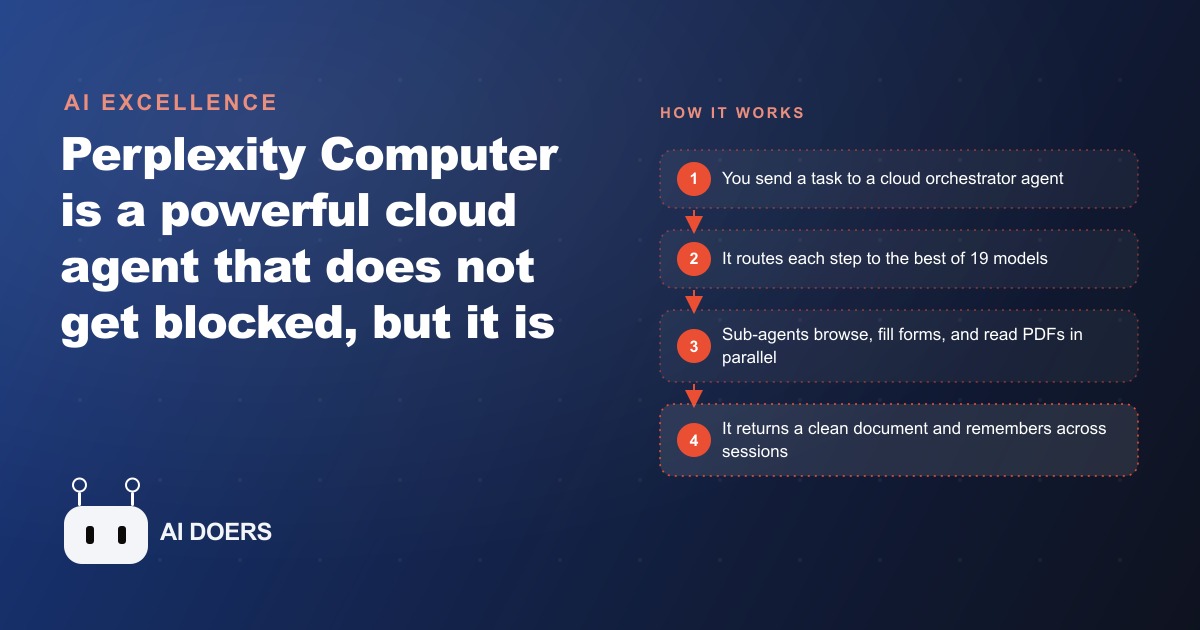
Perplexity Computer is a cloud agent that browses the open web without getting blocked and routes each task to the best of 19 models. It is impressive on research, but at 200 dollars a month with fast-burning credits it is still early. Here is the practical read.

A plumbing company rarely stalls because the owner cannot fix pipes. It stalls because the office work piles up faster than anyone can clear it, and Perplexity Computer is the first cloud agent I have watched that could realistically clear a chunk of it without getting blocked at the door. I am Madhuranjan Kumar, and rather than list features, I want to walk one plumbing business through what adopting this tool actually looks like, where it earns its cost, and the exact place it fell down.
The bottleneck was never the plumbing
Picture a two-truck plumbing outfit. The owner is on jobs from morning to evening, and the office work happens in stolen minutes and late nights. Someone has to look up code requirements for an unfamiliar city, compare part prices across three supplier sites, figure out the permit steps for a job in the next county, and prep quotes. None of it is hard. All of it is slow, and all of it competes with the actual paying work. The company was not short on demand. It was short on the hours to handle the research and paperwork that sit behind every job.
That is the bottleneck a cloud agent is built to attack. Not the skilled trade, which stays human, but the pile of web research and document-wrangling that quietly eats an owner's evenings.
Meeting a cloud agent that does not get blocked
Perplexity Computer is a hosted AI agent that runs in the cloud, closest in spirit to a tool like Manus but pushed further. Think of it as heavy agent capability without the server setup, the API keys, and the configuration headaches, wrapped in a cleaner interface and backed by Perplexity's web search. The one feature that made me take it seriously for a real business is that it does not get blocked. Most agents connect from a data center address that websites refuse, so they cannot click, fill forms, or move around a site like a person. Perplexity engineered an architecture, likely using thousands of proxies, that browses the open web without tripping those defenses.
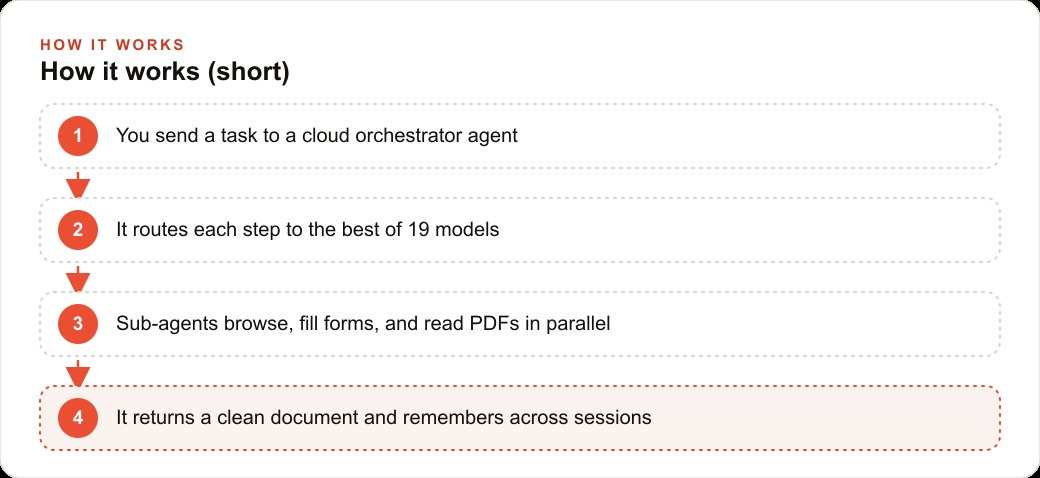
Under the hood it sends your task to an orchestrator, often built on Claude Opus, that can route each step to whichever of nineteen models fits best, reaching for Gemini, Grok, Claude, or DeepSeek as the job demands rather than being locked to one lab. It spins up isolated virtual machines that boot in a fraction of a second and die after the session, spawns sub-agents that share one workspace, and keeps a memory that persists across sessions. The part that matters for a plumber is plain: it actually uses the browser, clicking, scrolling, filling forms, and reading downloaded PDFs the way a person would, rather than scraping a homepage and guessing.
Week one: pointing it at supplier research
The first job was the one that annoyed the owner most: pricing parts. Normally that meant calling around or opening a dozen distributor tabs to check current prices and availability on the exact fittings a job needed. Because Perplexity Computer browses the live web without getting blocked, it could open several supplier sites at once, read the current prices and stock on the specific parts, and hand back a clean one-page comparison. What used to be forty-five minutes of tab-juggling before a bid became a single request the owner fired off from a truck between jobs.
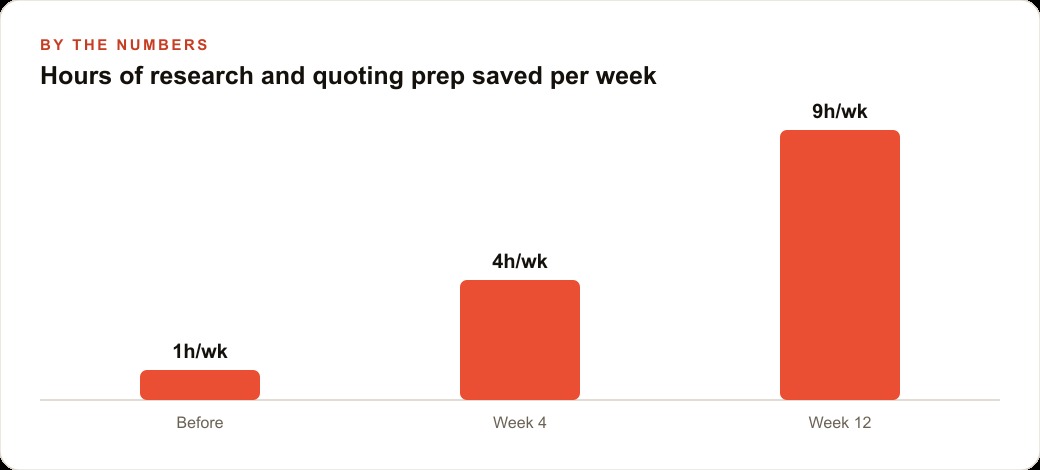
The illustrative payoff in that first week was modest but real: maybe an hour of research saved, which does not sound like much until you remember it was an hour the owner used to spend at ten at night. The comparison sheet also went straight into the quote, so the pricing was current instead of copied from a month-old memory. Those quotes and the customers behind them landed in the company's CRM and website stack, where follow-up on an open bid could finally happen on time instead of falling through the cracks.
Week four: building a permit and code reference
With the supplier research proving itself, the next target was regulatory research. A job in an unfamiliar municipality meant hunting down local plumbing code and permit steps, a task nobody enjoyed and everybody rushed. The owner had the agent research the code requirements and permit process for that city, in plain language, and build a tidy reference PDF the crew could keep on their phones. Because the agent reasons over real sources and reads the documents rather than guessing, the reference was grounded, and an apprentice could check a panel rating or a fixture rule without calling the owner mid-job.
By week four the tool was absorbing a few hours a week of the research load, and more importantly it was removing the small interruptions that used to pull the owner off a job to answer a question the crew could not look up fast enough.
Week eight: a weekly price-watch that runs itself
The chapter where the tool truly earned its keep was the scheduler. Perplexity Computer offers a cron feature that runs a task on a schedule in a fresh isolated machine and sends a push notification when it finishes. The owner set a weekly run that checked the key suppliers for price changes on the parts the company bought most, and pinged the phone when something jumped. That single automation meant the owner could reprice a common job before margin quietly disappeared, instead of discovering the increase weeks later on an invoice. The persistent memory helped here too, because over time the agent learned the company's usual parts and preferred vendors without being told each session.
By around week twelve, the saved research and quoting-prep time added up to something like nine hours a week, illustratively, hours that went back into selling and running jobs rather than into a laptop at night. Freeing that time also let the owner finally look at whether the Facebook and Instagram ad campaigns and the local Google Ads were actually bringing in the jobs worth having, a question there had never been time to ask.
Where it stumbled, and why that mattered
I would be dishonest to make this a clean success story, because the tool is early and it showed. It struggled to push a small code project to a repository, and more embarrassingly, it sometimes could not locate files on its own machine across separate chat sessions, something steadier agents do not lose track of. For a plumbing company that meant one clear rule: keep it on research and drafting, and keep it away from anything that touches the company's real systems or invoicing until it is steadier. The value was in gathering information and building references, not in operating the business's live tools.
That limitation is not a dealbreaker, but it defines the safe lane. Used as a research assistant, it shone. Asked to be an operations backbone, it wobbled. Knowing which is which is the whole skill of adopting an early tool without getting burned.
The honest cost math
Then there is the price, which is the reason I told the owner to trial before committing. Perplexity Computer requires the top Perplexity plan at two hundred dollars a month, and the default block of credits are bonus credits that burn fast on even simple work. For a small shop, two hundred a month is a real line item, so the question is blunt: do the saved research hours clearly beat it. If the tool reliably claws back nine hours a week of an owner's time, and that time is worth even a modest hourly figure, the math works. If it only saves an hour here and there, it does not, and a cheaper tool would fit better.
That is why the walkthrough started with one scoped research task and measured it honestly before touching the scheduler or paying for a second month. The credit burn has to be watched, the tool has to be kept in its research lane, and the value has to be proven on real work before the subscription is anything but a gamble. For this particular plumbing company, on illustrative numbers, it cleared the bar, mostly on the strength of the weekly price-watch and the supplier comparisons. For a different shop with lighter research needs, the same two hundred dollars might not be worth it at all.
Why the research quality won the owner over
The moment the owner stopped seeing this as a toy was when the depth of the research showed. In one widely shared test, the agent was asked how to get a gun license in Poland, and it searched in both English and Polish, opened real sources, reasoned through the requirements, and produced a clean, well-organized eight-page reference document. Side by side, a plain chatbot ran longer and returned a shorter, misaligned, weaker result. That gap is the whole argument for a tool that actually browses and reads rather than guessing from memory.
For the plumbing company, that same depth is what turned the permit-and-code reference from a rough summary into something the crew could genuinely rely on. When the agent pulls current requirements from live sources, reads the actual documents, and cites where each answer came from, the output stops feeling like a chatbot guess and starts feeling like a junior researcher did an afternoon of careful digging. An owner who has been burned by confident, wrong answers from lighter tools notices that difference immediately. The reasoning is visible, the sources are open, and the document is organized well enough to hand to an apprentice without editing it first. That reliability, more than any single feature, is what justified giving the tool a real trial rather than dismissing it as another shiny agent.
It also reframed how the owner thought about the two hundred dollar cost. A tool that produces shallow answers is expensive at any price, because you have to redo the work. A tool that produces genuinely usable research is cheap even at a real monthly fee, because it replaces hours you would otherwise spend or pay someone else to spend. The quality of the output is what moved the cost conversation from an expense to an investment.
The read for any owner
Perplexity Computer is genuinely new in one way that counts, browsing the open web at a human level without getting blocked, and genuinely early in ways that also count, losing its own files and burning credits fast. The right posture is neither hype nor dismissal. It is a scoped trial on your single most research-heavy task, an honest look at hours saved against the two hundred dollar cost, and a firm line keeping it away from your live systems until it steadies. Run it that way and you get the upside without betting the office on a tool that is still finding its feet.
The bottom line
Perplexity Computer is a preview of where cloud agents are heading: research assistants that browse the real web at a human level, route each step to the best available model, and run scheduled jobs while you sleep. For a plumbing company on illustrative numbers, the weekly price-watch and the supplier comparisons alone justified a careful trial, while the file-losing bugs and the fast credit burn kept it firmly in the research lane and away from live systems. The honest verdict is neither buy-it-now nor ignore-it. It is trial one scoped task, measure the hours against the cost, and let the evidence decide, because a tool this early rewards the owner who tests before committing and punishes the one who pays on faith.
You can absolutely test this yourself, and I would tell any owner to run one scoped research task before paying for a second month. If you would rather have someone decide whether this tool or a cheaper one fits your actual workload, set up the connectors and schedules safely, and avoid burning money on credits, that is the kind of call I help clients make, and you can bring me in to handle it.
That is exactly what we do at AI DOERS. Book a private 30-minute call with Madhuranjan Kumar and we will map the fastest path to it for your specific business.
Book your call →
Madhuranjan Kumar
Madhuranjan Kumar brings 20 years of performance-marketing experience and has managed over $200 million in Facebook ad spend for brands across the United States and beyond. His expertise spans the full modern marketing stack: Meta, Google Ads, TikTok, email automation, CRM, and the websites that hold it together. At AI DOERS he turns that track record into lead-generation systems for businesses across every industry.