
Perplexity AI Explained From Scratch: Every Feature, How It Works, and Why Business Owners Should Use It
Perplexity is described as an AI search engine, but that undersells what it actually does. From instant sourced answers to deep research synthesis, collaborative spaces, and an agentic browser that operates websites for you, it is one of the most complete AI research tools available.

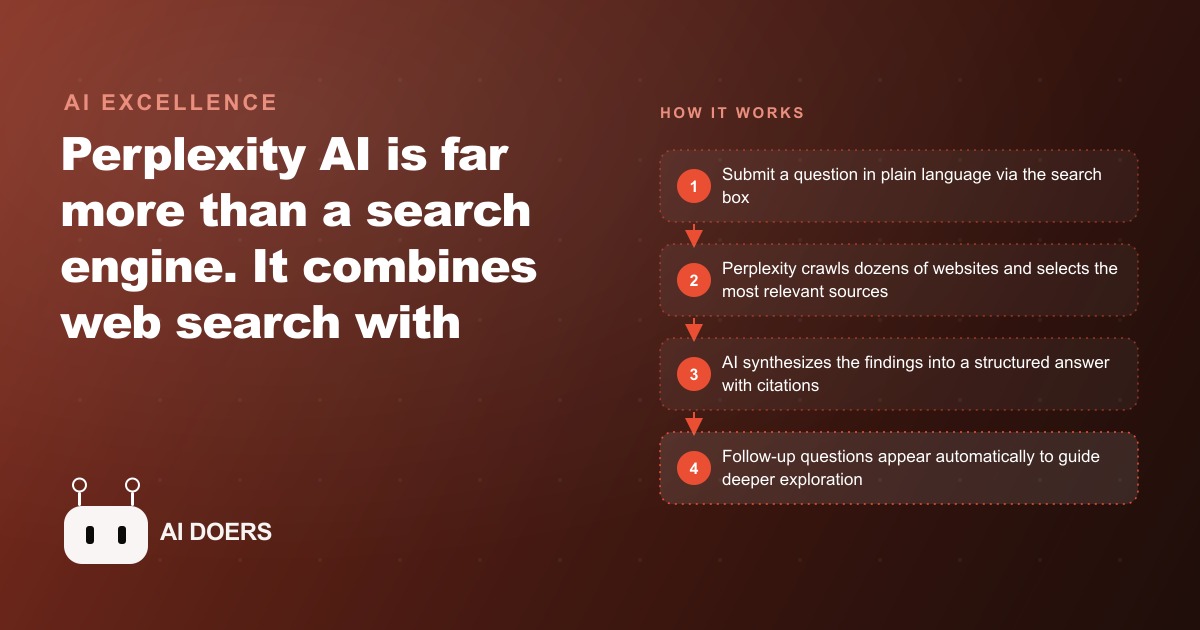
Perplexity launched Comet, an agentic browser that navigates websites and completes multi-step tasks on your behalf, and in doing so crossed a line that separates search tools from something the tech industry has been building toward for years: software that acts rather than answers. Most people subscribed to Perplexity for its Pro research features have not yet registered that this is a categorically different product. They are still thinking of Perplexity as a smarter Google. It is not, anymore.
My name is Madhuranjan Kumar. I want to walk through what specifically changed in this Perplexity release, why each feature matters in concrete terms, and what the right move is for a small business owner who has been watching AI tools evolve and trying to decide where to put actual time and money.
Perplexity launched an agentic browser that operates websites on your behalf, which is a categorically different product than a search engine
Comet is included in the Max plan at $200 per month. The key distinction from every other Perplexity feature is that Comet does not tell you what is on a website. It goes to the website and does things there. It can fill out a form, navigate a multi-page process, compare pricing across multiple pages in a sequence, and complete a task that would otherwise require you to click through a series of steps manually.
To understand why this matters, consider the kind of research that still requires manual browsing even with powerful AI search tools available. A plumbing company owner trying to understand what competitors charge for a water heater installation can ask Perplexity and get an aggregated summary, but that summary is assembled from whatever sources Perplexity indexed, which may be outdated or incomplete. With Comet, the owner describes the task, and the agent navigates to the competitor's website, finds the pricing page or clicks through to request a quote, and returns with current information. The owner did not open a browser. The owner described what they wanted.
The other Comet capability that matters for business users is multi-step form completion. Applying for a permit, requesting a quote through a multi-page form, submitting a contractor registration: any process that requires navigating through a sequence of pages and filling in fields can now be delegated to Comet with a description of the goal and the information to enter. The time cost of those processes, which tends to be disproportionately high because of the start-stop friction of multi-page forms, shifts from the owner to the agent.
Comet is a preview of what AI agents will do across every category of repetitive browser-based work. The Max plan at $200 per month is the current entry price. That price will come down as the capability becomes more standard, but the businesses that build comfort with agentic delegation now, while the learning curve is still early, will have an operational advantage that compounds as the tools improve.
The model picker turns Perplexity into a research coordinator, not a single-model tool
Before the current expansion, Perplexity was a smarter search interface that ran a proprietary model called Sonar for most queries. The upgrade to the Pro and Max plans introduced something more significant than a better model: a model picker that lets you direct complex questions specifically at GPT-5, Claude, Gemini, or other leading models through the same Perplexity interface.
The practical effect is that Perplexity becomes a research coordinator across models rather than a single-model research tool. A question about regulatory compliance for a home service business might be better directed at a model with particularly strong structured-reasoning capabilities. A question requiring synthesis of a large volume of sources might be better directed at a model with a longer effective context window. Previously, to get access to those different model capabilities, a user had to maintain subscriptions to multiple platforms and know which one to open for which question. The Perplexity model picker collapses that into one interface.
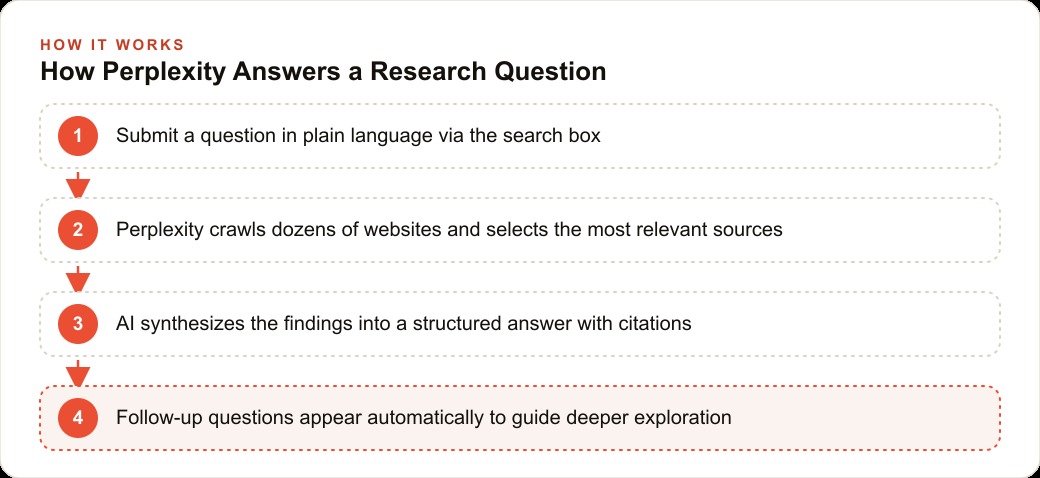
The Pro Research feature takes this further. Rather than running a single web search and synthesizing the results, Pro Research runs a multi-step research process: it identifies sub-questions within the original question, searches for answers to each, synthesizes across sources, and returns a structured answer that covers the topic more completely than a single-pass search could. For a business owner trying to understand a new local regulation, a competitor's market positioning, or the specifications of an unfamiliar product, Pro Research compresses what would otherwise be a 45-minute manual research session into 4 to 8 minutes of AI-assisted work.
File and image upload extends the research scope beyond what is on the open web. A competitor's brochure, a regulatory PDF, a supplier spec sheet, or a photo of an unfamiliar component can be submitted alongside a research question, letting Perplexity analyze the specific document in the context of its broader web-sourced knowledge. For service trades in particular, the image-to-answer capability speeds up parts identification that otherwise requires a call to a supplier or a trip to the parts counter.
Collaborative Spaces bring team research under one consistent AI layer
The Spaces feature solves a problem that emerges when a small team starts using AI research tools individually: the outputs become inconsistent because each person is starting fresh, using different prompts, and getting answers from different model configurations. Spaces create a shared research environment with a common AI assistant, shared background instructions, and a shared thread history that all team members can see and build on.
For a small business with a few people who all need to stay current on the same market conditions, competitor landscape, or regulatory environment, Spaces mean that the best research session any one person ran is available to the whole team. The context they built does not stay in one person's chat history. It becomes a shared resource that makes every subsequent session faster because the background is already established.
The collections feature, which organizes threads by project or topic, adds a longitudinal dimension to research that single-session tools cannot match. A business that saves every Perplexity thread about local code changes, new product specifications, and competitor pricing into a named collection builds a research record over time that can be referenced months later when quoting a job or training a new hire. That accumulated context is more valuable than the sum of the individual sessions because it shows change over time, not just the current state.
The follow-up question suggestions that appear at the bottom of every Perplexity answer are a small feature that compounds significantly in team use. When shared in a Space, those suggested follow-ups guide the whole team toward connected angles on a topic that not every member would have thought to explore independently. The research becomes more complete without requiring every team member to be a skilled researcher.
A plumbing company owner using Perplexity Pro can compress 90 minutes of Monday research into 12 minutes
I want to be specific about the return here because the ROI of a subscription tool is often described in vague terms that do not hold up under scrutiny.
The owner of a four-technician plumbing company spends roughly 90 minutes every Monday morning doing research that directly affects the week's operations: checking whether any local code updates apply to jobs booked, verifying current material costs against supplier pricing from the prior week, and checking what competitors are advertising for the two highest-volume service types.
Previously, that research required opening 8 to 12 browser tabs across the municipal code website, three supplier portals, two competitor websites, and a trade publication. The information was scattered, some of it outdated, and assembling a complete picture required moving between tabs and manually noting what mattered.
With Perplexity Pro, the same research covers three questions asked in sequence. First: have there been any updates to residential plumbing code requirements in the relevant jurisdiction in the last 30 days? Perplexity pulls from government sources and returns a synthesized answer with citations in about 90 seconds, including specific section references if there were updates. Second: what are current wholesale prices for standard water heater models from the three main suppliers in the area? The answer is approximate, sourced from publicly available supplier data, and sufficient for quote calibration. Third: what are local competitors currently advertising for water heater installation and sewer line repair? Perplexity pulls from competitor websites and local service listing pages and returns a summary.
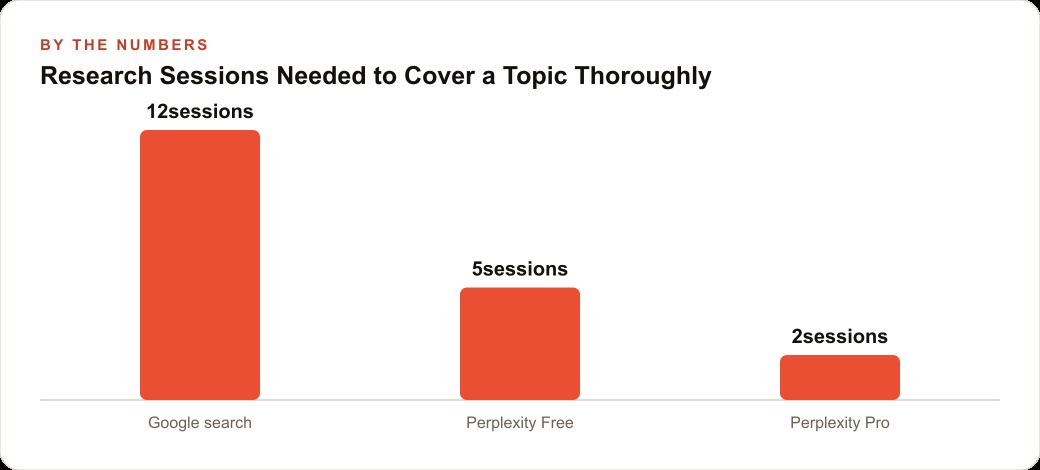
Total research time: 12 minutes, compared to 90. Across 50 working Mondays in a year, the saved time is 65 hours. At the owner's equivalent hourly rate of $65, the annual time recovery is $4,225. Pro plan cost: $240 per year. Return on that specific use case alone: more than 17 to 1.
The collections feature captures the compounding value. The owner saves each Monday morning research session to a collection called Market Conditions. By month six, that collection is a six-month record of how competitor pricing, material costs, and code requirements changed over time. That record is genuinely useful context when deciding whether to raise prices, when negotiating with suppliers, and when preparing for a busy season. It would not exist without the systematic research habit Perplexity makes sustainable.
The Pro and Max tiers create a meaningful capability gap between subscribers and non-subscribers
The free plan gives unlimited basic searches and three Pro Research uses per day. For occasional use, it gives a reasonable preview of the tool's value. For a business owner making weekly or daily research decisions, the limit hits quickly and the quality gap between Sonar on the free tier and the pro-tier models on complex questions is significant.
The Pro plan at $20 per month removes those limits and adds model choice, file upload, and higher-quality research synthesis. For the plumbing company scenario, the $20 monthly cost recovers in under a week of research time savings. The value of the subscription is not the access fee. It is the time cost of the alternative, which is the 90-minute manual research session that runs every week with no accumulating record and no ability to coordinate across a team.
The Max plan at $200 per month is worth evaluating specifically for Comet access. The question for any business considering the jump is whether there are multi-step browser tasks that currently consume meaningful staff time each week. Form submissions, quote requests across multiple vendors, competitive pricing checks that require navigating to specific pages rather than relying on indexed data: any of those tasks that recur weekly and take 20 to 30 minutes each are candidates for Comet delegation. Three such tasks per week, each taking 25 minutes, is 65 hours per year. At $65 per hour, that is $4,225 in recovered time, which covers the Max plan cost at $2,400 per year with room to spare.
The capability gap between a business using Perplexity Pro systematically and one doing research through standard search and manual tab management will widen as the tool improves. The features in this update, Comet, the model picker, Spaces, and Pro Research, are the architecture of a research operating system. The businesses that build their research habits around that system now will have a structural advantage in how quickly they can understand and respond to changes in their market. The businesses that keep doing research the way they did in 2022 will keep spending 90 minutes on what their competitors are covering in 12.
The practical starting point is simpler than most evaluations of AI tools suggest. Start a free account, run five of your most common weekly research questions through Perplexity, and time each one against how long the same research took you before. Do that for two weeks. If the average time per research session has not dropped by at least 50 percent, you are either asking questions that Perplexity is not well suited for, or you are not yet using Pro Research depth on the questions that deserve it. Most users who run this experiment find the time savings obvious before the two weeks are up, which makes the Pro plan decision straightforward. The $20 per month cost disappears inside the first recovered research session of the month, and everything after that is operational leverage you did not have before. The Comet and Max plan evaluation follows the same logic: count the multi-step browser tasks that consume staff time each week, estimate the hours, price the Pro plan against that, and the math makes the decision for you.
That is exactly what we do at AI DOERS. Book a private 30-minute call with Madhuranjan Kumar and we will map the fastest path to it for your specific business.
Book your call →
Madhuranjan Kumar
Madhuranjan Kumar brings 20 years of performance-marketing experience and has managed over $200 million in Facebook ad spend for brands across the United States and beyond. His expertise spans the full modern marketing stack: Meta, Google Ads, TikTok, email automation, CRM, and the websites that hold it together. At AI DOERS he turns that track record into lead-generation systems for businesses across every industry.