
The Pentagon Is Preparing for AGI: What a Small Business Should Actually Do
A defense bill asking for an AI readiness committee sounds far from a corner shop, but the playbook scales down. Here is how I would turn the headline into a calm, cheap plan for a small business.

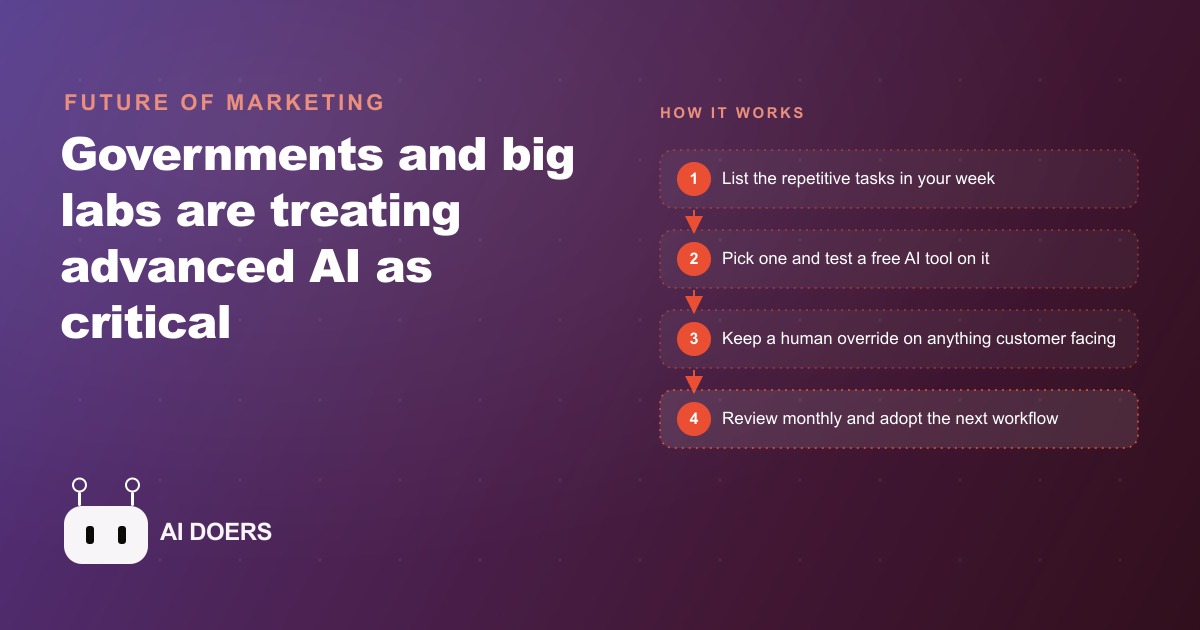
The Pentagon's AGI readiness committee is not the most useful thing a small business owner read this week, and I want to make that argument directly. I am Madhuranjan Kumar, and the headline about governments preparing for artificial general intelligence will generate a lot of commentary from people who have no intention of acting on it. What I want to do instead is take the actual structure behind that headline, the planning habits of serious institutions when they think something important is coming, and translate it into something a small shop owner can actually use this month.
The real lesson in the defense bill is not the deadline
The part of the news that generated the headline was a defense bill asking for an AI futures steering committee to stand up by a fixed date. That framing made for a punchy story. The part that is actually useful is quieter: serious institutions stopped treating advanced AI as a speculative scenario and started treating it as infrastructure that needs managed adoption rather than spontaneous response.
That is the insight worth taking. When organizations with long planning horizons start writing down how they will adopt AI on purpose instead of by accident, they are broadcasting a signal about the timeline they expect. They are not panicking. They are building routines. The playbook they are writing, watch for risks, maintain a human override, adopt on a schedule, translates directly to a small business, at essentially zero cost.
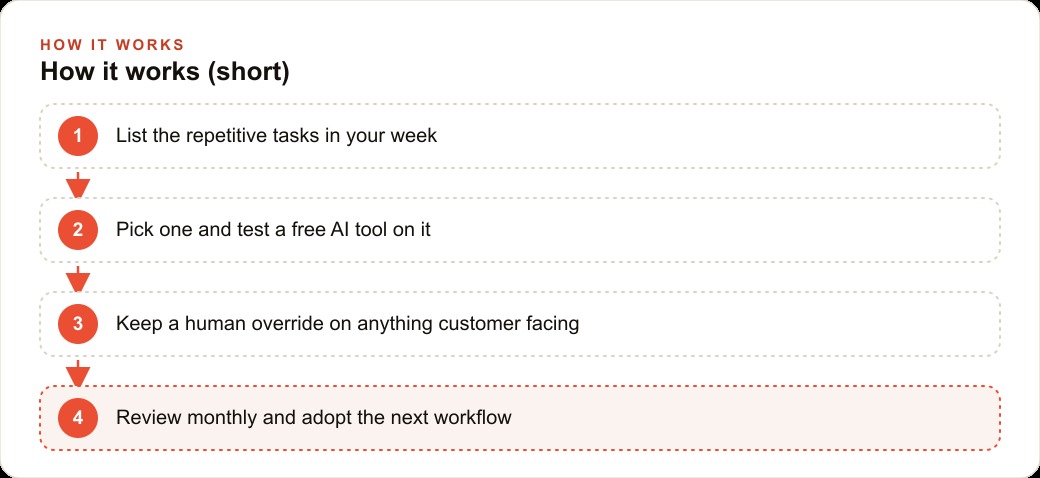
The committee analogy for a shop owner is a single notebook and a monthly calendar appointment. The committee lists its tasks and assigns responsibility for each. You list the repetitive jobs in your week and pick one to test with a free AI tool. The committee maintains protocols for human override. Your version is a rule that anything the AI drafts that touches a customer gets read by a person before it goes out. The discipline is structurally identical. The stakes are obviously different. The habits are the same.
Small businesses are already ahead of the curve on AI adoption and most owners do not realize it
The contrarian point that nobody is making in the AGI-readiness coverage is that small businesses, specifically the ones owned by people who actually do the work themselves, are often faster AI adopters than the enterprises everyone writes about. A plumber who discovers that an AI tool can draft quote follow-up texts while they are on a job site adopts that workflow in a day. An enterprise deploying the same type of automation waits twelve months for a procurement cycle, a change management plan, and a series of approvals that cost more in staff time than the tool would ever save.
The news cycle about AGI readiness is aimed at policymakers and large organizations. The practical reality is that most small business owners who experiment with AI tools for one specific task and see a result stick with it. The adoption challenge is not technical complexity. It is identifying the right task and running the first test. That is not a government committee problem. That is an afternoon problem.
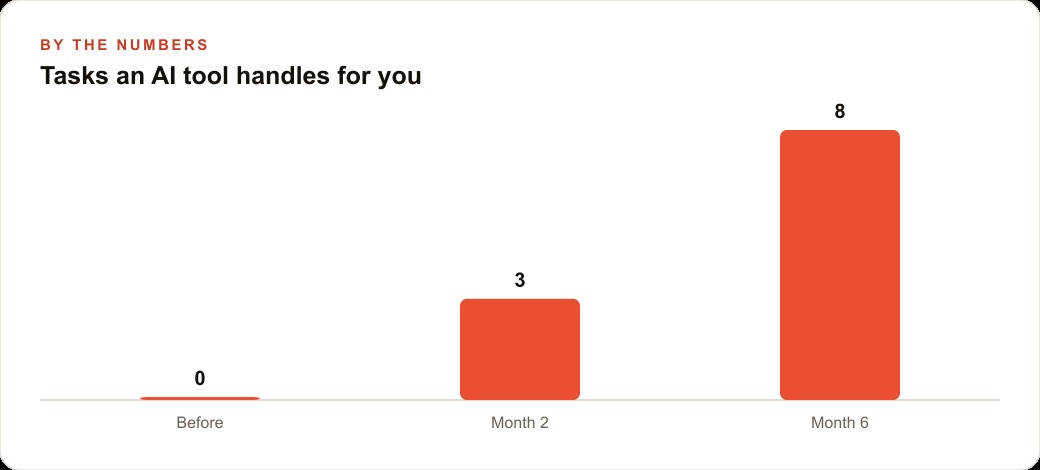
The broader context in the same week, which matters more than the defense committee headline for anyone running a business, is the continued decline in compute costs. Plans for enormous data center buildouts, regardless of their ultimate funding fate, all point in the same direction: the tools a business cannot justify today will be cheaper and more capable in six months. That trajectory is the useful signal, not the specific date anyone attaches to AGI.
The human override rule scales from the Pentagon to a sandwich shop
The steering committee's core mandate, ensuring that humans can intervene in and shut down AI systems, produces a specific design principle that applies at every scale. For a small business, the translation is simple: a human reviews anything the AI does that affects a customer before it goes out. This rule has no cost. It requires no infrastructure. It catches the errors AI makes that are different from the errors a junior employee makes, and it builds the institutional knowledge of what the AI does well and what it does poorly.
The override rule is not a vote of no confidence in the tools. It is the practice that lets you expand trust incrementally. A cleaning company that lets an AI draft booking confirmations but reviews each one before sending learns, over two or three months, exactly which types of messages the AI handles perfectly and which need consistent adjustments. After that learning period, the review step on the message types that never need changes can be made lighter. The human stays in the loop, the loop gets faster, and the trust gets earned rather than assumed.
This is worth making explicit because the most common failure mode for business AI adoption is not that the tool is bad. It is that someone lets the tool run unsupervised before understanding its failure modes, produces a bad customer interaction, and concludes the whole category is unreliable. The override rule prevents that failure by design.
Compute keeps getting cheaper, which is the only trend a small business needs to track
The section of the AGI-readiness news that actually changes a business decision is the one about infrastructure investment: data centers, energy, chips. All of that spending is a bet that AI compute will continue to be in high demand. What follows from high demand and competitive supply is that the cost per unit of AI capability keeps falling.
For a business owner, the practical implication is: do not wait for the perfect version of a tool before adopting it. The current version is already capable of automating the most valuable repeatable tasks in most small businesses. The business that adopts a good-enough tool today and builds the workflow habits around it will be positioned to upgrade to a better tool in six months from an advantaged position. The business that waits for the better tool before starting will still be starting when the next better tool arrives.
The standardization thread in the same news cycle matters in a quieter way. The push for a single national AI rulebook rather than fifty conflicting state regulations is a regulatory development with real business implications. A small business that operates across state lines or that uses AI tools in customer communication benefits from clearer, more consistent rules about what is permitted. That clarity is worth paying attention to, not because the specific regulatory outcome is certain, but because the direction of travel matters for anyone planning a multi-year AI investment.
What a plumbing company does this week instead of reading about AGI timelines
I want to be concrete about the translation from policy headline to business action, because the gap between the two is where most AI coverage fails the reader.
A plumbing company has a small number of tasks that repeat with high frequency: scheduling confirmations, quote follow-up messages, seasonal service reminders, and review requests after completed jobs. None of these tasks require the company to have an opinion about AGI timelines. They require identifying that these tasks repeat, understanding that an AI tool can draft them faster than a person can type them, and deciding to test that claim on one of them this week.
The test takes twenty minutes. Pick the quote follow-up message. Write a prompt that describes the business's voice, the recipient situation, and what the message should accomplish. Test it on three real past quotes. Evaluate the output. Adjust the prompt once. Test it again. By the end of the session, the company has either a working draft tool or a clear understanding of what adjustment it needs.
The oversight step is built in from the start. Every draft gets read before it sends. The business owner is the human override, and the override costs thirty seconds per message. Over time, as the draft quality improves, that review becomes faster and less frequent on the messages that consistently come back right.
That is the entire readiness playbook, scaled to a plumbing company. It costs nothing to run. It builds faster than a government committee. And it does not require anyone to have a position on when AGI arrives.
The framing in the news about a four-month window to prepare for AGI is dramatic and somewhat useful for generating attention. The actual useful content inside that framing is simpler: the institutions that plan for AI adoption systematically will be in better positions than the ones that respond reactively. Your version of that plan fits on one page. The monthly review is a calendar appointment. The AI does the routine work, the human stays in the loop, and the business gets better at using the tools without betting its operations on any single one of them. That is the AGI readiness playbook, and you can implement it before lunch.
If you want someone to map out which tasks in your specific business are the best candidates for AI automation, build the prompts around your real voice and workflows, and hand you a running system rather than a reading assignment, that is exactly the kind of work I do for businesses like yours. Both paths are valid. The one that does not work is reading about AGI timelines and deciding to think about it later.
That is exactly what we do at AI DOERS. Book a private 30-minute call with Madhuranjan Kumar and we will map the fastest path to it for your specific business.
Book your call →
Madhuranjan Kumar
Madhuranjan Kumar brings 20 years of performance-marketing experience and has managed over $200 million in Facebook ad spend for brands across the United States and beyond. His expertise spans the full modern marketing stack: Meta, Google Ads, TikTok, email automation, CRM, and the websites that hold it together. At AI DOERS he turns that track record into lead-generation systems for businesses across every industry.