
Why a Second AI Opinion Catches What the First One Misses
Relying on a single AI tool means trusting it to catch its own mistakes. Pairing a builder with a separate reviewer covers the blind spots and produces far better results.

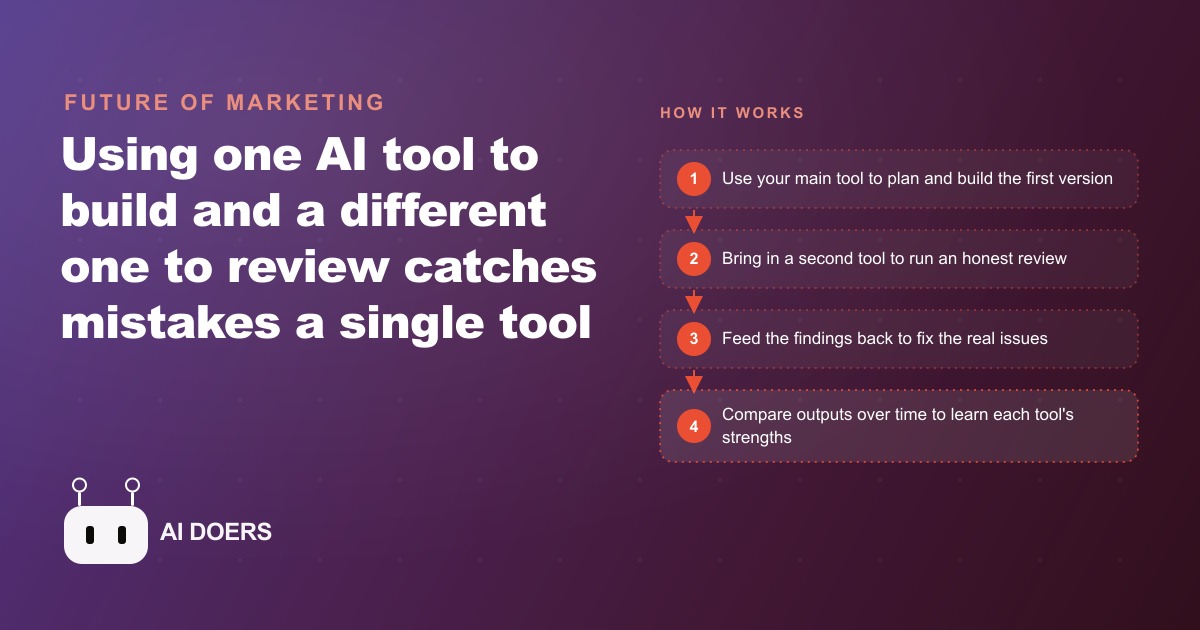
8 reasons pairing two AI tools produces better work than relying on one
The intuition most people bring to AI tools is the same intuition they bring to software in general: find the best one and use it for everything. That intuition produces a certain category of results. The results you get from combining two tools with different strengths are meaningfully better, and the difference shows up most clearly in high-stakes work where an undetected error is costly.
I am Madhuranjan Kumar, and I want to make the case for the two-tool approach with enough specificity that you can evaluate it against your own workflow rather than treating it as a general principle.
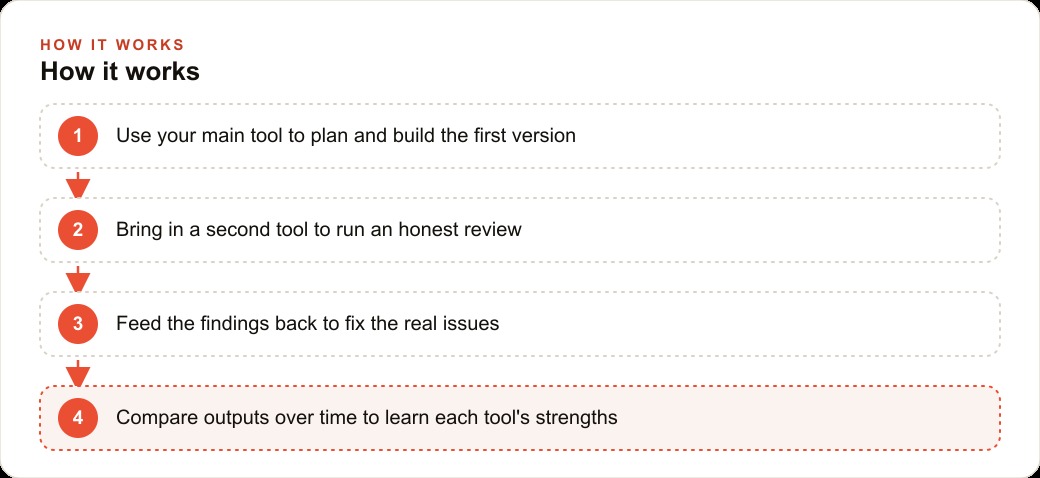
1. The builder and the reviewer have genuinely different failure modes
When a single AI tool builds something, it has access to its own reasoning about what it built. That self-referential review tends to miss the same categories of problems the building process missed. The tool knows why it made each decision. Its review of those decisions is colored by the same reasoning.
A second tool reviewing the output of the first has no access to the first tool's reasoning. It sees only the output. Its review is adversarial in the useful sense: it asks whether the output achieves the stated goal, not whether the choices made in building it were sensible. The gap between these two kinds of review is where the caught errors live.
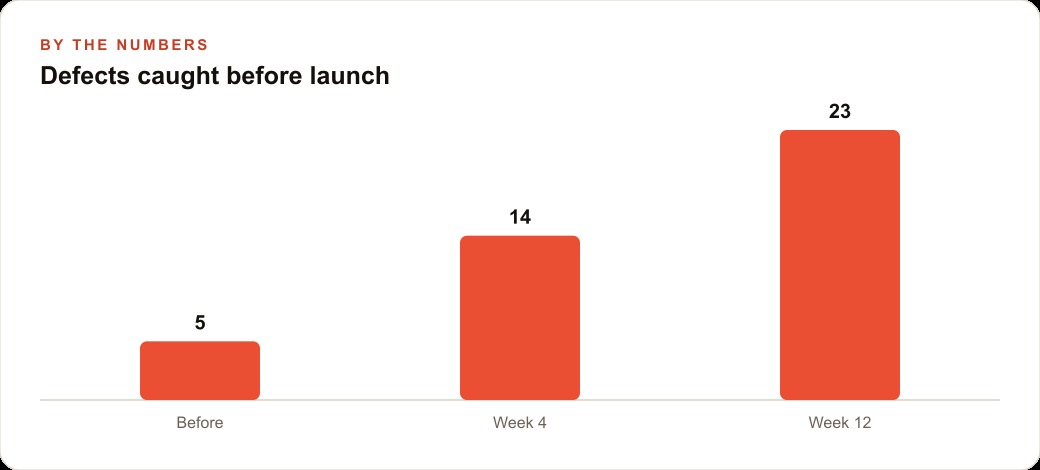
2. The reviewing model can be free or significantly cheaper than the building model
Running a premium model for the building phase and a capable but cheaper model for the review phase is a straightforward way to get adversarial review without doubling the cost. Many capable models are available on free tiers that can be used specifically for the review step. The economics of the two-tool approach are not additive in the way that doubling your model subscription would be.
The review phase does not require the same capabilities as the building phase. It requires the ability to read the output critically, identify gaps and errors, and explain what it found. That is a different task than building, and it does not require the most powerful available model.
3. One tool tends to excel at fluent production, another at rigorous analysis
Different models have different training emphases and different characteristic strengths. Some models produce more fluent, well-structured output with a high rate of internal consistency. Other models are more rigorous in catching edge cases, more willing to question assumptions, and more likely to flag a problem even when the surface of the output looks clean.
Routing the production task to the model that does fluent production well and the review task to the model that does rigorous analysis well gets more from both tools than routing both tasks to the same model. This is not a universal rule that applies to every combination. It is an observation that using each tool for what it does best produces better results than using one tool for everything.
4. Adversarial review surfaces the failure mode you were too close to see
When you build something, whether you are writing a contract clause, designing a workflow, or coding a feature, you develop a blind spot for the problems that your approach inherently creates. The assumptions you made look invisible because they are embedded in the design.
An adversarial reviewer asks the question you did not ask: what happens if this assumption is wrong? What happens at the edge of the stated range? What happens if the user does something unexpected? In one documented case, a second tool reviewing an authentication system found a flaw that would have locked out legitimate users under a specific sequence of actions. The builder missed it because the sequence was not part of the designed path.
5. Running the same task on both tools and comparing creates a calibration reference
Before settling on which tool to use for what category of work, running the same task on both and comparing the outputs creates a direct reference point for where each tool's strengths actually lie for your specific use cases. Generic benchmarks do not tell you which tool produces better output for your specific tasks. Direct comparison does.
For a business that has a stable set of recurring task types, a calibration session where both tools handle the same representative task produces a decision that is grounded in evidence rather than reputation. The comparison often surfaces surprises: a tool that is generally considered stronger for one category may perform comparably or worse on the specific version of that category your work requires.
6. The combination adapts to task variation more robustly than a single tool
Different tasks within the same general category have different profiles. Some tasks within business writing are mostly about structural clarity. Others are mostly about tonal precision. Others are mostly about technical accuracy. A single tool optimized for one profile will systematically underperform on the others.
A two-tool approach where the combination is adjusted based on the task type handles variation more robustly. When the dominant requirement is technical accuracy, the review passes to the more analytically rigorous tool. When the dominant requirement is structural clarity, the production phase weights the more fluent tool more heavily. The combination is not fixed. It adapts to what the task requires.
7. Review before delivery is a professional standard, not an optional step
In most professional domains, review before delivery is a standard part of the process, not an optional quality check. A legal document gets reviewed before it goes out. A financial model gets reviewed before the numbers go to a client. An engineering specification gets reviewed before the build starts. The review is not a sign of uncertainty in the initial work. It is a professional obligation to the recipient.
Running AI-generated work through an adversarial AI review before delivering it applies the same standard to AI-assisted output that professional standards apply to human-produced output. The business owner or professional who delivers AI-generated work without review is skipping a step that they would not skip if the work came from a junior team member.
8. The compounding benefit accumulates across the work you build over time
The single session benefit of the two-tool approach is catching errors that the building phase missed. The compounding benefit accumulates differently. The patterns of errors that the review consistently catches in your specific type of work become learning data for how you instruct the building phase. If the reviewer consistently flags that the builder underspecifies edge cases in workflow designs, you add edge case specification to the building prompt. Over time, the building phase improves because the review has made its characteristic failure modes visible.
This compounding benefit does not occur with a single-tool approach because the review is done by the same system that built the output. Its characteristic failure modes are invisible to its own review. Only a genuinely separate perspective can make them visible consistently enough that a pattern emerges.
The practical recommendation is this: identify one category of work where the cost of an undetected error is high, run the building phase on your primary tool, and run the output through a second tool with an explicit adversarial review prompt before delivering or acting on it. The prompt for the review should be specific: find failure modes, identify hidden assumptions, find the scenario where this breaks. A general "review this" prompt produces a general review. A specific adversarial prompt produces the rigorous analysis that justifies the two-tool investment.
For most business owners who try this approach on a category of work where the stakes are real, the number of significant catches in the first two weeks makes the rationale self-evident.
The specific prompt structure that makes adversarial review work
The weakest version of the adversarial review prompt is "review this and tell me what is wrong." That prompt produces a diplomatic scan of the output. The strongest version describes exactly what the reviewer should be looking for and explicitly grants permission to be harsh about what it finds.
A useful adversarial review prompt structure has three parts. First, describe the stakes: this is a proposal for a contract that determines payment terms with a client. Second, specify the review frame: assume the worst plausible interpretation of every ambiguous clause. Third, ask for the failure mode directly: identify every scenario where this document fails to protect the party who sent it.
That prompt structure produces output that is useful precisely because it is not diplomatic. Diplomatically phrased AI review tends to note concerns with phrases like "you may want to consider" and "one potential area to clarify" that embed the concern in hedging language. An adversarial prompt produces direct identification of the problem: this clause does not specify which party bears the cost if X happens, and under the worst plausible reading, the cost falls on you.
How to sequence the two tools for different task categories
The most common sequencing question is whether the review should happen before or after refinement. The answer depends on what refinement the first tool can do effectively from its own perspective.
For structural and logical tasks, the better sequence is often: build, self-refine once, then adversarial review. The first tool building and then reviewing its own output catches the most obvious surface problems. The adversarial review then catches the problems that survived the self-review, which are typically the more subtle or systemic ones.
For creative and tonal tasks, the better sequence is often: build, adversarial review, then refine based on review findings. Because creative output is harder for the building tool to self-evaluate meaningfully, skipping the self-review step and going directly to adversarial review gets the most useful feedback faster.
For high-stakes documents like contracts, proposals, or regulatory filings, both tools should review independently, and the building tool should then synthesize the review findings into a final revision. The synthesis step requires the building tool's fluency; the review findings come from the adversarial tool's rigor.
What "do not marry one tool" actually means in practice
The phrase "do not marry one tool" is easy to agree with abstractly and hard to actually live by when a particular tool becomes comfortable through daily use. Comfort with one tool creates a specific bias: you route tasks to the tool you know well because the interaction pattern is familiar, even when a different tool would produce better results for that specific task.
The practical counter to this is maintaining a minimal second tool for the review function specifically, regardless of which tool you use for building. The second tool does not need to be a full replacement for the first. It needs to be capable of reading the first tool's output and producing an adversarial review. Keeping that second-tool habit active prevents the single-tool comfort from becoming a single-tool dependency that removes the safety check.
The businesses that benefit most from the two-tool approach are the ones that treat the review step as non-optional for specific categories of output, the same way they treat client review as non-optional before a proposal goes out. The tool that does the review changes over time as better options become available. The habit of doing the review does not change. That separation of the tool from the habit is what makes the two-tool approach durable rather than dependent on any specific combination that will inevitably be superseded.
A concrete starting point: take the last five pieces of work you delivered with AI assistance, run each through a second tool with the adversarial prompt structure described above, and count how many significant findings appear. The count from that experiment tells you more about whether the two-tool approach is worth adopting in your workflow than any general argument can. For most people who run this experiment, the findings in the first batch are enough to make the review step a permanent part of the process.
That is exactly what we do at AI DOERS. Book a private 30-minute call with Madhuranjan Kumar and we will map the fastest path to it for your specific business.
Book your call →
Madhuranjan Kumar
Madhuranjan Kumar brings 20 years of performance-marketing experience and has managed over $200 million in Facebook ad spend for brands across the United States and beyond. His expertise spans the full modern marketing stack: Meta, Google Ads, TikTok, email automation, CRM, and the websites that hold it together. At AI DOERS he turns that track record into lead-generation systems for businesses across every industry.