
Overwhelmed By AI Tools? Copy This Lean Tech Stack and Decision System
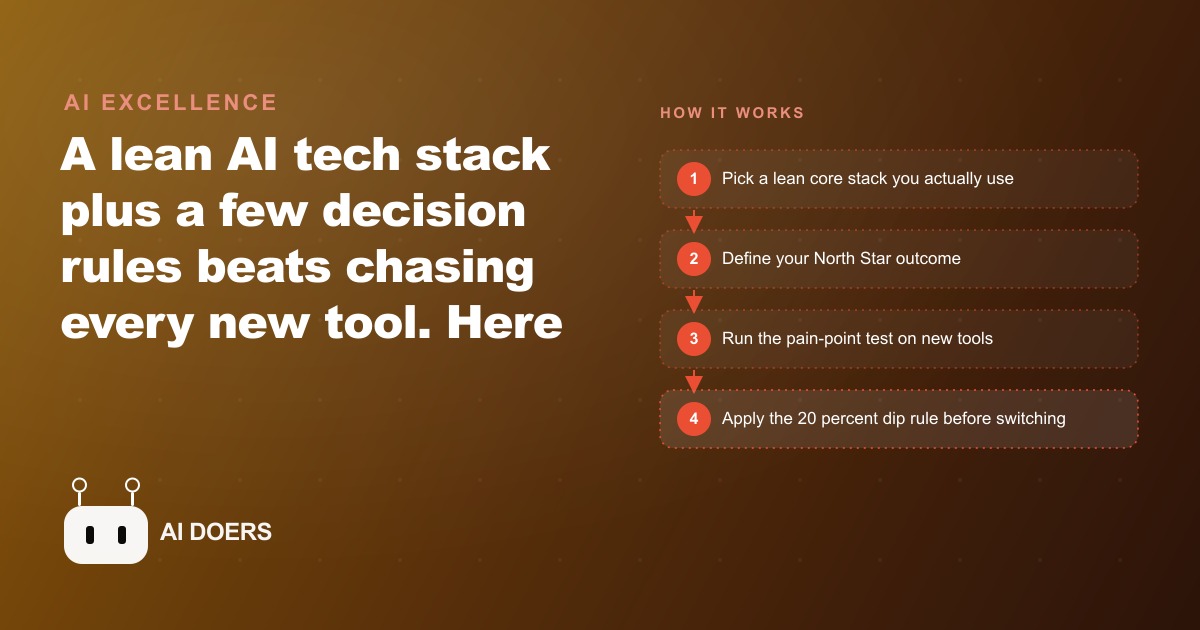
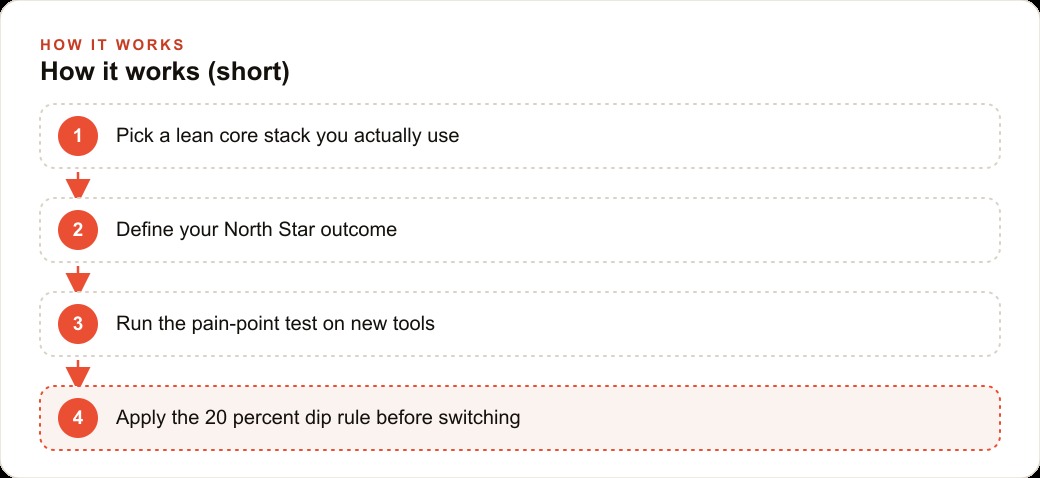
The fix for AI overwhelm is not learning every tool, it is a lean core stack plus a few decision rules. Keep a handful of daily drivers, treat agents as interchangeable, and run a pain-point test before adopting anything new.

The business owners who are getting the most out of AI right now are not the ones with the biggest tool lists. They are the ones who picked two or three tools, got genuinely skilled in them, and stopped reading about everything else.
I, Madhuranjan Kumar, want to make a case that most business owners have this completely backwards. The dominant advice is to "stay current," to "experiment broadly," to "not miss the next big thing." And the result of following that advice, in the vast majority of cases, is a stack of ten or twelve tools that each gets used occasionally, a mind permanently occupied with evaluation, and output quality that never compounds because the operator never gets deep enough in any single tool to extract its real value.
The contrarian position is uncomfortable to state plainly, so let me state it plainly: adding more AI tools to your stack is usually a way of avoiding commitment to any of them.
Adding more AI tools is not a strategy, it is a way of avoiding commitment to any of them
Every time a business owner adds a new tool to their workflow without removing an old one, they are making an implicit bet that they have the attention budget to develop genuine skill in one more thing. Most do not. The result is that every tool in the stack gets used at a surface level, the operator never pushes through the learning curve that leads to real capability, and the tool gets blamed for being limited when the actual limiting factor is depth of use.
There is nothing wrong with evaluating new tools. The mistake is treating evaluation as the strategy. Evaluation is overhead. Production is the strategy. And production requires deep, repeated use of a small number of tools until the operator stops thinking about how to use the tool and starts thinking only about the outcome they are trying to reach.
The best analogy I have found is kitchen knives. A professional chef who works with three knives every single day for five years is dramatically more capable than a hobbyist with twenty knives who uses each one once a month. The hobbyist probably has sharper knives in aggregate. They still cannot butcher a chicken as fast or as cleanly as the professional, because skill in a tool is not the same as access to the tool.
AI tools work the same way. The person who has spent three months writing prompts in the same assistant, who has learned its failure modes, who has built a personal library of prompts that reliably work, and who knows exactly when to trust the output and when to verify it has a capability advantage that no new tool immediately closes.
The daily driver effect: one tool used deeply beats ten used occasionally by a wide margin
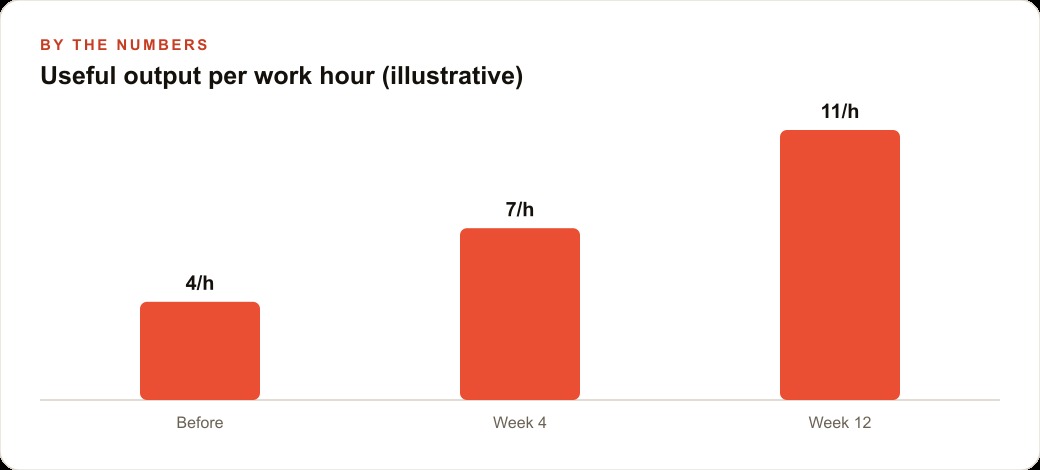
I want to put a concrete number on this. Take two business owners running plumbing companies. The first spends four hours per week evaluating and trying new AI tools: reading release notes, watching demos, starting trials, importing a few jobs into a new platform to test it. The second spends those same four hours getting deeply skilled in one core assistant. They are writing better prompts. They are learning the exact structure of input that produces reliable output for job estimates, customer communications, and supplier follow-ups.
At the end of three months, the first owner has a surface-level understanding of twelve tools and strong opinions about their onboarding experiences. The second owner has built a library of forty to fifty prompts that reliably save thirty to forty-five minutes of work per day. They can produce a first draft of a customer proposal in four minutes. They know exactly how to structure a job description so the assistant returns a useful scope estimate rather than a generic one.
The output gap is not marginal. It is enormous. And it grows wider with every week that the focused operator compounds their skill while the evaluating operator continues spreading attention across an expanding stack.
I have seen this pattern repeatedly across the operators I have spoken with and observed. The ones producing the best outputs are not the ones using the most tools. They are the ones who have pushed a small number of tools past the point where most people give up.
Your project folder is the real asset and every tool is just a harness over it
Here is the reframe that most people do not make explicitly but that the best AI operators are living by: the project directory, the document library, the prompt library, the organized context that you have built up, that is the asset. The AI tool is just the interface to that asset.
When you build a project folder with well-organized context, you can migrate between AI tools relatively easily. The tool is a harness. The structured information is the real intellectual capital.
This matters for the tool-chasing problem because it clarifies what should be stable and what should change. The project folder stays. The context grows. The prompt library improves with every job you run. The AI tool might change if a significantly better option appears, but switching is much less disruptive when the underlying asset is well-maintained.
The operators who chase every new tool tend to have the inverse problem. They are putting their energy into the tools themselves: the integrations, the settings, the trial runs, the learning curves. But their underlying context is a mess. Their project folders are not organized. Their prompts are ad hoc and not saved. Every new tool starts from scratch with them because they have not built the stable layer that a tool can harness.
Build the project. Build the context. Build the prompt library. Those compound. The tools are just the delivery mechanism.
The North Star filter cuts 90 percent of new releases before you have to think about them
If you are going to hold a lean stack, you need a filter that decides fast whether a new tool deserves attention. Otherwise the evaluation overhead creeps back in through a thousand small decisions: should I look at this, should I try that, is this one different.
The filter I use is what I call the North Star question: does this tool do something my current stack cannot do at all, or does it do something my current stack does but with a 10x improvement in a workflow I run daily. If the answer is no to both, the tool goes on a watch list and I do not revisit it for ninety days.
Most new releases fail this filter immediately. They do something an existing tool already does, slightly differently, with a fresh interface. They might be genuinely better in some marginal way. But marginal improvements in a tool you use occasionally do not justify the switching cost. Marginal improvements in a daily driver might, eventually, but only after the improvement has been proven over months, not announced in a launch post.
The filter cuts approximately ninety percent of what shows up in the AI news cycle before any real evaluation time is spent. The remaining ten percent gets a thirty-minute structured evaluation: can this do something I could not do yesterday, and if so, what workflow does it replace, what do I stop using, what is the transition cost. If it passes that, it gets a two-week real-world trial in actual production work. Not a demo. Not a showcase prompt. Real work.
Most things do not make it through the two-week trial either. But when something does, the adoption is clean and the old tool gets removed or deprioritized. The stack stays lean.
Every tool switch costs a 20 percent efficiency dip that most switches never fully recover
There is a real efficiency cost to switching tools that people consistently underestimate. I put it at roughly twenty percent, though the number varies by tool complexity and how embedded the old tool was in the workflow. The dip comes from the learning curve, from rebuilding mental models, from redeveloping the prompt patterns that were working, and from the psychological adjustment of not having a confident, automatic relationship with the interface.
The critical insight is that this dip is paid upfront. The recovery takes weeks or months. And in many cases, the new tool's advantage over the old one is not large enough to justify the dip cost at all, especially for operators running small businesses where output quality is tightly linked to personal expertise.
This is why the ten percent filter matters. If you apply it correctly, the only switches you make are to tools that offer genuinely large advantages in daily workflows. Those switches pay off. The marginal ones, switching to a tool that is slightly better at something you do twice a week, often do not recover the switching cost before the next tool comes along and the cycle repeats.
I have talked with operators who switched their primary writing assistant three times in a single year. Each time they convinced themselves the new tool was clearly better. Each time they spent four to six weeks rebuilding their prompt library, their workflow integrations, and their mental model of how to get reliable output. By the end of the year, they were no more capable with the third tool than they had been with the first at month six. They paid the switching cost three times and earned it back zero times.
The graduated tool you stopped using left you with something more valuable than the subscription
Here is the part people rarely acknowledge about the tools they move on from: they usually left you with something useful, and that something is often more durable than the capability you thought you were getting.
A tool you used for six months and then stopped using taught you a set of mental models. It showed you what AI-generated output looks like when it goes wrong in a particular way. It showed you what kinds of prompts produce useful structured output versus vague filler. It showed you how to verify outputs that sound confident but might be wrong.
Those learnings transfer. They make you a better user of every subsequent tool. The operator who stopped using a writing assistant after six months because they found a better one is still using the intuitions they built during those six months every time they prompt the new tool.
The mistake is to frame graduated tools as wasted time. They were not. They were the curriculum. And the operators who spend those months building genuine skill rather than evaluating twelve tools in parallel got a better curriculum from them.
When I look at the operators who are producing the best work with AI tools today, almost all of them went deep on something that is no longer their primary tool. They built their intuitions in that environment. They transferred those intuitions to the current tool. They did not need to rebuild from scratch because the underlying skill is not tool-specific. It is the skill of knowing how to structure a request, how to evaluate an output, how to iterate toward something usable. That skill compounds. The subscription was a vehicle. The learning was the asset.
The practical conclusion from all of this is simple, though it runs against most of the advice you will read. Pick a daily driver. Use it for everything you can for ninety days. Build your prompt library. Organize your project context. Get genuinely skilled. Then apply the North Star filter to everything else. Ignore the rest. The operators winning with AI right now are doing less with it, more deliberately, and compounding faster because of it.
There is a version of this argument that people hear as "stop learning about new tools," and that is not what I am saying. The point is to separate learning from adoption. You can stay informed about what is shipping without putting it in your workflow. Read the announcement, understand what problem it solves, and apply the North Star filter. If it passes, evaluate it. If it does not, file it and move on. The discipline is not ignorance. It is deliberate about where your production capacity goes.
That is exactly what we do at AI DOERS. Book a private 30-minute call with Madhuranjan Kumar and we will map the fastest path to it for your specific business.
Book your call →
Madhuranjan Kumar
Madhuranjan Kumar brings 20 years of performance-marketing experience and has managed over $200 million in Facebook ad spend for brands across the United States and beyond. His expertise spans the full modern marketing stack: Meta, Google Ads, TikTok, email automation, CRM, and the websites that hold it together. At AI DOERS he turns that track record into lead-generation systems for businesses across every industry.