
The Overnight Self-Improving AI Loop, and How to Borrow It for Your Business
A tiny open-source tool lets AI run hundreds of experiments on itself while you sleep. The same keep-what-works loop can sharpen your own workflows.

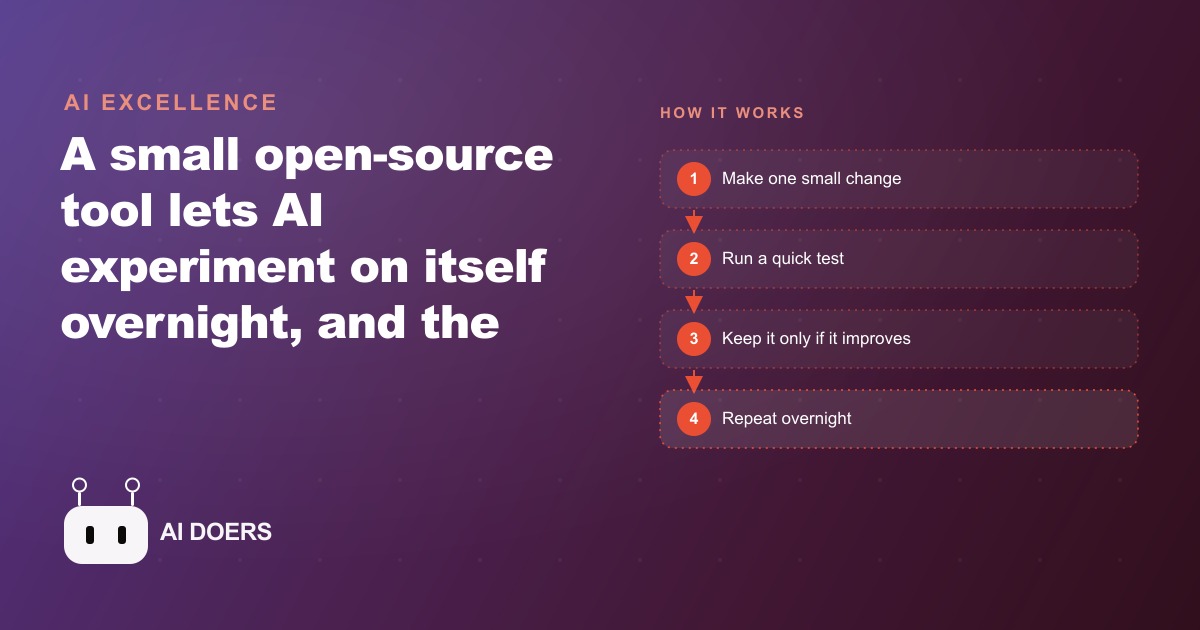
A well-known AI researcher released a tiny open-source tool that lets an AI agent experiment on itself overnight, and the founder of a large e-commerce company set it running before bed and woke to hundreds of finished experiments. The tool is interesting. The loop underneath it is the part your business can actually borrow. I am Madhuranjan Kumar, and here are the things worth understanding about this overnight self-improving loop, ending with how an accounting firm can steal the idea without training a single model.
1. It is an auto researcher you can actually run
The tool hands an AI agent a small but genuine language model setup and lets it experiment on its own while you sleep. What caught my attention is how small it is. This is not a secret lab project running on a warehouse of hardware. It is a simplified build an ordinary person can download and run at home. The goal of the program is blunt: it tries to improve itself. That is the part people find either exciting or unsettling, depending on where they sit, but the accessibility is what makes it matter for the rest of us.
2. The loop is almost boringly simple
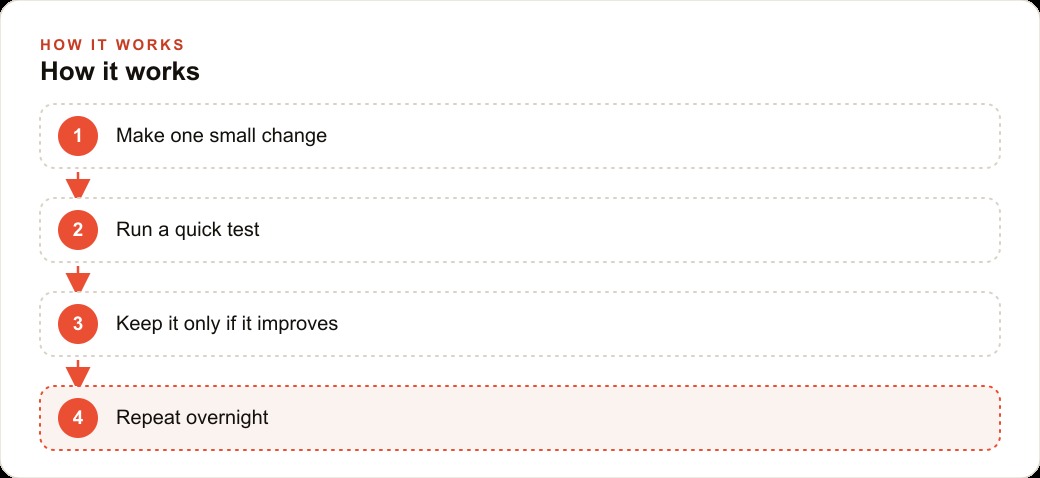
The mechanism is so plain it is easy to underrate. The agent looks at the code, makes one change, trains for about five minutes, and checks whether the results got better. If the change helped, it keeps it. If it did not, the change is thrown away. Then it does the whole thing again, over and over, all night long. Make a change, test it, keep it only if it improves, discard it if it does not, repeat. That is the entire engine, and its power comes from how many times it runs, not from any single clever step.
3. It is evolution with the clock sped up
If that loop sounds familiar, it should. It is how evolution works. A small variation appears, it gets tested against reality, and the useful ones survive while the rest go extinct. The only difference is speed. Instead of generations stretched across years, you get hundreds of cycles before breakfast. Good changes survive and bad ones disappear, automatically, without anyone deciding by taste. That shift from opinion to measured survival is exactly what most business improvement lacks.
4. Hundreds of experiments before breakfast
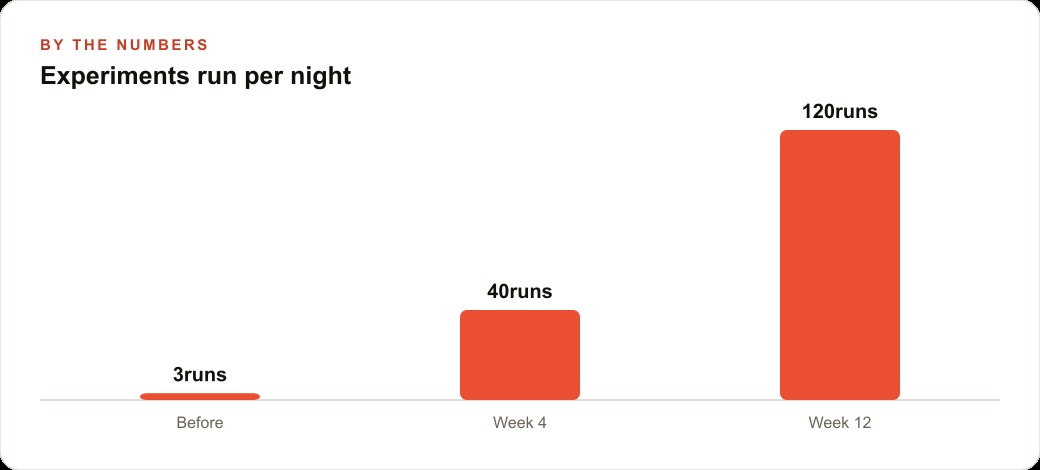
In one public run, the founder of a large e-commerce company set the tool going before bed, and it churned through around six hundred fifty experiments across two days, fully automated. Sit with that number. No human team could hand-run six hundred fifty experiments in two days, and even if they could, they would get bored, cut corners, and stop measuring carefully. An agent does not get bored. It runs the same patient test loop at three in the morning with the same rigor it used at nine at night. That tirelessness is the real product.
5. It runs on a single machine, not a warehouse
This is not a giant cluster. It is a simplified single-GPU setup that anyone can download and try at home. The significance is that the barrier to touching these ideas is far lower than the headlines suggest. You do not need to rent a data center to experiment with a disciplined improvement loop. The compute needed to run the pattern, if not the frontier AI research itself, is well within reach of a normal business, which means the excuse of it is only for big labs no longer holds.
6. The pattern matters far more than the code
Here is the item to underline. The valuable part of this whole thing is not AI training. It is the discipline of the cycle: make one small change, test it quickly, keep it only if the numbers improve, throw it out if they do not, and repeat on a schedule. Most small businesses do the opposite. They guess, change five things at once, and never measure, so they cannot tell what actually helped. The overnight tool is a vivid demonstration of a habit any business can adopt on things that have nothing to do with AI: pricing, email subject lines, intake questions, scheduling rules.
7. You do not need a research degree to borrow it
The person who ran this tool publicly is a company CEO, not a machine learning expert, and he said he learned more watching it reason through experiments than from months of following the field. That is encouraging, because it means the barrier is attitude, not credentials. You do not need a research team. You need one process worth improving, a clear number to watch, and the patience to let small wins stack up. Most competitors are still guessing, so a disciplined test loop quietly compounds in the background while they change things on a hunch.
8. An accounting firm that borrows the loop
Now the worked example, because the pattern only means something when it touches real work. Take an accounting firm and point the loop at the parts of the practice that repeat and can be measured, starting with client intake and document chasing. The agent gets a simple, safe sandbox: a copy of the firm's reminder messages, the intake questionnaire, and the rules for routing a new client to the right preparer. Nothing touches a live client.
Each night the agent proposes one small variation. Maybe it rewrites the missing-documents email to be shorter. Maybe it reorders the intake questions so clients actually finish them. Maybe it adjusts when the second reminder fires. Then it tests against the metric that matters, such as how many clients return their paperwork within three days. If a change lifts that number, the firm keeps it. If it does not, it is discarded before any real client sees it. Put illustrative numbers on it: if paperwork-return within three days sat at forty percent and a season of small tested tweaks nudged it toward sixty, that is a fifth of the client book no longer being chased by hand, which during a busy season is days of staff time recovered. Those figures are illustrative, but the direction is the whole point. The same idea works on bookkeeping checklists, on which questions catch the most errors, and on how engagements are scoped, all without a partner staying late to run the tests.
9. Where the compounding shows up beyond the back office
The loop does not stop at intake. Once a firm gets comfortable measuring one number and improving it, the habit spreads to the front of the business. The subject lines and offers in the firm's Facebook and Instagram ad campaigns become things to test rather than to guess at, and the leads those campaigns produce get captured and nurtured in the CRM and website stack where the same keep-what-works discipline can sharpen the follow-up sequence. The overnight tool is a demonstration, but the mindset it teaches is a growth engine that reaches every corner of the operation.
Why guessing quietly costs more than you think
It is worth sitting with how most small businesses actually make changes, because the contrast is the whole lesson. A typical owner notices that response rates are down, so on a Monday they rewrite the email, change the offer, move a button, and adjust the timing, all at once, and by Friday something is different but nobody can say which change did it. That is not improvement. It is superstition with extra steps, and it means the same mistakes get repeated because they were never isolated in the first place. The overnight loop is the opposite discipline made vivid: one change, one test, one clear verdict, then the next. Boring, patient, and far more powerful than a burst of simultaneous guesses.
The cost of guessing is invisible, which is exactly why it persists. You never see the improvement you failed to lock in because you changed five things at once and could not tell which one worked. A business running a measured loop, even a slow manual one, compounds small verified wins month after month, while a business guessing stays roughly flat and calls it bad luck. Over a year the gap between compounding and flat is enormous, and it costs nothing extra to be on the right side of it beyond the discipline to change one thing at a time and actually measure the result.
The intelligence explosion idea, kept in perspective
The overnight tool connects to a much larger claim that AI labs keep raising, the so-called intelligence explosion. The reasoning goes like this: once AI gets good enough to improve AI, each generation can help build the next, and progress could accelerate sharply. Several research teams have said openly that they expect some form of recursive self-improvement within roughly a year. Whether or not that specific timeline lands, the underlying loop is real and you can run a small version of it today. For a business owner, the takeaway is not to panic about runaway machines. It is to notice that the same keep-what-works engine driving those grand predictions is available to you right now, at the humble scale of your intake emails and scheduling rules, and that starting to use it early is how you stay ahead of the curve rather than scrambling to catch it later.
How to set up your own version
Start by choosing one process you can actually measure, because a loop is useless without a clear scoreboard. For most firms that is intake completion or response time. Next, give an AI agent a safe sandbox with copies of your templates and rules, so it can experiment without touching live client work. Then define one number it is trying to move and let it propose a single change per cycle. Finally, review the overnight log each morning, approve the wins, and let the small gains stack up week after week.
Watching it reason is its own education
There is a quieter benefit the founder who ran this tool pointed out, and it is worth repeating. He said he learned more watching the agent reason through its experiments than from months of passively following the field. That is a real advantage for a busy owner. When you set up a measured loop and actually read the log of what the agent tried and why, you are not just collecting results, you are watching your own process get examined step by step by something that never gets tired or defensive about it. You start to see which of your assumptions were never tested, which parts of the workflow were sacred for no reason, and where a small change moves the number. That education compounds alongside the results. The loop improves the process, and reading the loop improves the owner, and over a season both the workflow and the person running it get sharper.
The bottom line
An overnight tool that lets AI experiment on itself is a striking headline, but the durable takeaway is a habit, not a technology. Make one small change, test it against a clear number, keep it only if it improves, discard it if it does not, and repeat on a schedule. The accounting firm that pointed that loop at its intake and document chasing did not train a language model. It borrowed the discipline and let an agent run the patient testing it never had time to do by hand, and it compounded small verified wins across a busy season. You do not need a research degree, a cluster, or a moonshot. You need one process worth improving and the patience to let measured gains stack up while your competitors keep guessing.
You can wire this up yourself if you are comfortable with the tools and willing to babysit the first few runs. Plenty of owners would rather have someone set up the sandbox, the metric, and the guardrails correctly, then hand back a system that just runs. Either way, the lesson from this little overnight tool is the same. Steady, measured, automated improvement beats one big guess every time.
That is exactly what we do at AI DOERS. Book a private 30-minute call with Madhuranjan Kumar and we will map the fastest path to it for your specific business.
Book your call →
Madhuranjan Kumar
Madhuranjan Kumar brings 20 years of performance-marketing experience and has managed over $200 million in Facebook ad spend for brands across the United States and beyond. His expertise spans the full modern marketing stack: Meta, Google Ads, TikTok, email automation, CRM, and the websites that hold it together. At AI DOERS he turns that track record into lead-generation systems for businesses across every industry.