
OpenClaw Is the First Real Personal AI Agent, and Here Is How to Put It to Work in a Business
OpenClaw is the first agent that actually does the work instead of just chatting about it. Here is what it really does, and exactly how I would wire it into a real business so it earns its keep.

The average service business loses somewhere between ten and twenty percent of its inbound leads to slow or absent follow-up. Not to a competitor with sharper pricing, not to a worse customer experience, to the simple fact that someone called after five and never heard back quickly enough to stay interested. By morning that caller had already booked with someone who was faster. Response speed is the competitive variable most owners never measure, and the one that moves the most revenue when it finally gets fixed.
Most owners read that stat and think about hiring. I want to argue that is exactly the wrong frame, and that personal AI agents like OpenClaw represent the first genuine answer to a structural problem that has been quietly costing service businesses real revenue for years.
The lead-loss problem is not a demand problem, it is a response mechanics problem
The demand is already there. The marketing budget to generate it has already been spent. What leaks is the handling at the exact moment of contact, and that leak is almost always invisible because it happens after hours, during a busy stretch, or between two calls, leaving no obvious trace in any report the owner looks at. The lead called, did not hear back quickly enough to stay warm, called someone else, and the miss never showed up on any dashboard.
This is the central mistake in how most service businesses diagnose their growth problem. They see flat new-customer numbers and conclude they need better advertising, a bigger budget, or a sharper offer. Often the advertising is working fine. The problem is the gap between when the lead arrives and when a human gets around to responding. Research on lead response in service industries consistently shows that the probability of connecting with a new lead drops sharply within the first five minutes of contact and keeps falling the longer the wait extends. That window is not one most understaffed front desks can reliably hit across every operating hour, let alone after the office closes.
The cost is concrete once you do the math. Take a home-services business generating thirty inbound contacts per week through a combination of paid ads and referrals. If fifteen percent of those arrive after five and go to voicemail, and half of those callers never leave a message, that business is losing two or three potential jobs every single week before a single human makes a decision. At an average job value of three to four hundred dollars, the monthly leak sits in the low thousands of dollars, and the advertising budget that generated that demand is absorbing the full cost of those missed contacts without any return on them.
The traditional fix is a new hire. Another person on the desk, a part-time call handler, someone to cover the evening window. That works when the contact volume justifies a salary. For most small service businesses, the after-hours contact count is high enough to matter and too low to make a part-time hire economical. The structural leak has sat there for years because the only fix was expensive and the only alternative was accepting the loss as a cost of doing business.
Personal AI agents change that equation entirely, and not because they are clever. They change it because they are simply there.
Hiring another person solves the wrong bottleneck
I have been through this conversation with enough service business owners to recognise the pattern. Leads are slipping. The solution that surfaces first is a hire. The hire is budgeted, or argued against on cost grounds, and the conversation stalls while the same after-hours calls continue going to voicemail at the same rate as before.
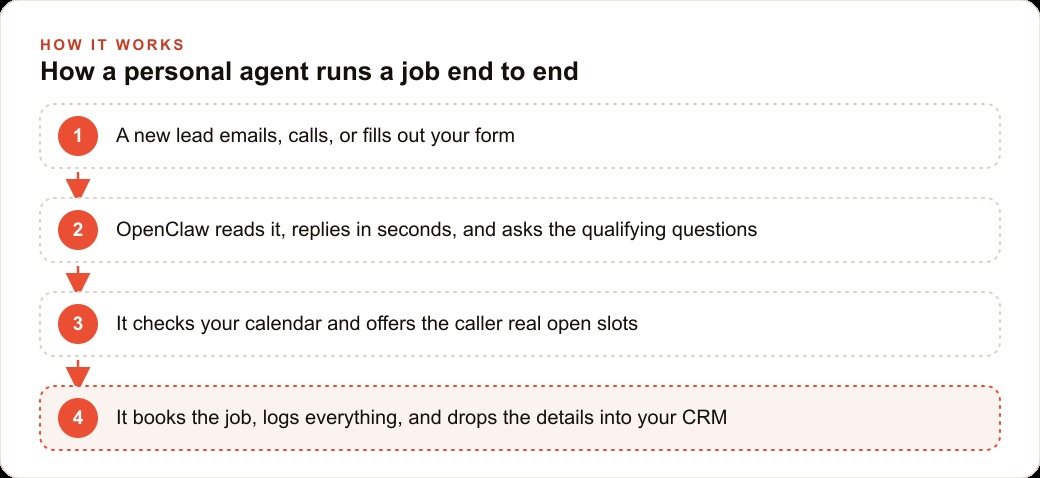
The problem with the hire-first reflex is that most of the tasks bleeding leads are not judgment-heavy work. Reply within thirty seconds, ask one qualifying question, check the calendar, offer the next open slot, confirm the booking, and log the contact details. That is not a job requiring a trained, salaried employee. It is a job requiring consistent presence and a clear script, executed the same way every hour of every day.
A personal agent owns that loop without the overhead. No onboarding period, no benefits, no scheduling constraints, no sick days, no variance in quality based on how the week is going. What it requires is a precise description of the steps and a working connection to the two or three tools where the outcome lands: the inbox, the calendar, and the CRM. That setup is a one-time investment. The agent runs from there indefinitely without additional management cost.
The math changes completely when framed this way. A service job worth four hundred dollars, captured three additional times per week because the agent was present at nine on a Wednesday evening, generates roughly forty-eight hundred dollars per month from contacts that previously became unanswered voicemails. The monthly subscription cost for a personal AI agent is typically a fraction of a single job's value. The conversation about whether to hire stops looking like the obvious answer when the alternative closes the same gap at a small fraction of the cost.
For businesses running Facebook and Instagram ads to drive inbound volume, this gap is especially pointed. Ad spend drives calls across the full day and into evening hours, including the window no one is staffed to answer. If the agent is not there during those hours, the ad budget is generating demand that is not being captured. The agent closes that loop without touching the creative strategy or the media allocation.
An agent's advantage is not intelligence, it is that it never clocks out
The dominant conversation around AI agents focuses on intelligence. Is it more capable than a chatbot? Can it handle complex situations? Does it understand nuance better than last year's version?
That is not the right comparison for a service business trying to stop losing leads after hours.
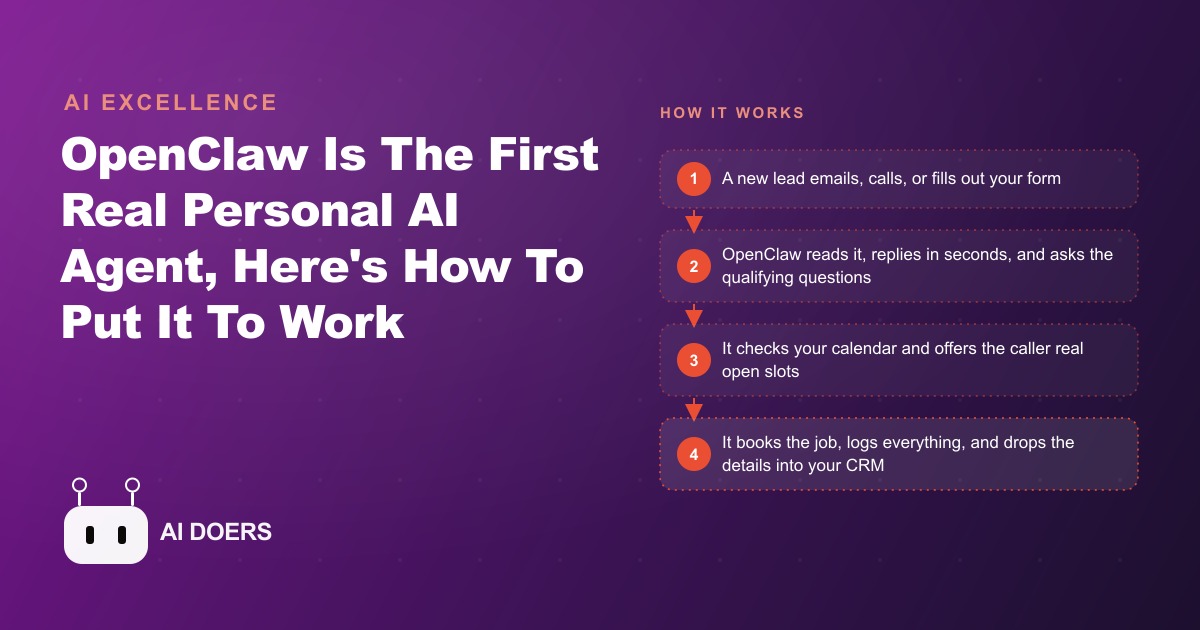
OpenClaw's competitive advantage is not that it reasons more cleverly than what came before. It is that it takes action instead of producing text, and it does so consistently at any hour without variation. A chatbot that generates a polished reply still leaves that reply sitting in a draft window until a human reviews and acts on it. An agent reads the incoming message, writes the reply, sends it, checks the calendar, offers the time slot, confirms the booking, and logs the outcome in the CRM, all without any human in the loop between the trigger and the completed task.
That is not a marginal difference. That is the entire operational gap between a tool that helps you do the task and a tool that does the task. Once a business has experienced the second kind on even one live workflow, returning to the first feels like hiring an assistant who types your emails and refuses to press send.
The action-versus-text distinction also reframes the relevant benchmark. The comparison that matters is not agent versus chatbot. It is agent versus a human part-time hire doing the same after-hours task. On cost, availability, and consistency, the agent wins clearly. It falls short only in situations requiring genuine human judgment, discretion, or emotional attunement, and for first-response lead qualification, those situations are the minority rather than the standard case.
Businesses that generate leads through SEO and organic search face the same after-hours contact dynamic. A contact form submission arriving at eleven on a Thursday evening that goes unanswered until Monday morning is functionally the same missed opportunity as an after-hours phone call that goes to voicemail. An agent monitoring inbound form submissions gives those leads the same thirty-second response as the phone lead gets, rather than the multi-day wait that standard form handling typically produces.
The businesses deploying now are setting a floor that is expensive to match later
There is a compounding effect to operational speed that most business owners underestimate when deciding whether to move now or wait for a more polished version of the technology.
When one local HVAC company starts responding to inbound leads in thirty seconds regardless of when the call arrives, callers in that market begin calibrating their expectations around that experience, not consciously and not immediately, but gradually through repeated contact. They remember the contractor who texted back at eight at night and offered a real, bookable appointment slot. The next time they need service, they compare that experience to the competitor who still sends voicemails after five.
Over a quarter or a full year, this compounding shows up in reviews, in repeat bookings, and in referrals from customers who mentioned the response speed to someone who then called the same business first. The company that first closed the after-hours response gap is not only capturing direct revenue from those contacts. It is building a service reputation that competitors will need real investment to match once they recognise the gap has opened.
None of this means the window is permanently closing this month. It means that waiting is not a cost-free decision. Every week spent evaluating is a week of after-hours leads landing in voicemail at exactly the same rate as before the evaluation started. The evaluation does not pause the leak.
Imperfect deployment this month beats a perfect plan that ships in six months
Here is the position I want to hold clearly: an agent running at eighty percent quality is generating real, measurable revenue for your business today. A perfect agent still sitting in the planning stage is generating nothing.
This sounds obvious stated plainly. The behaviour in practice is different. Most businesses spend weeks or months comparing tools, building internal alignment, and waiting for a clearer picture of which platform will prove dominant. During that entire evaluation period, the same after-hours leads continue going to voicemail at exactly the rate they were going before anyone started the discussion. Planning does not pause the leak.
The practical alternative is to deploy on the single task where the cost of an imperfect output is lowest and the cost of missing the task is highest. For a service business, that task is almost always first-response to a new inbound lead. If the agent phrases a qualifying question slightly awkwardly, the caller corrects it and the booking happens anyway. The failure mode is mild. The success mode is a booked job that would have been a voicemail that never received a callback.
Every one of those booked jobs lands in your CRM and web stack, where the contact details, conversation notes, and follow-up tasks sit automatically without manual data entry. The morning report is complete before anyone opens a laptop. Patterns in when leads arrive, what they ask, and how many convert to confirmed bookings start surfacing over weeks, and that operational intelligence has value well beyond the individual appointments it produces.
A five-truck plumbing business, four booked jobs, and one morning report that changed the math
To make this argument concrete rather than abstract, walk through one business in detail.
A five-truck plumbing operation in a suburban market spends a meaningful amount per month on advertising and generates a consistent volume of inbound calls. The office closes at five. Calls arriving after five go to voicemail. The owner knows this happens but has not tracked how many of those voicemails result in a next-morning callback versus how many go cold overnight, because no system captures that data in a visible way.
The agent is connected to the booking calendar and the CRM. When a call arrives after hours, it responds by text within thirty seconds: asks for the location and nature of the problem, checks the dispatch calendar for the next open slot, confirms the time with the caller, and logs the job with the caller's contact details and the problem description attached. The owner begins reviewing morning reports on day one.
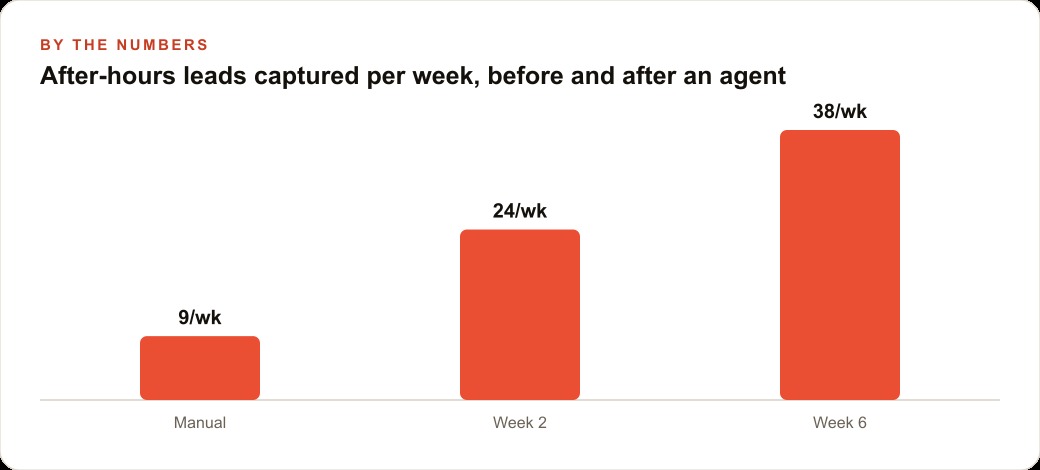
Week one: four booked jobs that arrived after five the previous evening. Before the agent, those four calls were four voicemails sitting in an inbox. At an average job value of four hundred dollars, that week's after-hours capture represents sixteen hundred dollars in revenue from contacts the ad budget had already paid to generate. The agent did not create new demand. It did not change the pricing or run new creative. It stopped a bucket from leaking that had been running quietly for years without a clear count of what was draining out of it.
By month three, the owner is tracking a consistent lift of three to six after-hours bookings per week above the previous baseline. At the conservative end of that range and at the same average job value, the agent is returning somewhere between five and ten thousand dollars per month from contacts that were previously lost to timing. The monthly subscription cost is a single-digit percentage of that return.
The same loop works for an electrician, a roofer, an HVAC operator, a dental office, or any business where inbound contact volume is meaningful and the response window after hours was previously limited by who happened to be available.
The case made plainly
Service businesses lose a real share of inbound leads to response timing. Hiring to close that gap is expensive relative to the actual task. Personal AI agents handle the task at a fraction of the cost, are available across all hours without staffing decisions, and produce consistent results from the first week of deployment. The businesses moving now are building a response-speed advantage over competitors still in evaluation mode. And imperfect deployment on the right task returns real revenue while a more polished plan is still being assembled.
The tool is OpenClaw. The task to start with is first-response to a new inbound lead. The evaluation window is thirty days of morning reports showing booked jobs that used to be voicemails. If the numbers do not justify the subscription at that point, cancel it. In most service businesses I have worked through this exercise with, the numbers close the case comfortably before the thirty days are up. The only question that tends to remain is why the evaluation took as long as it did.
That is exactly what we do at AI DOERS. Book a private 30-minute call with Madhuranjan Kumar and we will map the fastest path to it for your specific business.
Book your call →
Madhuranjan Kumar
Madhuranjan Kumar brings 20 years of performance-marketing experience and has managed over $200 million in Facebook ad spend for brands across the United States and beyond. His expertise spans the full modern marketing stack: Meta, Google Ads, TikTok, email automation, CRM, and the websites that hold it together. At AI DOERS he turns that track record into lead-generation systems for businesses across every industry.