
OpenClaw in Practice: How One Local AI Assistant Runs an Entire Business
By describing each workflow in plain English, a single open-source assistant running on your own machine can replace a CRM, a research tool, and a team of analysts, then improve its own prompts from your corrections.

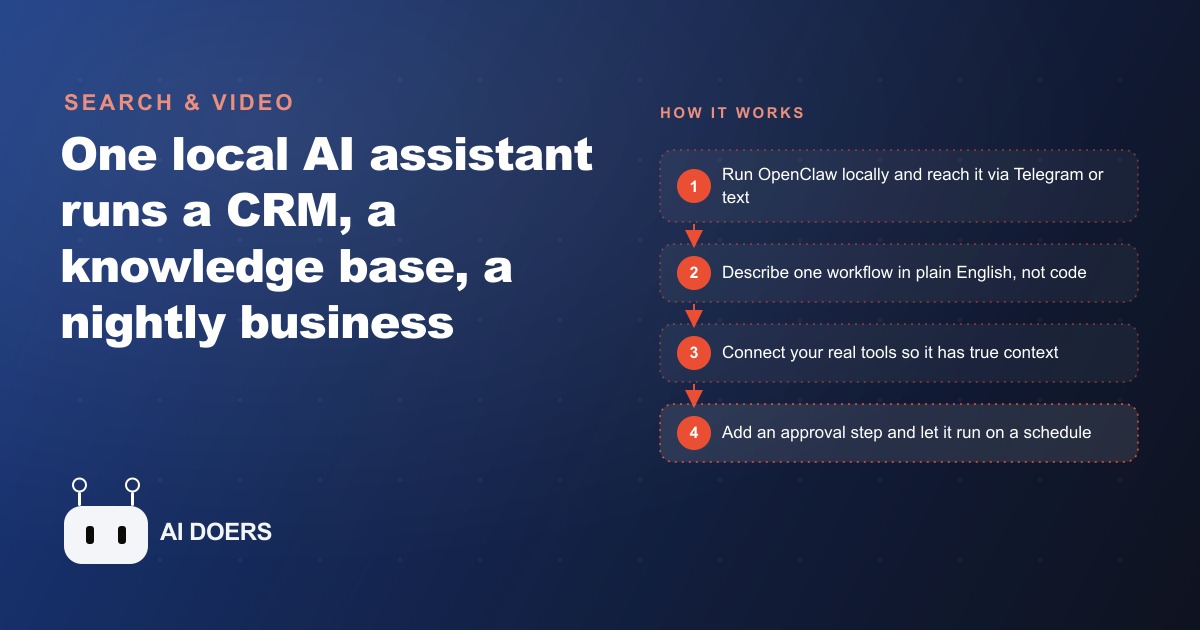
The AI model you choose matters far less than the market wants you to believe. The gap between any two frontier models at any given moment is noise compared to the gap between an AI that knows your context and one that does not.
I am Madhuranjan Kumar, and this is the argument that the AI industry does not foreground, because the industry profits from selling you the newest model, the premium subscription tier, and the next capability upgrade. The conversation about model selection is, to a significant degree, a distraction from the decision that actually moves the needle: how much of your real operational context does the system carry between sessions?
OpenClaw is an open-source framework that treats the personal data layer as the primary asset, not the model underneath. You run it locally on your own machine, reach it through a messaging interface you already use, and every session it runs on builds on the accumulated context of every session before it. That is the differentiator. Not the intelligence of the model. The persistence of the memory.
The model is a commodity, the context layer is not
Every major model that ships in a given quarter gets benchmarked, ranked, and breathlessly compared on standardized tests. The rankings shift constantly. The model that topped one benchmark slips to second on the next release. Developers argue about which model is smarter at coding, better at reasoning, or more creative at writing. These conversations are genuinely interesting if you are building foundation models. If you are a business owner using AI to run your operations, they are mostly beside the point.
What you actually need from a model is good enough reasoning, reliable instruction following, and the ability to work with the context you give it. Every current frontier model passes those bars. The marginal quality difference between them, at the level of business tasks rather than research benchmarks, is small enough that it does not determine outcomes. What determines outcomes is whether the system you are working with knows who you are, what your business does, who your clients are, what your voice sounds like, what your procedures are, and what happened last week.
That knowledge is the context layer. It is not stored in any model. It is stored in the data layer you build on top of whatever model you are using. The person who has invested seriously in building a rich, accurate, current context layer will consistently outperform someone with a marginally better model and no context layer. The compounding is entirely in the context, not in the model.
This is also why switching models is far cheaper than people assume, and why locking into one model's proprietary ecosystem is an unnecessary risk. If you have built your context layer in files and databases you own, you point the next model at the same data and continue. Your investment in context does not depreciate when a new model releases. Your investment in a proprietary tool's memory feature might depreciate to zero.
Running on your own machine is not about privacy, it is about persistence
The standard argument for local AI is privacy. Your data stays on your machine. Nobody else processes your sensitive business information. These are real benefits in regulated industries where data residency is a legal requirement. But privacy is not the primary argument for local execution, and leading with it undersells what is actually happening.
The primary argument for local execution is persistence. A system running on hardware you own accumulates context across every session without expiration. Cloud AI tools typically have session contexts that reset, memory features that are limited in how much they retain and for how long, and subscription terms that, if you stop paying, delete the accumulated context of months of work. Local execution changes the economics of persistence. What you build into the system stays in the system until you explicitly remove it.
Persistence compounds in a way that resets do not. A local assistant that has learned your communication style, your recurring clients, your project patterns, and your scheduling preferences over six months of daily use is qualitatively different from an assistant that starts each session with only what you provided in that session's prompt. The six months of learning is stored in the databases and context files on your machine. It travels with the hardware. It survives model updates. It belongs to you.
There is also a response latency argument for local execution that matters in practice. A locally running model responds without the network round trip to a cloud API. For short tasks the difference is negligible. For workflows that run many sequential queries, the latency difference accumulates, and the unpredictability of cloud API response times under load is eliminated. Local execution is consistently fast in a way that cloud execution is not during peak demand windows.
Self-improving prompts are the compounding return that SaaS tools cannot offer
SaaS AI tools are designed for a market, not for you specifically. The prompts they use internally, the workflows they have built, and the behavior patterns they embody are optimized for a general user. They are not optimized for your voice, your clients, your industry, your specific recurring tasks, or your specific definition of a good output.
OpenClaw and similar local frameworks treat prompts as assets that belong to you and improve over time based on your corrections. When you reject an action item because it was extracted incorrectly from a meeting, the system learns that pattern and adjusts its extraction behavior. When you tell the system that a particular email summary was too long, the summary skill updates its behavior. When you consistently approve a specific style of output, the system reinforces that pattern in future runs.
This self-improvement mechanism is not meaningfully available in SaaS tools. A SaaS tool might add a general preference setting or remember that you prefer bullet points over paragraphs. It does not adjust its fundamental workflow logic based on your specific operational feedback. The gap between a prompt that has been corrected 50 times by you specifically and a general prompt written for the average user is enormous when you are dealing with tasks that require genuine business judgment.
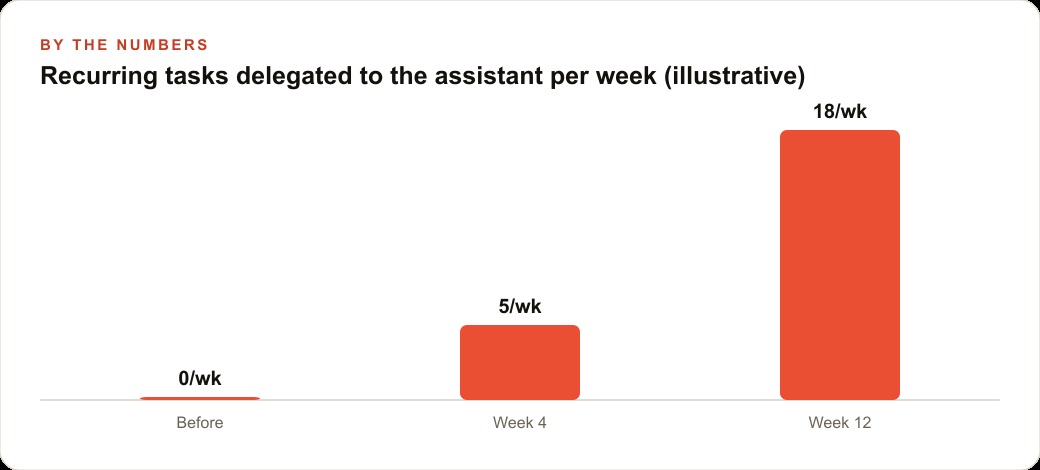
The compound return here is the important concept. Day one, the local system is probably comparable to a good SaaS alternative. Week four, after 50 corrections and adjustments, it is noticeably better. Month six, it is operating in a way so tuned to your specific work that it would be extremely difficult to replicate by switching to any generic tool, regardless of the underlying model quality. The time investment in corrections is not overhead. It is equity in a system that becomes more valuable the longer you work with it.
The businesses that will win are those that train their own AI on their own data today
The long-term competitive dynamics here are straightforward and underappreciated. A business that has spent two years building a local AI context layer, correcting its behaviors, accumulating operational knowledge, and integrating it deeply into daily workflows has a business intelligence asset that took two years to build. A competitor starting today needs two years to reach the same point, even using the same tools.
This is what creates the durable moat. Not the model. Not the interface. Not any specific feature of the framework. The accumulated, corrected, business-specific context layer that lives on your infrastructure and takes time to build is the asset. The longer you wait to start, the longer your competitor's head start grows.
The window where this is particularly high leverage is now, not because the tools will disappear but because the cost of building the context layer is primarily time rather than money. A small business that starts building its local AI system today and invests an hour per week refining it will have a meaningfully richer context layer in one year than a business that waited. The cost is not high. The cost of not starting is growing every month.
The businesses that will find this most defensible are those with proprietary operational knowledge that can be encoded: specific client handling procedures, specialized document formats, unique pricing logic, unusual customer relationship patterns. The more specific and proprietary your operational knowledge, the more valuable the local AI system trained on that knowledge becomes, and the less any competitor can replicate it by licensing the same generic tool.
One solo agency owner, three SaaS subscriptions, and one local setup: what the numbers look like
Consider a solo agency owner running a performance marketing consultancy with eight active clients. Their current stack includes a project management tool for tracking client work, a contact management subscription for keeping client communication history organized, and a research tool for competitor analysis and content ideas. Each carries a monthly cost, each requires manual input to stay current, and none of them communicate with each other.
After replacing these three tools with a single local AI setup, the changes look like this. The project management function is replaced by a local knowledge base where client work status is stored in plain files the AI can read and update. The contact management function is replaced by a local record the AI maintains automatically by reading email and calendar data. The research function is replaced by an AI that can search and summarize on demand without a separate subscription.
The monthly subscription cost eliminated is, illustratively, between 120 and 180 dollars per month depending on the specific tools and tier levels in use. The time saving is more significant: the manual work of keeping three separate tools updated, reconciling information between them, and navigating between them during a client call collapses into a single system that maintains itself and answers in plain language.
The tradeoff is a setup investment. Configuring the local framework, loading the initial context, connecting the email and calendar integrations, and running enough correction cycles to make the system reliable takes several focused hours upfront and ongoing attention in the first month. After that, the maintenance cost is minimal, and every month the system is better tuned to the specific clients, projects, and communication patterns of that particular business.
These figures are illustrative rather than guaranteed. The exact subscription savings depend on which tools are replaced and what tier levels are in use. The time savings depend on how much manual effort the current tools require to stay useful. The pattern that holds consistently: a well-configured local system, after the initial investment, performs better than generic SaaS alternatives for the specific business context it was built around, at a lower ongoing cost.
The argument is not that local AI is always cheaper or always better for everyone. The argument is that the model underneath matters far less than the context layer you build on top of it, and local execution is currently the most reliable way to build a context layer that compounds, persists, and improves over time without depending on any vendor's decision about what to remember and what to discard. That is a structural advantage that no model upgrade announcement can erase.## How to start building your own context layer today
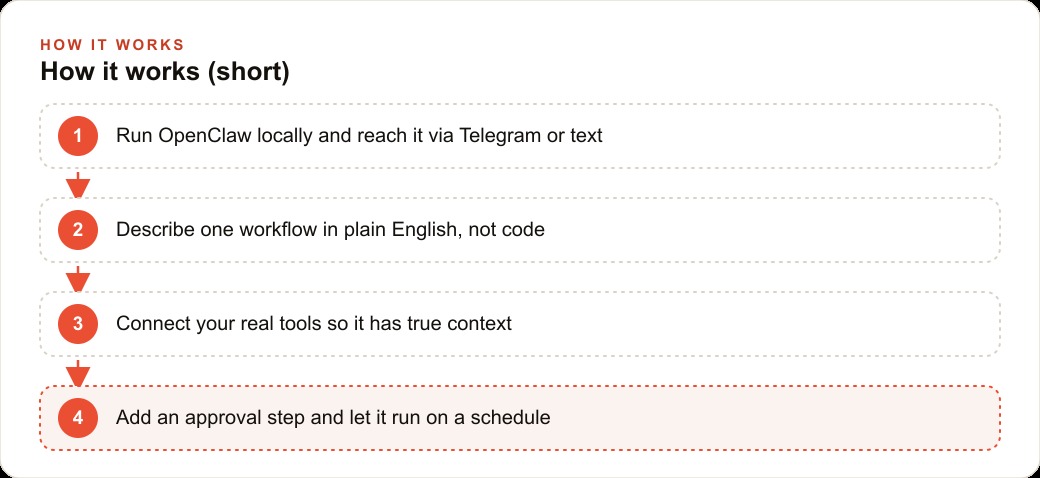
The practical starting point is simpler than most people make it. Pick one recurring task that currently takes you 30 to 60 minutes per week. Write a clear description of exactly what that task involves: what information it needs, what the output should look like, and what a bad output looks like. Load that description as context in a local session. Run the task against real inputs from your actual work. Correct the output until it reaches a quality you would approve without rewriting. Save those corrections so the next run starts from the improved version.
That first iteration, one task, run with your real data, corrected until reliable, is the beginning of a context layer. Not the full architecture, not the complete system, just the first piece of something that belongs to you and improves every time you use it. Every week you add one more corrected pass to that task, the gap widens between what your AI knows about your work and what any generic tool could know about you on the first session.
The businesses that start this process now will look back in 18 months and find it difficult to explain why the model choice ever seemed like the important variable. The context layer, built over time with real corrections on real work, will be so far ahead of a generic setup that the model underneath becomes an interchangeable detail. That is the entire argument in one sentence: the gap that compounds is not between models, it is between systems that know you and systems that do not.
That is exactly what we do at AI DOERS. Book a private 30-minute call with Madhuranjan Kumar and we will map the fastest path to it for your specific business.
Book your call →
Madhuranjan Kumar
Madhuranjan Kumar brings 20 years of performance-marketing experience and has managed over $200 million in Facebook ad spend for brands across the United States and beyond. His expertise spans the full modern marketing stack: Meta, Google Ads, TikTok, email automation, CRM, and the websites that hold it together. At AI DOERS he turns that track record into lead-generation systems for businesses across every industry.