
OpenAI's Three-Announcement Move and the Pricing Playbook Any Business Can Borrow
OpenAI dropped revenue numbers, a cheap plan, and ads in a single week, and the sequence was deliberate. The loss-leader, lock-in, and bundling lessons behind it work for businesses of any size.

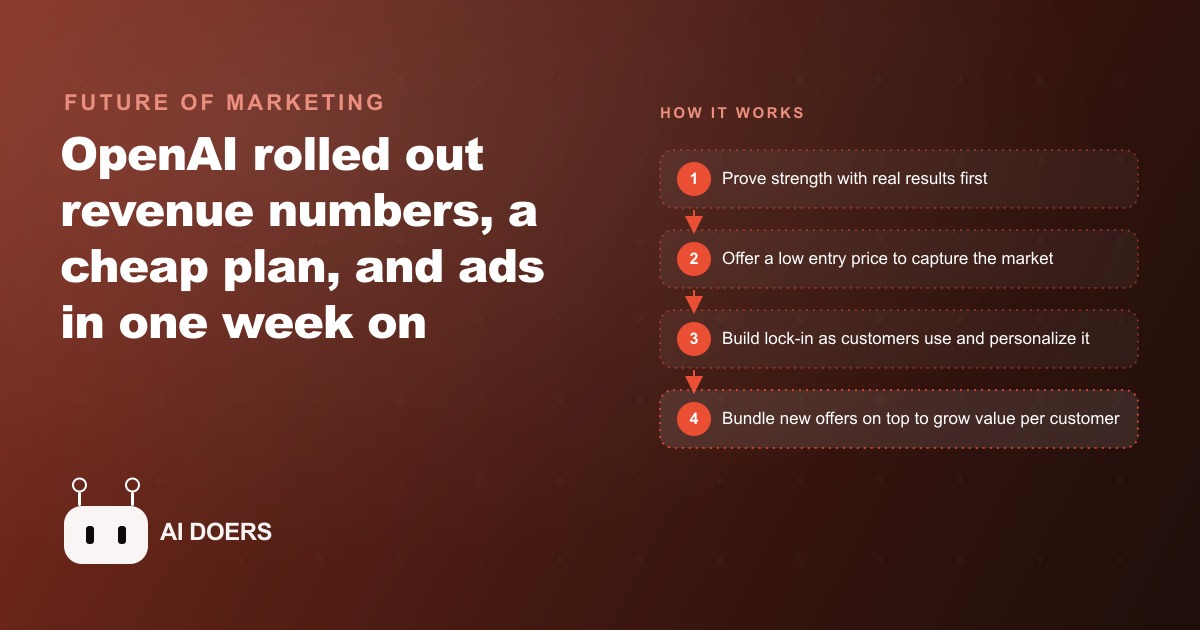
OpenAI made three announcements in a single week, and every serious competitor in the space watched the sequence carefully, because the three moves together form something more interesting than any one of them alone. I am Madhuranjan Kumar, and I want to argue that the playbook behind that week is worth studying by any business owner, not because it involves AI specifically, but because it is one of the cleaner examples of sequenced positioning I have seen executed at scale.
Here is what happened and why the order mattered.
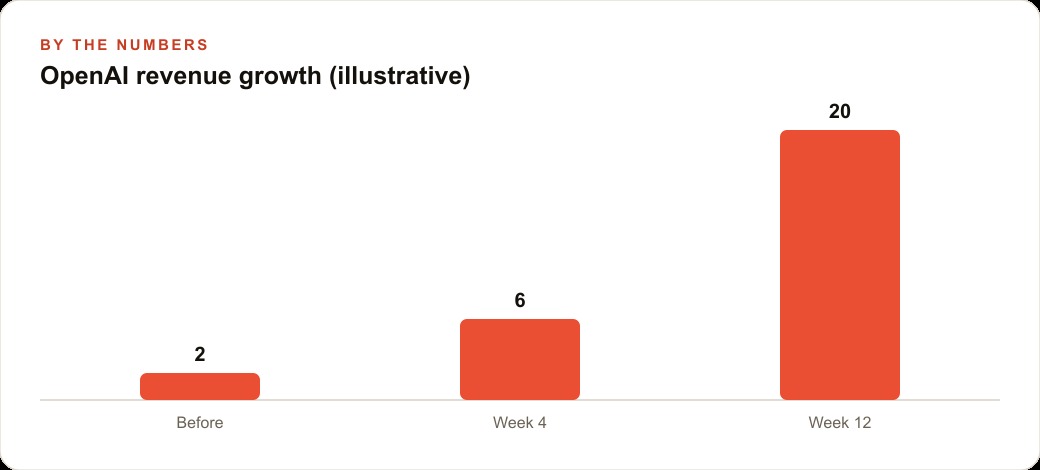
First, the company shared revenue data showing growth from roughly two billion to six billion to over twenty billion in annual recurring revenue as its compute capacity scaled. Second, it launched an eight-dollar-per-month plan, called Go, that made the product accessible to markets that could not pay twenty dollars. Third, it confirmed that advertising is coming to the free and low-cost tiers.
None of that was accidental timing. The three moves form a single thesis, and the sequencing is the lesson.
The announcement order is as important as the announcements themselves
Ads on a product that just proved it is printing billions in revenue land differently than ads on a product that is burning cash. In the first frame, ads are smart monetization layered on top of strength. In the second frame, they are a signal that the subscription revenue is not enough.
OpenAI revealed the revenue data first, which meant by the time the ads announcement landed, analysts were reading it against a backdrop of spectacular growth. The ads were not a rescue plan. They were optional upside on top of a business already working. The sequence changed the interpretation entirely.
This is the most transferable lesson in the whole episode. The order in which you say things determines how they are received. A price increase announced right after sharing strong client results reads differently than the same price increase announced after a period of silence. A new service offering introduced after demonstrating results in an adjacent area reads differently than the same offering introduced cold. Proof first, then the ask, is the rule. Most businesses do the opposite.
The cheap plan is a loss leader, and loss leaders compound over time
The eight-dollar Go plan almost certainly loses money on many of its users. Running inference at scale is expensive, and the economics of a low-price tier require that enough users eventually upgrade to offset the loss on those who never do. The company knows this. It is the explicit logic behind the move.
A loss leader works because the relationship is worth more than the margin on the entry transaction. You accept a loss on the first interaction to acquire a customer whose lifetime value exceeds what you spent. The key word is eventually, and that eventually only works if the product creates real dependency before the customer decides whether to upgrade or leave.
For OpenAI, the dependency mechanism is personalization. The more someone uses the AI, the more it learns about them, the more tailored the experience becomes, and the higher the switching cost grows. A user who has two months of conversation history, saved projects, and a model that has learned their preferences faces a real cost if they leave, even if they never consciously notice it. That is the investment in the relationship that the loss-leader entry price is funding.
This is a pattern any service business can implement without giving away a product at a loss. A free initial consultation, a deeply discounted first engagement, or a fixed-price discovery phase all serve the same function: they lower the barrier to starting a relationship that becomes more valuable over time. The math works if you are disciplined about what happens after the entry transaction.
Lock-in compounds when the product gets more useful with use
The compounding value of the lock-in is what makes the loss-leader math eventually work, and it is worth understanding as a separate mechanism. Lock-in in most products is passive: switching is inconvenient because data lives somewhere and moving it is annoying. Lock-in in a product that genuinely improves with use is active: switching means losing real value you accumulated, not just dealing with a migration headache.
For a business, the equivalent is building a service relationship where accumulated context is a real asset. A law firm that has advised a client for five years holds institutional knowledge about that client's situation, preferences, and history that a new firm starts without. An accountant who has handled the books for three years knows the quirks and the context that make the work faster and more accurate. A marketing partner that has run campaigns for a client has the baseline data and creative knowledge that make the next campaign better than the first.
This kind of accumulated context lock-in is the honest version, built on real value rather than artificial switching costs. It is also more durable, because the client understands exactly what they would lose by leaving and chooses to stay rather than staying because moving is annoying.
For a business managing clients through a CRM and website stack, the built-in accumulation of lead history, past campaign performance, and client interaction data is exactly this kind of lock-in asset. The longer a client relationship runs through a well-maintained CRM, the more visible the value of staying becomes and the more concrete the cost of switching is.
Bundling is the endgame, and it is more aggressive than it looks
Once a customer is inside the relationship and the lock-in is building, bundling is how the lifetime value expands. Bundling means offering new products or services to existing customers at a price that is easy to accept, because the trust and relationship already exist and the marginal cost of adding another engagement is lower for both sides.
The canonical tech example of bundling winning over a better standalone product is a business communication platform that was weaker than its main competitor on almost every feature dimension and still won the market by being bundled with software that enterprise customers already paid for. The quality comparison became less relevant when the bundle was effectively free.
For most businesses, bundling looks like: a client who came in for one service being offered a related service at a price that reflects the existing relationship rather than the full acquisition cost of a new client. A client who came in to run Facebook and Instagram ads being offered a Google Ads management add-on at a rate that rewards the loyalty. A client running SEO content being offered a reporting and analytics layer on top. The marginal cost of saying yes to a bundled offer from a trusted provider is low. That is the moment bundles convert.
The throughline for a business of any size
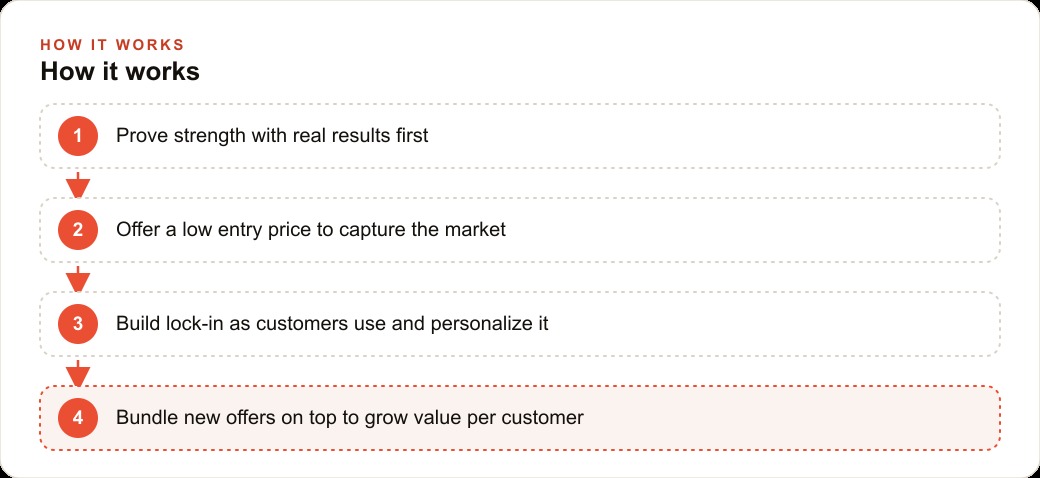
The three moves together form a throughline that applies regardless of the industry or the scale. Prove strength first, with real data or real results. Use a loss-leader entry to capture the market that would not start at your full price. Build genuine lock-in through accumulated value rather than artificial friction. Bundle new offers to the customers who are already inside the relationship and already trust you. Sequence every announcement so proof comes before the ask.
None of these require being a technology company or having a billion-dollar revenue base. A local law firm, a medical practice, a skilled trades business, and a marketing agency can all use the same mechanics. The entry offer lowers the barrier. The accumulated context makes switching costly. The bundle expands the value of each existing client. The sequencing of every announcement determines how it lands.
The one honest caveat is that a loss leader without a path to value is just a discount. If the entry engagement does not create a relationship worth staying in, the loss never gets recovered. Design the entry point so the outcome of the first engagement is something the client wants to continue. Everything after that follows the pattern.
That is exactly what we do at AI DOERS. Book a private 30-minute call with Madhuranjan Kumar and we will map the fastest path to it for your specific business.
Book your call →
Madhuranjan Kumar
Madhuranjan Kumar brings 20 years of performance-marketing experience and has managed over $200 million in Facebook ad spend for brands across the United States and beyond. His expertise spans the full modern marketing stack: Meta, Google Ads, TikTok, email automation, CRM, and the websites that hold it together. At AI DOERS he turns that track record into lead-generation systems for businesses across every industry.