
What the Wild OpenAI Deposition Teaches About Documentation, Verification, and Decisions
A newly released deposition about a famous boardroom fight reads like a thriller, but underneath the drama are plain lessons every owner needs. Here is what I take from it and how I would apply it.

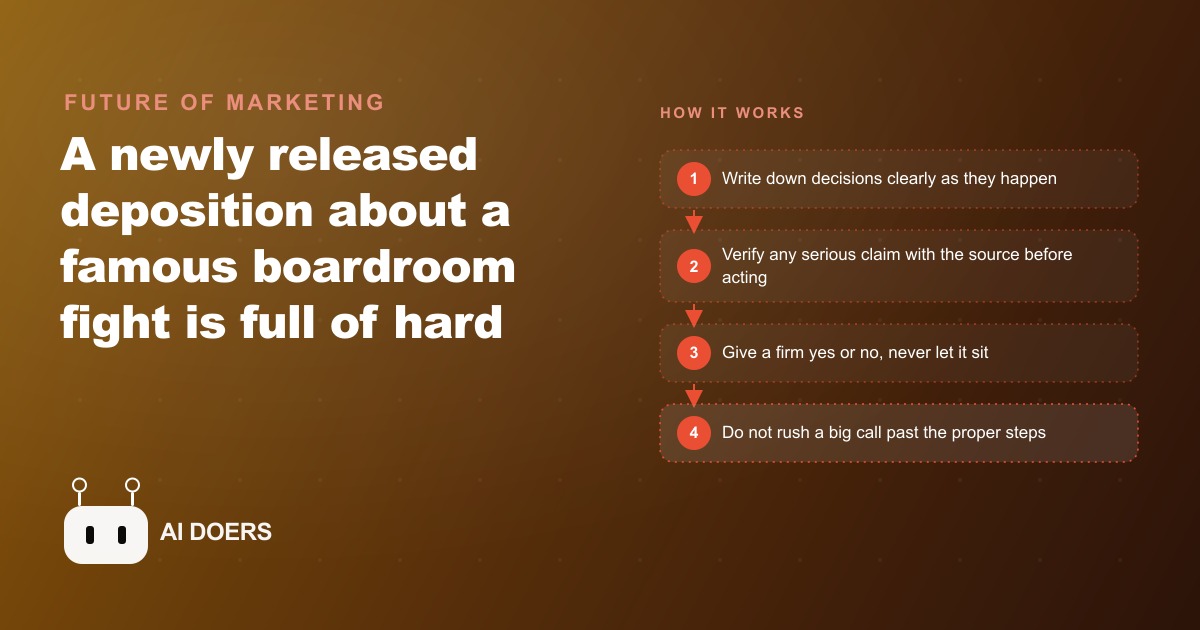
A famous boardroom fight reads like a thriller, but the most useful thing in the whole story is the least dramatic. Buried inside a newly released 62-page deposition about the months leading up to a high-profile CEO firing are three plain operating habits that decide whether any company, right down to a two-person shop, runs smoothly or tears itself apart. I am Madhuranjan Kumar, and I want to ignore the celebrity drama entirely and take those three habits apart, because they are the actual lesson and almost nobody is pulling them out of the noise.
Strip the famous names off the transcript and what remains is a case study in documentation, verification, and decision-making. Every escalation in the story traces back to one of those three breaking down. That is oddly reassuring, because it means the failure was not some exotic billion-dollar problem. It was the same set of ordinary mistakes that wreck small businesses every week, just played out on a bigger stage with better lawyers.
Whoever keeps the clearest record controls the story
The entire conflict was built on documentation. A long internal memo was prepared to make the case against the chief executive, and a trail of screenshots was collected over time as evidence. The instinctive reading is cynical, that documentation is ammunition you gather to win a fight. I would push against that. The real lesson is quieter and more useful: whoever keeps the clearest record tends to shape what everyone believes actually happened. Records cut both ways, and they matter most precisely when memories get fuzzy and two people remember the same meeting differently.
For a normal business this is not about building a case against anyone. It is about the ordinary friction of who agreed to what. A written summary of a decision, dated, specific, and shared, is not bureaucracy. It is the thing that stops a small disagreement from becoming a standoff three weeks later. The deposition is an extreme illustration of a mundane truth. The person or the company with the clean paper trail spends far less time arguing about the past, because there is a record to point at instead of two competing memories.
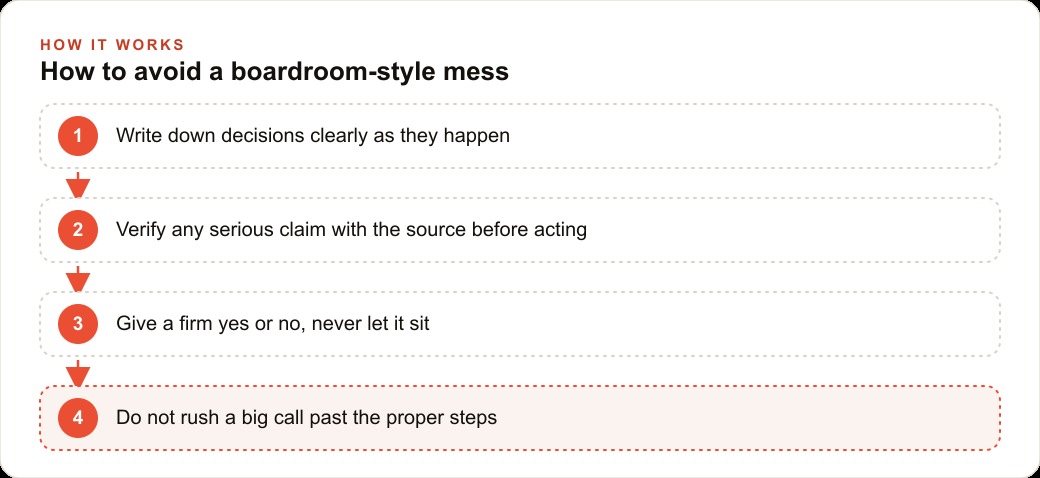
Acting on a single unverified source turns a dispute into a crisis
The second habit is verification, and its absence did the most damage. Several of the most serious claims that fueled the whole conflict came from a single source and were never checked with the people they were actually about. Asked directly whether he had confirmed a damaging claim with the person involved, the witness repeatedly said no, that it had not occurred to him, that he simply believed what he was told. That is the entire mechanism of how a rumor becomes a catastrophe. Someone hears one version, treats it as fact, and acts, and by the time anyone checks, the damage is done.
I find this the most transferable lesson of the three, because it is so cheap to fix. One phone call to confirm a claim before acting on it prevents an enormous amount of expensive harm. A partner hears that a vendor cheated them and, instead of confronting the vendor, quietly cuts the relationship. An owner hears secondhand that an employee said something and reacts to a version that was never true. The discipline is almost insultingly simple, verify a serious claim with the source before you move on it, and yet under pressure it is the first thing people skip. The pressure is exactly when it matters most.
Silence is usually worse than a firm no
The third habit is decisiveness, and here the failure was pure inaction. One of the clearest faults described was a leader who would not firmly accept or reject a demand from a senior person and instead let it sit, unresolved, festering. As the witness framed it, the failure was not making the wrong call. It was not making a call at all. A clear no would have been better than silence, because an unanswered demand does not go away, it curdles.
This runs against a very human instinct. When a decision is hard and either answer will upset someone, avoidance feels safe. It is not. Indecision transfers the discomfort into the future and multiplies it, while everyone involved fills the silence with their own worst assumptions. On top of all three failures, the process itself was rushed by an inexperienced group that skipped the steps needed to make the move durable, which is why it reversed within about a week and left the people who pushed it weaker than before. Fast plus undocumented plus unverified is a recipe for a decision that does not survive contact with reality.
A worked example: a moving company builds the habits in
Let me make this practical for a business that lives and dies on disputed details, a moving company, with illustrative numbers. Moving is almost designed to generate arguments after the fact, over what was quoted, what was fragile, what got damaged, so it is the perfect place to install these three habits.
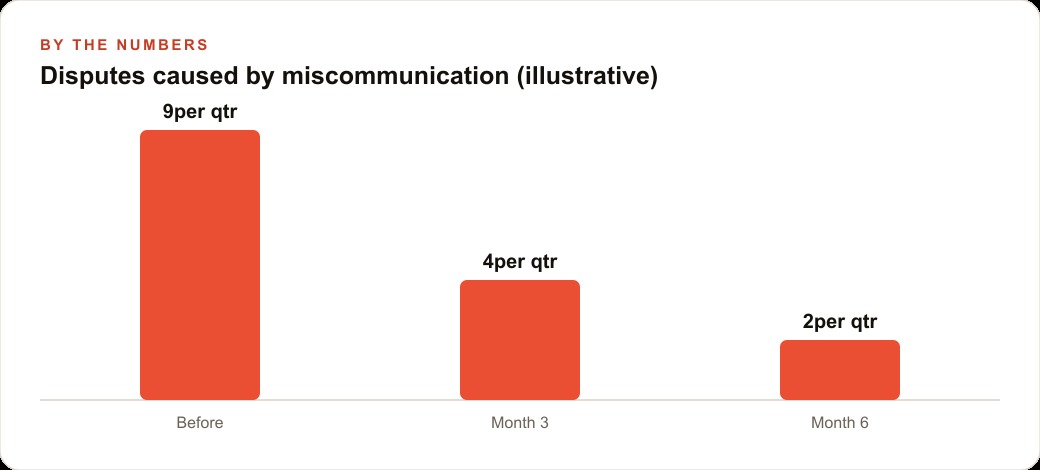
Start with documentation. Every job gets a clear written record of what was quoted, what the customer agreed to, which items were flagged as fragile or excluded, and any change made on the day. The trick is to make it effortless, because a tired crew will not fill out a form after a ten-hour shift. An AI assistant can take the crew's rough notes or a voice memo from the site and turn them into a clean, dated job record automatically, so the paper trail exists without a fight. Say this cuts post-move disputes from six a month to two. That is four avoided arguments, each of which might have cost a refund or a bad review, and those records live right alongside the customer history in the CRM and website stack so anyone can pull the truth in seconds.
Then verification. When a customer claims an item arrived damaged, or a crew member reports a problem, the rule is to check the record and confirm with the people involved before reacting, not to act on the first version that reaches the owner. The deposition is a cautionary tale about exactly this failure, trusting one source without confirming, and one calm check often defuses a complaint that would otherwise have escalated. Finally, decisiveness. When a dispute or a scheduling clash lands, the owner gives a firm answer quickly rather than letting it linger, and AI helps here too by summarizing the relevant job notes in seconds so the decision rests on facts, not memory. None of this is about building a legal case against your own customers. It is about keeping everyone aligned on what was agreed so small disagreements stay small, and that same clarity carries over to how the business tracks results across Facebook and Instagram ad campaigns, where knowing what was actually promised and what actually converted is the difference between real reporting and guesswork.
The rushed process is the fourth failure hiding behind the three
There is a fourth thread in the deposition that deserves its own attention, because it is the one that turned three bad habits into a public disaster. The decision was rushed. An inexperienced group moved fast and skipped the steps that would have made the move durable, and the whole thing reversed within about a week, leaving the people who pushed it weaker than before. Speed is usually sold as a virtue, and in most operational work it is. But a big, irreversible decision is exactly where speed becomes dangerous, because the steps you skip to move fast are the steps that make a decision stick.
For a normal business this shows up constantly. An owner fires a key employee in a moment of anger without documenting the reasons or checking the facts, and has to walk it back. A partnership makes a major commitment in a single heated meeting and spends months untangling it. The lesson is not that fast is bad. It is that the size and reversibility of a decision should set its pace. Small, reversible calls should be made quickly, which is the decisiveness lesson. Large, hard-to-undo calls deserve the full process, the documentation, the verification, the deliberate step-by-step, precisely because getting them wrong is so expensive. Confusing the two, rushing the big ones and dithering on the small ones, is the exact pattern the deposition captures.
The three habits reinforce each other, or they fail together
What strikes me most, reading the whole thing, is that documentation, verification, and decisiveness are not three separate fixes. They are a system, and they hold each other up. Good documentation makes verification easy, because there is a record to check a claim against. Verification makes decisiveness safe, because you can commit firmly to a call when you know it rests on confirmed facts rather than a rumor. And decisiveness only produces durable outcomes when the decision is documented, so everyone remembers what was actually decided and why. Pull one leg out and the other two wobble.
That is why I never tell an owner to fix just one of them. A business with immaculate records that never verifies claims still acts on rumors, just with better paperwork. A business that verifies everything but never decides still stalls, just with well-checked indecision. The three have to move together, and the good news is that installing one makes the next two easier. Start with documentation, because it is the foundation the other two stand on, and the habit of writing decisions down tends to naturally pull verification and clear answers along behind it. A person who has just written a clean record of a decision is far more likely to have checked the facts first and to state the decision plainly, because the act of writing it exposes the gaps.
There is also a cultural payoff that is hard to quantify but real. A team that documents, verifies, and decides cleanly argues less, trusts more, and moves faster over time, because the friction of relitigating the past keeps shrinking. The deposition is the photographic negative of that culture, a group where records were weaponized, claims went unchecked, and decisions were dodged, and the result was exactly the chaos you would predict. You are not just avoiding a lawsuit by building these habits. You are building the kind of calm operation that good people want to stay inside.
Records are for alignment, not ammunition
I want to correct the instinct the deposition can accidentally teach, because it is important. Reading a story where a memo and a pile of screenshots were assembled to push someone out, it is easy to conclude that documentation is a weapon you stockpile against the people around you. That is the wrong lesson, and a corrosive one to build a company on. The value of good records in a normal business is almost the opposite. It is alignment. A clear, dated summary of what was decided keeps everyone on the same page long after the meeting, so nobody has to relitigate the past from memory. It protects the honest person as much as it exposes the dishonest one, because when a dispute arises the record simply tells the truth. If you approach documentation as an act of clarity rather than an act of war, your team feels safer, not more surveilled, because the point is shared understanding rather than a case file on each other. The tone matters enormously here. Records written to inflame will inflame. Records written to align will align. Same habit, opposite culture, and the difference is entirely in why you keep them and how you phrase them.
Where the judgment actually lives
The tools are the easy part. The judgment is deciding what must be documented, how to phrase a record so it clarifies rather than inflames, and where a human absolutely has to make the call rather than an assistant. That discipline is what separates a calm operation from a chaotic one, and it is the first thing to slide when the week gets busy. The deposition is worth reading precisely because it shows what the absence of these habits looks like at maximum volume.
You can build all of this yourself. Pick one workflow, make a clean written summary the standard for every job, add the verify-before-acting rule and the answer-quickly rule, and use an assistant to keep the documentation alive through a busy week. Or, if you would rather have these guardrails wired into a simple system and handed over already working, with the AI pieces set up and the habits baked into the routine, that is the kind of setup I do for clients. Either path beats learning the lesson the way the people in that transcript did.
That is exactly what we do at AI DOERS. Book a private 30-minute call with Madhuranjan Kumar and we will map the fastest path to it for your specific business.
Book your call →
Madhuranjan Kumar
Madhuranjan Kumar brings 20 years of performance-marketing experience and has managed over $200 million in Facebook ad spend for brands across the United States and beyond. His expertise spans the full modern marketing stack: Meta, Google Ads, TikTok, email automation, CRM, and the websites that hold it together. At AI DOERS he turns that track record into lead-generation systems for businesses across every industry.