
OpenAI's Code Red, Explained for Owners Who Just Want Tools That Work
OpenAI declared an internal emergency and pulled focus back to ChatGPT because Google, Anthropic, and a wave of new labs caught up. Here is what that means for a real business and how I would use the fallout to your advantage.

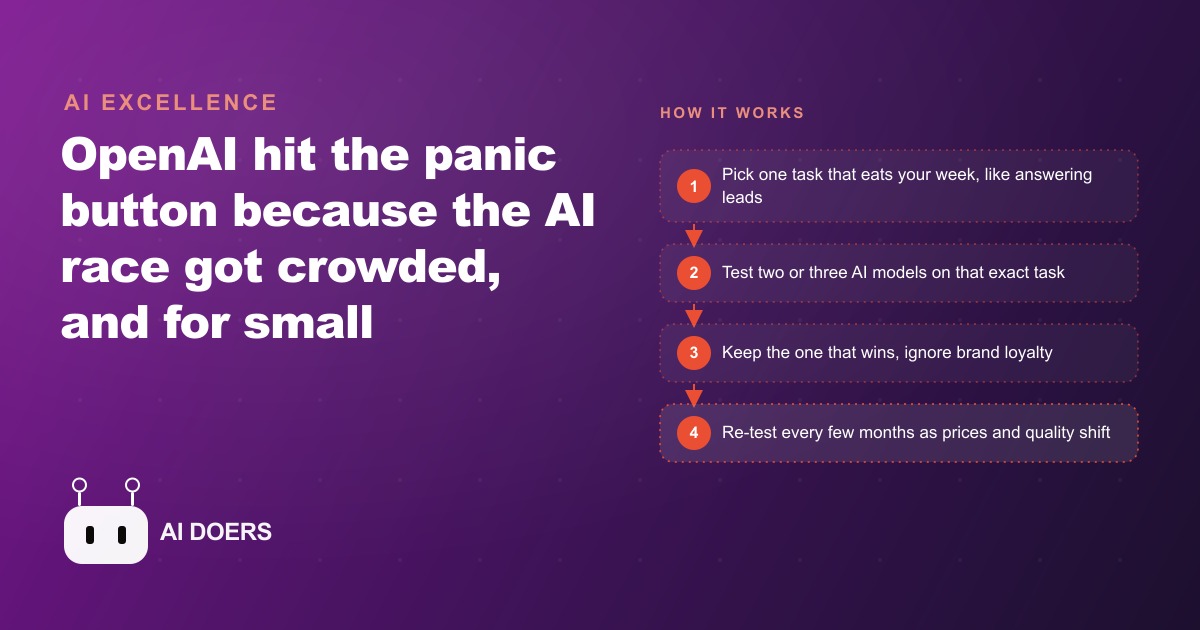
OpenAI called a code red. Inside the company that phrase means exactly what it sounds like: drop everything, focus on the core product, and stop losing ground to competitors that caught up faster than expected.
I am Madhuranjan Kumar, and I want to walk you through what actually happened, why it happened now, and eight specific moves you can make to use this moment to your advantage. The AI race getting more competitive is the best thing that has happened for business owners who rely on these tools, and most people have not figured out how to extract the benefit yet.
1. What a code red actually means inside OpenAI
A code red is OpenAI's highest internal urgency designation. When leadership triggers it, the signal to staff is that normal roadmap priorities are suspended and the company's resources redirect to a single critical problem. Side projects get paused. Experimental features stop receiving engineering time. People working on future products are moved to fixing or improving what already exists.
The code red was triggered specifically around ChatGPT. OpenAI's internal memo announced that the browser project, the standalone agent features in development, an ad product under construction, and several other strategic bets were being paused indefinitely. Every available engineering and research hour was redirected to the core ChatGPT product: speed, reliability, broader capability, improved image generation, and a lower rate of unnecessary refusals on legitimate requests.
In management terms, this is a defensive posture. You only trigger triage mode when you believe the current competitive situation is more dangerous than the opportunity cost of pausing all the experiments. OpenAI activated its highest urgency response because it concluded that losing ground on the core product was more dangerous than missing the adjacent bets.
2. What specifically triggered the code red at this moment
The competitive landscape shifted faster than OpenAI expected across two consecutive quarters. The trigger was not a single competitor but a cluster of simultaneous developments.
Google, which invented the core transformer architecture that all of these models build on, released Gemini 3 and pushed to the top of nearly every multi-step reasoning benchmark. Google's structural advantages are formidable: it owns its own chips through TPU development, it operates one of the largest cloud infrastructures in the world, and it funds AI research through a search advertising business that generates enormous cash flow. OpenAI has none of those built-in advantages and reportedly burns through significant capital each month. Google catching up on the model benchmarks while also holding the infrastructure advantage shifts the competitive picture sharply.
Anthropic, meanwhile, built a loyal and growing base among serious developers and business users. Many professionals in coding, writing, and analytical roles prefer Claude's accuracy and reasoning quality for specific tasks. Anthropic's backing from Google and Amazon gives it the runway to operate at the frontier level for years.
Several senior OpenAI researchers and executives departed to start new labs, taking institutional knowledge with them. The people who built OpenAI's early advantage understand its limitations and are now applying that understanding from outside the company.
Open-weight models from Meta and other organizations have also made capable AI accessible without any subscription, giving businesses an alternative path that did not exist 18 months ago.
3. Which products and projects got shelved when the code red went into effect
The code red paused or deprioritized the browser OpenAI was developing to compete with existing options, social-sharing features for ChatGPT that were in internal testing, standalone agent products being built outside ChatGPT's existing interface, an advertising product that would have introduced ads into ChatGPT responses, and several hardware initiatives.
The common thread across these paused projects is that they were plays to capture adjacent markets rather than deepen the core product. Building a browser, running ads, and developing hardware are things you pursue when your primary product position feels secure and you are looking for the next growth lever. Suspending all of them simultaneously is an admission that the primary product position needs active defense before any of those adjacent moves can be sustained.
4. What ChatGPT is getting as a direct result of resources being redirected
The resources pulled from paused projects are going into specific improvements to ChatGPT that regular users have requested or complained about for months.
Speed improvements target the latency on common tasks. Reliability improvements address the periods of degraded performance and instability that regular users have experienced during peak hours. The refusal rate reduction is the most user-facing change: OpenAI has acknowledged that ChatGPT refuses too many harmless requests and that this causes users to switch to competitors who are less cautious. Reducing unnecessary refusals directly improves the tool's usefulness for business applications where borderline-sounding requests are frequently legitimate.
Image and video generation capabilities are being expanded. Memory, which allows ChatGPT to retain information about a user across sessions, is being extended to more users and more contexts. Advanced reasoning models that were previously available only at the highest subscription tiers are being made more broadly accessible.
5. Why the code red is better news for users than for OpenAI
When a dominant company goes into triage mode because its competitors genuinely improved, the people who benefit most are the customers. The code red is OpenAI's internal crisis. For users, it is an opportunity.
The competitive pressure forces quality improvements that would not have appeared on a comfortable roadmap. ChatGPT getting faster and less prone to refusals because of competitive pressure from Gemini and Claude is a direct gain for anyone who uses ChatGPT. Google shipping a more capable Gemini because it was embarrassed by ChatGPT's early dominance is a direct gain for anyone using Gemini. Anthropic investing in Claude's reasoning quality to compete for the business user market is a direct gain for anyone using Claude.
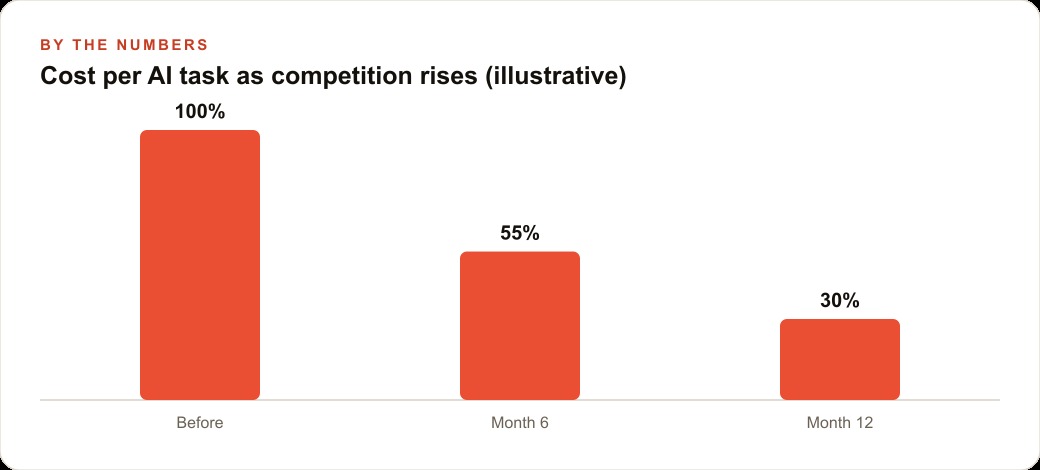
You did not start this fight. You benefit from it regardless of who wins. The labs are competing for your attention, and the price you pay to access their tools keeps falling while the quality keeps climbing. A business owner in 2026 has access to AI capabilities that cost enterprise-level budgets two years ago, available on a subscription that costs less than a monthly dinner out.
6. How to use the competitive pressure to reduce your AI tool costs right now
The code red environment creates specific switching and negotiating leverage that did not exist a year ago.
The simplest move is to test whether the free tiers of competing products now cover your current usage. If you are paying for a ChatGPT subscription and using it primarily for drafting and summarization, spend one afternoon testing whether Claude's free tier or Gemini's free tier produces equivalent or better results on your specific tasks. Use your actual business inputs for the comparison, not demo scenarios. Free tiers have improved substantially as the competitive pressure intensified, and many tasks that required a paid tier six months ago can be handled by free tiers today.
For tasks that still require a paid tier, compare pricing across providers. ChatGPT Plus, Claude Pro, and Gemini Advanced are priced similarly but differ meaningfully in what they include at each tier and which task categories they excel at. Running your three most frequent AI tasks through each and honestly evaluating output quality against price is a 90-minute exercise that most business owners have not completed recently enough to reflect the current state of these tools.
7. How to build an AI tool setup that is not dependent on any single provider
The code red is a reminder that any single provider can reprioritize, fall behind, or change its pricing structure. The businesses most exposed to that risk are the ones that have built all of their AI-dependent workflows around one product and have not tested alternatives.
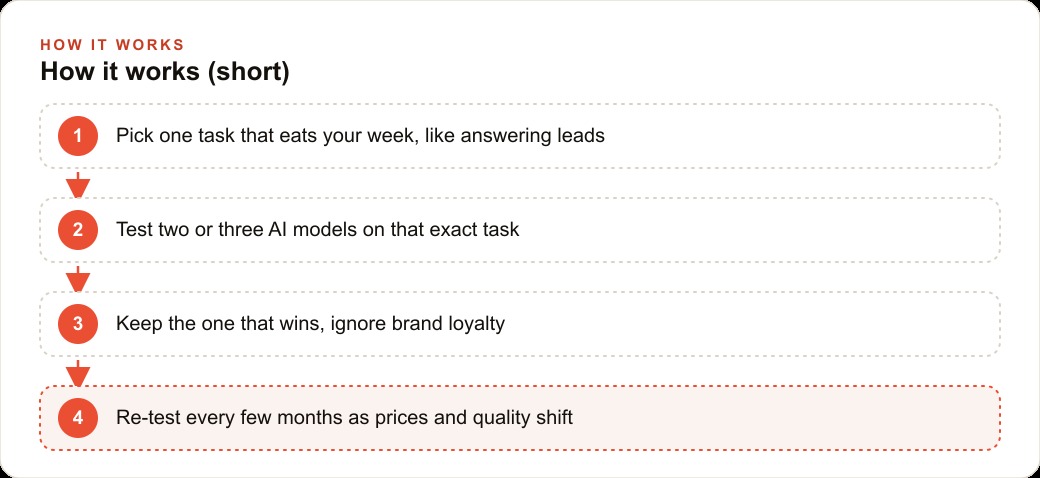
Diversification does not require using different tools for every task. It requires identifying the two or three tasks where AI is most critical to your business and ensuring each of those tasks has a qualified backup option you have already tested. If you use ChatGPT for customer email drafting, you should know from at least a week of testing whether Claude or Gemini produces acceptable output on the same inputs, so a switch can happen in a day rather than a disrupted month of rebuilding workflows.
The practical approach is to spend one hour per month testing your most critical AI workflow on whichever competing model shipped a significant update recently. At the current pace of the competitive race, there is usually at least one relevant development per month. Staying current does not require deep technical knowledge. It requires running the same task through a new model and comparing the output honestly against what you have been using.
8. The free and low-cost alternatives worth testing right now because of this competitive shift
Several alternatives have improved enough through competitive pressure to deserve a fresh test if you have not tried them in the past 90 days.
Gemini 3 through Google AI Studio is free for most use cases and currently leads most multi-step reasoning benchmarks. For research-heavy tasks like market analysis, document review, and structured data extraction, testing Gemini on your actual business inputs is worth 30 minutes of your time. The version available today is materially more capable than what you may have dismissed in an earlier test.
Claude's free tier through Anthropic's web interface improved substantially across the last two update cycles. For writing tasks where tone and precision matter, many professionals now prefer Claude's output for the same prompt that previously favored ChatGPT.
Meta's Llama models, available through multiple free inference platforms, cover standard text tasks with no subscription required. For simple, high-volume text processing where you are currently paying per-request fees to a cloud provider, running a Llama model through a free inference API can reduce that specific cost to nearly zero.
The broader point is that the code red environment has made the free-tier alternatives genuinely capable in ways they were not 18 months ago. Testing the current generation of these tools is a different exercise from having tested them before.
The worked example: a small agency cutting AI tool costs by 30% through selective switching
Here is an illustrative scenario for a four-person marketing agency running several AI-dependent workflows.
Before the competitive pressure reached its current intensity, the agency ran three recurring workflows on paid ChatGPT subscriptions for all four team members: weekly client report drafting, advertising copy generation, and competitive analysis summaries. Monthly AI tool spend was $80, covering four ChatGPT Plus subscriptions at $20 each.
After running a structured comparison test over two weeks using real client inputs, the agency found that Gemini's free tier produced competitive analysis summaries that team members rated equal to or better than ChatGPT on a blind comparison. They moved that workflow to Gemini's free tier, reducing the number of paid subscriptions needed from four to three for the drafting and copy workflows where ChatGPT still had a clear edge on their specific inputs.
They also found that Claude's free tier handled the first draft of standard client reports well enough for their review process, with a human editing pass at the end. By routing first drafts through Claude free and final editing through ChatGPT Plus for two team members, they reduced the number of paid subscriptions needed for the report workflow from four to two.
Total monthly AI tool spend dropped from $80 to $40, a 50% reduction. Output quality on the switched workflows was rated equivalent on real client deliverables. The two hours invested in comparison testing saved $480 over the following year. The agency also gained current working familiarity with two additional tools, which means they can switch again quickly when the competitive landscape continues to shift.
This outcome was only possible because the competitive pressure that triggered OpenAI's code red also forced its competitors to improve their free tiers specifically to attract exactly these users. The code red is OpenAI's internal crisis. For the businesses evaluating their AI tool costs this quarter, it is an opening.
That is exactly what we do at AI DOERS. Book a private 30-minute call with Madhuranjan Kumar and we will map the fastest path to it for your specific business.
Book your call →
Madhuranjan Kumar
Madhuranjan Kumar brings 20 years of performance-marketing experience and has managed over $200 million in Facebook ad spend for brands across the United States and beyond. His expertise spans the full modern marketing stack: Meta, Google Ads, TikTok, email automation, CRM, and the websites that hold it together. At AI DOERS he turns that track record into lead-generation systems for businesses across every industry.