
OpenAI's 2028 AI Researcher Timeline and What It Actually Means for Your Business
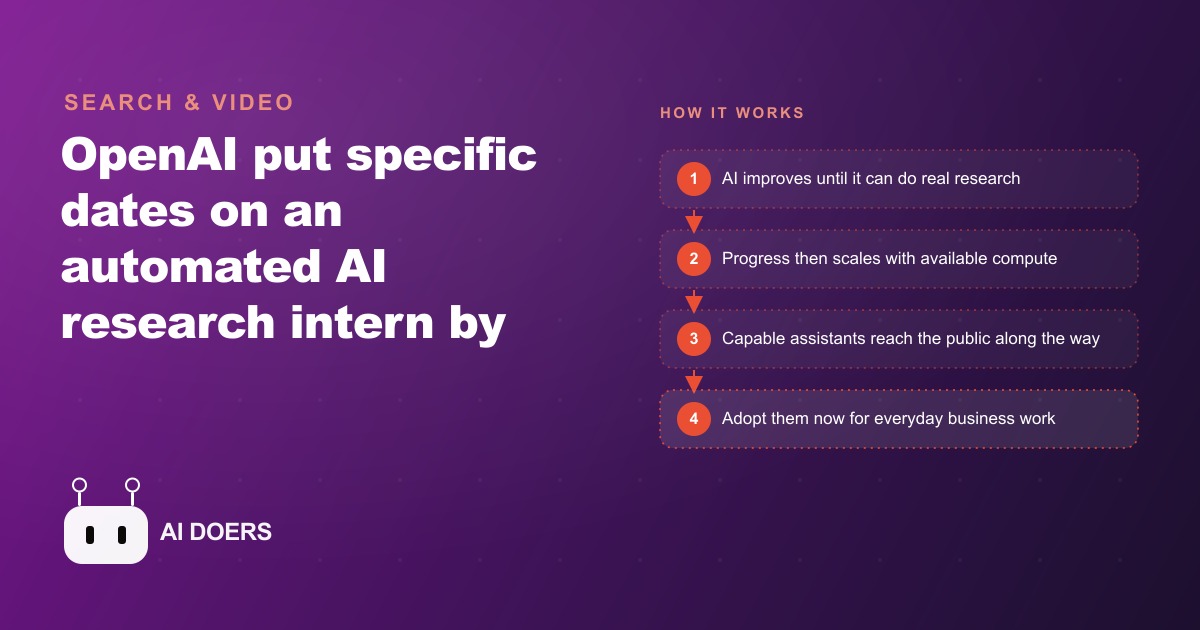
OpenAI put dates on an automated AI research intern by 2026 and a full automated researcher by 2028. Here is the plain reading of that roadmap and the practical move I would make for a real business right now.

The 2028 date is the least useful thing OpenAI told us
Everyone latched onto the calendar. Sitting down after finishing a corporate restructuring and renewing the Microsoft partnership, OpenAI leadership floated two dates: an intern level AI research assistant that is plausible by September 2026, and a legitimate automated AI researcher by March 2028. The internet did what it always does. It argued about whether the dates are right. I want to argue the opposite. The dates are the least useful thing in that entire announcement, and treating them as the headline is exactly how a business owner talks themselves out of doing anything.
My position is simple. The calendar does not matter to you. What matters is that the people closest to this technology, who admitted openly that they have set ambitious goals and missed them badly before, still believe capable autonomous AI is arriving on a schedule they are willing to name in public. When the builders stake their reputation on a rough date, the debate about whether it slips to 2029 or lands early in 2027 becomes a spectator sport. It changes nothing about what you should do on Monday morning. Waiting for the date to be confirmed is a losing move dressed up as prudence.
Arguing about the timeline is how you avoid the work
There is a comfortable trap in every big AI announcement. You can spend an afternoon reading takes about whether the milestone is realistic, feel informed, and end the day exactly where you started, which is doing none of your ordinary work with these tools. That feels like diligence. It is actually procrastination with a research tab open. I have watched owners do this for two years now, treating each new roadmap as a reason to keep watching rather than a reason to start.
The contrarian truth is that the timeline is irrelevant to your return on investment, because you are not buying the 2028 researcher. You are buying the tools that exist today, which the same lab already ships, and those tools already summarize documents, compare options, draft client communication, and assemble reports in minutes. None of that requires an automated researcher. It requires you to pick one real task and hand it over. The roadmap is not a starting gun that fires in 2028. The starting gun fired a while ago, and the people arguing about the date are still standing at the line.
The recursive loop is real, and it is already leaking into ordinary tools
I do not dismiss the substance behind the dates, because the mechanism is genuinely important. The core claim is self improvement. Once an AI can meaningfully help with AI research, the main limit on progress becomes how much computing power you can point at it, which creates a loop where the system improves on its own improvements and the rate of progress climbs. This is why every frontier lab is sprinting toward the same point. Whoever reaches self improving AI first gains a lead that is hard to close.
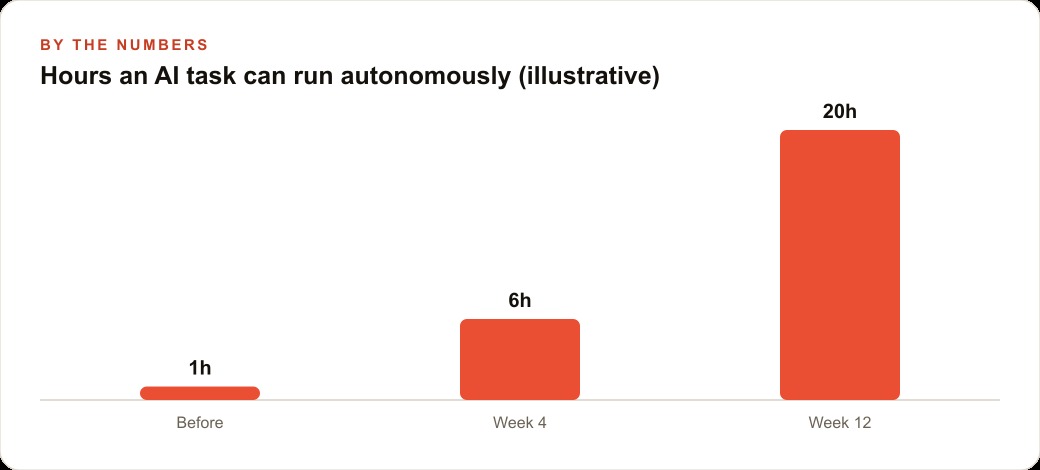
Here is what the timeline crowd misses. That loop does not stay locked inside the lab until some grand unveiling. It leaks. Every few months the models that power everyday products get quietly stronger, cheaper, and more capable, because the same research that pushes toward the researcher milestone also improves the ordinary assistant you can rent for a few dollars. Leadership also described how the duration of tasks an AI can handle on its own keeps stretching, from seconds and hours today toward days and weeks, while stressing that efficiency with compute matters as much as raw time. You do not need to believe the far end of that curve to benefit from the near end of it, which is arriving continuously rather than on one dramatic day.
The auditability point matters more than the milestone
If I had to pull one genuinely useful idea out of the announcement, it would not be a date at all. It would be the way OpenAI described keeping part of a model's internal reasoning private and unsupervised during training so it stays honest, then reviewing that reasoning afterward to understand how the model thinks. The aim is safer, more auditable AI. That is not a headline that trends, but it is the single most practical instruction for anyone putting AI into a real business.
The lesson is that you should never trust an output you cannot inspect. Demand that any assistant you deploy shows its sources and its working so a human can verify every figure before it reaches a client. Leadership also reframed AGI itself as a multi year process rather than a single switch flipping, which is why they prefer a concrete researcher milestone to a vague definition. Read together, these two points tell you this is a gradual, dated, auditable transition, not a sudden flip you can be caught out by. The owners who lose are not the ones who miss the date. They are the ones who deploy AI they cannot audit and get burned by a confident wrong answer.
The strongest objection, and why it still loses
The best argument against my position sounds reasonable, so let me give it a fair hearing. Someone will say that adopting AI too early is expensive and risky, that the tools change so fast that anything you build today is obsolete in six months, and that the disciplined move is to wait until the technology settles. If the roadmap is real and the labs are racing, why not let the dust clear and adopt a mature, stable version later, when it is cheaper and better documented and less likely to embarrass you in front of a client. That sounds like prudence, and it is the reasoning most cautious owners land on.
Here is why that objection loses. It assumes the value you get from AI is the tool itself, when the real value is the workflow you build around it and the judgment you develop about where it helps and where it hurts. The tool does get better and cheaper on the schedule the labs describe, but the workflow, the habit of handing a defined task to an assistant and checking its work, is a durable skill that transfers from one model generation to the next. The person who waited has a shiny new tool and no idea how to point it at their business. The person who started early has a battle tested process that simply gets more powerful each time the underlying model improves. Waiting does not save you the learning curve, it just delays it and hands your competitors a head start. The obsolescence worry is real for the specific tool and irrelevant for the capability, and confusing the two is exactly the error the timeline debate encourages.
There is also a hidden cost to waiting that never shows up on a spreadsheet. Every quarter you spend watching instead of building is a quarter your competitors spend learning what these tools are actually good at inside their specific business. That knowledge does not arrive in a manual. It comes from running real work through the system, seeing where it fails, and adjusting until the output is reliable. By the time the technology feels mature and safe enough for the cautious owner, the early movers have a year of hard won operational knowledge that no amount of catch up spending can buy back quickly. The date on the roadmap will not rescue the business that waited for it, because the roadmap only delivers better models, not the judgment to use them well.
I want to be fair about the risk, because it is real and I am not waving it away. Yes, an early workflow can produce a wrong answer, and yes, a model you build around this quarter will be surpassed next quarter. But look at how those two risks actually resolve. The wrong answer risk is handled entirely by the human approval step, which you keep in place precisely because the tools are not perfect. The obsolescence risk resolves in your favor, because a newer, better model dropped into a workflow you already trust makes that workflow stronger, not obsolete. Both of the cautious owner's fears turn out to be arguments for starting now with guardrails, not for waiting. The only fear that survives scrutiny is the fear of looking foolish for moving before it was obvious, and that fear has never built a durable business advantage.
A financial advisory firm does not need to wait for 2028
Take a financial advisory firm, where research and client preparation eat the most hours. Nothing about the following requires an automated researcher or a confirmed date. Picture an assistant connected only to approved research sources and the firm's own meeting notes. Before a client review, it pulls together a clean summary of the household's situation, drafts talking points, and flags items that need attention, all for an advisor to check and approve. It compares product options in plain language, turns a dense report into a one page brief a client will actually read, and prepares the recurring documents the team rebuilds every week.
Now put illustrative numbers on it. Say two advisors each spend six hours a week on preparation and repetitive drafting, and their loaded time is worth roughly seventy dollars an hour. That is around twelve hours a week, close to eight hundred forty dollars, and near forty thousand dollars a year of senior time spent on work a supervised assistant can carry most of. Recover even sixty percent of it and the firm frees the equivalent of a part time hire without adding headcount. Because auditability is the whole game in advisory work, I would require the assistant to cite every source and keep a human approval step on anything client facing from day one, exactly the way the lab talks about reviewing a model's reasoning rather than blindly trusting it.
The advisor keeps the judgment, the relationship, and the final sign off, and gets back the hours that research and paperwork were quietly stealing. Those recovered hours go straight into client relationships and new business. The firm that reaches new clients through Facebook and Instagram ad campaigns suddenly has the capacity to actually service the leads it was already paying to generate, and the follow up lives in the CRM and website stack where automation handles the next several touches. As the underlying models grow toward the researcher milestone the labs keep pointing at, this same setup gets more capable without anyone rebuilding it. That is the point the date arguers keep missing. You build once, and the roadmap upgrades your work for free.
The move is deliberately boring
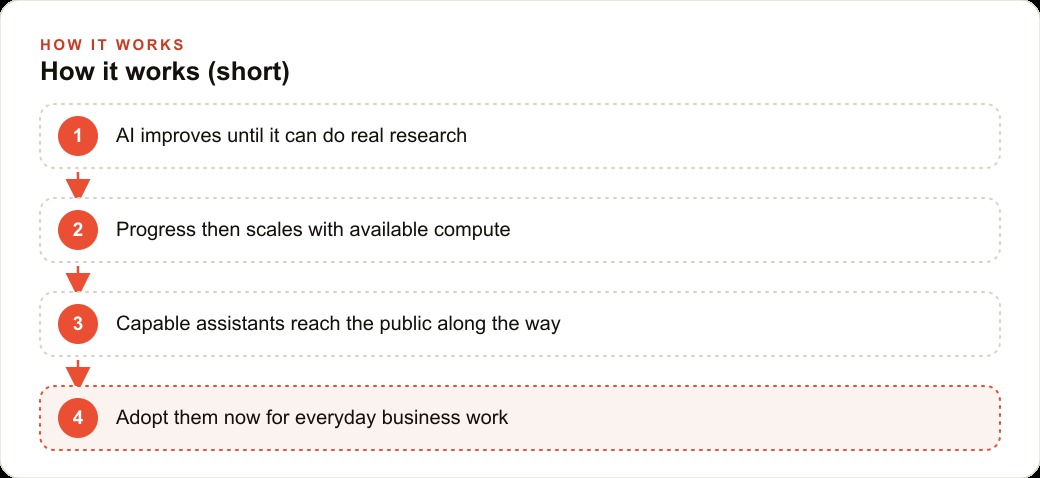
If the contrarian position sounds anticlimactic, good. The right response to an exciting roadmap is a boring, disciplined action, not more watching. Start with one research or preparation task that eats your week. Connect a capable assistant to only the sources it needs, and require it to cite where every fact came from. Prove it on real work for a week, keep a human approval step on anything that touches a client or a regulated decision, and resist the urge to automate the sensitive judgment calls. The autonomous, days long tasks the labs describe are a later chapter, not where you begin.
I will be blunt about where people stall. A focused firm can stand up that first client preparation assistant in an afternoon. The hard part is not the demo, it is choosing the right task, wiring in exactly the right sources, and writing the rules so the output is accurate and compliant enough to trust with a real client. That judgment work is where most people quit once the novelty fades, and it is why the same content foundation that powers your preparation also quietly strengthens SEO and organic search when it is built properly. You can take the disciplined path yourself, or bring in someone who has built these auditable workflows many times and hand it over already working. Either way, stop arguing about 2028. The tools that matter are on your screen right now, and the only date that affects your business is the day you finally start using them.
That is exactly what we do at AI DOERS. Book a private 30-minute call with Madhuranjan Kumar and we will map the fastest path to it for your specific business.
Book your call →
Madhuranjan Kumar
Madhuranjan Kumar brings 20 years of performance-marketing experience and has managed over $200 million in Facebook ad spend for brands across the United States and beyond. His expertise spans the full modern marketing stack: Meta, Google Ads, TikTok, email automation, CRM, and the websites that hold it together. At AI DOERS he turns that track record into lead-generation systems for businesses across every industry.