
GPT-4.5 Thinks and Writes Like a Human: What It Means for Professional Services Firms
OpenAI's new model is designed around conversational quality rather than benchmark performance, and its tiered agent pricing signals a shift from AI as a tool to AI as a billable workforce.

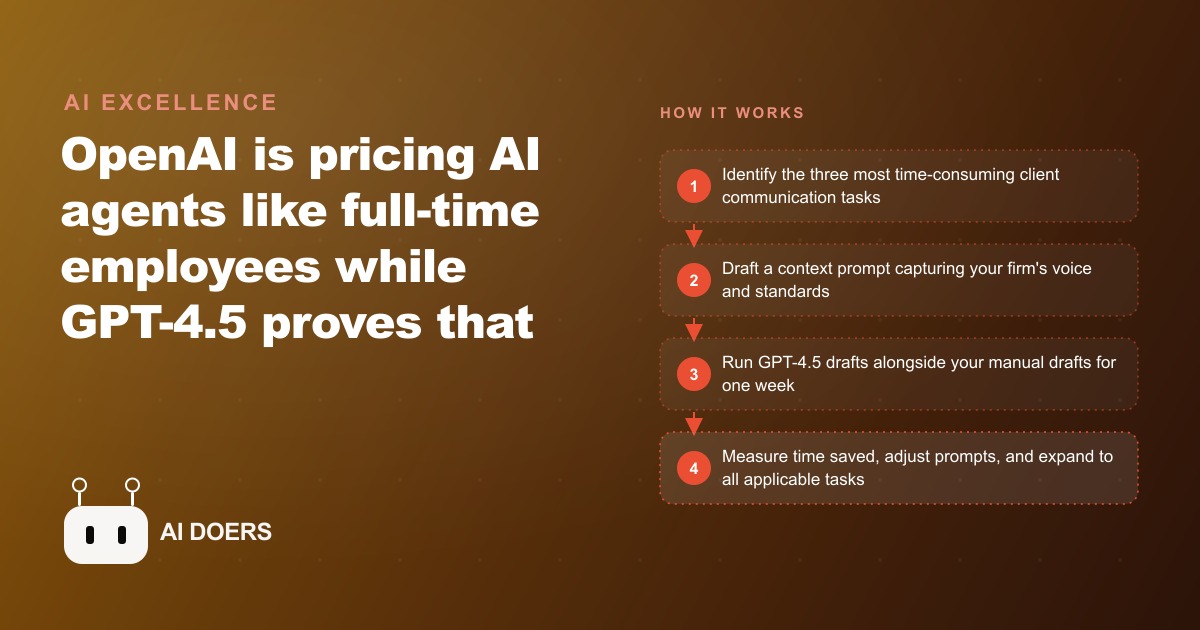
The businesses treating OpenAI's agent pricing as software subscription pricing are thinking about it wrong. Madhuranjan made this point directly when reviewing the announcement: $2,000 per month for a research assistant agent, $10,000 per month for a software developer agent, and $20,000 per month for a PhD-level researcher. The businesses that dismiss those prices as expensive are comparing them to a SaaS tool. The businesses that treat them as a headcount decision and run the right arithmetic will have a structural advantage within 18 months over those that do not.
OpenAI just priced AI agents like employees, and that framing is more accurate than any subscription model
OpenAI's agent pricing structure is a deliberate communication strategy, not just a pricing sheet. The company could have priced these products per API call, per document processed, or per task completed. Those are all reasonable pricing architectures for software. Instead, they chose monthly fees that sit directly in the range of professional human salaries for comparable roles. A human research assistant in a professional firm earns $2,000 to $4,000 per month in many markets. A software developer earns $8,000 to $15,000 per month. A PhD-level researcher commands $6,000 to $20,000 depending on specialization and seniority.
The overlap is not a coincidence. It is a frame. OpenAI is asking buyers to make the same evaluation they would make when considering a new hire: does this role produce enough output to justify what it costs? That is a fundamentally different question from whether a software tool is worth subscribing to. Software subscriptions are evaluated against convenience and feature utility. Workforce decisions are evaluated against the economic value the role generates. The second evaluation framework produces better decisions about AI agents because it forces specificity about what the agent actually does and what that output is worth to the business.
The businesses that resist this framing because they are culturally used to thinking of AI as software will systematically underspend on agents that deliver clear returns and overspend on cheaper tools that do not. The frame matters as much as the price.
GPT-4.5 is the first model where vibes is a legitimate quality dimension, not a dodge
GPT-4.5, known during development as Orion, was designed around a different target than most frontier models. Rather than maximizing performance on reasoning-heavy benchmarks like mathematics competitions or graduate-level science problems, the team optimized for conversational quality: calibrated tone, direct answers, appropriate confidence levels, and responses that feel like they came from a thoughtful person rather than a pattern-matching system.
The benchmark results reflect this design choice. GPT-4.5 scores 62.5 percent on simple question-and-answer accuracy compared to GPT-4.0's 38.6 percent on the same test. It carries the lowest hallucination rate of any OpenAI model on specific factual benchmarks. It does not match o3-mini on mathematical reasoning or complex coding tasks and does not claim to. It was built for the communication layer of professional work, not the computation layer.
OpenAI's team described the differentiator as vibes, which sounds like a dodge until you think carefully about what that word captures. When a client reads an explanation from their accountant and feels understood rather than lectured, that is not a vague subjective experience. It is a specific quality of the writing: the tone matches the relationship, the complexity level matches the client's background, and the most important information comes first rather than being buried in technical qualification. These are learnable, auditable qualities that determine whether a client trusts the communication. GPT-4.5 is the first model where that layer of quality is demonstrably better than its predecessors in a way that changes the output's usefulness for professional communication specifically.
Professional firms are the ones most underestimating what conversational quality is worth
Law firms, accounting practices, financial advisors, and medical practices share a structural characteristic: the product they sell is expertise, but what clients experience is communication. A client who receives excellent analysis delivered in confusing or clinical language does not feel well-served. A client who receives good-enough analysis delivered in clear, direct, appropriately warm language often feels better served than they technically were. This is not a criticism of clients. It reflects how trust is actually built in professional services relationships.
GPT-4.5's conversational quality is most valuable in exactly this context. The scenarios where the model's calibrated tone and low hallucination rate translate into measurable business value are the ones where communication quality determines client retention. Tax explanation emails, planning proposal summaries, diagnostic result discussions, legal strategy memos, and client check-in messages all fall into this category. These are not creative writing tasks where originality is the standard. They are professional communication tasks where accuracy, clarity, and appropriate tone are the standard, and where getting any of those wrong erodes trust.
Most professional firms currently underestimate what this is worth because they evaluate AI tools on whether the output is factually correct, which is a necessary condition but not sufficient for client-facing use. GPT-4.5 meets a higher standard: factually correct output in a register that clients trust. The combination is what makes it viable for direct client communications rather than only for internal drafts that a professional rewrites before sending.
The real comparison is not AI agent versus software subscription
The comparison that produces the right decision about OpenAI's agent pricing is not AI agent versus a $20-per-month software subscription. It is AI agent versus a human professional role, evaluated on the same terms: what does this role do, how does the output quality compare to a human professional at similar cost, and what is the total return on the investment over a year?
Here is what that comparison looks like with real numbers for an accounting firm.
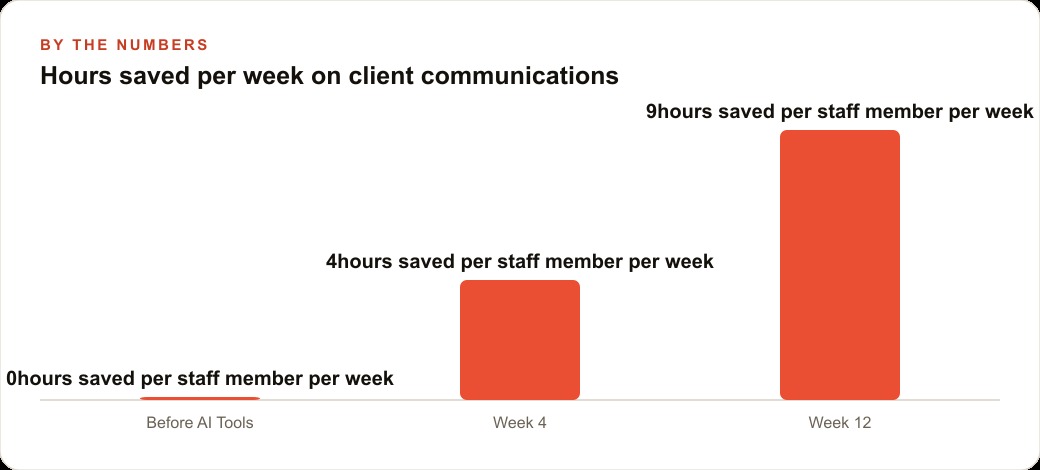
An accounting firm with three professional staff. Each sends approximately 40 client communication emails per week. Writing each email from scratch takes on average 8 to 12 minutes for a professional who is good at client communication, because the work involves thinking through the client's specific situation, calibrating the level of technical detail, and finding the right register for the relationship. With GPT-4.5 producing a first draft that already calibrates tone and leads with the most important point, that time drops to 2 to 3 minutes of review and light editing.
At 8 minutes saved per email, across 40 emails per week per staff member, each person recovers 320 minutes per week, or 5.3 hours. Across three staff members, that is 16 hours per week of professional time recovered from one category of work. At a billable rate of $150 per hour, 16 hours per week is $2,400 per week in recovered capacity. Over 52 weeks, that is $124,800 per year in recovered professional time from one use case.
ChatGPT Plus for three seats costs $720 per year. A research assistant agent at $2,000 per month costs $24,000 per year. Even at the full agent price of $24,000 per year, the return against the recovered time estimate alone exceeds 5 times. That is before accounting for the value of consistent communication quality, the reduction in client callbacks from unclear explanations, and the improvement in partner-level capacity when routine communication tasks are handled faster.
A firm that treats the $2,000 price as a tool cost will lose to one that treats it as a headcount decision
The practical implication of the headcount framing is that the evaluation criteria change. Software tools are evaluated on adoption ease, feature completeness, and whether they replace a task the team already does with something faster. Headcount decisions are evaluated on output quality, reliability, total value generated against total cost, and what happens to team capacity when this role is filled well.
Applied to OpenAI's $2,000 per month research assistant agent, the headcount evaluation looks like this: what does this agent produce each month, how does the output quality compare to a junior research professional at the same cost, what is the firm's billable rate for the work this agent enables, and how quickly does the total value generated exceed the $24,000 annual cost? Those questions produce a specific, defensible answer.
The software evaluation question, "is this worth $2,000 per month compared to other tools we use?", produces a much harder comparison and tends to land on no, because most software is cheaper and the question does not account for what the agent enables that a cheaper tool cannot. The framing drives the conclusion, and the firms that adopt the headcount framing early will make better decisions about which agents to deploy and at what scale.
The accounting firm example demonstrates the method. Three staff members, 40 emails each per week, 8 minutes saved per email: the arithmetic closes clearly at $20 per month per seat. It would close clearly at $200 per month per seat. At $2,000 per month for an agent handling not just drafting but also research, synthesis, and proactive client outreach, the economics require more careful modeling but can still close for the right firm at the right volume. The analysis has to be done with the same rigor applied to a hiring decision. Here is the arithmetic that makes the headcount framing concrete. An accounting firm with three professional staff, 40 client emails per week each, and 8 minutes recovered per email with GPT-4.5 handling the calibrated first draft: 120 emails per week, 960 minutes recovered, 16 hours per week across the firm. At $150 billable rate, that is $2,400 per week in recovered professional time, or $124,800 per year. Three ChatGPT Plus seats cost $720 per year. The return ratio before any secondary benefit is approximately 170 to 1.
Apply the same method to the $2,000-per-month research assistant agent. The agent needs to generate the equivalent of 13 hours of professional work per month at that billable rate to break even. For an agent proactively surfacing client opportunities, summarizing regulatory changes relevant to a client's tax situation, and preparing background briefings before client meetings, 13 hours of professional-equivalent output per month is a conservative floor. The economics can close. The analysis has to be done.
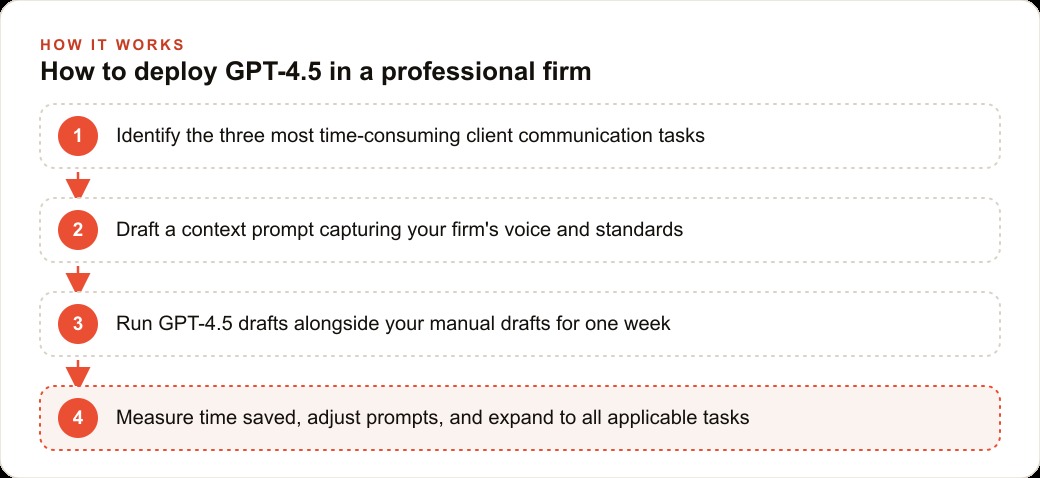
The starting point for most professional firms is not an agent at $2,000 per month. It is GPT-4.5 at $20 per month per seat used systematically for client communications over 60 days. That period is long enough to measure real time recovery, observe whether output quality is meeting the firm's standard, and see how clients respond to communications that went through a GPT-4.5 drafting step versus those that did not.
The secondary benefit that emerges in that 60-day window is often the one that convinces firms to expand usage. Consistency. GPT-4.5 does not have a bad Wednesday. It does not produce a rushed client explanation when three deadlines are colliding. It applies the same calibrated tone and the same care to the fortieth email of the week that it applies to the first. For a firm whose reputation is built on how clients feel after every interaction, not just after the major ones, that consistency compounds into retention and referral over time in a way that is difficult to manufacture through any other means at similar cost.
A firm with that 60-day data set can then evaluate the agent tier with real numbers rather than projections. What would 13 hours per month of agent-level research and synthesis output be worth to this firm at our billable rate, based on what we have seen AI-assisted output actually deliver? That is a solvable question. Start with the accessible tier and measure it. That period generates enough real data on time recovered, output quality, and client response to make the agent evaluation a calculation rather than a guess. Measure rigorously at the accessible tier, then use the data to evaluate the higher tier when the capability justifies it.
The firms that skip that analysis and default to treating the price as a software comparison rather than a headcount comparison are the ones that will look back in two years and see competitors who made a different decision gaining ground that compounds annually. "too expensive for software" are the ones that will look back in two years and see competitors who made a different decision gaining ground that compounds.
That is exactly what we do at AI DOERS. Book a private 30-minute call with Madhuranjan Kumar and we will map the fastest path to it for your specific business.
Book your call →
Madhuranjan Kumar
Madhuranjan Kumar brings 20 years of performance-marketing experience and has managed over $200 million in Facebook ad spend for brands across the United States and beyond. His expertise spans the full modern marketing stack: Meta, Google Ads, TikTok, email automation, CRM, and the websites that hold it together. At AI DOERS he turns that track record into lead-generation systems for businesses across every industry.