
The AI Company Wars Are Making Business Tools More Affordable Than Ever
Elon Musk's $97.4 billion OpenAI bid and Sam Altman's unified model roadmap signal a new phase of AI competition that directly benefits small business owners with cheaper, smarter tools.

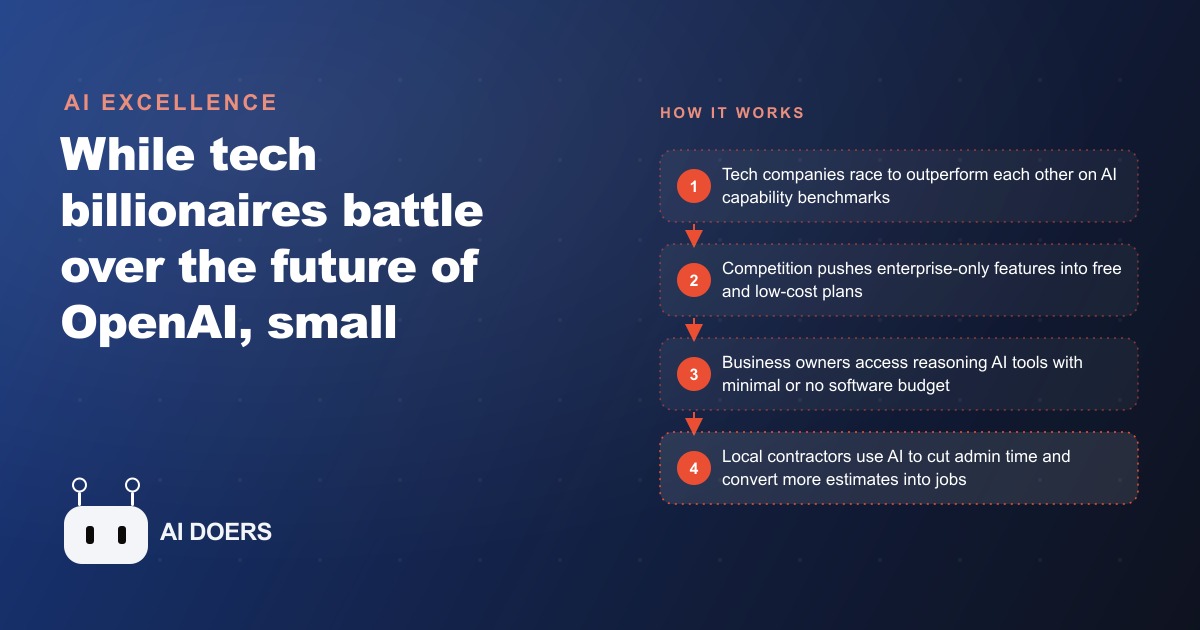
The $97.4 Billion Bid Was a Tactic, Not a Sincere Purchase Offer
Elon Musk walked into the OpenAI acquisition story with a $97.4 billion all-cash bid, a consortium of investors, and a public deadline. The business press covered it as a genuine takeover attempt. Madhuranjan Kumar looked at the mechanics and arrived at a different reading: the bid was never really about buying OpenAI.
Here is what makes that read compelling. OpenAI is in the middle of converting from a nonprofit structure to a for-profit one. A formal acquisition bid, regardless of whether it succeeds, legally triggers a due diligence process that requires the company to open its internal financials, its research pipeline, and its operational data to the bidding party. For someone with his own competing AI company and a clear strategic interest in knowing exactly where OpenAI's numbers stand, forcing that disclosure has value that is entirely independent of whether the deal closes. The bid is a mechanism for accessing information that would otherwise be unavailable.
Sam Altman declined publicly on X and added a comment about OpenAI's potential interest in purchasing Twitter at $9.74 billion, a pointed reference to what Musk paid for that platform. The exchange made good headlines. More importantly, it told you something real about how OpenAI's leadership reads the bid: not as a serious business proposition but as a move in a competitive game between two well-funded parties who understand each other's tactics very well.
The noise around the acquisition is real. It will generate more headlines before it resolves. The signal is elsewhere, and the signal matters far more to anyone who is actually trying to build or run a business.
What the Competition Is Actually Producing Is a Price Floor Collapse
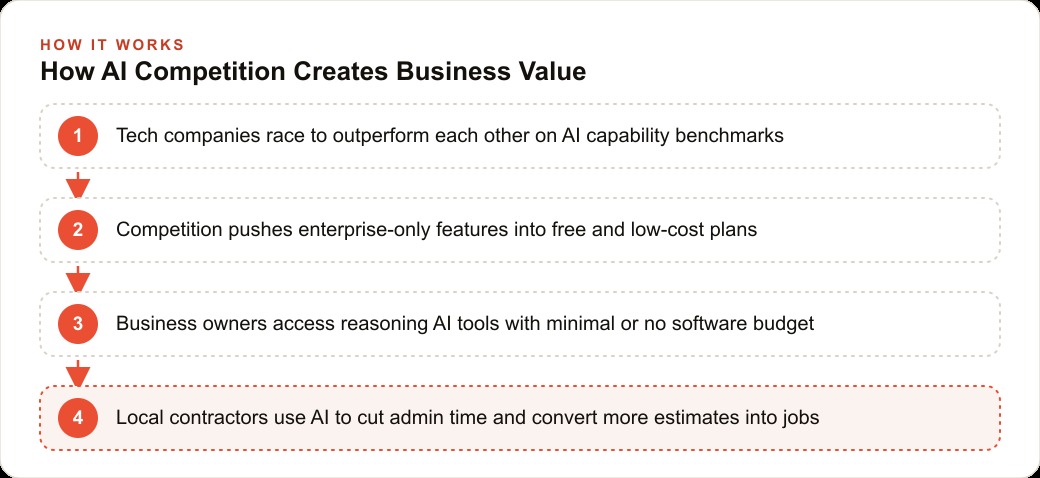
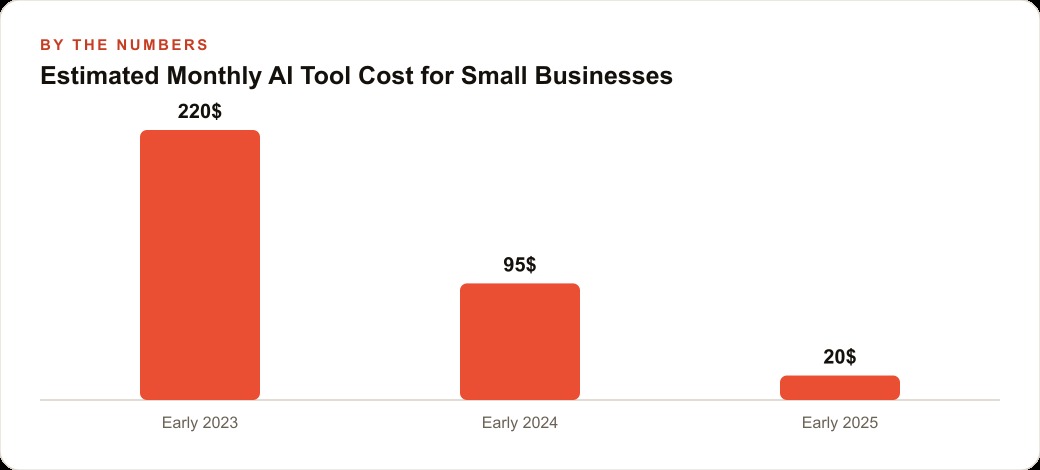
The more important development from the same period has nothing to do with ownership and everything to do with what multiple AI companies are doing to pricing and capability access as a direct result of competing against each other. When several well-funded organizations are all trying to attract the same users and the same enterprise customers, the economics of the competition are straightforward: prices fall, premium capabilities migrate to standard tiers, and things that required expensive enterprise contracts eighteen months ago become available for $20 per month today.
The evidence is concrete. Anthropic shipped a hybrid reasoning architecture that automatically routes between fast surface-level responses and deep chain-of-thought analysis based on what the query actually requires. OpenAI watched that and announced that GPT 5, the next major release, will collapse the entire model picker into a single unified system that makes the same routing decision automatically. Two companies are in direct competition on a capability that would have been remarkable and expensive a year ago, and that competitive pressure means both are working to make it accessible at the lowest possible price point.
Free tier users of ChatGPT will get unlimited access to GPT 5 at standard intelligence when it launches. The Plus tier at $20 per month gives higher reasoning capability and expanded file upload access. Deep research, a feature that runs multi-step research tasks and produces structured reports, is now available on mobile devices for paid subscribers. Adobe Firefly simultaneously launched a commercially licensed video generation model with camera controls trained entirely on licensed content, which removes the copyright exposure that had made AI video a legal risk for commercial use.
Each of these developments is a product of competitive pressure. No single company would have moved this fast without the others pushing the pace. The acquisition drama is the cover story. The price collapse and the capability democratization are the business story.
The Adobe Firefly development from the same period matters for a different set of businesses. A restaurant, a real estate agency, a retailer, any business that has been producing video content but using AI video tools with uncertain training data provenance, now has a commercially licensed option with camera controls trained entirely on licensed and public domain material. That removes the legal exposure that had made AI video a risk for commercial use and opens the format to businesses that had been staying out of it precisely because of copyright uncertainty. This is another direct product of competitive pressure in the AI market: one company's move on licensed training data forces others to address the same concern, and the businesses that produce commercial content benefit from the resulting standards race.
GPT 5 Free Tier and Unified Reasoning Are the Real News in This Story
The specific product changes deserve more attention than the boardroom maneuvering. A unified model that routes automatically between fast and deep reasoning is more useful in a business setting than a model picker for a practical reason: the person closest to the work is rarely also the person best positioned to decide which reasoning mode is optimal for each individual query.
A roofing contractor who has been using these tools for a few months knows what they need: reliable answers on complex questions, fast answers on routine ones, and no decision fatigue in between. The unified model delivers that without requiring the contractor to learn the difference between o3 and GPT-4o and when each one is appropriate. The same tool that quickly confirms standard labor hours for a shingle replacement shifts into deeper analytical mode when the query involves comparing three material options with a set of constraints around budget, wind rating, and resale timeline. The user does not choose the mode. The model reads the complexity of the query and decides.
The free tier expansion is the other genuine story from this period. For most of the highest-value business use cases, the free tier of a capable reasoning AI is sufficient. Follow-up emails to unconverted estimates, insurance supplement letters, social content, product descriptions, review replies: all of these tasks land well within the capability of standard-intelligence output. A roofing contractor who wants to evaluate whether AI is genuinely useful to their operation does not need to spend anything to find out. They test it at the free tier on a week of real tasks and upgrade only if they consistently hit the limits. Most will hit the limits quickly, because the tasks that matter most are the ones they do repeatedly, and repeatedly hitting the free limit is a reliable signal that the upgrade pays for itself.
Bolt's expansion from web app generation to native mobile apps from prompts is worth noting separately for anyone who has wanted to build a simple tool for their crew, such as a job sheet app or an inspection checklist, without the cost of custom development. Describing what the app should do and receiving a functional mobile application from a text prompt is exactly the kind of capability that was implausible eighteen months ago and is now available to any business owner willing to spend an afternoon exploring it.
The Roofing Contractor Is the Biggest Beneficiary of This Entire Story
The beneficiary of every pricing move, every new free tier, and every capability brought down from enterprise plans to standard subscriptions is not an investor and not an AI researcher. It is the business owner spending too many non-billable hours on administrative tasks that have nothing to do with the skilled work they actually do.
Consider a roofing contractor running a small crew, completing twelve jobs per month in a mid-size metro area. The work that fills their evenings and weekends is not roofing. It is writing follow-up emails to homeowners who received estimates but have not responded. It is comparing an insurance adjuster's scope-of-loss document against what the repair actually requires and identifying the missed line items. It is writing three or four social captions per week for a Facebook page they know matters for referrals but that takes time they do not have.
Each task has a concrete time cost. A follow-up email that reads professionally and specifically addresses the homeowner's expressed concern takes about fifteen minutes to write from scratch. An insurance supplement letter that identifies items missed in a scope of loss takes sixty to ninety minutes of careful document comparison. A social caption for a before-and-after roof repair post takes twenty minutes to produce something worth posting.
With a reasoning AI at the $20 Plus tier, all three workflows compress in ways that change behavior rather than just saving seconds. A well-constructed follow-up email prompt, one that includes the contractor's name and market, the homeowner's specific situation, the desired tone, and the call to action, produces a usable draft in ten seconds. The contractor reads it, adjusts one or two specific details, and sends it. Fifteen minutes becomes three minutes. An insurance supplement starts with the contractor uploading the adjuster's PDF and asking the AI to identify commonly missed line items for a complete repair at current materials and labor costs in their market. The AI produces a structured draft the contractor reviews and modifies. Ninety minutes becomes twenty minutes. The social caption starts with uploading a before-and-after photo pair and requesting three caption options from different angles. All three arrive in under a minute. The contractor picks one, makes a small adjustment for voice, and schedules the post.
At four hours per week recovered and a conservative owner-time value of $75 per hour, that is $300 per week, or roughly $1,200 per month, in recovered productive time at the Plus tier. Against a $20 per month subscription, the monthly return is 60 times the cost. And that calculation does not include the revenue impact of following up on more estimates consistently. If this contractor follows up on two additional unconverted estimates per month because the email process now takes three minutes instead of fifteen, and converts one of those into a job at an average ticket of $8,000, the $20 monthly subscription has generated a 400-times return in the month it mattered most. That math does not require optimistic assumptions. It requires only that the contractor uses the tool regularly enough for the behavior change to take hold.
The billionaires fighting over ownership stakes in AI companies are pursuing a different kind of return. The roofing contractor who follows up consistently because the email takes three minutes is pursuing a return that shows up in next month's revenue, in this quarter's jobs booked, in the next year of steadily improving close rates. The AI company wars produced both outcomes. The contractor's outcome is the one that matters for anyone reading this with a business to run and a weekly administrative burden that grows faster than the revenue does.
The practical implication for any service business is to start now, at the free tier, on one specific administrative task. Not a grand AI strategy. One task: the follow-up email, or the social caption, or the quote summary. Test it on real examples for two weeks. Measure the time. Decide whether to upgrade based on actual usage rather than projected value. The businesses that build this practice now, while the tools are becoming reliably capable but before every competitor has adopted them, gain a workflow efficiency that compounds. Two years from now the roofing contractor who has refined their prompt library and built consistent AI habits will close a higher share of estimates than one who has not, not because AI gave them access to information their competitor lacks, but because they follow up more, they communicate more clearly, and they do not let administrative bottlenecks slow the process between the estimate and the signed contract.
The billionaire drama will resolve in some form. The bid will be withdrawn or challenged or resolved through litigation. The drama is finite. The price compression it is producing in the AI market is structural and will continue regardless of how the acquisition story ends, because the competition that is driving it involves more companies than just the two at the center of the headline. Every month that passes without a clear winner in the AI race is another month of continued pricing pressure that benefits the businesses willing to take advantage of it.
That is exactly what we do at AI DOERS. Book a private 30-minute call with Madhuranjan Kumar and we will map the fastest path to it for your specific business.
Book your call →
Madhuranjan Kumar
Madhuranjan Kumar brings 20 years of performance-marketing experience and has managed over $200 million in Facebook ad spend for brands across the United States and beyond. His expertise spans the full modern marketing stack: Meta, Google Ads, TikTok, email automation, CRM, and the websites that hold it together. At AI DOERS he turns that track record into lead-generation systems for businesses across every industry.