
How One AI Agent Can Run a Whole Marketing Team
A master AI agent can delegate tasks to specialist agents for research, media, posting, and messaging. Here is how it works and how a veterinary clinic could use it.

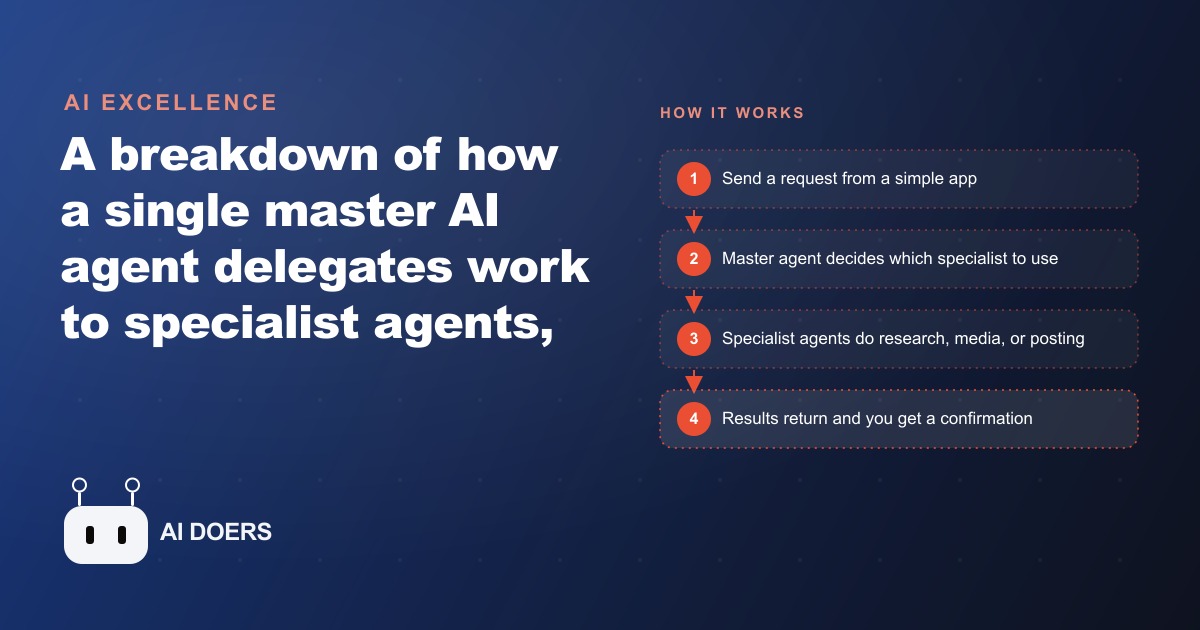
For most of the last three years, multi-agent AI systems were something you read about in research papers or watched in carefully produced demos. As of this month, the same structure demonstrated in those demos is running as practical daily infrastructure for small businesses, and the reason it works is that it is less architecturally complex than the name makes it sound.
I am Madhuranjan Kumar, and I want to lay out exactly how the master-and-specialist structure works, what it enables for a small business marketing operation, and why the modular design is the part that makes it durable rather than just impressive in a demo.
Multi-agent marketing infrastructure for small businesses crossed from proof-of-concept to working daily stack
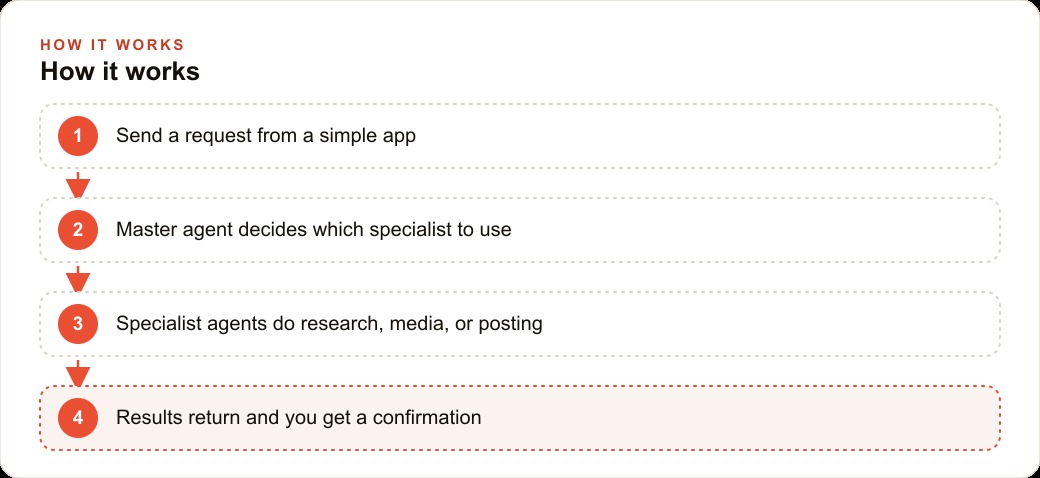
The demo that made this concrete showed a single operator typing one request: research a new AI tool that just launched, find relevant posts about it, generate a matching image, and schedule three social posts across platforms. The master agent took that request, reasoned through it, called a research agent to pull web data and social posts, passed the findings to a media agent to generate an image, and handed everything to a posting agent to schedule. The whole job finished without the operator touching it again.
That is not a particularly exotic workflow for a marketing team. Research a trend, make content about it, post the content. The exotic part is that one text request triggered a coordinated sequence across four specialized tools, and the operator's only job was to write the request.
The shift from experiment to practical infrastructure happened because the models handling the routing decisions got reliable enough that the master agent stops going off-track at a high enough rate. Earlier attempts at multi-agent systems failed not because the concept was wrong but because the routing agent would misinterpret the task, call the wrong specialist, and cascade the error through the whole chain. The current generation of models routes correctly on the first pass often enough that a real workflow can be built around the structure.
The master-and-specialist structure makes routing decisions the only job of the top-level agent
The master agent does not do the actual work. That is the design choice that makes the whole system maintainable. Its only job is to read the incoming request, decide which specialist is best suited to handle it, and pass the right information to that specialist. It does not need to know how the research agent searches the web or how the media agent generates images. It only needs to know what each specialist can do, so it can route correctly.
This separation is enforced through the system prompt on the master agent. The system prompt describes each specialist in plain language: the research agent handles web searches and social data, the media agent generates and finds images and video, the posting agent schedules content to platforms, and the helper agent controls email, calendar, and chat. When a request comes in that requires multiple specialists, the master agent calls them in sequence, passing the output of one as input to the next.
The result is a structure that looks simple from the top and sophisticated from the side. From the operator's perspective, they send one request and get one completed job. From the system's perspective, three or four separate tools ran in coordination, each doing the part it was designed for.
For a business already running Meta ads alongside organic content, the master agent can pull the two workflows together. A request like "write three post variations around this week's ad headline" can trigger the research agent to pull current platform performance data, the media agent to generate variations on the creative, and the posting agent to schedule the organic posts that support the paid campaign, all from one instruction.
A nested helper agent collapses the gap between content production and customer communication
The part of the architecture that most surprises people is that agents can themselves be tools of other agents. The helper agent, which handles email, calendar, and messaging, is a complete system on its own. It can mark, draft, send, and label emails. It can create and update calendar events and send invitations. It can read and send messages in chat tools. But from the master agent's perspective, all of that capability appears as a single tool called "helper agent."
This nesting means the master agent does not need to know anything about email protocols or calendar APIs. When a request requires sending a follow-up email, the master agent calls the helper agent with a plain-language instruction, and the helper agent figures out the execution. The master agent's routing logic stays simple while the helper agent's execution logic can be as sophisticated as needed.
The practical value of this for a small business is that the same request that produces a social post can also trigger a customer communication. A request to announce a seasonal promotion can generate the social posts, schedule them, draft the email to the subscriber list, and log any customer responses that come back into the CRM and website stack where follow-up automation handles the next touches, all in a single workflow. The operator does not have to manage content production and customer email as separate tasks in separate tools. They are coordinated through one instruction to one agent.
This is particularly relevant for any business managing Google Ads campaigns alongside email sequences. The master agent can pull campaign data through the research specialist, draft updated ad copy through the media specialist, and queue follow-up emails through the helper agent, all as steps in a single workflow triggered by one instruction.
Context from a notes database is what turns generic output into something that sounds like your brand
The piece of the system that matters most for output quality is not the routing logic or the specialist architecture. It is the context layer.
Every AI agent without additional context produces output in a generic voice, because all it knows about the task is what is in the prompt. The research agent knows how to search. The media agent knows how to generate images. But neither knows how this specific business talks to its customers, which topics it consistently covers, which phrases it avoids, or what its typical post structure looks like.
The fix is a notes database connected to the master agent. This database holds the business's real examples: past posts that performed well, the tone guidelines, the product descriptions the business uses consistently, the customer testimonials it references, and the standard operating procedures for different types of content. When the master agent receives a request, it pulls relevant context from the notes database and passes it to whichever specialist is doing the work.
The difference in output quality between a system with context and one without it is substantial. Without context, the posting agent generates a social post that could have come from any business in the category. With context, it generates one that uses the brand's typical opening structure, references the product line by the right name, and avoids the phrases the business has flagged as off-brand. The context is doing as much work as the model.
For a business running content and SEO strategy alongside social content, the notes database can hold the business's target keyword clusters, the topics it has already covered, and the internal link structure it is building toward. The research agent then pulls information that is relevant to the existing strategy rather than just whatever is trending in the category.
The modular structure means fixing one specialist never disrupts the others
The operational argument for the master-and-specialist structure, beyond the impressive demo, is that it is designed to be maintained. When a specialist is not performing well, you can improve or replace it without changing anything else. The master agent does not care how the research agent works internally. It only cares that when it calls the research agent with a topic, it gets back useful research. If you swap the research agent for a better one, the master agent and all other specialists continue working exactly as before.
This is the Lego brick design principle applied to AI systems, and it matters significantly for businesses that plan to use these systems over time rather than as a one-time experiment. Agents will need updating as the tools they depend on change, as the platforms they post to evolve, and as the business's own needs shift. A monolithic system where all the capability lives in one agent requires rewriting everything when any part needs to change. A specialist system lets you update each piece independently.
The same logic applies to the frontend. The system connects to a simple app through a single web hook. The operator sends a request to the app, the app sends it to the hook, and the master agent handles everything from there. If the backend grows from four specialists to eight, the frontend does not change. The operator still sends requests to the same app, and the master agent routes them to whatever specialists now exist.
A veterinary clinic recovered 11 hours per week of marketing coordination by deploying the structure
Here is how this plays out in a concrete example with illustrative numbers.
A veterinary clinic with three veterinarians and a front desk team ran its marketing coordination manually. Every Tuesday, a staff member spent the morning finding a relevant pet health topic, writing a social post about it, sourcing an image from a stock library, scheduling the post, and sending a weekly email summary to the subscriber list. The process averaged three to four hours per week. Every time a seasonal topic needed coverage, like flea and tick season or dental health month, the same process ran again with additional research time to make sure the information was accurate.
The clinic owner set up a master-and-specialist structure with four specialists: a research agent configured to pull from vetted veterinary information sources, a media agent configured to generate pet-health imagery matching the clinic's warm, approachable visual style, a posting agent connected to the clinic's social accounts, and a helper agent with access to the email list and the scheduling calendar. The notes database held the clinic's tone guidelines, its preferred post structure, the treatments and services it wanted to promote consistently, and examples of its highest-performing past posts.
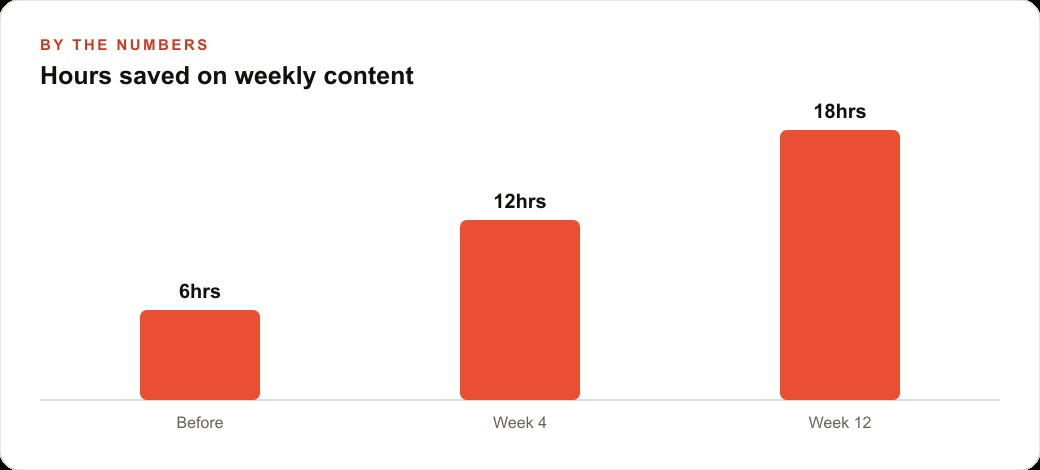
Once running, the Tuesday content workflow went from three to four hours to approximately 20 minutes of review. The operator sent a request describing the week's topic, the system generated the research summary, the post copy, the image, and the scheduled posting sequence, and the staff member reviewed and approved before it went live. The email summary to subscribers was drafted by the helper agent in the same workflow, requiring a five-minute edit rather than being written from scratch.
Over 12 weeks, the clinic recovered an illustrative 11 hours per week of marketing coordination time across content production and email, time that moved back to front-desk and patient communication work. The specialist that needed the most refinement was the research agent, which initially pulled general pet-health information rather than content specific to the clinic's patient population. Updating the research agent's context instructions fixed the problem without touching any other part of the system.
That last point is the practical proof of the modular design. The fix was contained, quick, and did not require touching the media agent, posting agent, or helper agent. The master agent never knew a change was made. It routed the next request to the research agent, got better output, and continued as before.
For any small business managing overlapping content, paid, and email workflows, the master-and-specialist structure removes the coordination overhead that currently sits between those channels. A request that once required four separate manual steps across four separate tools becomes one instruction to one master agent, which coordinates the specialists and returns a completed result. The overhead that goes away is the overhead that was not creating value in the first place.
The system takes patience to set up and refine. The people who get the best results from multi-agent structures are detail-oriented and willing to test, read the logs, and iterate on routing instructions and context until each specialist is producing consistently. That investment front-loads the work. Once the system is dialed in, it returns that time many times over across every week it runs.
That is exactly what we do at AI DOERS. Book a private 30-minute call with Madhuranjan Kumar and we will map the fastest path to it for your specific business.
Book your call →
Madhuranjan Kumar
Madhuranjan Kumar brings 20 years of performance-marketing experience and has managed over $200 million in Facebook ad spend for brands across the United States and beyond. His expertise spans the full modern marketing stack: Meta, Google Ads, TikTok, email automation, CRM, and the websites that hold it together. At AI DOERS he turns that track record into lead-generation systems for businesses across every industry.