
The October AI Tool Wave and What Digital Marketing Agencies Need to Do Right Now
Across browsers, video, images, coding tools, and new language models, October changed the tool landscape fast enough that agencies who are not tracking it are already behind.

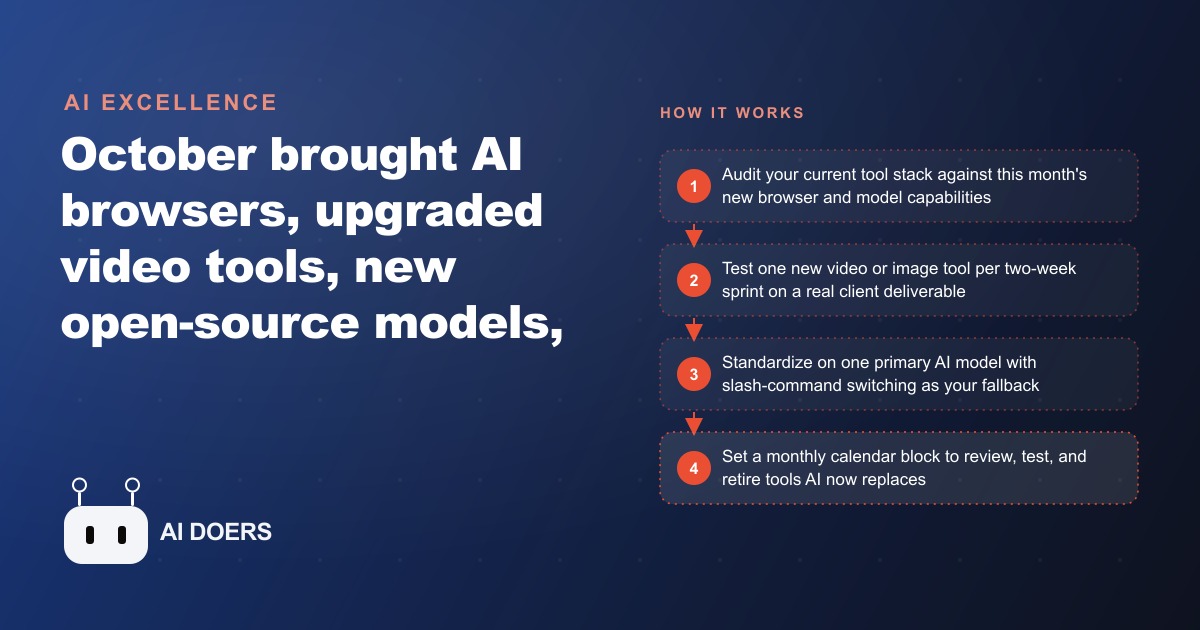
Every October, the AI news cycle produces the same result: agency teams spend two weeks reading about new tools, install three of them, and then go back to doing everything the same way they did in September.
This has been true in 2023, in 2024, and it is true now. The volume of releases is not the problem. The problem is that most agencies have no operating principle for what to do with a month that produces AI browsers, upgraded video generation models, open-source video alternatives, browser-based coding environments, new workflow builders, cheaper language models, and deep integration across major creative platforms. Without an operating principle, the default is to track everything, which produces the illusion of staying current while producing no actual change in how work gets done.
The contrarian position, and the one Madhuranjan Kumar holds based on watching how agencies actually change versus how they claim to be changing, is that the agencies winning right now are the ones that made a deliberate choice to stop tracking most of the news cycle. They pick one capability per evaluation cycle, go deep on it against real deliverables, get a clear answer, and move on. That process compounds over twelve months into genuine operational advantage. The reactive approach compounds into a library of bookmarks and no durable skill.
Reacting to every October release is how agencies fall behind, not how they pull ahead
The assumption driving reactive evaluation is that knowledge of a tool equals advantage from a tool. The assumption is wrong. Knowing that VO 3.1 allows first-and-last-frame video control is not the same as having a workflow that uses that capability reliably on client deliverables. Knowing that Haiku 4.5 is cheaper than Sonnet 4.5 is not the same as having a tested routing policy that applies the cheaper model to the tasks where it performs equivalently.
October produced a dense wave: AI browsers from two major labs, video upgrades across VO 3.1 and open-source LTX2, Claude Code moving into the browser, a new ChatGPT workflow builder, significantly cheaper model options, and Adobe integrating third-party AI models across its full creative suite. An agency team that tries to evaluate all of that in one month evaluates none of it with the depth required to produce an operational change.
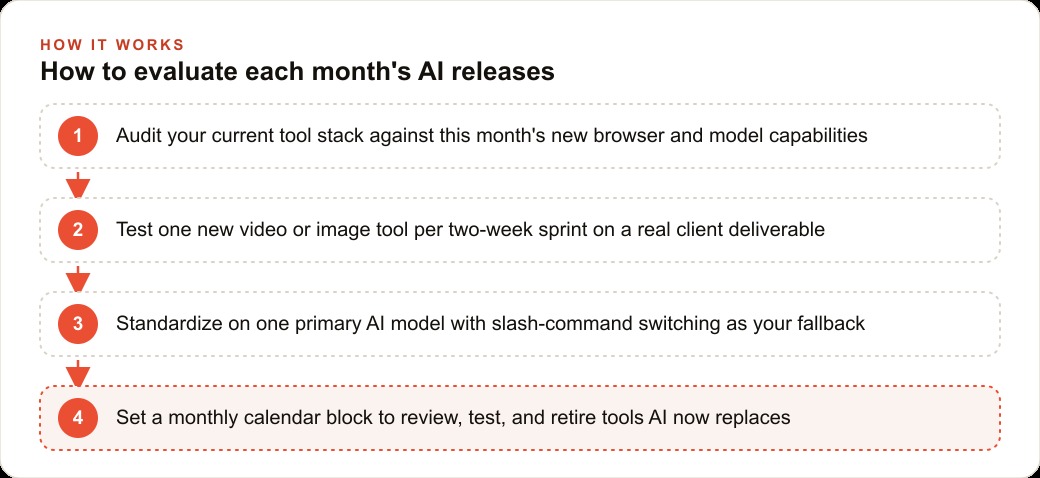
The agencies doing this wrong run evaluation as research. They read the announcements, circulate the articles, have a team discussion, and form opinions. Opinions are not operational capabilities. The agencies doing it right run evaluation as a structured experiment with a real client deliverable as the test environment, a before-and-after metric, and a binary recommendation: integrate or skip. The difference in output is significant. The research-based approach produces awareness. The experiment-based approach produces institutional knowledge.
The practical implication for October specifically is that the correct response to a dense release month is to slow down, not to speed up. Identify the one release that most directly addresses your agency's current primary operational bottleneck. Assign that evaluation to one team member. Give it two weeks and a real deliverable. Collect the result. Everything else can wait for next month's evaluation cycle.
A team that runs that process six times over six months has six real capabilities. A team that tried to track twelve releases per month for six months has a long reading list and no new operational capability. The question is not which team is smarter. The question is which one changed how they actually do the work.
The real October signal is not a tool, it is the AI browser becoming the work environment
Among all of October's releases, one structural shift stands apart from the feature-level updates. Two major AI labs released competing browsers and Microsoft deepened Copilot's integration into Edge in the same week. That is not three separate feature announcements. That is a signal that the browser is becoming the primary interface for AI-augmented work.
ChatGPT Atlas and Perplexity Comet are both built on the Chromium engine, which preserves compatibility with existing Chrome extensions. Both embed an AI sidebar that reads the currently active tab. Both support slash commands that route specific tasks to different models on demand. Comet's multi-model support means users are not locked into a single capability profile regardless of the task. The agent modes in both systems go further: they allow the user to assign a multi-step research or analysis task, step away, and receive a completed output rather than a tool to operate manually.
For agency teams, this is not a new feature to evaluate alongside other new features. It is a change in where AI assistance occurs. Most agency work happens inside a browser: competitive research, content drafting, client reporting, campaign review, platform management. An AI system that reads the current tab, maintains context across a session, and can take actions on the user's behalf does not improve the workflow at the margins. It changes what the workflow is.
The agencies that recognize the AI browser as infrastructure rather than as a feature will build their workflows around it early. Competitive research shortcuts, content summarization shortcuts, and reporting compilation shortcuts built into an AI-native browser will, over twelve months, create a compounding throughput advantage relative to teams running standard browsers with AI as a separate tool to switch to. That compounding advantage is not dramatic week to week. Over a year it is very large.
The mistake is treating the AI browser announcements as items on a checklist of things to evaluate eventually. This is the evaluation that deserves immediate attention because it affects every task the team does, not a specific workflow type.
Model cost reduction is more valuable than any new feature this month
Haiku 4.5 is priced at roughly $0.80 per million input tokens and $4 per million output tokens. Sonnet 4.5 costs roughly $3 per million input tokens and $15 per million output tokens. The gap is approximately 70 to 75 percent on both ends of the cost structure.
For agencies using AI models to generate copy at scale, the practical calculation is straightforward. Identify the tasks in the current workflow that consume the most tokens per month: ad copy variation generation, email drafting, first-pass content creation, social caption writing, metadata generation. Test each of those tasks against Haiku 4.5 with the same prompts currently used for Sonnet 4.5. Evaluate the output quality against the standard required for that specific task type.
The consistent pattern across multiple agency workflows is that Haiku 4.5 handles tasks requiring high throughput but low judgment equivalently to Sonnet 4.5 at 70 percent lower cost. It underperforms on tasks that require genuine judgment: nuanced brand voice matching on a difficult brief, producing coherent long-form content with sustained argument structure, or analyzing complex client feedback and proposing a specific reasoned course of action.
The routing policy is simple to implement and the return is immediate. Route high-volume, low-judgment tasks to Haiku 4.5. Reserve Sonnet 4.5 for the tasks where the model's stronger judgment produces output that clients actually see and approve. The cost reduction on high-volume tasks accumulates every month from the first month the routing policy is in place.
This is more valuable than most new capabilities released in October because it requires no workflow integration, no team training, and no client communication. It is a cost optimization on existing workflows that reduces the per-deliverable AI cost without reducing output quality on the deliverables that matter.
The SUI 1.5 model, also released in October, runs at 950 tokens per second compared to Sonnet 4.5's 69 tokens per second. For any workflow where generation latency affects how quickly the team can iterate through variations, that speed difference changes the practical rhythm of iterative work. A copy variation run that takes 90 seconds at standard speeds takes under 10 seconds at this throughput. Speed and cost reductions compound: faster generation at lower cost per token changes the economics of AI-assisted copy generation at volume.
The agency that tested two capabilities instead of twelve is the only one with a useful answer
Consider two agencies of similar size processing October's news wave at the same time.
The first agency circulated all the major announcements in their team Slack, assigned different people to read up on different tools, and scheduled a meeting to share what everyone learned. By mid-October they had a team with a broad working knowledge of everything that was announced. Nobody ran a test against a real client deliverable. The team formed opinions, discussed possibilities, and filed the meeting notes. Three months later the workflow is unchanged.
The second agency identified their primary current bottleneck before October started: lifestyle video for their e-commerce clients was the highest-cost, longest-lead-time deliverable in their service offering, and it was the one where client timelines created the most friction. When VO 3.1 announced first-and-last-frame control and ingredient-to-video generation, they recognized the direct relevance. One team member ran a two-week sprint with a clear brief: produce five lifestyle video clips for a real client's seasonal campaign using the VO 3.1 ingredient-to-video workflow, measure production time and revision cycles, and compare to the previous production method.
The result was specific and actionable. Using VO 3.1's structural controls, production time for this content type dropped by roughly 60 percent. Revision cycles fell from an average of three rounds to one, because first-and-last-frame control eliminated the most common reason for revisions: clients requesting structural changes to scenes the creative team had no mechanism to specify precisely before generation. The agency integrated the capability, updated their pricing model for this service type, and moved on to the next bottleneck.
The first agency had broader coverage and shallower knowledge. The second agency had narrower coverage and an operational result. The second agency is the one that actually changed how it delivers work. That gap compounds over twelve months. The agency that runs six focused two-week sprints in a year ends the year with six verified operational capabilities. The agency that tries to track everything ends the year with comprehensive awareness and no new verified capability.
What a quarterly evaluation process looks like for a ten-person team that is actually winning
The agencies that sustain AI capability advantages over time are not the ones with the most attentive social media monitoring. They are the ones with a structured evaluation process that channels the attention the news cycle demands into deliberate, sequenced testing.
The structure Madhuranjan Kumar recommends for a ten-person agency is a quarterly cadence with monthly execution. At the start of each quarter, the team explicitly identifies their top three operational constraints: not their most exciting tool interests or the capabilities they saw demoed at a conference, but their actual top three constraints. The workflows that cost the most time per deliverable, generate the most revision cycles, or create the most throughput friction. These become the evaluation targets for the quarter.
Each month, one team member owns a two-week sprint on the tool or capability most directly relevant to one of those constraints. The sprint must involve a real client deliverable, not a sandbox test. The output is not a summary or a set of impressions. It is a one-page brief: what was tested, what the before-and-after metrics showed, what the capability can and cannot do for this specific use case, and a clear binary recommendation to integrate or skip. The brief goes to the full team.
At the quarterly review, the team looks at what three sprints produced, decides which capabilities to integrate permanently into the workflow, and identifies the next set of constraints for the following quarter.
This process has three structural advantages. It channels curiosity into sequenced testing rather than parallel shallow evaluation. It anchors every test to a real business constraint rather than a general capability curiosity. And it produces institutional knowledge that belongs to the team rather than impressions that belong to individuals.
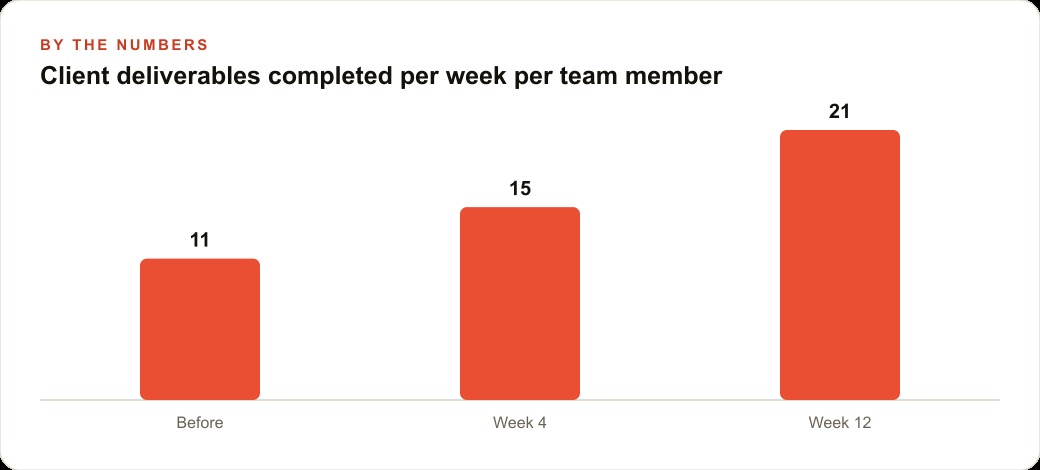
The outcome of a year of quarterly evaluation cycles is an agency with twelve to sixteen genuine capabilities, each verified against real deliverables, integrated into actual workflows, and understood well enough that any team member can use them reliably. That is not an impressive number of tools to have evaluated. It is an impressive number of tools to have mastered. The distinction matters more now than it did before AI because the complexity of the tool landscape makes mastery the scarce resource, not awareness.
Every agency in the market can read about new tools. The agencies winning are the ones that have built the discipline to ignore most of what they read and go deep on the small number of things that directly address what their specific team needs to do better. The AI tool wave will continue every month. The agencies that build a systematic evaluation process now will be compounding that process advantage while reactive agencies are still deciding which newsletter to subscribe to.
That is exactly what we do at AI DOERS. Book a private 30-minute call with Madhuranjan Kumar and we will map the fastest path to it for your specific business.
Book your call →
Madhuranjan Kumar
Madhuranjan Kumar brings 20 years of performance-marketing experience and has managed over $200 million in Facebook ad spend for brands across the United States and beyond. His expertise spans the full modern marketing stack: Meta, Google Ads, TikTok, email automation, CRM, and the websites that hold it together. At AI DOERS he turns that track record into lead-generation systems for businesses across every industry.